God’s Existence Through Christian Vedanta Shared Vision Today
Classical theistic arguments meet Vedanta insights, showing Christianity and Vedanta echo one sacred reality.
People ask whether God exists because they want more than comfort; they want truth. Christianity and Vedanta both start from a similar intuition: reality is not random, consciousness is not an accident, and love is not a chemical trick. They speak in different languages, yet they point to a single depth behind the surface world. This essay explores major arguments for God’s existence and then reads them through both traditions, letting each illuminate the other in our searching and living.
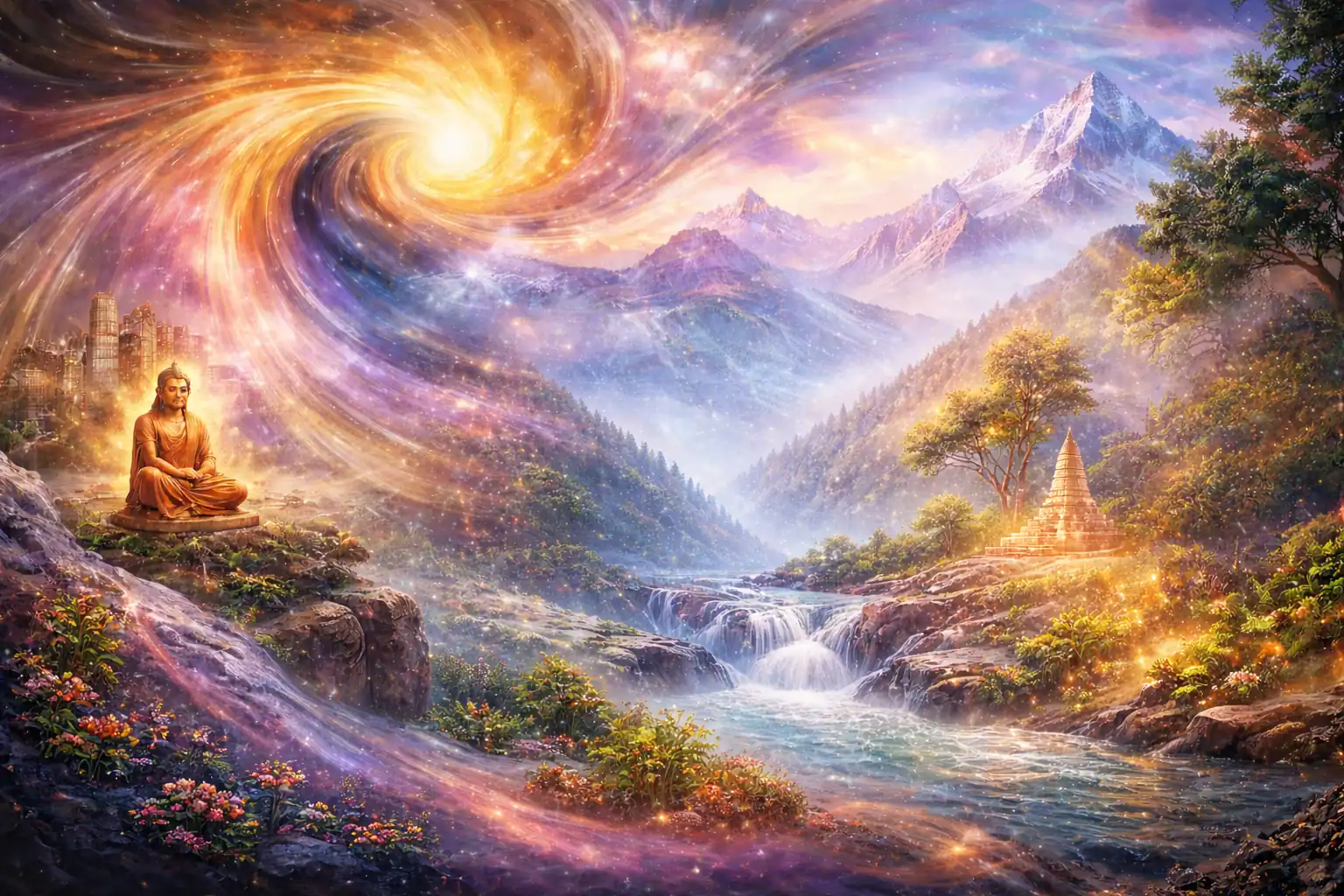
In Christian terms, God is the living source of being, goodness, and meaning, revealed as Creator, Logos, and Spirit. In Vedanta, Brahman is the ultimate reality, with Īśvara as the personal Lord and ātman as the inmost Self. These are not identical in all details, yet they often function as different windows on the same light. When we compare arguments, we are not trying to flatten either tradition, but to notice deep consonance, ethical unity, and shared contemplative depth too.
1) Framing the Question: What Do We Mean by “God”?
Before weighing arguments, it usually helps to name what “God” is supposed to mean. Many debates quietly talk past each other because one side imagines a very humanlike deity, while the other is speaking about ultimate reality itself.
Christianity: God as Being, Love, and Personal Communion
Classical Christianity generally describes God as:
- Necessary Being (God depends on nothing else)
- Creator (source of all that exists)
- Goodness itself (the measure of value, not merely one valuable thing among others)
- Personal and relational (God knows, wills, loves)
- Revealed as Father, Son (Logos), and Holy Spirit (divine life shared)
A compact way Christian tradition often says it is: God is not one being among others, but the source of being, and the fullness of love.
Vedanta: Brahman, Īśvara, and ātman
Vedanta typically speaks in a threefold way:
- Brahman: ultimate reality, the ground of all existence, beyond all limiting categories
- Īśvara: Brahman related to the world, the personal Lord, the intelligence and governance of the cosmos
- Ātman: the inmost Self, the deepest “I” that is not merely ego or personality
Different Vedantic schools nuance this differently (Advaita, Vishishtadvaita, Dvaita), yet the shared center is that reality has an ultimate depth that is luminous, intelligent, and spiritually knowable.
Why Many Find Them “Essentially the Same”
If you look at how these ideas function in the spiritual life, you can see why many readers experience Christianity and Vedanta as describing one reality with two emphases:
- Christianity highlights relationship, grace, love, and history (God meets us personally).
- Vedanta highlights metaphysical depth, interiority, and direct realization (God is closer than our breath).
Together they often sound like two harmonies around one theme: the Real is personal without being limited, and infinite without being impersonal.
2) A Map of Deep Parallels (Concept by Concept)
To keep the later arguments grounded, here is a practical bridge-map. It does not force identical meanings, but it shows strong family resemblance.
God and Brahman
- God (classical theism): the ground of being, truth, and goodness.
- Brahman: sat (being), cit (consciousness), ānanda (fullness or bliss).
Both point to ultimate reality as not merely “a thing,” but the very basis by which anything is.
Logos and Īśvara
- Logos (John 1): divine Wisdom/Word through whom all things are made.
- Īśvara: the Lord, the ordering intelligence and moral governance of the universe.
Both connect ultimate reality to intelligibility, law, and meaning in creation.
Spirit and Inner Light
- Holy Spirit: indwelling presence, comforter, sanctifier.
- Antaryāmin / inner witness: the indwelling guide, the illuminating presence in the heart.
Both traditions teach that God is not only “out there,” but also “within,” transforming the person from inside.
Image of God and Ātman
- Imago Dei: human beings reflect God.
- Ātman: the deepest self is spiritual, not reducible to matter.
Christianity often says we are made in God’s image; Vedanta often says our deepest self participates in, or is inseparable from, ultimate reality. Even when interpreted cautiously, both refuse the idea that humans are “only matter.”
Salvation and Moksha
- Salvation: union with God, healing of the person, love perfected.
- Moksha: liberation from ignorance, freedom from bondage, realization of the Real.
One tradition stresses sin and grace; the other stresses ignorance and knowledge. Yet both aim at transformation into truth and love, not merely rule-following.
3) The Cosmological Argument: Why Is There Anything at All?
One of the oldest arguments begins with a simple shock: existence exists.
The Core Intuition
- Things in the world are contingent: they do not have to exist.
- A chain of contingent things, by itself, does not explain why anything exists at all.
- So there is a necessary foundation: a reality that exists by its own nature.
Christian philosophers like Aquinas frame this as moving from contingent beings to a necessary Being. Vedanta frames it as moving from changing names and forms to the unchanging ground.
Christian Reading
In the Christian tradition, God is “He who is” (often associated with the divine name in Exodus 3:14). The point is not grammar, but metaphysics: the foundation of reality is not nothingness, but living being.
Vedantic Reading
Vedanta points to sat, pure being, as primary. The world of change is real at its level, yet it depends on a deeper reality. The Upanishadic move is: the changing depends on the unchanging, like waves depend on the ocean.
The Shared Conclusion
Both traditions converge on this: the universe is not self-explanatory. Its existence is best grounded in an ultimate reality that is not borrowed, not fragile, and not temporary.
4) The Argument from Contingency: The World Does Not Explain Itself
A close cousin of the cosmological argument is the contingency argument.
The Basic Form
- Everything we encounter is dependent.
- The total set of dependent things is still dependent.
- Therefore, there must be an independent reality that grounds the whole.
Christianity calls this reality God. Vedanta calls it Brahman (and, in devotional context, Īśvara).
Why This Feels Like Vedanta
Vedanta is relentless about dependence:
- Bodies depend on food, time, and nature.
- Thoughts depend on prior impressions and attention.
- Even the sense of “I” depends on awareness.
When you trace dependence far enough, you arrive at what does not depend: pure awareness, pure being, the luminous ground.
Why This Also Feels Like Christianity
Christianity similarly sees creatures as receiving their existence. Creation is not just a past event, but an ongoing dependence. In that sense, “creation” can mean: everything exists right now because the Source sustains it.
So the argument gently nudges the mind toward a reality that is closer than we think: the very “is-ness” of everything.
5) The Kalam Argument: Did the Universe Begin?
Another argument says: if the universe began, it likely has a cause beyond itself.
The Simplified Form
- Whatever begins to exist has a cause.
- The universe began to exist.
- Therefore, the universe has a cause beyond it.
This argument is often discussed in philosophical and scientific contexts. But the deeper spiritual point is not physics trivia. It is this: the universe looks like a gift, not a brute fact.
Christian Resonance
Christianity’s creation language naturally aligns with “the universe is not eternal on its own.” God is the cause of causes, not one more cause inside the universe.
Vedantic Resonance
Many Vedantic accounts describe cycles of manifestation, yet still distinguish the manifested universe from Brahman, which is not limited by time. Whether the cosmos is cyclic or has a temporal beginning, Vedanta’s key claim remains: the Real is beyond time.
The Shared Insight
Time itself appears dependent. Both traditions invite us to consider a timeless ground that is not trapped in the universe’s clock.
6) The Teleological Argument: Why Is the Universe Intelligible?
The design or teleological argument points to order, intelligibility, and goal-directed structure.
The Core Idea
- The universe is not chaos.
- Nature is governed by stable patterns.
- Minds can understand those patterns.
- This fit between mind and world suggests a deeper rational source.
Christianity speaks of Logos: a rational order and meaning in creation. Vedanta speaks of Īśvara: cosmic intelligence, dharma, and an ordered moral structure.
A Subtle Point: Intelligibility Is Not Guaranteed
A universe could exist that is wildly irregular, or one in which minds could not reliably know anything. Yet we live in a universe where mathematics works, logic tracks reality, and knowledge is possible.
- Christianity often says: the world is intelligible because it is made through divine Wisdom.
- Vedanta often says: the world is intelligible because it arises within an intelligence-ground, not outside it.
Either way, intelligibility itself becomes a signpost.
7) The Moral Argument: Where Do Good and Evil Get Their Weight?
People often experience moral truth as more than preference. Some actions feel truly right or wrong, even when inconvenient.
Basic Form
- Objective moral values and duties exist (or at least seem to).
- Objective moral values make best sense if grounded in a moral Reality, not mere consensus.
- Therefore, a moral ground, often called God, is plausible.
Christian Resonance: Love as the Measure
Christianity centers morality on love: love of God and neighbor. The striking claim is that goodness is not arbitrary; it reflects God’s nature. “God is love” (1 John 4:8) is not just sentiment. It is metaphysics and ethics together.
Vedantic Resonance: Dharma and the Purification of Heart
Vedanta generally links morality to:
- Dharma: right order, truth-alignment
- Karma: moral causality
- Sattva: clarity and harmony needed for realization
Moral life is not only social behavior; it is an inner purification that makes truth knowable.
Shared Conclusion
Both traditions treat ethics as participation in reality, not a human invention. If values have real authority, it points to a Real that is good.
8) The Argument from Consciousness: How Can Matter Produce Meaning?
Consciousness is one of the hardest facts to reduce.
The Puzzle
Brains are physical, yet conscious experience includes:
- first-person awareness
- meaning
- intentionality (thoughts “about” things)
- inner unity
- the “I” that witnesses
Many thinkers argue that consciousness is not easily explained as an accidental byproduct of matter.
Christian Reading: Spirit and Personhood
Christianity tends to see the human person as more than mechanism. Personhood and meaning reflect the Creator. The capacity for truth and love suggests kinship with the source of truth and love.
Vedantic Reading: Consciousness as Fundamental
Vedanta goes further: consciousness is not a late arrival in the cosmos. It is primary. The world appears in awareness, and awareness is self-luminous.
In this light, the existence of consciousness is not surprising. It is exactly what you would expect if reality’s foundation is cit, consciousness itself.
Shared Conclusion
If consciousness is fundamental rather than accidental, then the God-claim becomes less strange: ultimate reality is mind-like, spirit-like, or awareness-like, not blind.
9) The Ontological Intuition: The Idea of the Greatest Reality
The ontological argument is often controversial, yet it highlights something important: when we speak of God, we are speaking of ultimate reality, not a large creature.
The Intuition
If God means the greatest possible reality, then God cannot be a merely optional idea. The very concept points beyond itself.
Even if one does not accept the formal proof, the spiritual takeaway remains: God is not one object among objects. God is the horizon of all being and meaning.
Vedantic Parallel
Vedanta similarly refuses to treat Brahman as an item in the universe. Brahman is that by which all items are known and exist.
So both traditions, in their strongest forms, push the mind beyond “God as a thing” toward “God as the ground.”
10) The Argument from Religious Experience: Encounter and Transformation
Across cultures, people report experiences of:
- awe and sacred presence
- deep peace beyond thought
- moral conversion
- luminous unity
- unconditional love
Skeptics interpret these as brain states. Believers interpret them as contact with the Real. The question becomes: which interpretation better fits the whole pattern, including long-term transformation?
Christianity: Saints, Prayer, and Union
Christian tradition includes contemplatives who speak of union, surrender, and inner light. The language often remains relational: lover and beloved, soul and God, grace and purification.
Vedanta: Samadhi, Realization, and the Witness
Vedanta speaks of direct insight into the Self and Brahman, often emphasizing clarity, freedom from fear, and stable compassion.
Shared Pattern: Fruits Matter
Both traditions evaluate experience partly by fruits:
- greater humility
- stronger compassion
- less ego and grasping
- steadier truthfulness
- deeper love
If experiences consistently produce these fruits, they become evidence that something real is being contacted, not merely imagined.
11) The Argument from Beauty: Why Does the Heart Recognize Glory?
Beauty is oddly authoritative. It calls the soul. It awakens longing.
Christian Reading
Beauty is often seen as a trace of God’s glory. Creation is not only useful; it is radiant. Beauty suggests that reality is not indifferent.
Vedantic Reading
Beauty can be read as the shining of Brahman through forms. Even when forms change, the intuition of the beautiful points toward the unchanging fullness.
Shared Conclusion
Beauty functions like a whisper: reality is meaningful, and the soul is made for more than survival.
12) The Argument from Desire: The Hunger for the Infinite
Humans desire truth, goodness, love, and permanence. Yet the finite world does not fully satisfy.
The Core Thought
If we have a deep desire that nothing finite satisfies, perhaps we are oriented toward the Infinite. Not every desire proves its object exists, but the universal structure of spiritual longing is suggestive.
Christianity: Restlessness for God
Augustine’s famous theme is that the heart is restless until it rests in God. That rest is not boredom, but completion.
Vedanta: The Search for the Real
Vedanta describes the human as seeking ānanda, lasting fullness. Pleasure flickers, but the desire underneath aims at the absolute.
Shared Conclusion
Spiritual longing is not a mistake. It may be the soul’s compass.
13) Historical Argument: God in History and the Figure of Christ
A distinctively Christian line of reasoning appeals not only to metaphysics, but to history: the life of Jesus, the rise of the Church, and experiences of redemption.
From a Vedantic comparative lens, one can read Christ through multiple complementary frames:
- Incarnation as God entering human life
- Logos as divine wisdom expressed in person
- The indwelling Christ as the presence of God within the heart
Vedanta has its own language for divine embodiment and revelation (avatars, sages, realized beings). While doctrines differ, the shared motif is strong: the Real is not absent; it meets us, teaches, heals, and transforms.
In this comparative approach, Christ becomes not a competitor to Brahman, but a face of the same ultimate reality, seen through love and self-giving.
14) Common Objections and How Both Traditions Respond
Objection A: “If God exists, why suffering?”
Christianity generally answers with a mixture of freedom, fallenness, and redemptive love. God enters suffering, bears it, and transforms it. The cross becomes a claim: God is not distant from pain.
Vedanta often explains suffering through ignorance (avidyā) and karma, but it also offers a path to freedom: realization loosens bondage, compassion heals the world, and the Self remains untouched at the deepest level.
A combined reading can be powerful:
- Christianity emphasizes solidarity and love in suffering.
- Vedanta emphasizes freedom through knowledge and inner liberation.
Both can agree: suffering does not prove God absent; it calls for transformation, compassion, and awakening.
Objection B: “God is just psychology.”
Both traditions can accept that spirituality includes psychology, while refusing reduction. Love also correlates with brain states, yet love can still be real. The question is not whether experiences have correlates, but whether they refer to something beyond themselves.
Objection C: “Religions disagree, so none are true.”
A Vedanta-Christian comparative lens suggests a different possibility: traditions may differ in symbol, story, and emphasis while converging in depth. If reality is infinite, no single conceptual net catches it fully. Many languages can point to one sun.
15) A Shared Metaphysics of Nearness: God Is Not Far Away
One of the most striking shared themes is nearness.
Christianity: “The Kingdom is within”
Christian scripture includes the idea that God is closer than we imagine, and that divine life can dwell within. Paul’s language about living “in” God, and God living in the believer, points toward interiority, not only external rule.
Vedanta: The Witness is Always Present
Vedanta’s witness-consciousness is never absent. The Real is not reached by traveling. It is recognized by removing confusion.
Combined Insight
If God is the ground of being, then God is not located somewhere else. God is the depth of “here.” Arguments for God’s existence are not meant only to win debates; they are meant to reorient perception toward the sacredness of reality.
16) How the Main Arguments Converge into One Vision
Let’s gather the threads.
- Existence and contingency suggest a necessary ground.
- Intelligibility and order suggest a Logos-like source.
- Morality suggests a good foundation, not indifferent chaos.
- Consciousness suggests spirit-like ultimacy.
- Experience, beauty, and longing suggest the soul’s openness to the Infinite.
- Transformation suggests contact with something real, not merely imagined.
Christianity and Vedanta interpret these through different lenses, yet the conclusion often feels like the same mountain seen from two sides:
- Reality is grounded in an ultimate source that is true, good, and spiritually knowable.
- Human life is meant for union, liberation, and love.
- The path is not merely intellectual; it is ethical and contemplative.
17) Practical Synthesis: How to Test the Vision in Life
Both traditions ultimately invite experiment, not only argument.
A Shared Practice Pattern
- Purify intention: seek truth, not ego victory.
- Live ethically: love, truthfulness, compassion, self-control.
- Pray or meditate daily: silence, attention, surrender.
- Study wisely: scripture and Upanishadic insight as mirrors.
- Serve: love becomes knowledge, knowledge becomes love.
Christian Contemplation Meets Vedantic Inquiry
- Christian contemplative prayer often repeats a sacred name, rests in God, and opens to grace.
- Vedantic inquiry asks “Who am I?” and loosens identification with passing thoughts.
Together they can form a balanced path:
- Love without depth can become sentiment.
- Depth without love can become cold.
- Love and depth together mature into wisdom.
18) Closing Reflection: Does God Exist?
The question “Does God exist?” is often asked as if God were an object that might or might not be somewhere in the universe. Both Christianity and Vedanta gently redirect the question.
God, in the strongest sense, is not one more item inside reality. God is the reason there is reality, the reason truth can be known, the reason love has weight, the reason beauty calls the heart, and the reason conscience can command.
So the arguments do not merely point to a distant designer. They point to an ultimate reality that is:
- the ground of being (Brahman, “He who is”)
- the source of order and meaning (Īśvara, Logos)
- the indwelling presence that transforms (Spirit, inner witness)
- the fulfillment of the heart’s deepest longing (union, moksha, sanctification)
In that light, Christianity and Vedanta can be seen as essentially aligned in values and aim: truth, love, self-transcendence, compassion, and liberation. They speak with different accents, yet they are often describing the same sacred reality, inviting the same awakening, and shaping the same kind of life.
You will get Vedanta updates in your inbox.
Occasional reflections on Vedanta. Unsubscribe anytime.