Jagat And Reality Understanding World Through Vedānta
Unpack Jagat, the world, its appearance, order, and role in liberation.
In Vedānta, Jagat means “the world,” not only the physical universe but the entire field of experience: bodies, minds, relationships, time, space, events, and change. Jagat is the stage on which every human story unfolds, from ordinary routines to spiritual striving. Yet Vedānta does not accept the world as self-explanatory. It asks deeper questions: What is the world made of? Why does it seem stable yet constantly shift? What is its relationship to consciousness?
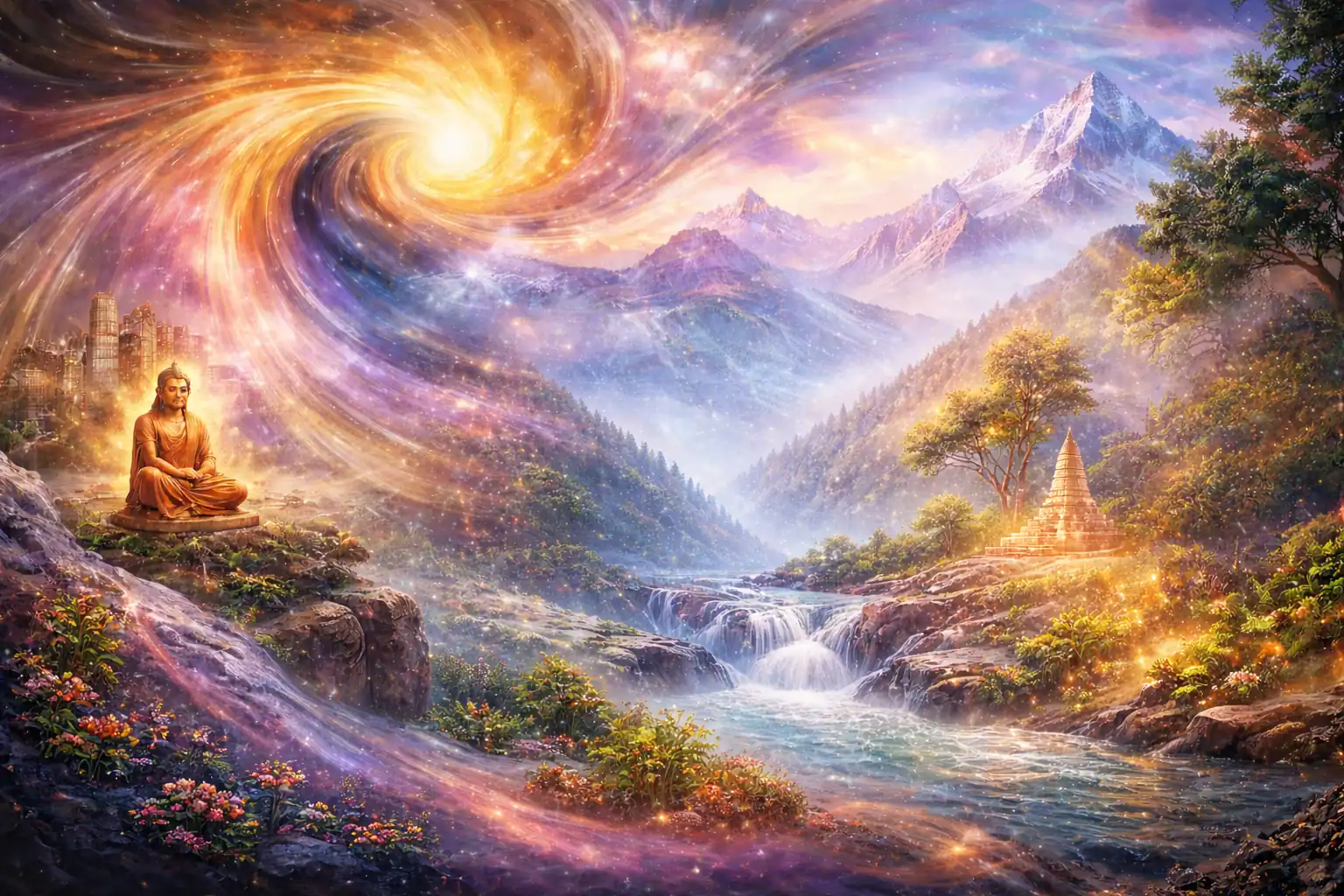
Jagat can feel wonderfully meaningful and painfully fragile. It gives joy through beauty, love, and achievement, but it also brings loss, uncertainty, and impermanence. Vedānta treats this mixed nature as a clue rather than a complaint. The world is not dismissed as “nothing,” nor worshiped as “everything.” Instead, Jagat is examined with careful insight so the seeker can live skillfully within it while discovering what lies beyond it.
1) What Jagat Means in Vedānta
The word Jagat comes from a sense of movement: “that which moves,” “that which changes.” This immediately signals Vedānta’s starting point: the world is a domain of flux. Planets move, bodies age, emotions shift, cultures transform, and even mountains erode over time. Jagat is the realm where “becoming” dominates.
Vedānta includes several layers inside Jagat:
- Bhūta Jagat: the material world of elements and forms
- Jīva Jagat: the living world of beings and life systems
- Manas Jagat: the mental world of thoughts, meanings, and narratives
- Sambandha Jagat: the relational world, where identity and value are negotiated
So Jagat is not only “out there.” It includes what you see and what you interpret, what you touch and what you remember. Vedānta is interested in Jagat because liberation is not pursued in a vacuum. The seeker stands inside Jagat, and the mind takes Jagat to be ultimate. The teaching begins by clarifying what the world truly is.
2) The World as Experience: The Most Immediate Jagat
Before discussing cosmology, Vedānta often turns to a simpler fact: your world is first known as experience. You do not encounter “pure matter” directly; you encounter sights, sounds, textures, thoughts, and feelings. Jagat appears as a stream of perceptions interpreted by the mind.
This is why Vedānta treats the mind as an essential participant in world-experience. Two people can face the same event yet inhabit different worlds: one sees opportunity, another sees threat. The event may be the same, but the meaning-world differs. So Jagat is not merely objects; it is the field of objects plus the lens of cognition.
From this angle, Jagat becomes a spiritual question: if my experience of the world is shaped by interpretation, then freedom requires not only changing circumstances but understanding the very mechanism of world-appearance.
3) Jagat and the Three Marks: Change, Dependence, and Limitation
Vedānta often points to three broad features of Jagat:
Change (Pariṇāma / Vikāra)
Everything in Jagat changes. Even things that seem stable are stable only relative to our short lifespan. Change is not an accident; it is the signature of Jagat.
Dependence (Paratantratā)
World-things depend on causes and conditions. A tree depends on seed, soil, sunlight, water, and time. A thought depends on memory, mood, and stimulus. Nothing stands alone.
Limitation (Paricchinnatā)
World-things are finite. A form occupies a limited space, appears for a limited time, and has limited capacities. Even great achievements remain bounded.
These marks matter because the human heart quietly seeks what is unchanging, independent, and unlimited. Vedānta says: if you demand the infinite from the finite, suffering will follow. Not because the world is cruel, but because expectations are misaligned with reality.
4) Is Jagat Real? Vedānta’s Careful Answer
Vedānta does not give a careless yes or no. It distinguishes levels of reality.
- The world is empirically real: it functions, it has laws, it yields consequences.
- The world is not absolutely real in the sense of being self-existent and independent of the ultimate.
This distinction is central. Jagat is not denied at the level of daily life. Fire burns, water quenches thirst, ethical choices matter, relationships affect the mind. Yet Vedānta asks: does Jagat have reality in and by itself, or does it borrow reality from a deeper ground?
Different Vedānta schools answer with different emphasis. Some stress the world’s dependence on God; others stress the world’s dependence on Brahman and the mind’s projections. But all treat Jagat as something that must be understood, not blindly accepted.
5) Jagat in Advaita: Appearance Without Independent Absoluteness
In Advaita Vedānta, Jagat is often described through the concept of māyā. Māyā does not mean “the world is a hallucination.” It means Jagat is an appearance that is:
- Ordered and lawful
- Experienced and practical
- Yet not ultimately independent
A classical analogy is the rope-snake example: in dim light, a rope is mistaken for a snake. The “snake” causes real fear, real sweating, real reaction. But when light comes, the snake is understood to have never existed as a snake. The rope remained, and the mistake was corrected.
Similarly, Advaita says: Jagat is experienced, but its status changes when knowledge arises. The world is not erased; rather, it is re-understood as an appearance in consciousness whose essence is Brahman.
In Advaita vocabulary, Jagat is often categorized as mithyā: neither absolutely real like Brahman, nor utterly unreal like a square circle. It is dependent reality, a functioning appearance.
6) Jagat in Viśiṣṭādvaita: Real World, Divine Body
In Viśiṣṭādvaita Vedānta, Jagat is real and meaningful, not merely an appearance to be sublated. The world is often described as the body of Brahman: the Divine pervades and supports it as an inner controller. Jagat has purpose because it expresses divine order and provides the field for souls to mature through dharma and devotion.
Here, Jagat is not simply a trap. It is a sacred environment in which the Jīva learns surrender, love, and wisdom. Liberation does not require rejecting the world as false; it requires seeing it as belonging to the Divine and living in alignment with that truth.
This view tends to emphasize gratitude, responsibility, and devotion as ways to relate to the world.
7) Jagat in Dvaita: Real Creation, Real Difference
In Dvaita Vedānta, Jagat is a real creation of God, and the differences between God, souls, and matter are real. The world is not a mere overlay; it is the stage of divine play and moral consequence. The world’s order reflects divine will, and the Jīva progresses through grace, devotion, and right action.
This framework supports a strong realism: Jagat matters, choices matter, and the world is a meaningful arena for serving the Divine.
8) Jagat as Order: Ṛta, Dharma, and the Intelligence of the World
Regardless of school, Vedānta recognizes that Jagat is not random chaos. It exhibits order: physical laws, biological patterns, psychological tendencies, and moral consequences. Ancient Indian thought sometimes calls this cosmic order ṛta, and in ethical life it becomes dharma.
From a practical viewpoint, this matters because:
- When you align with order, life becomes smoother.
- When you fight order out of ego, suffering grows.
Dharma does not mean rigid rules. It generally points to appropriate action: truthfulness, non-harm, steadiness, compassion, self-control, and responsibility. These qualities stabilize the mind, and a stable mind can inquire into deeper truth.
So Jagat is not only a changing field; it is also a structured field. Vedānta invites the seeker to respect this structure while also seeing that structure depends on a deeper source.
9) The Five Elements and the Material Jagat
Many Vedānta-adjacent texts discuss the world through the five elements (pañca mahābhūta): space, air, fire, water, earth. These represent fundamental modes of matter and experience.
- Space: room, openness, accommodation
- Air: movement, touch, vibration
- Fire: transformation, light, digestion
- Water: cohesion, flow, life support
- Earth: solidity, stability, form
This is not merely “ancient science.” It is a symbolic and experiential map. The elements correspond to the senses and to how matter is experienced. The deeper message is that material form is built from patterns and processes, not from an isolated, self-existent “thing.”
Understanding this weakens clinging. When you see the body and world as processes, ego rigidity relaxes. The world becomes less of a possession and more of a flow.
10) Jagat and Time: The Hidden Driver
Time is one of Jagat’s most decisive features. The world is not just a set of objects but a sequence. The future becomes present and slips into past. This creates urgency, nostalgia, fear, ambition, and regret.
Vedānta uses time to reveal impermanence. If everything you cling to is time-bound, then clinging becomes a recipe for distress. This does not mean you must become cold or indifferent. It means you must love without grasping, build without ego-attachment, and act without demanding permanence from what cannot give it.
Time also invites a deeper inquiry: what is it that is aware of time? The witness of time seems not to age in the way the body ages. This becomes a doorway to the Self.
11) Jagat and Suffering: The World Is Not Enough
Vedānta is frank: Jagat offers pleasure, but it cannot offer final fulfillment. This is because every worldly pleasure is conditioned:
- It depends on circumstances.
- It depends on the mind’s state.
- It ends or changes.
- It is mixed with fear of loss.
The Jīva’s suffering is not only because the world contains pain. It is also because the Jīva expects the world to provide what only the Self can provide: stable wholeness.
This insight can sound pessimistic, but Vedānta treats it as a liberation move. When you stop demanding infinity from finite objects, you can enjoy the world more purely. You can appreciate beauty without trying to imprison it. You can love people without turning them into your salvation project.
12) Jagat as Classroom: The Purpose of World-Experience
If Jagat cannot give final fulfillment, why does it exist? Vedānta often answers: Jagat is the field where the Jīva matures.
- Through pleasure and pain, the Jīva learns discernment.
- Through duty, the Jīva purifies intention.
- Through relationship, the Jīva grows empathy and humility.
- Through loss, the Jīva recognizes what truly matters.
Jagat becomes a classroom for wisdom. It exposes the limitations of ego-driven seeking and quietly pushes the seeker toward inner freedom.
Even the most difficult experiences can become turning points, not because pain is good, but because it can break illusions and open deeper priorities.
13) The Dream Analogy: Jagat and the Mind
Vedānta often compares waking Jagat to dream. The purpose is not to say waking is identical to dream in every way, but to highlight a key fact: both are known within consciousness.
In dream, you encounter a world that seems real while you are inside it. You feel fear, joy, and urgency. When you wake, you realize the dream world depended on your mind. The waking world is more stable and shared, but Vedānta still asks: is the waking world also known only through consciousness? If so, consciousness is the non-negotiable foundation of Jagat-as-experience.
This does not deny physics. It reframes what is primary in self-knowledge: the one factor you cannot step outside is awareness itself.
14) How to Relate to Jagat: Three Yogic Attitudes
Vedānta offers practical attitudes so the seeker can live well in the world while moving toward freedom.
Karma Yoga: Skillful Action in Jagat
Act with care, honesty, and dedication. Offer results, reduce ego. This makes Jagat less of a battlefield and more of a place for growth.
Bhakti Yoga: Devotional Relationship with Jagat
See the world as permeated by the Divine. Gratitude replaces entitlement. Reverence replaces complaint. The heart becomes stable.
Jñāna Yoga: Inquiry into Jagat’s Nature
Ask: what is changing? what is constant? what is dependent? what is the witness? This inquiry dissolves confusion about what the world can and cannot provide.
These approaches are not mutually exclusive. They generally support each other: right action purifies the mind, devotion softens the heart, and knowledge brings clarity.
15) Jagat and Liberation: The World After Knowledge
What happens to Jagat when wisdom dawns? Vedānta says the world may look similar outwardly, but the inner relationship changes dramatically.
- The seeker no longer treats Jagat as the final source of identity.
- The mind stops collapsing into panic when circumstances shift.
- Enjoyment becomes simpler, less possessive.
- Compassion increases because the ego’s defensive walls thin out.
In Advaita, Jagat is seen as an appearance in Brahman, like waves in the ocean of consciousness. In devotional schools, Jagat is seen as the Lord’s creation, a sacred arena. In all cases, liberation is not necessarily escape from the world, but freedom in the world.
A person may still work, love, serve, and build, yet internally remain anchored in something deeper than changing conditions.
Conclusion
Jagat is the world: the moving, changing field of experience where life unfolds. Vedānta examines Jagat to reveal its marks of change, dependence, and limitation, and to clarify why it cannot grant final fulfillment. Yet Jagat is not dismissed. It is orderly, meaningful, and capable of shaping the seeker through dharma, devotion, and inquiry. When wisdom arises, the world is still experienced, but it no longer binds. Jagat becomes a classroom, a sacred play, or an appearance in consciousness, while freedom becomes the seeker’s lived reality.
You will get Vedanta updates in your inbox.
Occasional reflections on Vedanta. Unsubscribe anytime.