Īśvara Explained Through Vedānta: Cosmic Intelligence, Personal God
Īśvara is Brahman with māyā, guiding cosmos, karma, devotion, and spiritual realization gently.
In Vedānta, Īśvara is a central tattva: the principle of divine governance that makes the universe intelligible, ordered, and spiritually meaningful. People often approach Īśvara as “God,” yet the tradition gives a careful, layered account that includes cosmology, ethics, psychology, and liberation. Īśvara is not merely a belief or a comforting idea. Īśvara is presented as the cosmic intelligence that sustains dharma and connects our actions to their fruits.
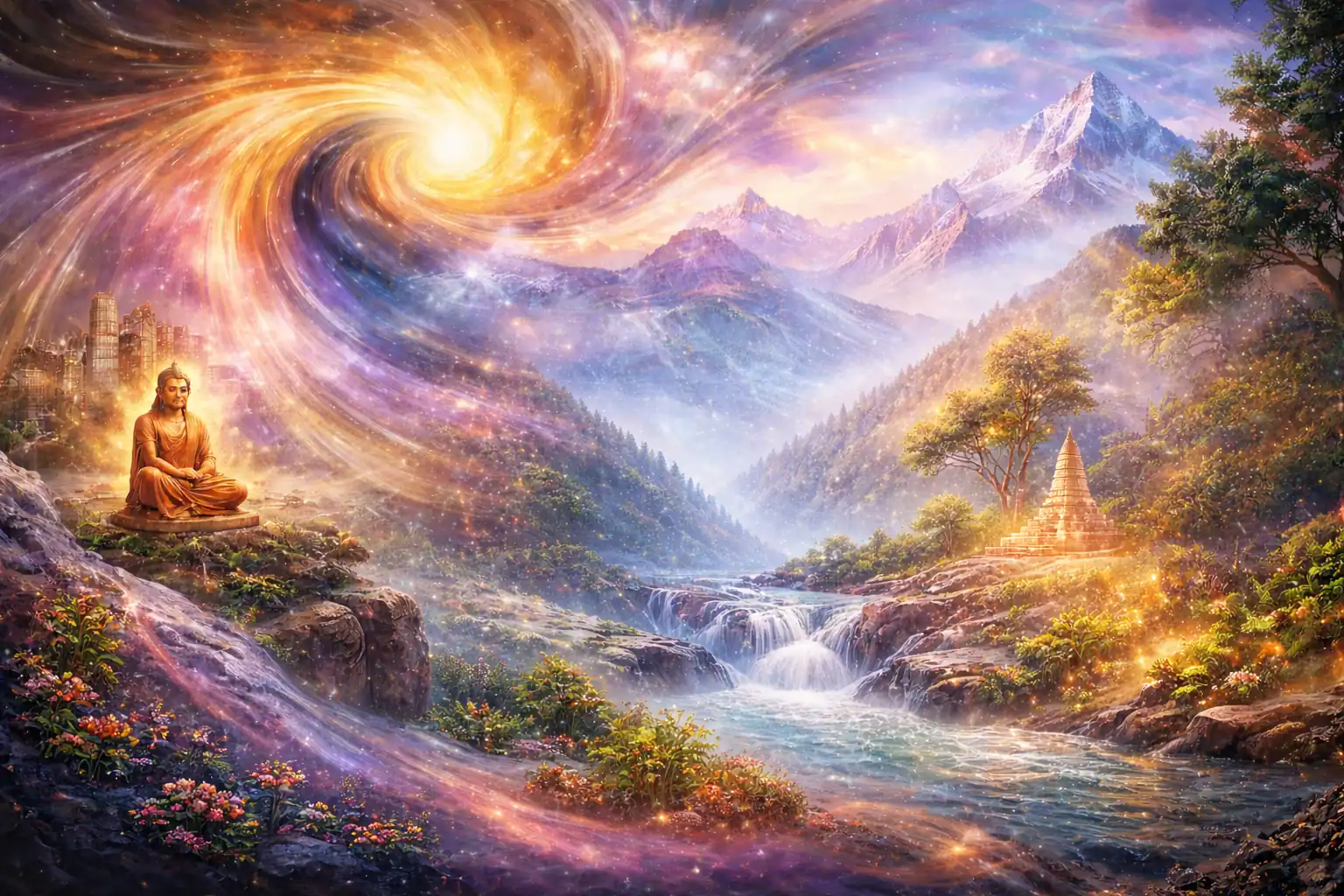
At the same time, Īśvara is not only cosmic law. Īśvara can be intimately personal, approachable through prayer, surrender, and love. Vedānta generally holds both dimensions together: Īśvara as the omniscient, omnipotent ruler of the universe, and Īśvara as the compassionate Lord who accepts devotion and reveals truth. Understanding Īśvara as tattva means seeing how divinity relates to the world, the individual, and the ultimate reality called Brahman.
Īśvara as a Tattva
The word “tattva” means “that-ness,” a fundamental principle that helps explain reality. When Vedānta discusses Īśvara as tattva, it is offering a conceptual bridge between the absolute (Brahman) and the relative (the world of name and form). In many schools, Brahman is the ultimate reality, beyond change, beyond limitation. Yet the lived world appears full of change, diversity, and causality. Īśvara functions as a key to interpret that appearance without reducing it to randomness or mere accident.
A common Vedāntic formulation is: Īśvara is Brahman associated with māyā. Māyā is the power of manifestation: it projects multiplicity and makes the unchanging appear as a changing universe. This does not mean Īśvara is “less” than Brahman in essence; rather, it means that when reality is considered in relation to the universe, it is spoken of as Īśvara. When reality is considered beyond all relational frameworks, it is spoken of as nirguṇa Brahman, Brahman “without attributes” in the sense of being beyond limiting descriptions.
So Īśvara is not a separate being competing with Brahman. Īśvara is a way Vedānta explains how the absolute can be the ground of the cosmos while remaining unstained by the cosmos.
The Meaning of the Name Īśvara
“Īśvara” comes from a root that implies ruling, owning, possessing mastery. Īśvara is the Lord, the one who “has” or “holds” sovereignty. But in Vedānta, lordship is not merely political or anthropomorphic. It is cosmic mastery: omniscience (sarvajñatva), omnipotence (sarvaśaktimatva), and governance of the moral order.
When scriptures speak of Īśvara as “creator,” “sustainer,” and “dissolver,” they are describing functional roles: the source from which the universe emerges, the intelligence by which it is maintained, and the principle into which it resolves. This triad is sometimes expressed through Brahmā, Viṣṇu, and Śiva as divine forms. Vedānta generally allows that the same Īśvara can be contemplated through many names and forms. The tattva remains one: the divine principle that is both cause and controller of the cosmos.
Īśvara and Māyā: The Manifesting Power
To grasp Īśvara, one generally has to understand māyā carefully. Māyā is often misunderstood as “illusion” in the everyday sense, as if the world is simply unreal like a hallucination. Vedāntic usage is subtler: the world has empirical reality (it functions, it is experienced, it has lawful regularity), but it is not absolute reality (it is not independent, permanent, or self-existing). Māyā is the explanatory principle for this in-between status.
Īśvara is said to be the controller of māyā. This is crucial: the individual being (jīva) is not master of māyā, but rather entangled within it through ignorance (avidyā). Īśvara, by contrast, wields māyā without being deluded by it. That is why Īśvara is described as omniscient and free, even while being the cause of the universe. The universe is not a limitation for Īśvara; it is an expression of divine power.
This distinction also explains why spiritual practices emphasize humility and surrender: the jīva cannot “outsmart” māyā merely by intellectual cleverness. One generally needs purification, devotion, and discriminative knowledge to see reality as it is.
Īśvara and Causality: Material and Intelligent Cause
Many Vedāntic discussions highlight a deep philosophical point: Īśvara is both the nimitta-kāraṇa (intelligent cause) and, in some accounts, also the upādāna-kāraṇa (material cause). In ordinary life, the potter (intelligent cause) is different from clay (material cause). But Vedānta often says the universe is not fashioned from some external “stuff” that exists apart from the divine. The divine is the ground of being itself. The material cause is not outside Īśvara.
This is expressed through examples like gold and ornaments: ornaments are many, names and forms vary, but gold is the underlying substance. Similarly, the universe is a multiplicity of forms, but its essence is one reality. To call Īśvara the cause is to say that the universe depends on the divine at every moment for its existence, order, and intelligibility.
Philosophically, this protects Vedānta from a purely mechanical view of nature where meaning is accidental. It also protects Vedānta from a simplistic dualism where “God” and “matter” are eternally separate substances. Instead, creation is generally viewed as manifestation of an intelligent, lawful order arising from one underlying reality.
Īśvara, Dharma, and the Moral Order
A major dimension of Īśvara as tattva is ethical: Īśvara is the upholder of dharma. Dharma includes righteousness, duty, harmony, and the principles that sustain social and inner order. It is not merely a set of rules imposed from outside. It reflects the structure of reality as it supports flourishing and spiritual growth.
Closely linked is the doctrine of karma. Karma says actions have consequences, not only psychologically but also in the unfolding of life circumstances. Vedānta often explains karma as operating within a lawful universe overseen by Īśvara. The fruits of actions (karma-phala) are not random; they arise from an ordered system. Many texts describe Īśvara as the “dispenser” of results, meaning that the moral causality of the universe is rooted in an intelligence that ensures coherence and fairness across time.
This helps answer a common question: if the universe is governed by law, where is compassion? Vedānta generally says the karmic system itself is compassionate in a long arc, because it educates the jīva, shapes maturity, and guides one toward liberation. Yet it also acknowledges suffering and complexity. Īśvara is not presented as a petty judge, but as the cosmic principle that makes spiritual evolution possible.
Īśvara and the Problem of Suffering
A frequent philosophical challenge is: if Īśvara is omnipotent and compassionate, why is there suffering? Vedānta approaches this in several intertwined ways.
First, it emphasizes karma and the agency of the jīva. Suffering is often connected to past actions, present choices, and ignorance. This does not mean every pain is a simplistic “punishment.” Rather, it means there is moral and causal continuity in existence, even if the details are not visible from a narrow perspective.
Second, Vedānta points to ignorance (avidyā) as a root cause. Much suffering arises from misidentification: taking the impermanent as permanent, taking the limited self as the whole, taking pleasure and pain as ultimate. Spiritual practice aims to shift identity from the changing to the unchanging.
Third, on the highest level, Vedānta often says the world is not the final truth. If one expects the empirical world to deliver absolute satisfaction, disappointment is inevitable. Īśvara is not only the manager of the world; Īśvara is also the teacher who leads the seeker beyond the world’s limitations toward liberation.
Within this view, devotion is not merely emotional comfort. It becomes a way to align with the deeper intelligence of life, to accept what cannot be immediately changed, and to gain the inner strength to act where action is possible.
Īśvara as Antaryāmin: The Inner Controller
Vedānta also speaks of Īśvara as Antaryāmin, the inner ruler. This is a powerful idea: divinity is not only “out there” in the cosmos but also “in here” as the witness, the guiding intelligence, the conscience-like illumination that makes experience possible.
The Antaryāmin teaching helps integrate devotion and contemplation. If Īśvara is present as the inner light by which thoughts and emotions are known, then spiritual practice becomes intimate. Prayer is not shouting across a cosmic distance. It is communion with the deepest presence.
This does not collapse Īśvara into the individual ego. The ego is limited, fluctuating, conditioned. The inner controller is the ground that illumines even the ego. In practice, meditative inquiry often uses this insight: trace awareness back to its source, and recognize that the very capacity to know is itself sacred.
Īśvara and the Guru-Śāstra Relationship
In Vedānta, Īśvara is closely linked to revelation (śāstra) and the teacher (guru). The scriptures are considered a pramāṇa, a valid means of knowledge for what cannot be known by the senses alone, especially about Brahman and liberation. Many traditions regard the Veda as apauruṣeya, not authored by a human mind, but revealed. This is often connected with Īśvara as the source of that revelation.
Similarly, the guru is honored not as a mere personality but as a channel of Īśvara’s teaching function. In this sense, Īśvara is not only creator and ruler; Īśvara is also teacher, the one who removes ignorance. When a seeker approaches Vedānta with sincerity, discipline, and humility, the tradition often says Īśvara provides the right conditions: a teacher, supportive circumstances, and an unfolding of understanding.
This view supports a spiritual attitude that blends effort and grace. One studies and practices diligently, yet recognizes that insight matures through a larger intelligence beyond personal control.
Īśvara in Devotion: Saguna Worship and Relationship
For many seekers, Īśvara is most alive through bhakti, devotion. Vedānta generally validates devotion as a powerful path because it reshapes the heart, purifies motives, and softens egoism. Worship of Īśvara with attributes (saguṇa) includes prayer, mantra, ritual, singing, remembrance, and service. These practices cultivate a relationship with the divine that can be tender, awe-filled, and transformative.
Vedānta also allows for many forms of Īśvara: Rāma, Kṛṣṇa, Śiva, Durgā, Nārāyaṇa, and others. The form is a focus for the mind and heart; the tattva is the same divine reality approached through a chosen ideal (iṣṭa-devatā). The tradition often says: choose a form that inspires you, commit sincerely, and let devotion deepen.
Crucially, devotion is not opposed to knowledge. In many Vedāntic contexts, devotion becomes the emotional foundation that makes knowledge stable. Knowledge without humility can become dry. Devotion without discernment can become sentimental. Together, they generally form a complete spiritual life.
Īśvara in Yoga: The Special Puruṣa
In the Yoga tradition, which often dialogues with Vedānta, Īśvara is described as a special puruṣa, untouched by afflictions, karma, and impressions. Īśvara is an object of devotion and meditation (Īśvara-praṇidhāna). This complements Vedānta: meditation on Īśvara steadies the mind, reduces ego, and supports inner clarity.
Yoga emphasizes practical transformation: calming mental fluctuations, cultivating concentration, and preparing the mind for insight. In this setting, Īśvara is both a support and an ideal. Surrender to Īśvara becomes a method: relinquish the insistence that everything must conform to personal preferences, and align with a deeper order. This surrender is not passivity; it is a disciplined inner orientation that reduces friction and increases clarity.
Īśvara and Jīva: Relation and Difference
A central Vedāntic question is: what is the relationship between Īśvara and jīva? Different schools answer differently.
In Advaita Vedānta, the jīva is Brahman appearing as an individual due to ignorance, while Īśvara is Brahman associated with māyā. Both are “appearances” relative to the absolute, yet they operate meaningfully at the empirical level. Liberation is realizing one’s identity with Brahman, transcending the sense of separation.
In Viśiṣṭādvaita, the jīvas and the world are real and form the body of the Lord; Īśvara (Nārāyaṇa) is the indwelling soul of all. The jīva is distinct but inseparable, and liberation is loving communion and service in the presence of the Lord.
In Dvaita, Īśvara and jīva are eternally distinct; devotion and grace are central. The jīva’s dependence on Īśvara is emphasized, and liberation is attaining divine proximity without losing individuality.
These differences matter, yet they share a practical point: spiritual life is a movement from ego-centeredness to God-centeredness, from ignorance to clarity, from bondage to freedom. Īśvara remains the guiding reference for that movement.
Īśvara and Prayer: A Vedāntic View
Prayer in Vedānta is not merely asking for favors. It can be a sophisticated inner practice. There is petitionary prayer, where one asks for guidance, strength, or relief. There is also gratitude, confession, and surrender. Over time, prayer often evolves into alignment: “May I accept what comes, may I respond wisely, may I grow.”
Vedānta also encourages “prayer as offering.” One can offer actions to Īśvara and accept results as prasāda, a gift. This is karma yoga: doing one’s duty with sincerity, offering effort to Īśvara, and receiving outcomes without inner collapse. This approach reduces anxiety and resentment, because success and failure are no longer personal verdicts. They are part of a larger moral and spiritual education.
Such prayer gradually purifies the mind, making it fit for deeper inquiry into Brahman.
Īśvara, Grace, and Human Effort
The question of grace is delicate: if Īśvara is the dispenser of results, does human effort matter? Vedānta generally answers: both matter, but at different levels.
Effort matters because the jīva has choice in intention, discipline, and orientation. One chooses to study, to practice, to be ethical, to cultivate devotion. Yet the results are not fully in one’s hands because the universe is vast, karmas are complex, and outcomes depend on countless factors. Grace is the name given to the supportive intelligence that arranges conditions beyond personal control.
In practice, this view encourages a balanced life: strive wholeheartedly, but remain humble; plan wisely, but accept uncertainty; take responsibility, but release obsessive control. Īśvara becomes the stabilizing center that allows both dynamism and peace.
Īśvara and Liberation
How does Īśvara relate to mokṣa, liberation? Often, Īśvara is described as the one who removes ignorance, directly or indirectly, by providing teachings, inner readiness, and the final clarity of recognition. In devotional schools, liberation may be described as reaching the Lord’s abode or living in the presence of Īśvara with unbroken love. In non-dual schools, liberation is the dawning that one’s true nature is Brahman, with Īśvara understood as the same reality viewed through the lens of cosmic function.
In all cases, liberation involves a shift from the limited to the limitless. The fear of death, the anxiety of lack, the hunger for validation, the restlessness of desire gradually fade. Īśvara is either the destination of love, the teacher of truth, or the cosmic framework through which truth is realized.
A profound Vedāntic insight is that the more one understands Īśvara, the more one understands oneself. Because the individual’s existence and consciousness are not isolated facts; they are rooted in a deeper reality.
Īśvara in Daily Life: A Practical Integration
To treat Īśvara as tattva is not only philosophical. It has daily implications:
- Responsibility with peace: Do your duty, but do not let outcomes define your worth.
- Ethics as spiritual practice: Dharma is not external pressure; it is alignment with reality.
- Surrender without weakness: Accept what you cannot control, act where you can.
- Devotion as inner training: Love of Īśvara reshapes desires and heals fragmentation.
- Inquiry with reverence: Knowledge becomes transformative when grounded in humility.
With these, Īśvara becomes the thread that ties together work, relationships, suffering, joy, and aspiration. Life becomes a field for growth rather than a contest for ego.
Conclusion
Īśvara, as a Vedāntic tattva, is the principle of divine lordship that explains cosmic order, moral causality, and the pathway to liberation. Īśvara is Brahman in relation to the universe, the controller of māyā, the giver of karma’s fruits, the inner ruler, and the compassionate object of devotion. While different Vedānta schools describe the relationship between Īśvara and the individual in distinct ways, they agree that turning toward Īśvara refines the mind and reveals deeper truth.
Ultimately, understanding Īśvara is not only about defining “God.” It is about seeing the world as meaningful, seeing oneself as guided, and discovering that beyond the changing patterns of experience lies a reality that is steady, luminous, and free.
You will get Vedanta updates in your inbox.
Occasional reflections on Vedanta. Unsubscribe anytime.