Maya: Swami Vivekananda’s Boldest Diagnosis of Life’s Contradictions
Vivekananda calls Maya life’s contradictions; transcend them inwardly to realize Brahman within yourself.
“Asato mā sad gamaya, tamaso mā jyotir gamaya, mṛtyor mā amṛtaṁ gamaya. Om śāntiḥ śāntiḥ śāntiḥ.” Lead us from the unreal to the Real, from darkness to Light, from death to Immortality. Peace, peace, peace.
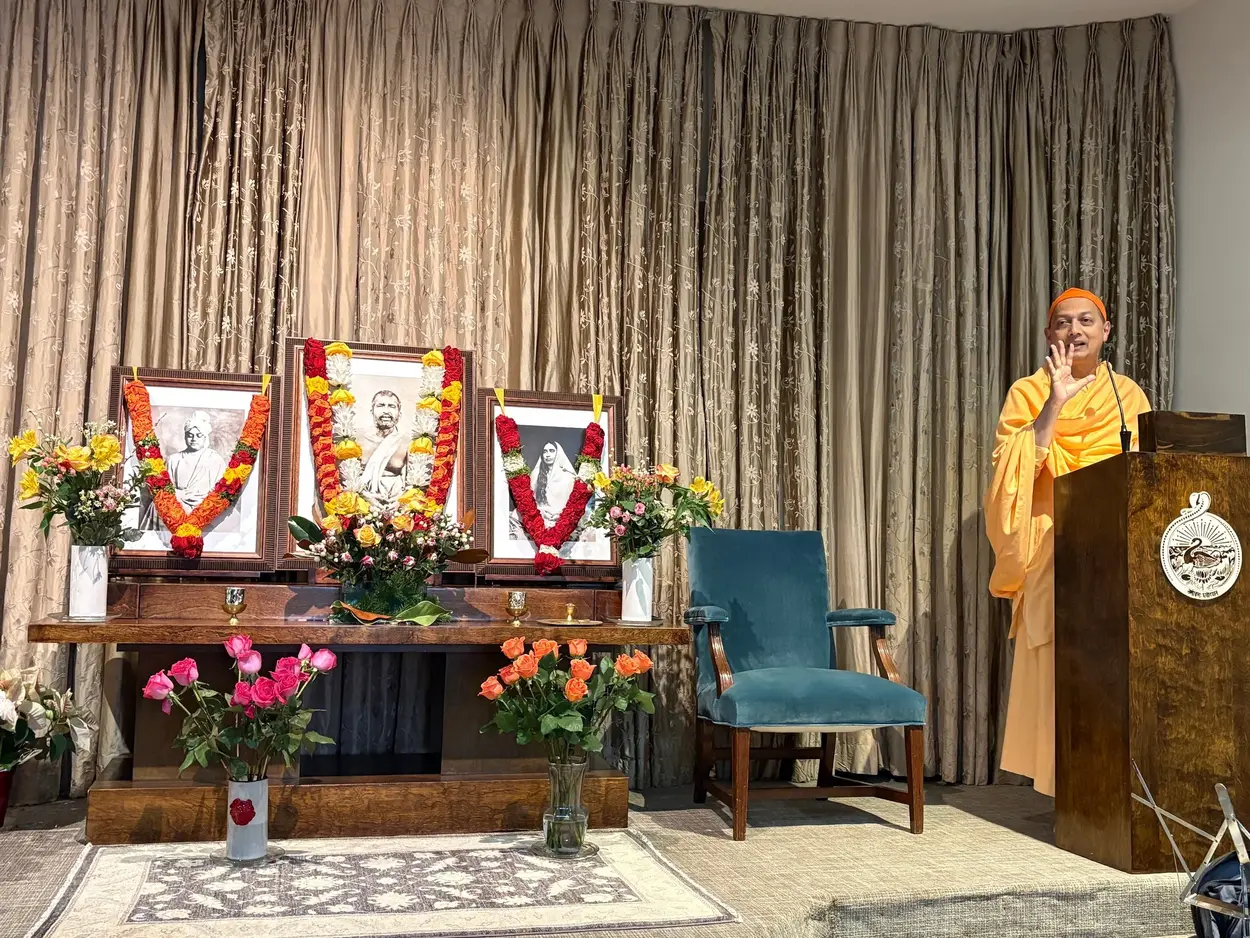
In this second talk of his series on Swami Vivekananda’s Jnana Yoga, Swami Sarvapriyananda turns to a subject he openly admits he has never spoken on before: Maya. He calls it perhaps the most difficult theme he has ever tried to explain, warning that it can leave you with a headache. And he offers a memorable contrast to explain why: Brahman is simple; our experience is complicated. “My eye is complicated,” he says, placing the mystery not in Reality itself, but in the strange way we perceive and live.
Swami Sarvapriyananda grounds the talk in Vivekananda’s three London lectures on Maya from the Jnana Yoga series, delivered in a house that still stands and is marked today as a heritage site. His aim is not to overwhelm with technical philosophy, though he does not avoid it. Instead, he uses classical ideas to set up what he sees as Vivekananda’s special contribution: a way of understanding Maya that feels immediate, existential, and almost unavoidable.
A Disciple’s Question That Made the World Dissolve
Swami Sarvapriyananda begins with an episode from the life of Vivekananda that dramatizes the intensity of the topic. Manmatha Nath Ganguli, a disciple, once approached Vivekananda and asked to understand Maya more fully. Vivekananda initially refused: “Ask something else.” But Ganguli persisted, arguing that if he could not learn Maya from a guru like Vivekananda, he would never grasp it in his life.
When Vivekananda finally began speaking, Ganguli later wrote that something extraordinary happened. The room seemed to shimmer and slide out of focus, like the air above a flame where heat-waves distort perception. The surroundings seemed to vibrate, then dissolve. Vivekananda himself disappeared from sight. Ganguli even lost the sense of his own body and was left only with Vivekananda’s voice.
In a sudden outburst, Ganguli cried, “All this is Maya! Even what you are doing, the Ramakrishna Mission, the monastery, all your work, all of it is Maya!” Then he realized he had addressed Vivekananda too casually, using the familiar “you” rather than the respectful form. At that instant the world snapped back into place, difference returned, and Vivekananda sat smiling.
Swami Sarvapriyananda highlights Vivekananda’s response: “You are right. All this is Maya.” And then Vivekananda adds a practical challenge: if you do not like the play of Maya, go to the Himalayas and merge into Brahman. If you cannot, then come and help in this work. The point is sharp: Maya is not merely an abstract puzzle. It touches even religion, even service, even spirituality as it is lived in the world.
Classical Context: What Advaita Means by Maya
To appreciate Vivekananda’s approach, Swami Sarvapriyananda first sketches the classical understanding, noting that Maya is an ancient word found across many Indian schools, Hindu and Buddhist. In many theistic and tantric traditions, Maya is understood as God’s power (Shakti) to create. In that view, creation is real, and the power that produces it is real.
Advaita Vedanta, however, takes a distinctive position. It is summarized in a famous statement:
Brahma satyam, jagat mithyā, jīvo brahmaiva nāparaḥ. Brahman alone is real. The world is mithya, an appearance. The individual being is none other than Brahman.
Here “mithya” is not simple nonexistence. It means dependent appearance: the world is experienced, functional, and undeniable in ordinary life, yet not ultimately real in itself. It does not stand on its own as absolute reality. In this framework, the heart of Maya is ignorance (ajñāna) of our true nature. We do not recognize ourselves as Brahman, and from that misrecognition arise fear, attachment, limitation, and suffering. Knowledge (jñāna) is the cure.
Swami Sarvapriyananda points out a striking fact: there is more written on Maya than on Brahman. More ink has been spilled on appearance than on Reality. That itself, he suggests, tells us something about the human condition: we wrestle endlessly with the tangle, even when the essence is said to be simple.
Vedantasara’s Classic Definition: Five Key Features
Swami Sarvapriyananda recalls how, in traditional training, students memorize definitions from Vedantasara, a compact but foundational Advaita text. Its description of Maya includes several notable characteristics, which he explains in accessible terms.
1) Not describable as “is” or “is not” Maya cannot be declared ultimately real, because with enlightenment it vanishes. But it cannot be declared nonexistent, because our entire lived world operates within it. So it is called anirvachaniya, not expressible as either real or unreal.
2) Associated with the three gunas Borrowing from Sankhya cosmology, Maya is said to be constituted by sattva, rajas, and tamas, the tendencies of clarity, activity, and inertia.
3) Opposed to knowledge Maya is jñāna-virodhi, negated by knowledge. Just as knowledge removes ignorance of chemistry or a language, self-knowledge removes ignorance of the Self.
4) A “positive” force with functions This is controversial: Maya is not merely absence of knowledge. It has a functional “positivity” because it performs two tasks.
5) A mysterious “something” that dissolves under inquiry It is called yat kinchit, an elusive factor that cannot be pinned down. When you try to establish it firmly, it slips away.
Swami Sarvapriyananda emphasizes the famous two powers of Maya:
- Avarana (veiling): it hides reality.
- Vikṣepa (projection): it throws up an error in its place.
The rope-snake example clarifies it: you fail to recognize the rope, and then you project a snake. Sri Ramakrishna’s images enrich it further: Sita stands between Rama and Lakshmana as the veil; a pond is covered by water plants until pushed aside; muddy water distorts the reflection of sun and moon; the cobra’s poison harms others but not itself, showing power without self-entrapment.
Why the Theory Was Attacked: Ramanuja’s Sevenfold Critique
Swami Sarvapriyananda then explains that this Advaitic account of Maya drew intense criticism for centuries, particularly from schools such as Vishishtadvaita. He highlights Ramanuja’s classic sevenfold objection, often called sapta-vidha anupapatti, the “seven inconsistencies” in the theory of Maya.
The objections include questions like:
- Where does ignorance reside: in Brahman or in the individual?
- What is ignorance: real, unreal, or something else?
- How can something be neither real nor unreal without violating logic?
- How can Maya veil Brahman, the Absolute?
- Is ignorance truly a positive entity or just absence?
- What knowledge removes it, especially if Nirguna Brahman is said to be beyond all attributes?
- If Maya is beginningless, can liberation truly occur?
Swami Sarvapriyananda notes that these critiques were not merely destructive. They sharpened philosophical precision. If your position survives serious attack, you understand it more deeply.
But now comes Vivekananda’s distinctive move.
Vivekananda’s Shift: “And This Is Maya”
Swami Sarvapriyananda describes Vivekananda’s approach as vivid, direct, and unforgettable. Vivekananda takes the idea of contradiction and relocates it from textbooks into life itself. He does not primarily argue Maya as a metaphysical principle. He points to the texture of living and says, again and again: “And this is Maya.”
Swami Sarvapriyananda even counts Vivekananda’s repeated refrain: seventeen times. That repetition is not rhetorical decoration. It is a method. Vivekananda wants you to see Maya everywhere, not as a doctrine, but as the lived paradox that stares back at you from ordinary experience.
Death and the Clinging to Life
Vivekananda points to the “tremendous fact of death.” Everything ends: cities crumble, civilizations vanish, mountains erode, worlds themselves dissolve. Saints and sinners die alike. And still, the human heart clings to life with astonishing tenacity.
Swami Sarvapriyananda enriches this with a modern parallel: Ernest Becker’s The Denial of Death, where the fear of death is presented as a deep driver of human behavior. We repress it, and it returns through “immortality projects”: children, fame, empires, art, nationalism. Yet these are imperfect substitutes for the simple craving: not to be remembered, but to continue to exist. As Woody Allen quips, he does not want to live forever in movies; he wants to live forever in his apartment. Vivekananda’s point is that we know death is certain, and yet we behave like it is not. And this is Maya.
Knowledge and Its Limits
We feel we should be able to know, and we do know more and more. But at the edges we hit paradox: infinite space, endless time, the web of causation. Swami Sarvapriyananda notes how modern thought itself carries these words: relativity, uncertainty, incompleteness. The more advanced our inquiry, the more clearly it reveals boundaries.
The problem is not merely that we lack information. It is that knowledge itself meets inherent limits. We are compelled to seek understanding, but the universe seems to place a horizon we cannot cross. And this is Maya.
Pleasure and Unfulfillment
Our senses drag us outward into taste, sight, touch, and experience. Pleasure promises satisfaction, and gives some, yet often leaves a deeper barrenness. The more we chase, the more the hunger grows. Vivekananda compares it to a moth drawn again and again to flame, even while knowing the result. And this is Maya.
Freedom and Constraint
We feel free. Yet life confronts us with forces that shape, limit, and sometimes override our will. Philosophers debate free will endlessly because we feel it intimately, while evidence and reflection often undermine it. The paradox remains: we experience ourselves as free, and experience the world as binding. And this is Maya.
Enjoyment and Vulnerability
Swami Sarvapriyananda highlights a particularly sharp Vivekananda observation: as the capacity for enjoyment increases, the capacity for suffering increases too, sometimes disproportionately. A primitive person may be physically hardy but insensitive to refined enjoyments. A modern refined person enjoys more, yet may break under smaller pressures. Sarvapriyananda extends this to contemporary life: over-protection can produce fragility, where minor criticism or failure becomes unbearable. The pattern is consistent: refinement often brings vulnerability. And this is Maya.
Attachment That Feels Like Love
Vivekananda’s example of the mother and child cuts deep. A mother loves her child with her whole being. The child may grow cruel, yet she cannot release the bond. Society praises her, condemns the child, but Vivekananda points to the hidden chain: sometimes the attachment is not pure love but a compulsion that enslaves. She suffers, knows it, yet cannot shake it. And this is Maya.
The Stage Remains, the Actors Change
Swami Sarvapriyananda adds a poignant image: one monk visiting his childhood home sees new children playing there, new parents inhabiting the same space. The stage is unchanged; the actors are replaced. Life passes like theater, and death removes us without asking whether we were victorious or defeated. And this is Maya.
Narada and Krishna: Twelve Years in Half an Hour
To crystallize Maya, Swami Sarvapriyananda retells the story: Narada asks Krishna, “What is Maya?” Krishna asks for water. Narada goes to a village, meets a girl, marries, builds a life, has children, becomes a householder with responsibilities. A flood comes and sweeps away his family and possessions. He collapses in grief and wakes to see Krishna: “Where have you been? I’ve been waiting nearly half an hour.”
Twelve years, compressed into minutes. A whole universe of attachment appears and disappears. And this is Maya.
Vivekananda’s Key Claim: Maya Is Not an Explanation
Now Swami Sarvapriyananda emphasizes what he considers the decisive Vivekananda insight:
Maya is not a theory that explains the world. It is a statement of fact about the contradictory nature of experience.
Classical Advaita often faced pressure to “explain” how the One became the many. Vivekananda refuses to play that game on its terms. He says: look at life. It is full of paradox. That paradoxical texture is what we call Maya. It is not an answer to curiosity; it is the name of our predicament.
Two Major Objections, and Vivekananda’s Response
Swami Sarvapriyananda presents two objections Vivekananda anticipates.
1) The Hegelian Objection: Progress Will Resolve Contradiction
Some philosophies suggest the Absolute evolves through history toward higher and higher expression, finally becoming perfect. Vivekananda rejects this: any expression is limitation. Anything in time, space, and causation is finite, however refined. The Infinite cannot “arrive” at itself by becoming a perfected object.
Swami Sarvapriyananda explains Vivekananda’s alternative through two movements:
- Pravritti: outward motion into expanding experience.
- Nivritti: inward return toward the source.
True spirituality begins when we see that ultimate fulfillment is not found in outward objects but in the inward ground of experience. Renunciation, therefore, is not negativity; it is the turning away from mistaken hope that infinity can be obtained from finite things.
2) The Agnostic Objection: Just Make the Best of Life
Agnosticism says: who knows the ultimate? Live well and manage. Vivekananda points out a flaw: life always contains an idealistic overflow, a drive to transcend. The heart seeks freedom, God, nirvana, truth. Art, science, religion, philosophy, and moral striving all show that humanity refuses to be content with mere survival and comfort.
Swami Sarvapriyananda stresses Vivekananda’s insight: this quest for freedom is universal. Even early religions depict gods as personifications of freedom from hunger, disease, and death. Monotheism gathers that into one supreme freedom beyond the universe. And Vedanta begins there and goes further.
The Ascent: From God Beyond, to God Within, to You as Brahman
Swami Sarvapriyananda traces the arc Vivekananda sketches:
- Transcendent God beyond time, space, causation.
- Immanent God present in and through the universe.
- Non-dual realization: the final step is not merely “God is everywhere,” but Brahman alone is, and that Brahman is your true Self.
He quotes Vivekananda’s correction to Mary Hale: Vivekananda denies he taught “everything is God.” His meaning is subtler: “All is not. God only is.” The world is appearance; Brahman is the only reality.
The culminating Advaitic recognition is:
Tat tvam asi. Aham brahmāsmi. That thou art. I am Brahman.
Swami Sarvapriyananda frames it in the talk’s most arresting line: Maya did not hide the truth from you. You are the truth. What was concealed was not an object to be found, but the subject itself.
Beyond Maya: The Same World, Transformed
The end of the talk returns to the opening prayer. The aim is not a new philosophy to decorate the mind, but a shift of identity from the finite, anxious self to the infinite ground of being. When that dawns, the world does not necessarily vanish; rather, it is seen in a new light. The same stage remains, but you know yourself as what supports the entire drama.
And so Swami Sarvapriyananda closes in prayerful language, invoking Sri Ramakrishna, Holy Mother, and Swami Vivekananda, that these insights may shine in our hearts “in this very life,” granting at least a glimpse of light beyond Maya.
“Asato mā sad gamaya, tamaso mā jyotir gamaya, mṛtyor mā amṛtaṁ gamaya. Om śāntiḥ śāntiḥ śāntiḥ.”