Kalpataru Day: The Day Sri Ramakrishna Became the Wish-Fulfilling Tree
The afternoon at Cossipore when a dying master blessed all who came: the story, its meaning, its keeping.
Of all the festivals in this series, this is the only one founded on a single afternoon — and on a word. On the first day of January 1886, Sri Ramakrishna, mortally ill and lodged in a garden house at Cossipore in Calcutta, came down into the garden in the late afternoon, entered a state of ecstasy, and blessed the devotees gathered there with the words the tradition has never forgotten: may your consciousness be awakened. Those who were present said afterwards that on that day he had become a kalpataru — the wish-fulfilling tree of the old stories, which gives whatever is asked of it — except that what this tree gave was not wealth or health or worldly success, but awakening itself. The day has been kept ever since, on the first of January every year, at Belur Math and in Ramakrishna centres and Vedanta societies around the world. This guide tells the story of that afternoon as the witnesses recorded it, asks what the blessing actually promised, follows the day out into the world and into the home, and stands, at the end, where the devotees stood: under the tree.
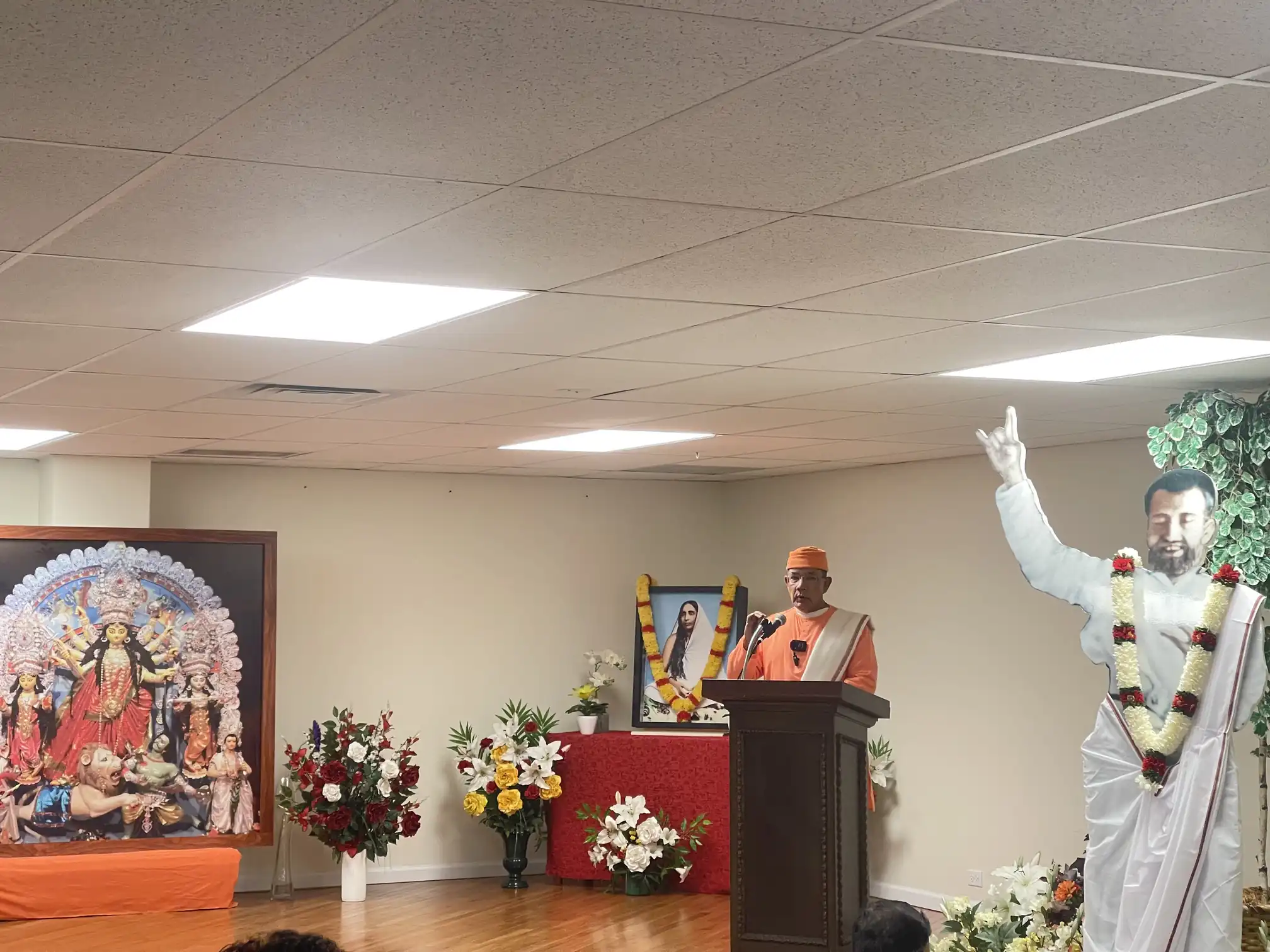
Kalpataru Day Celebrations Worldwide
Every listing below is taken from the institution's own published programme or official festival calendar. Times are local to the venue. Where an institution keeps the day but has not yet published its time, the listing says so rather than guessing.
India
- Sri Ramakrishna Math, Chennai — Friday 1 January — Kalpataru Day, from the Math's Festival Calendar. The calendar gives the observance rather than a clock time.
- Ramakrishna Mission, Bankura — 1 January — Kalpataru Utsav stands in the centre's own list of its annual observances, kept with chanting and readings. A standing observance; the centre publishes no clock time.
Australia
- Vedanta Centre of Sydney, Ermington (Sydney) — Friday 1 January, evening — Aratrikam 6:30 pm, bhajans by devotees 7:00 pm, talk 7:30 pm, prasad distribution 8:30 pm. From the centre's own published programme.
Germany
- Vedanta Gesellschaft, Berlin — the society keeps Kalpataru Day together with the Holy Mother's Puja at its year-end retreat: Thursday 31 December, 10:30 pm — discourses on the Holy Mother and the significance of Kalpataru Day; Friday 1 January, 10:45 am — the Kalpataru Day and Holy Mother Puja, followed by lunch prasad at 12:00 noon. From the society's own retreat programme.
Singapore
- Ramakrishna Mission, Singapore — Friday 1 January — Kalpataru Day, from the Mission's Festival Calendar. The calendar gives the observance rather than a clock time.
United States
- Vedanta Society of Southern California, Los Angeles — Friday 1 January — Kalpataru Day, from the society's Calendar of Observances. The calendar publishes no timed programme for the day.
- Vedanta Society of New York, New York — Friday 1 January — Kalpataru Day in the society's own Festival Calendar. The calendar notes that only some of its listed celebrations are held at the centre, and refers devotees to the society's monthly bulletin for the services it holds.
- Vedanta Society of Greater Houston, Houston — Friday 1 January — the society keeps Kalpataru Day together with the Holy Mother Sri Sarada Devi's Birthday celebrations, from its own published list of confirmed events. No clock time is published.
- Vedanta Society of Western Washington, Seattle — 1 January — the society's own page describes its customary Kalpataru Day as a daylong meditation vigil at the ashrama, beginning at 7:00 am and concluding with vespers and a special talk in the evening. That is the society's standing description of the day it keeps every year; its programme for this January had not been published separately.
The following centres are not yet listed, because their programmes for Kalpataru Day had not been published (last updated 15 November 2026): Belur Math, whose own programme for the day is still to come, and the Ramakrishna Math at Kashipur — the Cossipore garden house itself; and the Vedanta societies and centres of San Francisco, Chicago, Toronto, London, Durban, Gretz in France, Japan, Buenos Aires and São Paulo.
1. The First Day of the Year 1886
The garden house at Cossipore stood at the northern edge of Calcutta, far enough from the press of the city to hold its quiet, close enough that a devotee could come out by carriage after the day’s work and be home again by night. It was not a grand house. It was a two-storeyed dwelling set in a large garden, with trees that gave shade in the heat and a stillness that the doctors had prescribed as medicine. In December of 1885, Sri Ramakrishna had been brought here from Dakshineswar, by way of a house in the city, so that the disease in his throat could be treated under the constant eye of physicians and so that the ceaseless stream of visitors who sought him could be managed in a place built for rest. The treatment, everyone understood by then, was unlikely to cure him. The garden house had been taken, in effect, as the place where the last chapter of his life on earth would be lived out, and those who loved him arranged themselves around that knowledge like members of a household settling into a long vigil.
The vigil had its order. In the room upstairs, the Master lay on his bed, propped against pillows, his throat swollen and painful, his body worn thin by months of illness and by the long years of spiritual practice that had preceded it. Around him, in shifts that ran through the day and the night, served the young men who had gathered to him in the last years at Dakshineswar — boys in their late teens and twenties who had left college seats and family expectations to sit at his feet, and who now found that their discipleship had narrowed to the most concrete of tasks. Someone had to prepare his food in the exact form the doctors allowed. Someone had to watch through the night, when the pain was worst and sleep came hardest. Someone had to receive the visitors, answer their questions, and judge which of them might be brought upstairs and which must be content with a word from the staircase. Narendranath — the young man the world would later know as Swami Vivekananda — stood at the centre of this band, and under his eye the rota held: nursing, cooking, cleaning, singing in the evening, and long hours of meditation in the garden when the Master slept. The householders, for their part, sustained the whole from outside. They paid the rent of the garden house, they brought the doctors and the medicines, they carried provisions from the city, and on Sundays and holidays they came in numbers, filling the ground floor and the garden paths, waiting for whatever word or glance the day might bring them.
The first day of January was such a holiday. In Calcutta the English New Year was kept by offices and counting-houses, and men who on an ordinary weekday would have been bound to their desks were free from the morning. The winter in Bengal is the kind season: the air at midday is cool and bright, the sun stands in a clear sky, and a garden in the early afternoon is the most pleasant place in the world. From the morning onward, the householder devotees began to arrive — some alone, some with friends they had brought along, some with flowers or fruit in their hands. They gathered in the hall downstairs and out among the trees, talking in the low, happy way of people who have come to the one place where they feel their lives are understood. Upstairs, unknown to most of them, the day had brought a small mercy. The Master felt better. The pain in his throat had eased a little; his strength, which had been failing by inches, seemed for the moment to hold. In the early afternoon he expressed a wish that would have been unremarkable for any other invalid and was, for this household, an event: he wanted to go down and walk in the garden.
They helped him dress. A cap was put over his ears against the air, a warm shawl drawn around his shoulders, and slippers placed on his feet. Supported on either side, he came slowly down the stairs and out into the sunlight, into the garden he had seen for weeks only from his window. It was about three o’clock in the afternoon, the accounts agree — the hour when the winter light begins its long decline and everything in a Bengali garden stands briefly gilded. The devotees in the garden saw him coming and moved toward him in a body, startled and overjoyed, for many of them had not seen him on his feet in weeks and had half prepared themselves to never see it again. He walked slowly along the path, speaking a word here and there, his step unsteady but his face, the witnesses remembered, lit with a peculiar gladness. Nothing about the scene announced what it would become. It had the appearance of a sick man’s small outing on a fine afternoon, of the kind that convalescents are granted and families treasure. But the man walking between the trees was not, in the understanding of those who watched him, an ordinary invalid, and the gladness on his face was not, in their later telling, the gladness of a patient enjoying the air. It was the gladness of a giver who has decided, on a day when his household is gathered and the light is right, to give away everything he has left.
2. “What Is the Talk About?”
The Master walked until he came to the part of the garden where a group of the householder devotees stood talking under the trees. Two of them, in particular, were deep in a conversation that had become, in those months of his illness, the standing question of the whole community. Girish Chandra Ghosh — the playwright and actor who had built the Bengali theatre, a man of volcanic temperament and equally volcanic devotion, who had surrendered himself to the Master with the famous completeness of a man handing over his power of attorney — was speaking with Ramchandra Datta, the physician and chemist whose house had been one of the first stations of the Master’s city life and whose practical devotion ran the household’s errands in the world. What they were discussing, as the Master approached, was the Master himself. More precisely, they were discussing what he was: whether this frail, dying man, who had been a temple priest of no learning and no account in the world’s eyes, was in truth an incarnation of God — one of those rare descents, as the Hindu tradition reckons them, in which the Divine takes birth deliberately, for the sake of the age.
This was not, among them, an abstract proposition. Girish proclaimed it publicly. From the stage of his own theatre and in the drawing rooms of Calcutta he said it without embarrassment, and it drew to Cossipore both the curious and the hostile — men who came to test the claim, and men who came to mock it. The two friends under the tree were turning the matter over between themselves, as believers do when they are off their guard, when they realised that the subject of their conversation was standing before them. The Master had come up quietly. He was smiling. In substance, as the accounts record the exchange, he put to Girish the question of a man who has overheard his own eulogy and means to examine it: what was this talk? What had Girish understood about him, that he went about proclaiming such things to the world?
The question was a trap of the gentlest kind, and everyone who knew the Master knew its flavour. He had spent a lifetime puncturing pretension, his own included; he accepted no one’s testimony about spiritual things at second hand, and least of all testimony about himself. Girish, to do him justice, did not retreat a single step. He came forward, and he knelt down on the garden path before the Master, folding his hands. And his answer, as the accounts preserve its substance, was not a doctrine but a surrender. There were, he said, sages of old — Vyasa, who arranged the Vedas and composed the great epic; Valmiki, who sang the Ramayana — men whose vision the tradition itself treats as the measure of all sacred knowledge. What could he, Girish, say of the Master, when even Vyasa and Valmiki, with all their realisation, had not been able to fathom the measure of his greatness and glory? It was the answer of a devotee who has stopped trying to prove his faith and simply states it: my knowledge of you is not that you can be measured, but that you cannot.
The confession carried a weight in that company that an equal confession from a purer man would not have carried. Girish’s life was public property — the theatres, the drinking bouts, the chaos of a genius who made no attempt to hide any of it — and everyone present knew the history of his coming to the Master: how he had arrived defiant and mocking, how he had been disarmed not by argument but by acceptance, and how he had finally executed what he himself called his power of attorney, formally handing over responsibility for his own spiritual welfare, since he plainly could not manage it himself. If the doctrine of the incarnation could be confessed by Girish — not as a theory he had adopted but as the ground he stood on — then it had been tested against the hardest material Calcutta could supply. The Master, who had accepted the power of attorney, now accepted the confession that completed it.
The Master was visibly pleased — pleased, the witnesses felt, in a way that went past pleasure. He answered, in substance, that he asked for nothing more; that he was satisfied; that Girish need say nothing further at all. Consider what had passed between them. On one side, the complete confession of faith, made kneeling on a garden path, without conditions and without reserve. On the other side, its acceptance — not corrected, not moderated, not turned aside with a joke, as the Master had turned aside a hundred lesser offerings. He let the confession stand. And then, as he stood there with Girish kneeling before him and the others gathered close, something came over him that every person present recognised and none of them had expected on that quiet afternoon. His face changed. His eyes took on the far look that the devotees knew from his hours in the temple at Dakshineswar — the look of a man whose consciousness is withdrawing from the surface of things into some depth where the ordinary world does not follow. His body grew still and strangely radiant. He was passing, there in the garden, in the middle of a sentence’s pause, into that state of ecstasy — of samadhi, half-conscious and half-transcendent — in which, all his life, he had ceased to be a man among men and had become, in the language of those who loved him, a doorway standing open. The talk under the tree was over. What the talk had been about was about to demonstrate itself.
Girish Ghosh: The Sceptic Who Knelt
Every tradition keeps a favourite sinner, and the Ramakrishna tradition keeps Girish Chandra Ghosh. He was not a seeker who arrived at Dakshineswar with folded hands and a clean life behind him. He was the most famous man of the Bengali stage — actor, manager, playwright, the maker of the modern Bengali theatre — and he was, by his own cheerful admission and by the testimony of everyone who knew him, a ruin: a drinker, a bohemian, a man whose appetites had wrecked his health, his fortunes, and more than one household. He came to Sri Ramakrishna the way a drowning man comes to a riverbank, not the way a pilgrim comes to a shrine, and he never pretended otherwise. That is precisely why the tradition cherishes him, and why it matters that the blessing of the first of January was drawn out of the Master not by the devotion of the pure but by the defiance of this man.
Girish had first met the Master as a curiosity. The story the devotees tell is of a playwright at the height of his fame and the depth of his disorder, brought almost casually into the presence of a temple priest who wept and sang and spoke of God as others speak of a neighbour. Girish was not conquered at once. The accounts are honest about this: he argued, he tested, he stayed away, he returned. He had buried wives and children, he had known the theatre’s applause and the bottle’s oblivion in equal measure, and he had a professional’s ear for fraud. What undid him, the tradition says, was not an argument but a patience — a love that made no demand that he first become respectable. The Master accepted the offerings Girish could actually bring: not purity, but honesty; not discipline, but surrender.
The surrender had a name, and the name is a legal one. In the telling preserved by his fellow devotees, Girish gave the Master his bakalma — his power of attorney. The word belongs to the law courts: it is the instrument by which a man authorises another to act in his name, to sign for him, to bear the consequences of his affairs. Girish, who could not keep his own resolutions for a week, executed that deed in the court of the spirit. He would no longer pretend to steer. The Master would take charge of his good and his ill alike, and Girish would simply hold on. It is easy to sentimentalise the episode and important not to: the tradition does not present the bakalma as a magical discharge of responsibility. Girish went on working, writing, managing, failing, repenting — but he went on as a man who had transferred the ownership of his life, and who therefore could neither despair of it nor boast of it.
From that transfer came the proclamation that gives the first of January its human trigger. Girish did not keep his faith private. With a playwright’s instinct for the public word, he began to declare openly what he believed: that the unlettered priest of Dakshineswar was no ordinary saint but an incarnation of God, come for the redemption of the age. He said it in drawing rooms and green rooms, to devotees and to mockers, with the recklessness of a man who has never in his life lowered his voice. It was this public talk — Girish and Ramchandra Datta speaking together of the Master in these terms — that the dying Ramakrishna overheard in the garden at Cossipore, and that drew from him the exchange the tradition has preserved: the question what Girish had seen in him to proclaim such a thing, and Girish, kneeling, answering in substance that if the ancient sages who sang God’s glories could not fathom their limit, how should a man like him measure such greatness. The Master asked for nothing more. The accounts say he passed into ecstasy, and the blessing followed.
Pause over the shape of that sequence, because the tradition certainly does. The kalpataru did not open its hands because a committee of the virtuous had petitioned it. It opened because a ruined actor, kneeling in a garden, refused to take back the largest claim he had ever made about another human being — refused, at the very moment when caution would have been easiest, when the man before him was visibly dying and the claim was visibly absurd to every worldly eye. The devotees draw the moral without embarrassment: grace at Cossipore answered faith, not merit. The blessing was addressed to all who stood there, and the tradition has always been careful to preserve who stood at the head of that company — not the youngest and purest of the disciples, but the oldest and most compromised of the householders.
His later life is the evidence the devotees cite, and they cite it soberly. Girish did not become a plaster saint. He remained a man of the theatre to the end, tempestuous, generous, flawed; the accounts do not hide his lapses, and he never hid them himself. What changed, they say, was the centre of gravity. The man who had given away his power of attorney credited every recovery to the one who held it, met bereavement — and bereavement kept coming to that house — without the old collapse, and placed his prodigious gifts, play after play with religious themes among them, more and more at the service of the faith he proclaimed. When the young monastic disciples were inclined to judge the householders, the tradition remembers, it was Girish’s devotion the Master himself would set before them. The sceptic who knelt became, in the Order’s memory, the standing proof of its central claim about that January afternoon: that the tree in the garden gave its fruit without first inspecting the hands held up to receive it — and that a life taken in those hands, however late and however damaged, was not wasted.
3. “May You All Be Blessed — May Your Consciousness Be Awakened”
He stood in the garden path in that half-awakened state, the accounts say, his consciousness poised between the world of the devotees before him and the depth into which he habitually sank — and from that threshold, which in him had always been a place of giving, he gave. He spoke to the assembled devotees, and the blessing he pronounced over them has been carried by the tradition in a form so short that a child can hold it: that he blessed them all, and that his blessing was this — may your consciousness be awakened. What else can I say to you, the sense of his words ran, than this: I bless you all; be illumined. Then he did what the words alone would not have done. He went to them, one by one, and touched them — laying his hand upon the breast of each devotee, in the place where the heart is, as he had touched men before in moments of transmission that changed the course of their lives.
The accounts give the number of those present as some thirty devotees; the precise count matters less than what the accounts agree happened next, which was not one thing but many things at once, sorted by the nature of each person who received the touch. Some of the devotees, the moment his hand rested on them, fell into meditation where they stood, their eyes closing against the garden, their minds plunging without effort into the stillness they had sought for years with effort. Some wept — openly, helplessly, the tears of men who have been carrying a grief or a guilt for a long time and find it suddenly lifted by a hand they did not expect to be gentle. Some laughed, in pure and unaccountable joy. Some cried out — calling on the Master, calling on God, naming aloud the form of the Divine that arose before their inner eye. There were those who saw light, and those who felt a current of bliss rise in the body as if a knot somewhere deep had been untied by the touch. There were those who, in that moment, had the vision of their chosen deity — the form of God to which their whole devotion had been addressed — standing before them as plainly as the trees. Each, the accounts insist, received according to his own nature and his own ripeness: the blessing was one, but it flowered thirty ways, because what it awakened in each man was the seed that man had been carrying. It was less like a distribution of gifts than like the striking of a bell in thirty different rooms.
There is a detail in the accounts that those who treasure this day have never been able to leave alone, and it is the detail of who was blessed. The touch did not go only to the stainless. Among the devotees gathered in that garden were men whose lives, by their own confession, were far from pure — men with habits they could not break, with pasts they could not defend, with faith that was more longing than achievement. The Master on that day made no examination. He did not ask who had kept the disciplines and who had failed them, who deserved the touch and who had merely wandered in with the holiday crowd. He blessed, in the telling of the witnesses, all who were there — the ripe and the unripe, the scholar and the drunkard’s friend, the daily practitioner and the man who came twice a year. The accounts dwell, too, on the physical character of the gift — on how many of the devotees described the touch not in the language of emotion but in the language of current and force. Again and again in the testimony, men who were not given to such speech report a thrill passing through the body at the contact of his hand, a sensation as of something entering and rising, after which the mind did what it had never done unbidden. Others reported no sensation at all, and instead a silence — the garden, the voices, the afternoon itself falling away to a great distance while something interior stood clear for the first time. The tradition has been careful, in handing these reports down, not to iron them into uniformity; the divergence is itself part of the record. And there is a further feature of the afternoon that the witnesses noted and that the day’s later interpreters have made much of: the gift fell where it fell, on the householders in the garden, while the young monastic disciples — the boys of the sickroom rota, the Master’s own inner circle — were largely about their duties in the house and were not, in the main, recipients of that day’s public shower. The blessing of the first of January was, in this sense, an event of the marketplace rather than the monastery: it belonged to married men with offices and debts and ungovernable households, to men who would go home by carriage that night to lives that looked nothing like a religious vocation. What the Master awakened in them had to survive exactly there.
This indiscriminate quality of the giving is what fixed the day’s name in the end. In the heavens of the old stories there stands a tree called the Kalpataru, the wish-fulfilling tree, beneath which whatever a man asks for is given to him — not because he has earned it, but because giving is what the tree is. The devotees who walked out of the Cossipore garden that evening, dazed and weeping and laughing by turns, reached for that image to say what had happened to them: that for one afternoon, in a garden in the suburbs of Calcutta, the Master had stood among them as that tree stands, and had refused no one. The first of January is kept in the tradition by that name to this day — Kalpataru Day — and the blessing spoken in the garden is its whole liturgy in a sentence: may your consciousness be awakened.
4. The Witnesses and Their Accounts
An event like the first of January at Cossipore — public, brief, and inward in nearly everything that mattered about it — stands or falls, for later generations, entirely on its witnesses. The tradition is fortunate in them, and it is worth pausing over who they were, because the day did not descend to posterity as a legend polished by centuries of retelling. It was written down, from several independent directions, by men who had been standing in the garden, and who had reputations, professions, and in some cases literary fame of their own to protect. They did not all tell it the same way. They did not need to.
The fullest treatment is found in the great biography composed by Swami Saradananda — Sarat Chandra Chakravarti as he had been, one of the young men of the Cossipore household itself, who in later life became general secretary of the Ramakrishna Math and Mission and spent years assembling, from documents and interviews and his own memory, the five-volume Bengali life known in English as Sri Ramakrishna the Great Master. Saradananda was a witness of the Cossipore period from inside the sickroom rota, and his method was the opposite of hagiographic haste: he gathered testimony, compared it, and recorded not only the Master’s words and movements on the first of January but the interior history of the day as well — what the blessing did to particular men, traced through their own later accounts of themselves. In his telling, the case of Ramchandra Datta receives detailed attention. Ramchandra, the scientifically trained physician of the group, was a man whose devotion coexisted with a rationalist’s suspicion of his own emotions; the Great Master follows what the touch in the garden set moving in him, and how the experience confirmed and steadied a faith he had previously held at arm’s length from his own temperament. Girish’s exchange with the Master, which lit the fuse of the afternoon, likewise comes down in Saradananda’s pages with the care of a man checking a deposition. Where the biography is most valuable, perhaps, is in its refusal to flatten the devotees into a chorus: each man’s experience is rendered as his own, in his own degree, and the biographer’s own voice keeps reminding the reader that such things are recorded, not explained.
The second great source stands closer to the day itself. Mahendranath Gupta — M., as he signed himself — was the schoolmaster who had been visiting the Master since the early Dakshineswar days with a notebook in his pocket and a stenographer’s conscience, and whose Sri Sri Ramakrishna Kathamrita, published in English as The Gospel of Sri Ramakrishna, preserved the Master’s conversations in dated, scene-by-scene entries of a precision no other devotee attempted. M. came to Cossipore through the last months, and the Gospel’s record of the garden-house days — the room upstairs, the visitors, the Master’s teachings snatched between bouts of pain — forms the indispensable background against which the first of January must be read: it establishes what the household was, who was in it, and what the texture of an ordinary afternoon at Cossipore felt like, so that the extraordinary afternoon can be measured against it. Beyond these two pillars there is the distributed testimony of the devotees themselves — the recollections set down in memoirs and reminiscences over the following decades by men who had been in the garden as householders, and the memories preserved among the monastic disciples, for whom the day was part of the founding inheritance of their order. Ramchandra, in particular, did not keep his experience to himself: he spoke of the day for the rest of his life, kept its anniversary at his own garden retreat at Kankurgachi, and is credited in the tradition with fixing upon it the name of Kalpataru, the wish-fulfilling tree — an act of naming that is itself a piece of testimony, since it tells us how the man closest to the day’s practical arrangements understood what had occurred.
The accounts differ, as honest accounts of the same afternoon will. They differ in emphasis — one witness remembers the words, another the touch, another his own interior upheaval and very little of the scene around him. They differ in the degree of detail they give to the sequence: how far the Master had walked, where exactly Girish knelt, whether the blessing preceded the touches or accompanied them. Devotees who arrived at the garden later in the day, after the event, enter the records too, with their regret and with the Master’s kindness to them; the sources do not tidy these loose ends away. What the sources do not differ on is the core of the matter, and this convergence is precisely why the tradition rests its confidence where it does. The witnesses were numerous — some thirty men, by the usual reckoning — and independent: a playwright, a physician, a schoolmaster, merchants and clerks and teachers, several of them constitutionally allergic to exaggeration and one or two on record as sceptics about easy marvels. They wrote, or dictated, or testified within living memory of the event, in most cases while other witnesses were alive to contradict them. And they agree on the essentials: the afternoon walk, the overheard conversation, Girish’s confession, the ecstasy, the blessing that asked for the awakening of consciousness, the touch given to each, and the extraordinary harvest of experience that followed it home. A tradition can survive embellishment; what it cannot manufacture is this kind of unglamorous, mutually corroborating plainness. The testimony also continued to accumulate in a form archives cannot hold: in observance. Ramchandra Datta, who had stood in the garden, went home and reorganised his devotion around the day. At Yogodyan, the garden retreat he established at Kankurgachi in the east of the city, the first of January became the fixed summit of his calendar, and the relics of the Master that came into his keeping were enshrined there in the conviction that the garden at Cossipore and his own garden were chapters of one story. Other devotee households followed the same pattern, keeping the anniversary in their homes with worship, feeding of the poor, and the reading of the accounts — practices which are themselves evidence, of the sociological kind, that something had happened which a community needed to mark annually or lose. Annual observance is how illiterate centuries remembered; in a literate community that also wrote everything down, it functions as a seal on the documents. The day was believed early, and it was believed in writing, and it was believed on foot, by people walking back each winter to a garden — three cords of one rope.
The first of January 1886 is believed, in the end, the way any well-attested afternoon is believed — because the people who were there wrote it down, and their writings fit together without ever having been made to.
The Garden House at Cossipore
A festival that happens once, in one place, on one afternoon, belongs to that place forever, and Kalpataru Day belongs to a rented garden house in Cossipore, in the northern reaches of Calcutta. The house was not a temple and was never meant to be one. It was a garden property — the kind of suburban retreat, with its trees and tank and quiet lanes, that prosperous Calcutta families kept for air and amusement — taken on rent so that a very sick man could be nursed away from the noise of the city and the crowds of the temple garden at Dakshineswar. The tradition knows it by a name that honours what it was: the Udyanbati, the garden house. Everything about the first of January follows from this unremarkable setting. There was no shrine room large enough for what happened, no ritual calendar prescribing it, no crowd assembled by announcement. There was a house, a garden, a path between the trees, and some thirty people who happened to be there because they had nowhere else they wished to be.
The accounts let the reader reconstruct the ground with unusual precision, because the witnesses remembered it the way people remember the room where something decisive occurred. There was the house itself, with the Master’s room where the nursing went on day and night — the young disciples serving in shifts, the Holy Mother preparing his food, the doctors coming and going with their increasingly helpless prescriptions. And there was the garden: the trees under which the householder devotees sat talking that holiday afternoon, the path down which the Master, feeling a little stronger, unexpectedly came walking in his semi-absorbed state, the open ground where the devotees gathered around him and the blessing was given and received — some weeping, some meditating where they stood, some calling on him aloud, as the accounts describe. The geography is the theology. God, in this story, did not descend into a sanctum. He came down a garden path, in the open air, among the trees, to people sitting in the winter sun discussing him.
One of those people gave the ground its second life. Ramchandra Datta — a householder disciple, a man of science by profession, and one of those who had been present and transformed in the garden — later acquired the adjoining mango grove associated with the Master’s days there, and established upon it the Yogodyan, the garden of union, where he enshrined the Master’s relics and where devotees gathered to remember. The tradition treats Ramchandra’s purchase as an act of the same devotion that had knelt in the garden: the instinct, as old as religion itself, that ground once touched by the sacred must not be surrendered to oblivion or to the builder’s cart. Between the rented house and the purchased grove, the whole afterlife of the day is contained: first the event, then the keeping of the event, then the keeping of the place where the keeping began.
The garden house itself is kept to this day. It stands as a centre of the Ramakrishna Order, the house preserved, the Master’s room maintained as a shrine, the garden tended — and on the first of January it fills, as few other days fill it, with the crowds who come to stand in the place where the blessing was given. That pilgrimage traffic is the clearest expression of why place matters to this particular festival. Most festivals commemorate events no living geography can verify: their fields are in scripture, their rivers have shifted, their cities are rebuilt a hundred times. Kalpataru Day is barely beyond the reach of documented memory, and its stage survives. A pilgrim at Cossipore does not merely recall the story in the place where it is told. He stands on the path. He looks at the trees — not the same trees, in most cases, and the tradition is untroubled by that, because what the place preserves is not botany but orientation: here, facing this way, at this distance from the house, under this sky, it happened.
There is a deeper sense in which the garden house is the right monument for the day, and the devotees feel it even when they do not say it. A temple would have falsified the event. The blessing at Cossipore was domestic: given by a patient in a borrowed house to the friends who had nursed and fed and fanned him, in the middle of the unglamorous economy of service that the garden house existed to shelter. The house remembers that economy. Its shrine room was a sickroom. Its holiest ground was a garden path used for taking the air. To preserve the Udyanbati is therefore to preserve the festival’s whole argument in brick and leaf — that the wish-fulfilling tree of heaven, when it finally appeared on earth, appeared not in a paradise but in a rented garden in the suburbs, and that it bore its fruit within earshot of a kitchen.
5. The Last Months at Cossipore
The garden house had been taken in December of 1885, and the eight months that followed — the whole of the Cossipore period — have a density in the tradition’s memory out of all proportion to their length, because everything that Sri Ramakrishna still had to build, he built there, and he built it largely out of sickbed hours. The building in question was not a doctrine. It was a company of young men. Around the bed upstairs, the rota of nursing became, without anyone announcing it, a novitiate. The young disciples cooked for him, fanned him, read to him, carried him, emptied and cleaned, sat up in pairs through the nights when the pain in his throat let neither him nor them sleep. Shashi, the tireless one of the band, made the Master’s service so absolute a religion of its own that the others measured themselves against it; Narendranath organised, questioned, sang, and received in private the instructions that would shape his life’s work. The Master, for his part, taught from the bed as he had taught from the temple courtyard — in parables tossed off between medicines, in sudden probings of a young man’s sincerity, in long explanations given to one visitor that were really addressed to the boy silently holding the fan. He was, the disciples understood, distributing himself: his knowledge to one, his method to another, his charge over the future to a third. The illness was not an interruption of the teaching. In the memory of those who were there, it was the teaching’s final and most concentrated form, because everything inessential had been burned away by pain, and what came out of the sickroom had the weight of a man speaking with his remaining strength.
The householders served the same end from their side of the household. They found and paid for the house, engaged the physicians — the best Calcutta could offer, orthodox and homeopathic alike — and stood the endless small expenses of a sickroom maintained at the level of devotion rather than economy. The Holy Mother was there through it all, in the pattern her whole life had established: almost invisible, and absolutely load-bearing. Sri Sarada Devi had come to Cossipore as she had lived at Dakshineswar, cooking the Master’s food with her own hands in the cramped space allotted to her, preparing the precise broths and soft preparations his throat could manage, serving the young disciples who were, in her own later understanding, her children, and withdrawing from every eye. The women of the devotees’ families revolved around her; the young men upstairs knew that the kitchen below was her kingdom and that the household ran on it. It is one of the quiet facts of the period that when the Master died, it was this woman in the kitchen, and this band of boys around the bed, who between them held everything he had made — and neither group yet knew what it was they were holding.
He died at Cossipore in the early morning of the sixteenth of August, 1886, a little after one o’clock, having passed in his final hours into the deep stillness his disciples called by the name they reserved for its last occurrence. The body was carried to the burning ground nearby, and the young men came back to an empty room and a house full of provisions for a patient who was gone. What happened next is the proof of what the Cossipore months, and preeminently the first of January, had actually accomplished. The householders, grieving, proposed in effect that the boys go home; the work, whatever it had been, was finished, and boys must eat. The boys refused. They stayed together, first in the emptied garden house and then, in October of that year, in a dilapidated, half-ruined house at Baranagar, a few miles north, which a devotee’s generosity rented for them — a house with a reputation for ghosts that kept the rent low and the brotherhood undisturbed. There, in poverty that was frequently absolute, with the Master’s relics enshrined in their single room of worship and his name as their only endowment, the young nurses of Cossipore formally became what they already were: an order of monks. Baranagar Math, the first monastery of the Ramakrishna movement, was not founded on a charter or a donation. It was founded on a rota of night-watches around a sickbed, and on an afternoon in a garden when a dying man had walked down the stairs, blessed everyone within reach without asking a single question about their worthiness, and awakened in thirty ordinary men the consciousness he asked heaven to awaken. The tradition has never had difficulty drawing the line between the two events. The blessing of the first of January was given to householders, in a garden, by daylight. The vow of Baranagar was taken by monks, in a ruin, in want. They are the same gift at two temperatures — and every Kalpataru Day since, wherever the Master’s people gather at the turning of the year, is an attempt to stand, once more, in that garden, among the unexamined and the unready, and to hear the sentence that requires nothing of the hearer but that he wake.
It remains only to mark how deliberately the brotherhood sealed what Cossipore had begun. When the Master’s body had been cremated, the ashes were gathered with a reverence that surprised even the gatherers, and the question of their keeping settled itself along the lines of the two households he had made: a portion was enshrined by Ramchandra at Yogodyan, the householder’s garden, and a portion travelled with the young monks, the sacred centre around which their monastery, wherever it lodged, would constitute itself. Relics are usually the end of a story — the point at which a living presence is converted into a memory. At Baranagar they functioned the other way, as a beginning: the urn in the shrine room was the still point of a community that ate uncertainly, slept on the floor, and spent its days in prayer, study, and the retelling of the garden-house months to one another until the retelling itself became a rule of life. And when Christmas Eve of that same year, 1886, found nine of them gathered at Antpur, a village home of one of their number, sitting through the night around a fire and speaking of renunciation, they rose from it having resolved together what each had resolved singly at Cossipore — to give their lives wholly to the realisation the Master had blessed in others. Historians of the movement have long treated Antpur as its second founding, and the participants treated it as nothing more mysterious than a consequence. A wish-fulfilling tree does not plant itself. It is planted by those who stood under it, received what fell, and discovered that the only fitting response to an unconditional gift is an unconditional answer. The garden house at Cossipore still stands, kept by the tradition as a place of pilgrimage, its garden quieter now than the city that has grown up around it. But the household that filled it in the winter of the Master’s last year has never really dispersed; it merely changed its address — to Baranagar first, and in time to a monastery on the bank of the Ganges and to centres across the world, each of which keeps, at the turning of every year, the memory of an afternoon when the sick man came down the stairs, walked out into the winter light, and gave away the one thing he had spent a lifetime accumulating: the awakening of other souls.
The Tree in the Upanishads
Long before there was a garden house at Cossipore, India had been thinking about a tree. The image that Ramakrishna’s devotees reached for on the first of January — kalpataru, the wish-fulfilling tree — sounds like the simplest of fancies, a tree that gives you whatever you ask. But it fell, in that garden, into soil prepared by three thousand years of arboreal theology, and the tradition that keeps the festival hears, behind the pretty Puranic name, a sterner and stranger music: the music of the tree that grows upside down.
The Katha Upanishad states the image with unforgettable economy. There is, the text says, an eternal ashvattha — the sacred fig — whose root is above and whose branches are below, and that tree, the Upanishad declares, is no mere tree: it is the pure, it is Brahman, it is called the immortal, and in it all the worlds rest. The picture reverses every orchard on earth. Ordinary trees draw their life from the soil and spend it in the air; this tree draws its life from heaven — from the unseen, the unmanifest, the root that is God — and spends it downward, branch by branch, into the worlds of form: gods, men, animals, the whole teeming creation hanging, fruit and leaf, from a root it cannot see. To contemplate the tree is therefore to contemplate one’s own situation precisely. Every human life is a branch of it, nourished from above by a source it did not plant, mistaking its foliage for its foundation. Liberation, in this image, is not escape from the tree. It is the tracing of the branch back to the root — the discovery that the life in the leaf was always the life of the whole.
The Bhagavad Gita takes up the same tree in its fifteenth chapter and hands the hearer an axe. Krishna describes the imperishable ashvattha again — roots above, branches below, its leaves the hymns of the Veda, its boughs fed by the qualities of nature, its lesser roots reaching down into the world of human action and binding the soul to its deeds. And then the teaching turns: this mightily rooted tree is to be cut down with the strong axe of detachment, so that the seeker may reach the goal from which there is no return — the primal Person from whom the whole ancient process has streamed forth. Generations of commentators have dwelt on the violence and the mercy of that instruction. The tree is sacred; the tree is Brahman itself in its manifest life; and still the Gita bids us cut — not in hatred of the world, but because a branch that will not stop clutching at its own foliage never learns that it is also the root. Detachment is the axe; surrender is the destination; the tree, rightly understood, instructs its own transcendence.
Set beside these two, the third tree of the tradition looks almost too kind. The kalpavriksha of the Puranas — the kalpataru — is one of the treasures churned from the ocean of milk at the beginning of the world, planted in Indra’s paradise, and its property is simple bounty: stand beneath it, ask, and receive. No axe is mentioned. No root need be traced. The Puranic tree gives objects — wealth, pleasure, victory, long life — to whoever shelters under it, and the storytellers filled heaven with its shade. The philosophical tradition was always a little suspicious of this tree, and the suspicion is itself instructive: a gift that answers every wish as spoken leaves the wisher exactly as he was, only fuller. The Upanishadic tree demands transformation; the Puranic tree offers satisfaction. Indian spirituality kept both images because human beings need both rebukes — against the greed that only wants more, and against the despair that no longer dares to want at all.
Cossipore, the tradition holds, is where the two trees were planted in one garden. What Ramakrishna did on the first of January, in the devotees’ reading, was to stand beneath no tree and yet to be one: a man with nothing — no health, no possessions, no months left to live — giving to all who approached the one gift the kalpavriksha of paradise never stocked. He did not give objects. He gave awakening: the consciousness of the root, in the Upanishad’s language; the knowledge, in the Gita’s, of the Person from whom the process streams. And he gave it in the kalpavriksha’s manner, not the axe’s: freely, indiscriminately, on asking and even without asking, to the playwright and the professor and the boys who fanned him alike. The teacher whose whole life had been a schooling in renunciation — who had himself wielded detachment’s axe on every attachment a man can name — spent one of his last afternoons demonstrating that the end of renunciation is not refusal but bounty: the root, realised, feeds every branch without distinction.
That double inheritance is what the festival, at its deepest, asks its keepers to practise. Beneath the Cossipore tree there is room for every wish, and the tradition does not mock the small wishes people bring — for health, for children, for rescue from trouble; it brought such wishes itself, that first afternoon, in thirty hearts at once. But the festival’s own story keeps quietly correcting the order of asking. The tree that gives everything is, in the end, the tree that is everything — root above, branches below, one’s own life hanging from a source that is also oneself. The wish worth asking for, the day proposes, is the one the dying man in the garden actually granted: not another fruit from the tree, but eyes to see the tree whole.
6. What Is a Kalpataru?
Before the name belonged to a day, it belonged to a tree, and the tree belonged to the oldest stratum of Indian storytelling. In the Puranas, when the gods and the demons together churned the ocean of milk — hauling on the serpent Vasuki wound around Mount Mandara, labouring for the nectar of immortality — the deep gave up its treasures one by one. Out of the foam came the goddess Lakshmi, radiant and unlooked-for. Out of it came the Kaustubha gem, the moon, the celestial physician Dhanvantari bearing the nectar itself, the seven-headed horse, the elephant of Indra, and Kamadhenu, the cow of plenty, who yields whatever her keeper requires. And out of it, in the lists the storytellers hand down, came the Kalpataru: the tree that grants wishes.
The word itself is a small poem. Kalpa is an age, an aeon, one of the vast measures of time by which Indian cosmology reckons the life of worlds; taru is a tree. The Kalpataru is thus the tree of the age, the tree that stands through the turning of aeons and is never exhausted by giving. Where Kamadhenu grants through abundance of the animal kind — milk that never fails — the Kalpataru grants through the stillness of a rooted thing. It does not pursue, it does not negotiate, it does not ask what the wish is for. Whoever sits beneath its branches and forms a desire finds the desire answered. In the paradise of Indra, in the Nandana garden where the gods take their ease, the Kalpataru stands among the five trees of heaven, and the poets return to it whenever they need an image for generosity that has no bottom.
The image had a long career in the Indian imagination, far beyond the churning myth. Sculptors took it up early and gladly. On ancient reliefs, the wish-fulfilling tree rises with coins and jewels and rich cloth raining from its branches — abundance made visible, wealth imagined not as a hoard but as a fall of gifts from something alive. Jain art cherishes the kalpavriksha as well, carving it on temple walls and painting it into manuscripts, a shared inheritance across traditions that agreed on little else. In village lore the great tree at the edge of the settlement — the banyan with its descending roots, the peepal wrapped in sacred thread — gathers something of the same aura. People tie threads to branches for the fulfilment of vows, leave offerings in the hollow of the trunk, marry the tree, mourn under it, settle disputes in its shade. The wish-tree is woven into the texture of ordinary hope: the lame hope of the childless, the anxious hope of the parent, the plain hope of the farmer watching the sky. Everyone in India, the tradition assumes, already knows what a kalpataru is, the way everyone knows what a mother is.
The image had a second, stranger career inside the scriptures themselves, and it is worth pausing over, because the Cossipore naming draws on it too. In the Katha Upanishad, and again in the Bhagavad Gita, the cosmos is pictured as a tree — the ashvattha, the sacred fig — but a tree inverted, with its roots above in the unseen and its branches spreading downward into the world of birth and death. The wise, the Gita says, are those who can cut that tree with the axe of detachment and seek the place from which there is no return. Set the two trees side by side and the Indian imagination shows its full range: the kalpavriksha of paradise, which pours out gifts, and the ashvattha of the philosophers, which must be felled. One tree is grace, the other is bondage. The tradition that named a dying man Kalpataru was, consciously or not, claiming that in him the two trees met — that the felling of the world-tree and the fruiting of the wish-tree were, in his person, a single act, and that what fell from his branches was precisely the detachment the philosophers said must be won with an axe.
Against that background, consider the daring of the name when the tradition fastened it to the first day of January at the Cossipore garden house in Calcutta. The man it named was not a god in a garden of paradise. He was a temple priest in his fiftieth year, wasted by the cancer in his throat that would kill him before the year was out, living on milk and gruel, tended round the clock by a band of young disciples who slept in shifts so that he would never be unattended. He had no treasury. He owned almost nothing. When he walked down from his room into the garden that afternoon and began to touch the devotees gathered there, blessing them one by one, the name the witnesses reached for was the name of the tree of heaven: he had become, they said, the Kalpataru.
But notice what the naming does to the image, and what the image does to the man. The tree of Indra’s garden gives objects: gold, cattle, kingdoms, long life, the whole catalogue of worldly desire. The kalpataru of Cossipore gave none of these, and the accounts are stubborn on the point. What he gave, in the tradition’s reading, was awakening itself — the one gift that is not an object, the one gift that changes the wisher rather than the wisher’s circumstances. The tradition’s daring is double. It dares to set a dying, destitute man in the place of the most opulent image in its mythology. And it dares to redefine the image from within: a wish-fulfilling tree whose fruit is not what you asked for, but the waking of the one who asks. Every later observance of Kalpataru Day lives inside that double daring, and the day cannot be understood apart from it.
7. “Be Conscious” — The Blessing Interpreted
The blessing at the heart of Kalpataru Day is disconcertingly small. The accounts record that as Sri Ramakrishna moved among the devotees in the garden, touching this one on the chest, that one on the head, he spoke words to the effect of a single wish: may your consciousness be awakened. That is the whole of it. No promise of prosperity attends it, no assurance of health, no pledge that the devotee’s tangled life would straighten out by spring. The word the tradition preserves is chaitanya — consciousness, awareness, the waking of the mind to what it truly is. The wish-fulfilling tree, at the moment of its most famous giving, wished its children awake.
It may help to hear the blessing in the Master’s own idiom, because chaitanya was a word he had been using, in one connection or another, all his teaching life. In his parables and table talk he returned endlessly to the contrast between the man who lives bound — chewing over the world, in his homely image, like a camel chewing thorns, tasting the blood and calling it flavour — and the man in whom awareness has turned toward God and never entirely turns back. Awakening, in this vocabulary, is not the acquisition of a new faculty. It is the redirection of the one faculty everyone already has. The devotees touched at Cossipore who left accounts speak the same language in their own registers: of light where the world had been solid, of the figures around them standing transfigured, of an inward certainty, impossible to argue and impossible to shake, that the divine was not elsewhere. Read together, the accounts gloss the blessing better than any commentary: to be conscious, as the Master used the word, is to know in the marrow what the mind had only been told — that consciousness is not a product of the world but its ground, and that the one who knows it has come home to his own nature. That is an enormous thing to be wished in a whisper by a man who could barely swallow. It is also, the disciples insisted, exactly the size of the gift.
The disciples themselves were the first interpreters, and their glosses run in a consistent direction. In the Order’s reading, the blessing was not a technique and not a charm. It was the transmission of a possibility: the Master’s own awakened state, pressed like a seal into the devotee’s heart, to unfold over years of practice. Several of those touched in the garden fell into ecstasy on the spot, the accounts say; some wept, some laughed, some sat down where they stood and could not rise for a long while, absorbed. But the tradition is careful to note that the same day also produced quieter fruits, and no fruit at all that an observer could see, and it treats this unevenness as part of the teaching rather than an embarrassment to be edited away. A seed is not a harvest. The blessing, as the disciples glossed it afterward, was the seed.
The form of the giving deserves attention too, because it was almost aggressively unceremonial. There was no rite. The Master, whose throat disease had reduced the famous voice to a painful whisper, came down from his sickroom in the afternoon — the accounts treasure the ordinariness of it, the walk in the winter garden he had taken on other days for air — and as the devotees gathered round him, he began to bless them with his touch, one after another, as simply as a father laying a hand on the heads of his children at the door. Some, the accounts say, received according to the bent of their own hearts: the thing each most deeply wanted from him rose up in them as he touched them, and was met. Some fell into samadhi where they stood. Others, who had come with no articulate desire at all — who had come only because it was the holiday and the Master was there and the garden was pleasant — were overwhelmed without preparation and without warning. In the tradition’s reading, this disorderliness is itself doctrinal. A tree does not schedule its fruit for the deserving. It fruits in season, over saints and picnickers alike, and the Cossipore accounts insist on the picnic element: the holiday crowd, the winter sun, the sheer unsolemnity of the setting, as if to say that awakening is not confined to the atmosphere of the shrine.
This is what separates the day’s blessing from a miracle-cure promise, and the separation is not subtle. Sri Ramakrishna was dying, visibly, of a disease that tormented him daily, and he did not cure himself. Devotees who came to Cossipore with sick bodies — and in a gathering of that size, in that city, in that century, there were certainly the sick among them — were not, so far as the accounts tell us, sent home healed. Some who received the touch that day continued to suffer the illnesses they had brought with them, and the tradition has never pretended otherwise. If the gift had been health, the day would stand refuted by its own guest list. The tradition’s reply is that the gift was never health. What the Master promised, if promise is even the right word for so spare a blessing, was of a different order entirely: not the removal of suffering but the waking of the sufferer; not a longer lease on the dream but an opening of the eyes within it. A man may be awakened in a sickroom. Indeed, the accounts suggest the sickroom is where awakening most often begins.
Swami Vivekananda, who carried the Master’s message across the world in the years after, returned to this point with a characteristic refusal of comfort. As the tradition remembers his teaching, the Master had given the highest thing he had to give, and it was not a finished product to be consumed but a beginning to be worked out by each recipient in the sweat of his own life. The blessing did not exempt anyone from sadhana. It obliged. To be touched by the Kalpataru was, in this reading, to be handed a task disguised as a gift: the consciousness whose awakening was wished for the devotee still had to be awakened by the devotee, day by day, in meditation and service and self-command. Vivekananda’s own ferocity about spiritual laziness belongs here. He had no patience with devotees who treated grace as a substitute for effort, and he read the Cossipore blessing as its opposite — grace as the starter of effort, grace as the reason effort could not finally fail.
So the blessing interprets itself, if one stays with it long enough. Be conscious: it is an imperative wearing the dress of a benediction. The tree does not say, be rich, be healed, be safe. It says, wake up. Everything else in the day — the ecstasies, the tears, the lives that turned — flows from those few syllables, and the tradition has spent well over a century unfolding what was folded inside them.
8. Grace and Effort: The Order’s Reading
Every tradition that speaks of grace must sooner or later answer an awkward question: if the gift is free, what is left for the receiver to do? The Ramakrishna tradition holds Kalpataru Day in one hand and its own demanding discipline in the other, and it has never felt the need to set either down. In the Order’s reading, the first of January at Cossipore is the supreme instance of kripa — grace, the unearned descent of the divine favour — and it is simultaneously a lesson in sadhana, the effort by which a human being makes himself ready to receive what he could never earn. The two are not rivals in this reading. They are the two hands of one act.
Begin with the preparation, because the tradition insists on it. The young men who surrounded Sri Ramakrishna at Cossipore had not wandered in off the street that afternoon. For months they had been nursing him through the ugliest stages of his illness — carrying him, feeding him, cleaning him, keeping vigil through the nights in rotation, giving up examinations, careers and family expectations to do it. The householder devotees who gathered in the garden had served too, with money, provisions and attendance, at real cost to households that were not rich. When the Master came down the stairs and began to bless, he blessed, in the tradition’s phrase, those who had emptied themselves in service. In the Order’s reading, the readiness of the hearts is not an incidental detail of the scene; it is half the scene. The Kalpataru gives to all, but the gift ripens where the soil has been broken. Grace is free the way rain is free, and like rain it fills the vessel that has been set upright and emptied. This is why the monastic order that grew out of that garden has never observed the day as an excuse for passivity: the anniversary of the freest gift in its history is kept, characteristically, with intensified practice.
The word without distinction does heavy work in that sentence, and the tradition knows it. Sri Ramakrishna was a Brahmin and a temple priest, formed in a world where touch was rationed by caste and purity, where the wrong hand on the wrong shoulder was a pollution to be washed away. In the Cossipore garden, by every account, the touch fell where it fell: on monks in training and on householders of no particular sanctity, on the respectable and on devotees whose lives the respectable deplored, on men the temple would have kept at a careful distance. In the Order’s reading, this was not carelessness but the signature of the thing itself. Kripa that distinguishes is still commerce, however refined — a wage paid to merit. The Kalpataru of the myths asks nothing about the traveller beneath it, and the tradition’s claim for the first of January is that, for one afternoon, the economy of merit was suspended and the older, wilder economy of the tree took its place. It is not accidental that the devotees who treasured the day most fiercely included several who knew they could never have earned their way into it.
Nor were the prepared hearts only the young men’s. Behind the nursing party stood the Holy Mother, Sri Sarada Devi, whose unseen service provisioned the Cossipore household through those months — cooking, managing, sustaining the sustainers — and the tradition, which calls her the Master’s own Shakti, reads her hidden labour as part of the day’s preparation too. The pattern is the doctrine in miniature: the afternoon of free giving rested on a scaffolding of effort that almost nobody saw, offered by people who expected nothing from it. And the Order has institutionalised the same pattern in the observance itself. Kalpataru Day at the centres is not kept as a pageant of receiving; it is kept with special worship, with prolonged meditation, with the reading of the accounts, often with feeding of the poor — that is, with a deliberate, communal re-enactment of both halves of the doctrine. The community labours, as the attendants laboured; then it sits, as the devotees sat, to receive what labour cannot manufacture. The festival is the theology, performed annually, by people who would mostly rather perform it than argue it.
Then there is the self-revelation, which is how the tradition most deeply understands the day. As the tradition teaches, Sri Ramakrishna ordinarily concealed what he was. He played the eccentric priest, the simpleton, the child; devotees who pressed him about his own nature were deflected with jokes or sent away to their practices. At Cossipore, in the devotees’ phrase, he became the Kalpataru to all without distinction — and in the Order’s reading this was an unveiling. The touch that had before been given sparingly, to this disciple or that, for this purpose or that, was now given to everyone who came: monk and householder, the advanced and the beginner, the pure and the compromised. The tradition connects this directly with the Master’s own teaching about the avatara, the divine descent. As the tradition teaches, the avatara is precisely the one who can give what no human teacher can give, because in him the giving is not an act of generosity but an overflow of nature — as the tree gives fruit not by deciding to be kind but by being a tree. The devotees at Cossipore, in this reading, were not merely blessed by a great saint. They were present at the moment when the saint let himself be seen, briefly and without reserve, as what the tradition believes him to be.
There is a further parallel the tradition draws, quietly, with the Master’s worship. All his life he had worshipped the Divine Mother in the temple at Dakshineswar, offering flowers, food and his own heart at the feet of the image. At Cossipore the direction of worship reversed: the devotees received from his hands what he had spent decades offering to receive, and the fruits of his sadhana — the phrase matters in the tradition’s telling of the earlier Shodashi worship as well — were distributed as common property. Nothing was kept back for the keeper. In the Order’s reading, that is the final meaning of the tree: a life of practice, accumulated in one frail body over fifty years, poured out in a single afternoon to anyone who held out a hand. Grace, in this tradition, is not the opposite of effort. Grace is effort — someone else’s effort, completed and given away. The receiver’s effort begins where the giver’s leaves off, and Kalpataru Day is the hinge between the two.
From Cossipore to Antpur: The Blessing Takes Root
A blessing is an event; an order is a consequence, and the tradition draws a straight line — dates it, almost month by month — from the garden at Cossipore to the founding resolve of the Ramakrishna movement. The line begins in grief. In August 1886, eight months after he had stood among the trees and given his blessing to all, Sri Ramakrishna died in the garden house, in the room where his young disciples had nursed him. What he left behind was not an institution. It was a company: a widow who withdrew into prayer and obscurity, a band of householders returning to their professions, and a dozen and a half young men, several of them barely out of their teens, who had burned their boats for a master now gone, and who possessed between them almost nothing except one another and a memory. Among the memories, the first of January stood in a class of its own. They had not merely heard a teaching that day. By their own testimony they had been touched, individually, and given something each recognised in the others. The question of the Baranagar months was what that something obliged them to become.
Baranagar was where they tried to answer it. In a dilapidated rented house — cheap because it was said to be haunted, the accounts add with grim humour — the young disciples gathered under the leadership that was already settling on Narendra, the future Swami Vivekananda, and attempted to continue the life they had lived around the Master: prayer, meditation, study, austerity, and a poverty so complete that the tradition’s own histories record days of hunger borne as a discipline. It was a brotherhood in search of a form. They had the blessing and they had the bereavement, but a vow is a different thing from a sorrow, and by the winter the difference had become the question. Men drifted toward home and obligation; the centre held, but it had not yet declared itself permanent.
The declaration came at Antpur, and it came, as the tradition loves to point out, on Christmas Eve. Antpur was the village home of one of the young men, Baburam — later Swami Premananda — whose mother had invited the party for the holiday. On the night of 24 December 1886, the company gathered outdoors around a dhuni, the open fire of the wandering ascetic, under a winter sky. Narendra spoke to them — and here the accounts, recorded by men who were present, are specific — of Jesus: of his renunciation, his poverty, his utter abandonment of the world for the sake of God and men, and of the disciples who had carried that fire across an empire. The young Bengalis around the fire heard, in the story of the Christian founder, the mirror of their own unfinished resolve. They meditated in the firelight, and when at last they stood and warmed their hands at the flames and pledged themselves to the renounced life together, they learned — to their astonishment, the accounts say — what night it was. It was Christmas Eve. They had kept, without intending it, the vigil of the birth of Christ, and they had spent it being born themselves.
One of those present, Swami Shivananda, set down the sentence by which the tradition remembers the night: “It was at Antpur that our resolve to become a group grew more intense.” It is a quiet sentence for a decisive event, and its quietness is its credential. Antpur did not manufacture an emotion; it concentrated one. What had been given at Cossipore in January as a blessing received, was taken up at Antpur in December as a responsibility assumed — the same young men, the same gift, passed from the Master’s hands into their own. Within weeks the consequence followed in due form: in January 1887, at Baranagar, the brotherhood performed the viraja homa, the Vedic fire rite of renunciation, and took the vows and the ochre cloth of sannyasa, each receiving a monastic name. The Ramakrishna Order counts its birth from that fire. Narendra became, in time and after other names, Vivekananda; the haunted house at Baranagar became its first monastery; the company of the garden became a movement that would carry the memory of the garden around the world.
Hold the three dates together, as the tradition does, and the line it draws is unmistakable. First January: the Master, dying, gives the awakening to all, without distinction — grace descending. Twenty-fourth December: the disciples, orphaned, gather around a fire and resolve to become a group — grace accepted, at the cost of everything. January following: the vows, the names, the Order — grace institutionalised, given a form durable enough to outlive its witnesses. Kalpataru devotees who keep the first of January are therefore, in the Order’s own understanding, keeping more than an anniversary of a miracle in a garden. They are keeping the first link of a chain they can follow, link by dated link, from a touch on the breast in Cossipore to the fire at Antpur to the founding of the brotherhood — the proof the tradition values most that the blessing of that afternoon did not evaporate with the afternoon, but took root, and grew.
9. The World’s Smallest Festival
Kalpataru Day should not, by any reasonable standard, exist. No scripture commands its observance. No ancient temple calendar carries it, no almanac of the old religion marks the first of January for anything of the kind, no council ever decreed it, no king endowed it. The great festivals of the Hindu year come down wrapped in myth and sanctioned by texts older than memory; this one comes down wrapped in nothing but a recollection. Some dozens of people were in a rented garden house in a Calcutta suburb on a winter afternoon, their teacher was dying and they knew it, something happened among the trees that they could not stop talking about for the rest of their lives — and because they could not stop talking about it, there is a festival. It is, in the strictest sense, a feast founded by memory rather than by institution, and the tradition that keeps it has always seemed quietly proud of the fact.
The scene itself survives because the witnesses wrote, and the chain of transmission is part of the festival’s character. The day stands in the great biography of the Master compiled by Swami Saradananda, himself one of the young attendants of the Cossipore months, and it echoes through the memoirs and reminiscences of the householder devotees who filled the garden. It was not proclaimed by any authority at the time; it accumulated authority the way family stories do, by being found true to the experience of everyone who checked it against his own memory of the afternoon. Even the physical setting became part of the telling. The garden house at Kashipur — Cossipore — where the Master spent his last months is preserved by the Order as a place of pilgrimage, and on the first of January devotees thread through the room where he lay and the garden where he walked, reading the ground itself as a kind of scripture. A festival founded by memory naturally makes a shrine of the place remembered.
The modesty of the observance matched its origins for a long time. The brotherhood of young disciples who had nursed the Master at Cossipore carried the date with them into their first monastery at Baranagar, a crumbling rented house where they were often unsure of the next meal, and they kept the day the way they kept everything: with worship, with remembrance, with telling the story again. When the monastery found its permanent home at Belur, on the bank of the Ganga, the day settled into the calendar of the place — a winter observance, inward in tone, drawing the monks and the devotees who lived within reach of the river. Nothing about it was designed for export. There was no founding vision of a worldwide feast, no organisation charged with spreading it. What spread was the Order itself, as the disciples’ work carried them and their successors across India and then across oceans, and the day travelled in their baggage the way family observances always travel: because the people who remembered could not imagine the year without it.
The day also travels unusually well, and that too follows from its origins. A festival tied to a temple needs the temple; a festival tied to a river, a mountain, a sacred geography, stays home. Kalpataru Day is tied to a story and a date, and both are portable in a suitcase. The small Vedanta society in a northern city, meeting in a rented room with the radiators clanking, can keep it as completely as Belur: the account is read, the Master’s picture is garlanded, the company sits in the winter dark and hears about a garden in Calcutta where a dying man gave away awakening like fruit. Nothing in the observance requires scale, and so nothing in emigration dilutes it. If anything, distance has intensified it — the day functions for the diaspora as a thread back to the garden, a reminder that the tradition’s most generous moment happened not in a marble shrine but in rented premises, among exiles from ordinary life, which is a description of most congregations that have kept it since.
So the festival grew by accretion, centre by centre, wherever the Ramakrishna movement planted itself, until the first of January found the story being told and the blessing commemorated in Vedanta societies and Ramakrishna centres on every inhabited continent. And here the day acquired the second of its two great accidents of timing — the first being that it fell in the last winter of the Master’s life. Kalpataru Day falls on the day the whole world’s calendar turns. The coincidence is only a coincidence: the date is fixed by the Gregorian reckoning, and the observance would mean the same on any date whatever. But devotees are human, and the tradition has made gentle, unembarrassed use of the resonance. The year begins, for most of the world, with resolutions — the thin, self-improving promises of the gym and the ledger, usually dead by February. The devotees who gather on Kalpataru Day begin the year under a different sign: not a resolution they make but a blessing they receive, or rather a blessing they remember receiving on behalf of everyone. As the tradition frames it, the Master’s wish for awakened consciousness hangs over the first day of the year like a counter-proposal to all the year-improving that follows. Begin, the day says, not by promising to become someone else, but by waking to what you are.
Perhaps this is why the world’s smallest festival has outlasted many grander ones in the affections of those who keep it. It asks so little and commemorates so much. No one is obliged to observe it; nothing in heaven or earth punishes its neglect. It persists for the simplest of reasons — because the people who were in the garden remembered, and told, and were believed, and because everyone who hears the telling must decide for himself whether a dying man’s touch in a winter garden can still be reaching, all these years later, for his own heart as well.
10. Questions the Day Answers — and Refuses
A festival that rests on testimony invites questions, and the tradition that keeps Kalpataru Day has, to its credit, preserved the awkward ones along with the answers. They deserve a section of their own, because the day is diminished, not protected, by pretending they were never asked.
The first question is the plainest. Was the awakening permanent in those who were touched? If the Kalpataru’s gift was what the tradition says it was, should not every devotee in the garden have walked out a finished saint? The accounts themselves refuse this tidy version. They show, instead, the untidy spread that anyone honest about human beings would predict. Some lives turned on the spot and never turned back; the young disciples who had served at Cossipore moved from that afternoon toward the monastic vows and the founding of an order, and the day stands in their biographies as a hinge. Others among the householders glowed for a season and then subsided into the long, ordinary work of family and business, carrying the memory rather than the fire. Some, the accounts admit with unusual candour, seemed scarcely changed at all, and had to find their transformation years later, by slower roads, or are still, so far as any witness could tell, finding it. The tradition’s interpreters have made their peace with this. The blessing, in the Order’s reading, was an awakening of consciousness, and an awakening is not an exemption from the rest of the journey — a man woken at dawn still has to live the day. The permanence the tradition claims for Cossipore is not the permanence of a spell but the permanence of a beginning that, once truly begun, is never wholly lost, even when it must be begun again.
The second question cuts closer to the bone of the observance itself. Can grace be received by proxy — by remembrance, by reading, by standing in a congregation long afterward and hearing the story told? If not, the festival is a mere anniversary, a fond backward look at an afternoon closed to everyone born too late. The tradition’s answer is given less in argument than in the existence of the feast: the day is celebrated at all because the Order believes the giving did not end when the garden emptied. As the tradition teaches, the Master’s blessing was not addressed to a guest list. It was the act of the Kalpataru, and a tree does not stop being a tree when the first company of travellers moves on; whoever comes later and sits in the same shade is sitting in the same shade. The remembrance of the day, in this reading, is not a substitute for the touch but a mode of it — the story carrying the blessing the way a wire carries a current it did not generate. Sceptics will call this a rationalisation, and the tradition, at its best, does not flinch from the word; it simply points to the phenomenon it has watched for generations, of men and women who encountered the day at second hand — in a book, at a service, in a story told by a grandmother — and found their lives altered in the specific direction the blessing names, toward consciousness, toward waking. Testimony answering testimony.
A third question is quieter, and the tradition’s own devotees ask it of themselves, which is a healthy sign. Does the day flatter its keepers? A festival about receiving — about a gift given to people very like oneself, in a garden very like the gardens of one’s own pilgrimage — carries an obvious temptation: grace turned into an heirloom, the blessing treated as the property of the in-group, the tree fenced round with the railings of a single institution. The Order’s reading, at its most searching, supplies its own correction, and it lies in the words without distinction. If the touch at Cossipore really fell without distinction, then the day cannot honestly be kept as a badge of belonging; it can only be kept as an open door. The centres that observe it best, the tradition’s own teachers have implied, are those where the anniversary brings in the stranger, the curious, the half-believing — the modern equivalent of the holiday crowd that wandered into the garden for the winter sun and found itself, unaccountably, weeping. A Kalpataru with a guest list is a contradiction in terms, and the day, kept honestly, keeps dissolving its own fences.
Which brings the hardest question, the sceptic’s own, and it should be stated at full strength. Here was a beloved teacher dying by inches of a painful disease, surrounded by devotees half-mad with grief and devotion, in the charged atmosphere of a farewell everyone understood to be a farewell. Is it any wonder that touches felt electric, that men wept and fell into trance, that the afternoon burned itself into memory as the day heaven opened? Psychology, the sceptic says, explains Cossipore completely, and nothing remains over. The tradition’s reply is not to deny the psychology — the grief was real, the devotion was real, and no honest account of the day should launder them out. Its reply is to point past the afternoon to the decades. The fruits, it says, are the evidence it offers: the nursing brotherhood became an order that endures; the touched and the half-touched built schools, hospitals and centres of learning across a subcontinent and beyond it; the blessing’s specific content — consciousness awakened — kept recurring as the stated motive in lives that bore every mark of the real thing, including the least ecstatic marks of all, patience and service and endurance. A delusion, the tradition argues, does not usually issue in a century of unpaid nursing. The sceptic may remain unconvinced, and the day makes no attempt to compel him. That, finally, is the tradition’s own chosen posture toward its most tender festival: it is testimony, offered as testimony, and it refuses to masquerade as proof. The Kalpataru gives without distinction — and, it turns out, without argument. Whoever wishes to sit under the tree may sit. Whoever wishes to walk past, walks past. The tree, being a tree, does not call after him.
11. How the World Keeps Kalpataru Day
Kalpataru Day is kept on 1 January, and there is something quietly fitting in the way the date behaves. Most of the great days of the Hindu year travel with the moon, arriving early one year and late the next, and devotees must consult the almanac to find them. This day does not travel. It stands where the civil calendar begins, on the first morning of the new year, at Belur Math and at Ramakrishna Math and Mission centres and Vedanta societies on every continent where the Order has planted a flag — and so a monk in Bengal, a householder in Chicago, a student in Berlin and a retiree in Sydney all keep it on the same morning, in the same turning of the year. The festival commemorates what happened at the Cossipore garden house on 1 January 1886, when Sri Ramakrishna, in the last year of his life and already gravely ill, came down into the garden among his devotees and blessed them without reserve. The observance, wherever it is held, is shaped like an attempt to stand again in that garden.
The day ordinarily begins before dawn. At Belur Math, the headquarters of the Order on the west bank of the Ganga, the morning opens with mangala-arati in the great temple, the lamps waved before the image of Sri Ramakrishna while the river is still dark. A special worship follows through the morning: the Master is bathed, dressed and offered flowers and food with the full traditional honours, a homa fire is kindled and fed with oblations, and the shrine — decorated for the day with flowers and lights — receives a slow, continuous stream of devotees. Many centres read aloud, as part of the day, from the accounts of the original afternoon: the closing chapters of Sri Ramakrishna, the Great Master, and the Cossipore chapters of The Gospel of Sri Ramakrishna, in which his attendant-compiler followed him to the garden house and recorded those final months day by day. To hear those pages read in a hall full of people sitting very still is to understand what the festival is for. It is not, in the first instance, a celebration of an idea. It is the retelling of an afternoon, in the hearing of people who have come to place themselves inside it.
Discourses follow the readings — a senior monk or scholar speaks on the blessing itself, on what it means to say that a human being became the wish-fulfilling tree, and on what the devotees of that day asked for and received. Devotional singing runs through the day like a second liturgy: bhajans and kirtan, the songs of Bengal offered in the shrine and the hall, sometimes by well-known singers, sometimes by the centre’s own congregation, the distinction mattering less as the day goes on. At noon comes the meal, and with it one of the day’s oldest instincts. At the large centres, cooked prasad is served to everyone who has come — thousands may sit down in rows at Belur Math and the major maths — and the feeding of the poor, seva offered to Narayana in the form of the guest and the destitute, is not an appendage to the festival but one of its central acts. The devotees at Cossipore were fed by the household that nursed a dying man; the centres answer by feeding their own thousands, and a visitor who arrives knowing nothing of the theology will still understand the dinner.
At Cossipore itself the day has a density it has nowhere else. The garden house where Sri Ramakrishna spent the last months of his life — known now as the Kashipur Udyanbati, and maintained as a branch centre of the Ramakrishna Math — is a modest two-storey house in a garden in north Kolkata, and on the first morning of the year the lane outside it fills before daylight. Devotees come in their tens of thousands across the day. They pass the room upstairs where he lay, the small garden below where he walked when he could, and the mango tree under which, the accounts record, he sat that afternoon and beneath which the blessing was given; the tree, or its successor in the same earth, is garlanded, and people stand before it a long time. There is no spectacle at Kashipur and no attempt at one. What the pilgrims queue for is proximity — to a staircase, a veranda, a patch of garden — and the queue moves with the patience of people who believe that the place itself is a kind of text.
Baranagar Math keeps the day with a different accent. The dilapidated rented house at Baranagar, a short distance north of Cossipore, became the first monastery of the brother disciples in the months after the Master’s passing — the seedbed of the Order, where young men who had been present in the Cossipore garden lived on rice, salt and faith through the heroic early years. Kalpataru Day at Baranagar is therefore a homecoming within a homecoming: the blessing is remembered in the house where those who received it first tried to live as if it were true. Many centres likewise keep the day in conscious companionship with the Holy Mother’s Puja, for Sri Sarada Devi’s birth-tithi falls in the same winter season, and in numerous centres — very commonly in the West, where congregations gather when they can — the two observances are woven into one period of celebration, the Mother worshipped alongside the Master whose tree she, in her own way, also became. The pairing needs no forcing. The devotees who were blessed at Cossipore spent the rest of their lives going back and forth between the memory of that garden and the door of the Holy Mother’s room.
Between the great maths and the individual home stands a middle layer of observance that Bengal in particular has made its own: the neighbourhood celebration. In towns and suburbs across the state, local devotees’ associations, libraries, clubs and small ashramas keep Kalpataru Day with a hired pandal or a borrowed hall — an image of the Master garlanded on a stage, readings through the morning, a discourse by an invited monk, singing that drifts out into the lane, and a noon meal cooked in cauldrons and served to the whole street, contributor and passer-by alike. Many of these celebrations are decades old, kept by committees whose members have grown grey in the work; others are founded, still, by some family or circle for whom the day has private meaning, and take their place in the locality’s calendar as naturally as the older festivals around them. The Order blesses this layer without owning it, and the day’s historians may one day judge it the most Bengali thing about the festival: a commemoration that refused to stay inside institutions, and went out to be kept by neighbourhoods.
In the Vedanta societies of the West the day takes the shape of the societies themselves: a special service on the morning of 1 January or the Sunday that carries it, a talk on the Cossipore blessing, meditation, singing from the society’s own hymnals, and a shared meal. Around it, in centre after centre, a frame has grown up that the nineteenth century would have recognised as its own kind of devotion: the year-end retreat. Devotees withdraw for the last days of December into silence, classes and meditation; the old year is closed in vigil, some keeping a midnight service or sitting in meditation as the year turns; and then, without a break in the quiet, the retreat flows into the morning worship of Kalpataru Day. The sequence preaches its own sermon. The world outside spends the night counting down to noise; the retreat spends it counting down to stillness, and wakes to a dying saint in a garden, giving away awakening like fruit.
The pattern repeats, with local variations, across India. At Kamarpukur, the village of his birth, the Math there keeps the day as one of its great festivals, the lanes of a small Bengal village filling with pilgrims who combine the Master’s birthplace with the memory of his last gift. In the maths of the cities — Varanasi, Chennai, Bangalore, Delhi, Mumbai — the day runs from early worship through discourses to the feeding of devotees at noon, and in many places continues into the afternoon with talks, devotional music and programmes by the centre’s students and youth groups. A winter accent belongs to the day in the north: January is the coldest month of the Bengali year, and the distribution of blankets and warm clothing to the poor has become, at centre after centre, as fixed a part of Kalpataru Day as the homa — the wish-fulfilling tree, translated into wool. As dusk comes the observance closes where it opened, at the evening arati, the lamps waved once more before the shrine; and in household after household a portion of the day’s prasad travels home in a container, carried to the grandmother who could not travel, the neighbour who was working, the child who was asleep — the blessing, in the most literal sense, distributed.
The nuns of Sri Sarada Math and the sisters of the Ramakrishna Sarada Mission keep the day in their own centres and schools, where the morning worship is followed by readings and singing and where generations of schoolgirls have first heard the story of the garden told as a story that concerns them; in such places the festival is transmitted the way the tradition itself was transmitted at Dakshineswar — by women and men who serve first and speak afterwards.
And beneath all the public observance runs the quiet one. In homes where no centre is near, the day is kept with a picture on a shelf, a reading at dawn, a meal shared, a vow made without witnesses. The tradition has never insisted that the tree stands only in Kolkata. It insists only that it stands — and that on the first day of the year, anyone may come and stand under it.
12. Kalpataru in the Wider World
It is worth pausing over how unlikely the day’s reach is. Kalpataru Day commemorates no birth and no death, no enlightenment under a famous tree and no victory in an epic war. It commemorates an afternoon — a few hours in the garden of a rented house in a northern suburb of Calcutta, in 1886, when an ailing saint of no institution, no wealth and no army walked among some dozens of devotees and blessed them. There was no proclamation and no newspaper. Yet the date now stands in the printed calendars of a worldwide order, observed on five continents, and the word at its centre has wandered far beyond the Order into the common language of Indian public life. The footprint of the day is, in large part, the footprint of a metaphor.
For kalpataru — the wish-fulfilling tree of heaven, the tree that gives whatever is asked of it — has become one of the standing images of Indian rhetoric. In speeches and editorials the word is reached for whenever something is expected to provide without limit: a scheme, a river valley, a benefactor, a technology, a generous state. Welfare programmes and housing projects are christened with its name; banks, schools and co-operative ventures carry it on their signboards; politicians promise that a policy will prove a kalpataru for farmers, for industry, for the poor. The metaphor is double-edged, and Indian commentary knows it — to call a thing a kalpataru can be praise for abundance or a sly warning that too much is being promised, that real trees do not grow that way. But the persistence of the word says something true about the culture’s imagination: abundance, in this idiom, is not a machine or a market. It is a tree, alive, rooted, and generous by nature. When the Order named the Cossipore afternoon for that tree, it was speaking a language the whole civilisation already dreamed in — and the dream, in turn, has kept the name of the day circulating in mouths that may never have heard of Cossipore.
The garden house itself holds a place in Calcutta’s heritage memory quite apart from theology. Kolkata is a city that keeps its nineteenth century in houses: the homes of reformers, poets and revolutionaries stand in its lanes as addresses of pilgrimage, and the Kashipur Udyanbati is among the most visited of them all. For the city’s own people, the first of January has long been a day of movement — an English New Year holiday on which families pour out to the zoo, the museum, the Maidan, and, in enormous numbers, to the temples: to Dakshineswar, where Sri Ramakrishna served as priest, and across the river to Belur Math. Kalpataru Day rides within that great civic current and gives a portion of it a destination. The queues at Kashipur on the first morning of the year are at once a religious observance and a piece of the city’s annual self-renewal, and the two cannot be separated without misunderstanding both. Heritage here is not a plaque. It is a habit of returning.
In Bengali devotional culture the day is carried as much by song as by ceremony. Bengal sings its saints; the tradition of Ramakrishna-bhajan and kirtan — devotional songs composed in Bengali, in his own lifetime and after, by poets and playwrights who had sat in his presence — swells around every festival of the Order, and Kalpataru Day has gathered its own repertoire: songs of the garden, of the tree, of the compassionate one who refused no one. In villages and small maths across Bengal the day is marked by akhanda kirtan, singing that continues for hours, by processions, by the feeding of whole neighbourhoods. The Bengali genius for turning memory into melody has done for Cossipore what it did for every episode of the Master’s life: it has made the afternoon portable, singable, capable of being kept by people who will never see the garden. A festival that can be sung can be kept anywhere, and this one is.
The tree itself, finally, is an image far older and wider than any single tradition, and the day gains depth when the resemblances are honoured without being blurred. The kalpavriksha of the older lore rose from the churning of the ocean of milk and stood in Indra’s paradise, giving whatever was desired; Jain and Buddhist art carved wish-trees heavy with fruit, jewels and cloth; the impulse to hang a wish on a tree appears in folk practice from the clootie wells of Scotland and Ireland, where rags are tied to branches beside holy wells, to the wishing trees of East Asia hung with red prayer-slips at the new year; and the Tree of Life — in Eden, in the Kabbalah, in the imagery of a dozen faiths — stands for the ordered abundance of creation itself. These are cousins, not twins. The folk wishing-tree is a mechanism: offer, tie, hope. The Tree of Life is a map of the cosmos. What happened at Cossipore is stranger and more specific than either — a man, in the tradition’s reading, becoming the tree, so that the gift was no longer a thing granted but a presence encountered, and the fruit given was not wealth or long life but awakening. The wider world of trees makes the day intelligible; the garden at Kashipur keeps it distinct.
The day also has a print and broadcast life that no nineteenth-century festival could have imagined. It stands in the Bengali almanacs, the panjikas consulted in millions of homes, listed among the year’s vrats and utsavs as Kalpataru Utsav — a modern festival admitted, by the slow democracy of the almanac, into the company of the ancient ones. The newspapers of Kolkata mark it; the programmes at Belur Math and Kashipur are broadcast and streamed, so that the queue in the lane is matched by an invisible congregation watching from other continents and other time zones, some of them keeping the day at the hour of another hemisphere’s midnight. Scholars of religion, for their part, have taken to citing Kalpataru Day as a case study in how festivals are born: not in mythic time but in documented history, within living memory of the event, shaped self-consciously by an Order that knew exactly which afternoon it was commemorating. The day is barely older than the light bulb, and it is kept from Durban to Fiji, from Tokyo to Toronto, by an organisation whose own global spread is the festival’s true vehicle — the calendar travelled in the luggage of the monks.
The day has a visual life as well. The scene at Cossipore — the frail figure in the garden, the devotees kneeling at his feet, the tree above — became one of the standard images of Bengali devotional art, reproduced in the framed prints that hang in prayer rooms and centre shrines, in the calendar art that carries a festival into kitchens and shops, and in the illustrated lives of the Master through which generations of Bengali children first meet the story. The image did quietly what images do: it fixed the festival’s meaning at a glance. Whoever has seen that print knows, before a word is read, that this is a day about a gift given to people on their knees in a garden — and knows also, from the face at the centre of it, that the gift cost the giver something. Meanwhile the word itself ripened in everyday speech. In Bengali, to call a person a kalpataru is to say that no one leaves their door empty-handed; grandmothers earn the title, and so do beloved teachers and improbable benefactors, and the compliment carries, whether the speaker knows it or not, the memory of a garden in Kashipur where the title was earned in earnest.
The story also travelled early into the West’s own books. The French writer Romain Rolland, whose life of Ramakrishna introduced the Master to European readers, dwelt on the Cossipore months with a novelist’s pity and awe; the English Gospel, in Swami Nikhilananda’s translation, carried the garden chapters into the homes of readers who would never see Bengal; and through such pages the word kalpataru entered English-language spiritual vocabulary, exotic at first, then familiar, then quietly naturalised — a Sanskrit tree with roots, by then, in Brooklyn and London as surely as in Kashipur.
So the footprint widens in rings: a word in the speeches of a nation, a house in the memory of a city, a repertoire in the throat of a culture, an archetype in the imagination of the species — and at the centre of the rings, still, a date. The first of January, which the modern world keeps as the year’s blank page, carries in the calendars of the Ramakrishna movement a picture of what a page might be filled with: not resolutions extracted from the self, but gifts received from beyond it.
13. Keeping Kalpataru Day at Home
The festival asks for no apparatus, and the home observance can be as simple as the household that keeps it. Its natural beginning is the evening before. When the noise of the year’s last day has thinned, take down the account of the Cossipore afternoon — the closing chapters of the Great Master, or the Gospel’s record of those months — and read it slowly, aloud if there is someone to hear it, a few pages at a time, without hurrying toward the famous moment. Read the part about the illness, too, and the upstairs room, and the devotees climbing the stairs with their small offerings. The blessing lands differently when it is reached by the road the accounts actually travel: through weakness, through waiting, through a winter afternoon in a garden. Then close the book, and let the night be ordinary. The tradition is not afraid of ordinariness; it was in an ordinary garden that its tree flowered.
In the morning, set his picture where the household gathers, with flowers if flowers can be had — marigolds if the season and the city allow, anything living if they do not. Read the blessing aloud, the words the accounts preserve: “May you all be spiritually awakened.” Read them as addressed — because in the accounts they are addressed, to everyone present and, the tradition has always heard, to everyone who would come after. Some households then sit for a while in silence; some sing; some simply make tea and let the day begin under a sentence they have chosen to hear. There is no wrong door into the day.
Then comes the discipline at the festival’s heart, the one observance no centre can perform on your behalf: asking deliberately. A wish-fulfilling tree is a dangerous gift to the unreflective, and the tradition knows it — its own hint, repeated by teachers ever since, is to ask for the highest. The devotees at Cossipore asked for what burned in them, and the accounts honour the asking; but the day at home invites a slower commerce. Sit with the question of what you would actually ask if asking were real. Not the list the year usually extracts — the promotion, the repair, the reprieve — but the asking underneath the askings. The day does not forbid the small petitions; it was not a small-hearted saint who blessed that garden. It simply arranges them, placing at the root of the tree the one request the tree itself exists to give, and letting the others fall where they may. Many keep a private custom here: the asking is written down, sealed, and opened a year later, when the next Kalpataru Day comes round — a correspondence with oneself, conducted at the pace of trees.
The day’s second half is giving, because the tree’s nature is not complete in receiving. At Cossipore the devotees were fed; the household of a dying man spread what it had. So feed someone. It need not be large and it must not be theatrical: a meal cooked for a neighbour who eats alone, an invitation issued to the person the family usually forgets, food carried to a shelter or a doorstep. The festival’s arithmetic is simple — blessing received becomes blessing in circulation — and the kitchen is its oldest temple. In the same spirit, the day suits reconciliation better than resolve: a letter written to the estranged, a call made to the person with whom the silence has lasted longest, an apology that has been in draft for years finally sent. The blessing, turned outward, becomes a practice; the Master’s “all” is answered by widening one’s own.
Children keep the day best when they are given the story rather than the doctrine: the garden, the sick saint who came downstairs because his children had gathered, the tree that gave fruit to everyone. Let a child choose one gift to give that day — a drawing carried to a grandparent, a toy surrendered to a collection, a song sung for someone who is sad — and the festival’s logic has been taught entire, without a single abstraction. And for those whom the first of January finds at work, in hospital wards and trains and control rooms and kitchens not their own, the day keeps a miniature form that loses nothing essential: the account read for five minutes before the shift, the blessing said once, silently, over the work itself, the meal shared with whoever is nearest. The tree was never measured by the size of the garden. It is not measured by the size of the observance either.
And in place of the list of resolutions the new year usually demands — that small annual treaty the self signs with itself and breaks by February — begin one practice. One. A fixed quarter-hour of meditation before the household wakes; a page of scripture read nightly; a weekly act of unrecorded help. The tradition’s counsel has always favoured the single thread pulled steadily over the bundle grasped at once, and Kalpataru Day, which commemorates a blessing given once and for all, is the year’s natural day for choosing the thread. Keep the observance, finally, in proportion. Flowers, a reading, a chosen asking, a feeding, a reconciliation, one practice begun — a household that does these has kept the day fully, and may let the evening close as quietly as the garden at Cossipore closed, with the lamps lit and nothing left to prove.
14. Under the Tree
Every festival keeps a picture at its centre, and this one’s picture is of a tree that is not a tree. In the garden at Cossipore there stood a mango tree, and it stands in the tradition’s imagination still — not because of anything the tree did, but because of who sat beneath it and what he became there. The kalpavriksha of the old stories belonged to the gods and grew in a paradise no traveller could reach. Sri Ramakrishna’s strange originality, if the accounts are to be believed, was to bring the tree down into a rented garden in north Calcutta and to be it, himself, for one afternoon: rooted in a failing body, in pain, within months of death, and giving away the rarest fruit his tradition names as if it were the most natural produce of the season. The tree still stands wherever the story is told — which is to say, it stands in the only place it was ever really planted, the imagination of those who heard what happened under it and could not forget.
The word the tradition has built the festival on is a small one: all. “May you all be spiritually awakened,” he said — not to the deserving, not to the initiated, not to the monks who would carry his name into history, but to all who had come: householders with their worries intact, doubters, latecomers, the spiritually unpromising, men whom respectability had already written off. The accounts insist on the breadth of it, and the insistence is the festival. A blessing addressed to all cannot be monopolised, and so the day has never been able to become the property of an institution, however lovingly an institution keeps it. It leaks. It spreads from the maths to the lanes, from the lanes to the speeches of politicians, from the garden to the kitchens of people who keep it alone. Under this tree there is no queue of merit. There is only shade, and room.
There is a severity inside the tenderness, and the day is dishonest without it. The man in the garden was dying. The throat that spoke the blessing was already closing; the strength that walked among the devotees, touching, assuring, spending, was the last of his strength, and he spent it — the accounts are plain — on other people’s awakening rather than on rest, or privacy, or the conserving of a famous invalid’s remaining days. Kalpataru Day is sometimes kept as a soft festival, all flowers and sweetness, and the softness is not false; but its root goes down into something harder: a considered decision, by a man with almost nothing left, that what remained was for giving. That is why the day can bear the weight of the new year placed upon it. Resolutions ask what the self can extract from the coming months. The tree asks a different question — what the self, however diminished, still has to give away.
And the first of January suits it as no other date could. The year opens, in the modern world, with a peculiar mixture of hope and self-reproach: the ledger closed, the page blank, the old failures itemised and the new intentions already wilting under their own number. Kalpataru Day answers that morning with an older arrangement. Before anything is attempted, something is given. Before the year is filled with striving, it is opened by a blessing that was not earned and cannot be repaid, only passed on. To begin the year under a tree rather than before a mirror — that is the festival’s whole theology in a single posture, and it is available to the monk at Belur and the stranger at the gate in exactly the same measure.
The accounts preserve the faces in that garden crowd, and one of them explains the rest. The great playwright of the Bengali stage came to Cossipore proud, sceptical and ruined by his own appetites, the last man in Calcutta expected to kneel in a garden; and what he did there, in the end, was to hand over the conduct of his life as a man signs over a power of attorney, asking the Master to take the responsibility he could no longer carry himself. The tradition loves that story because it proves the blessing was not a mood. It changed the direction of lives that had every reason to continue as they were. The crowds who queue at Kashipur each first of January are, knowingly or not, standing in that man’s footprints — people arrive carrying lives that feel unmanageable and leave carrying, instead, the suspicion that they are carried.
So the day ends where it began, with an invitation rather than a doctrine. Once a year, the tradition opens the gate of a garden in Cossipore and asks whoever will to come and stand where the devotees stood — the anxious and the ambitious, the grieving and the merely curious, those who know exactly what they would ask and those who have forgotten how to ask for anything at all. The tree is not in a hurry and neither is the invitation. Stand there a while. Ask for the highest thing you know. And then go out into the new year and be, in whatever small parish of the world is yours, a little of what the tree was: rooted, ungrasping, and fruitful for whoever happens to come and sit in your shade.
You will get Vedanta updates in your inbox.
Occasional reflections on Vedanta. Unsubscribe anytime.