Sri Ramakrishna and Mother Kali: The Child's Devotion at Dakshineswar
At Dakshineswar Ramakrishna knew Kali as living Mother whose presence turned longing into vision surrender and fearless love
There are two ways to stand before an image of the Divine Mother, and the distance between them is the distance this article travels. The first way is the way of the visitor: one admires the sculpture, notes the symbolism, perhaps folds the hands out of courtesy, and walks on with the mind exactly as it was. The second way is the way of the child: one comes with a hunger that will not be managed, speaks to the Mother as one speaks to a living person, weeps when she seems silent, and refuses to leave until the silence breaks. Sri Ramakrishna spent his life in the second way. At the Kali temple of Dakshineswar, on the eastern bank of the Ganga just north of Calcutta, the priest became a child, and the stone image became, in his experience, a Mother who breathed, listened and answered.
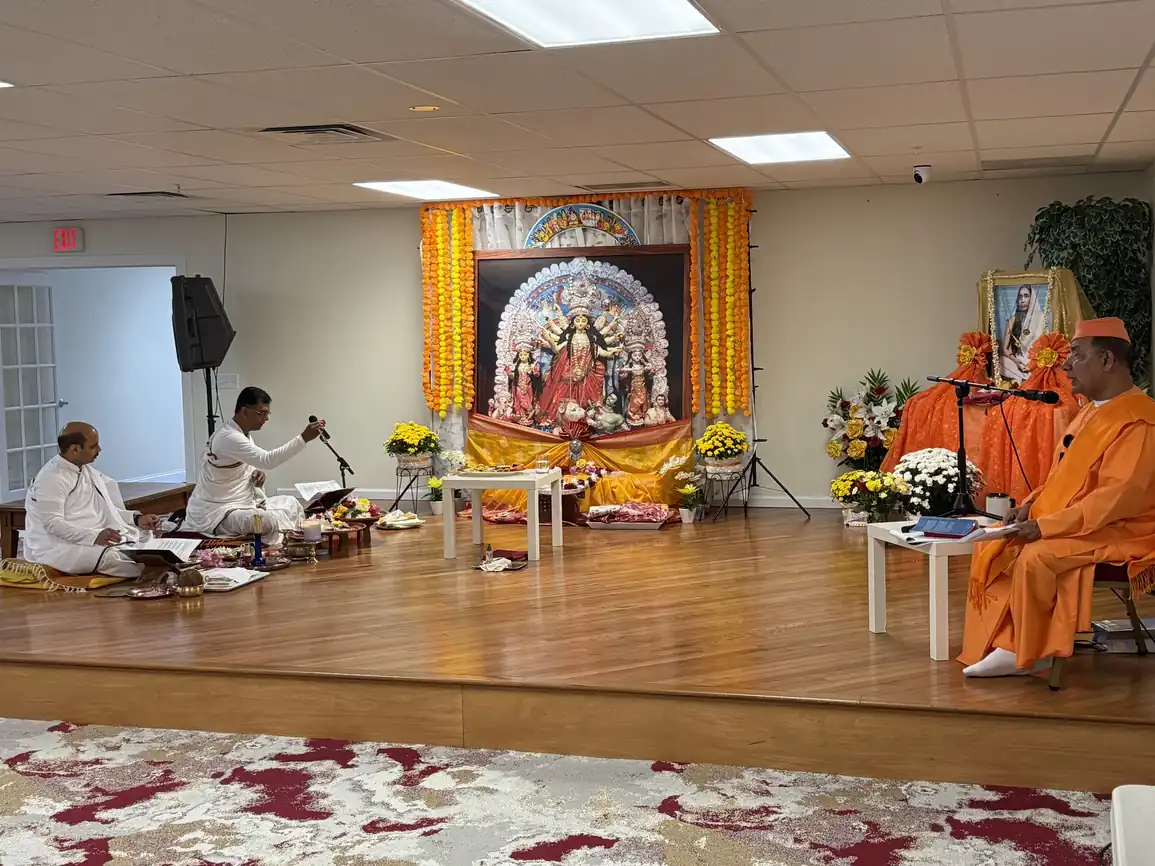
That experience is the centre of the Ramakrishna tradition, and it is easily misunderstood from outside. To a modern reader, devotion to Kali can look like the most particular, even the most formidable, corner of Hindu practice: a dark goddess, a garland of heads, a sword, a tongue outstretched, one foot upon the still body of Shiva. Nothing could seem further from the serene abstractions of Vedanta, with its formless Brahman and its quiet logic of the Self. Ramakrishna’s life closes that apparent distance. The tradition records that the same man who worshipped Kali with tears also realised the formless Absolute, practised the disciplines of several faiths, and taught, from the far side of those experiences, that the Mother and Brahman are one Reality known in two ways. The devotion was not a preliminary to be outgrown. It was, in his account, a door that opened onto everything.
This week the devotion has a public face. Across Bengal and the Bengali diaspora, preparations for Kali Puja are in their final days: artisans are finishing the images, temples are publishing their midnight timings, and households are preparing for the night of the new moon, when Kali is worshipped while much of India lights its lamps for Lakshmi. The festival falls on Sunday, 8 November this year, and it offers the natural doorway into this article. But the teaching remains the house. What follows moves from the festival preparations to Dakshineswar itself: to the temple garden and the young priest, to the longing that his contemporaries mistook for madness, to the theology by which Kali is Brahman in motion, to his defence of the clay image and his parable of the chameleon, and finally to the practices his devotion leaves for householders — yearning over ceremony, vigilance against lust and gold, and a mind kept, in the greater part, upon God.
A word about sources, because devotion deserves accuracy as much as reverence. The record of Ramakrishna’s Dakshineswar years rests chiefly on two works of his own tradition: The Gospel of Sri Ramakrishna, Mahendranath Gupta’s diary of the Master’s conversations in his final years, and Sri Ramakrishna, the Great Master, Swami Saradananda’s biography, which gathers the testimony of those who knew the Dakshineswar period at first hand. Where this article reports an episode, it follows those records; where the records themselves present a matter as the testimony of devotees, the article says so. The Mother whom Ramakrishna loved does not need exaggeration. The plain record is already extraordinary.
1. Final Touches in Kumartuli: Kolkata Prepares for the Mother’s Night
On 4 November 2026, Indulge Express reported that the artisans of Kumartuli, Kolkata’s historic potters’ quarter, were busy giving the final touches to the Goddess Kali idols ahead of Kali Puja. The report, by Bristi Dey, updated on the source page on 4 November 2026, notes that only a handful of days remain before the Goddess arrives in the city. The source is the Indulge Express report of 4 November 2026.
Kumartuli is not a factory floor in the ordinary sense. Its workshops line the lanes near the river from which the clay itself is taken, and the making of an image there is a craft handed down through generations of artisan families: a bamboo and straw armature, coats of river clay, drying in the weak autumn sun, and at last the painting of the face and the opening of the eyes. The final touches of which the report speaks are therefore not cosmetic. In the understanding of the devotees who will receive these images, the artisan’s last work prepares a seat. The Goddess is not manufactured in Kumartuli. She is invited there, and the care taken over her arrival is itself a form of worship, performed with hands long before it is performed with flowers.
The festival toward which all this labour moves is Kali Puja, also called Shyama Puja, celebrated on the new-moon night of Kartik Amavasya. This year it coincides with Diwali: Kali Puja falls on Sunday, 8 November 2026, with the Amavasya tithi running from the late morning of 8 November to the midday of 9 November, and the Nishita Kaal, the midnight period in which the principal worship is offered, falling late on the night of the 8th. At Kalighat, among the most revered of Kali’s temples, the temple remains open through the night for the midnight worship, and guides published for devotees this week set out the darshan arrangements for the crowds the night will bring. In Bengal the sequence has its own tenderness: the evening before, Bhoot Chaturdashi, households light fourteen lamps for the fourteen generations of ancestors, and then the city turns its face toward the Mother’s night.
For the wider diaspora the same countdown is under way in quieter registers: a temple hall being decorated, a priest confirming the hour of the midnight puja, a family deciding what to offer and whom to invite. What unites the artisan in Kumartuli, the priest at Kalighat and the householder abroad is not spectacle. It is a shared conviction that the Divine can be approached as Mother — not as an abstraction to be defined but as a presence to be received, prepared for and welcomed home. Preparation, in this tradition, is devotion in its working clothes.
It is exactly here that Sri Ramakrishna becomes the festival’s most searching interpreter. No one in the modern history of this devotion prepared for the Mother as he did. He did not commission an image; he served one, daily, as its priest. He did not wait for a festival night; he turned ordinary days in a temple garden into a vigil that lasted years. And he left behind, in the Gospel’s record, an account of what such preparation does to a human being: how longing ripens, how the fearsome form of Kali resolves into tenderness, how the Mother of the universe becomes, for the child who will not let go of her, the most intimate presence in the world. The artisans are giving the idols their final touches this week. Ramakrishna’s question, put to every devotee who receives one, is what final touches the devotee is prepared to undergo in return.
2. Dakshineswar: A Temple Garden on the Ganga
To understand Sri Ramakrishna, one must first stand, at least in imagination, in the garden where his devotion took visible form. Dakshineswar is not an abstract setting. It is a real place on the eastern bank of the Ganga, a few miles north of Calcutta, where river, trees, shrines and daily worship shaped the outward life of a saint whose inward life was turned wholly toward the Divine Mother.
The Gospel of Sri Ramakrishna returns again and again to this garden. The Master spoke to his devotees in his small room there. He walked under its trees. He worshipped in its main temple. He wept, prayed, sang and waited there through the long years of his intense spiritual practice. The place and the person cannot be separated without losing something essential in both.
The temple was founded by Rani Rashmoni. She was a wealthy widow who managed a large estate, a woman remembered for practical ability, courage and deep piety. Though she came from a humble background by birth, she came to hold great responsibility, and she used her resources on a scale that matched that responsibility. Her devotion to Mother Kali was central to her life, and the building of a temple to the Mother became one of its defining acts.
The tradition records that the Rani had intended to travel on pilgrimage to Kashi. On the eve of that journey, it is said, the Mother appeared to her in a dream and directed her instead to build a temple on the bank of the Ganga and to establish worship there. Whether one receives that account as history, as sacred memory or as the way Bengali devotion has always told the founding of a holy place, its meaning is clear. Dakshineswar was not built as a monument to wealth. It was built, in the understanding of those who cherish it, at the bidding of the Mother herself.
The land was purchased and the work proceeded over several years. The temple was consecrated in 1855, in a great festival that drew priests, scholars and devotees from far around. The date matters. When Gadadhar Chattopadhyay, the young man who would become known to the world as Sri Ramakrishna, first came to Dakshineswar, the temple was new. Its rituals were still settling into rhythm. Its garden was still growing into maturity. He did not inherit an ancient and forgotten shrine. He entered a living, newly awakened place of worship, full of activity, expectation and sacred purpose.
The presiding deity of the main temple is Kali, worshipped there under the name Bhavatarini, the Mother who carries her children across the ocean of worldly existence. That name is itself a teaching. Kali at Dakshineswar is not presented first as a figure of terror. She is presented as the one who saves, who ferries the soul across fear, ignorance and bondage to freedom. For Sri Ramakrishna that saving presence would become intimate beyond all ordinary language. She would be Mother before she would be doctrine.
The main temple rises in the Bengali navaratna style, with nine spires, set upon a high platform approached by a broad flight of steps. Before it lies a spacious courtyard, paved and open, where devotees gather and where the daily life of the temple unfolds. The image of the Mother stands within the sanctum upon the recumbent form of Shiva, radiant with ornaments, garlands and the solemn beauty that Bengali temple worship gives to the Divine Mother. To a visitor she is an image of black stone, richly adorned. To Sri Ramakrishna she would become, by his own repeated testimony in later years, a living presence who could be seen, heard, fed, pleaded with and loved.
Dakshineswar is, however, much more than a single temple. It is a temple garden, a small sacred world complete in itself. Along the river front stand twelve smaller temples dedicated to Shiva, arranged in a row and facing the Ganga. There is also a temple dedicated to Radhakanta, that is, Krishna as the beloved of Radha. There are bathing ghats descending to the river, quarters for temple staff, kitchens, store rooms and the buildings needed to sustain worship day after day, season after season.
This completeness mattered for what followed. In one enclosed garden Sri Ramakrishna would later find the paths of many traditions represented. He worshipped Kali in the main shrine. He meditated near the Shiva temples. He practised Vaishnava devotion with the presence of Radhakanta close at hand. The garden gave bodily form to the catholicity that would later astonish his visitors. Long before he spoke of the harmony of religions as a realised truth, he lived in a place where different names and forms of the Divine dwelt side by side in peace.
Two parts of the garden would become especially sacred through his practice. The first is the Panchavati, a grove of five trees planted and tended as a place for meditation. The five trees traditionally named for such a grove are the banyan, the bel, the amalaki, the ashoka and the peepul. Under their shade Sri Ramakrishna spent long hours in prayer and contemplation, particularly in the earlier years of his sadhana. The Gospel records many later conversations held in or near that grove, and disciples remembered it as a place where the very air seemed charged by the intensity of his longing.
The second is his own small room at the north western corner of the temple precincts, overlooking the garden and near to the Panchavati. In later years that room became the meeting place of the Dakshineswar years. There the Master received householder devotees and young seekers alike. There he sang, told stories, answered questions, laughed, wept and spoke of God with an immediacy that transformed ordinary conversation into scripture. The room was modest in size and furnishing. Its greatness lay entirely in who lived there and in what was realised there.
The river completes the picture. The Ganga at Dakshineswar is broad, slow and luminous, changing with the hours of the day. Sri Ramakrishna loved the river deeply. The sight of its waters, the boats passing, the sound of evening worship and the vast sky above the far bank all enter into the recollections of his life there. For a devotee of the Mother, the river too could speak. Its ceaseless flow toward the sea became, in his teaching illustrations, an image of the soul moving toward God, and of a life that finds rest only when it reaches the infinite.
The daily round of the temple in those years was ordered and demanding. There was worship in the morning, offerings at noon, rest for the deity in the afternoon and evening arati with lights, music and song. Priests, cooks, gardeners, treasurers and servants each had their appointed duties. The estate of the Rani, and after her death the care of her son in law Mathur Babu, sustained the establishment. This orderly outward frame is important to remember, because within it an inward fire was about to burn with an intensity that no routine could contain.
Sri Ramakrishna did not create Dakshineswar. He received it. An older world of Bengali devotion, temple craft, river pilgrimage and Mother worship prepared the stage. Yet by the time his life there had run its course, the relationship had reversed. Today the world knows Dakshineswar chiefly because he lived and worshipped there. Pilgrims come not only to see a fine nineteenth century temple complex, though it is that, but to stand where a child of the Mother wept for her vision and found her. The garden remains beautiful. Its sanctity, for devotees, lies in the love that was poured out within it.
There is a quiet lesson in this beginning. Great spiritual lives rarely unfold in a vacuum. They need a place, a practice, a daily discipline and a form of the Divine to love. For Sri Ramakrishna, Dakshineswar supplied all of these. The temple gave him the Mother in a concrete form upon an altar. The garden gave him solitude within community. The river gave him vastness at his doorstep. The routine of worship gave his longing a channel, until the longing overflowed every channel and carried him, and eventually all who heard of him, far beyond what the founders could have imagined.
3. The Young Priest Who Wept for the Mother
The young man who came to Dakshineswar was named Gadadhar Chattopadhyay. He was born in the village of Kamarpukur, in the Hooghly district of Bengal, to a poor but deeply religious Brahmin family. His father, Khudiram Chattopadhyay, and his mother, Chandramani Devi, were both remembered for honesty, devotion and simplicity. From childhood Gadadhar showed a temperament unlike that of other boys. He was joyful, quick, artistic and intensely sensitive to sacred things.
Sri Ramakrishna the Great Master, the detailed life composed by Swami Saradananda from the testimony of those who knew the Master, records many incidents of his boyhood that point in one direction. The child was moved to ecstasy by the sight of natural beauty. He lost outward awareness while watching cranes against dark monsoon clouds. He delighted in the village festivals, in the singing of sacred narratives, in modelling images of the gods and in acting the parts of deities in village plays. Formal schooling, by contrast, held little attraction for him once it became merely a means to earning a livelihood. His heart was already set on a different kind of learning.
He came to Calcutta as a young man in the company of his elder brother, Ramkumar Chattopadhyay. Ramkumar was learned in Sanskrit and in the ritual texts, and he supported himself by teaching and by priestly work. Gadadhar assisted him, lived simply and worshipped the family deity with great care. Those who observed him in this period noticed both his purity and his unusual absorption in worship. Even ordinary priestly duties, in his hands, became acts of concentrated love.
When Rani Rashmoni completed her temple at Dakshineswar, Ramkumar was invited to take up the priestly office in the newly consecrated shrine, and he accepted. Gadadhar accompanied him to the temple garden. At first his own role was modest. He assisted, he observed, he worshipped, and for a time he was associated with the worship in the Radhakanta temple. The great turning of his life, however, came when the charge of worshipping Mother Kali passed into his own hands.
Ramkumar, worn by age and by the strain of his duties, withdrew from the office, and his health declined. The tradition records that Gadadhar was at first hesitant to assume formal priestly responsibility, for his mind was already moving in ways that made ritual office seem a small thing beside direct vision of the Mother. Persuaded by his brother and by the temple authorities, he nevertheless accepted the worship of Kali. Ramkumar died in 1856, and the young priest was left alone before the Mother, with grief in his heart and a longing that soon became the central fact of his existence.
It is difficult, at this distance, to convey the nature of that longing without either diminishing it or making it sound like a literary embellishment. The sources are consistent, and they are emphatic. Sri Ramakrishna the Great Master describes a period in which the young priest performed the daily worship with meticulous care and then, when the formal rites were done, remained before the image pleading for a living vision of the Mother. He wanted to know whether the Mother whom the scriptures praised and whom devotees worshipped was real, and whether she could be seen and known as tangibly as the world of the senses is seen and known.
He wept. That simple word recurs in the accounts, and it should not be passed over quickly. His weeping was not sentimentality and it was not display, for much of it happened when he was alone. It was the weeping of a child separated from its mother, intensified to a pitch that ordinary life rarely reaches. The day would end and the thought would seize him that another day had passed without the vision for which he lived. At such moments, the Great Master records, his anguish became almost unbearable. He would rub his face against the ground. He would cry aloud in the Panchavati where no casual visitor would disturb him. Sleep left him. Food lost its savour. The world of ordinary interests receded until only one question remained alive in him.
This is the first great fact of Sri Ramakrishna the devotee, and it precedes Sri Ramakrishna the teacher by many years. Before he instructed others, he longed. Before he reconciled paths, he wept for one face. His later universality was not built on indifference to form. It was built on a devotion so complete toward one form that it broke through the limits of form altogether. Students of his life who skip the weeping priest in order to reach the wise teacher miss the foundation upon which the whole building stands.
His worship in this period also changed in character. Outwardly he still offered flowers, sandal paste, food and light according to the prescribed rites. Inwardly, every act became personal. He was not performing a ceremony before a symbol. He was serving a Mother whom he believed to be present, conscious and able to respond. He would place the offering before her and watch, in the spirit of the accounts, to see whether she would accept it. He would sing the devotional songs of Bengal, the songs of Ramprasad and Kamalakanta and other lovers of Kali, and as he sang the words ceased to be poetry and became his own biography.
The songs matter here. Bengal possessed a rich treasury of Shakta devotional song in which the Mother is addressed with astonishing intimacy, now praised, now reproached, now implored, always loved. Sri Ramakrishna absorbed that treasury until it became the natural language of his heart. In later life he would still ask devotees to sing those songs, and a single line could send him into deep absorption. In the early Dakshineswar years they were his companions in solitude, giving voice to a longing that his own words could not exhaust.
As the intensity grew, his behaviour began to depart from what temple routine expected. He might spend far longer than the allotted time in worship. He might offer to the Mother a flower he had first touched to his own head or heart, a breach of ritual propriety that scandalised observers who did not understand its meaning. In his own later explanation, paraphrased in the recollections of his disciples, the act expressed identity of feeling rather than carelessness. He no longer experienced himself as a distant servant performing correct motions. He experienced himself as a child whose whole being already belonged to the Mother, so that what touched him and what was offered to her could no longer be kept in separate compartments.
He also began to pass into states of deep absorption during worship and prayer. His body would grow still. His awareness of the surroundings would fade. Hours could pass in what looked to others like unconsciousness and felt to him, on returning, like an inundation of bliss and light. The temple staff and his relatives were understandably alarmed. Nothing in their experience provided a ready category for a young priest who neglected food, wept through the night, spoke to the image as to a living person and lost awareness of the world in prayer.
Yet even in this period there was no disorder in his devotion itself. Those who watched closely noticed a pattern. His absorption was always turned toward the Mother. His speech, when he spoke of his state, was always of her. His one sorrow was separation from her, and his one joy was any sign of her nearness. This singleness is what distinguishes, in the traditional understanding, divine longing from mere emotional disturbance. The current of his life was not scattering. It was narrowing, deepening and accelerating toward a single sea.
The young priest also practised disciplines of renunciation in a natural, unstudied way. Money meant nothing to him. He could not bear the touch of gold and silver when his mind was absorbed, a sensitivity that the Gospel illustrates in later anecdotes. Fine food, comfort and reputation fell away without struggle, not because he had adopted a theory against them but because a greater love had displaced them. At Dakshineswar he owned almost nothing. His wealth was the Mother, and by that standard he considered himself, even in his anguish, a child of the richest house in the world.
For the reader approaching this life for the first time, it may help to set aside, for a moment, every later category of saint, teacher and prophet, and simply to picture the scene the sources present. A temple garden by a great river. A young priest of no learning by worldly measure, no wealth and no ambition. An image of the black Mother in a quiet sanctum. And a heart that will not be comforted by doctrine, by ritual correctness or by the praise of others, but only by the living vision of the Mother herself. That picture is the seed of Dakshineswar. Everything that Sri Ramakrishna later gave to the world grew from the tears that watered it.
4. Vision, Madness and the Testing of a Saint
The tradition records that the longing of the young priest did not remain unanswered. In the accounts preserved in Sri Ramakrishna the Great Master and retold throughout the Gospel of Sri Ramakrishna, the first great vision came at the very point where his anguish had become impossible to bear. He had begun to wonder whether his life itself was worth continuing if the Mother would not reveal herself. In that extremity, his attention was seized by the sword that rests in the hand of the Mother in her image, and the impulse rose in him to end his suffering with it.
What followed is told, in the tradition, not as a private fantasy but as the decisive breakthrough of his life. At the moment of that desperate resolve, the Mother revealed herself. The temple, the image, the buildings and the surrounding world were, in his later paraphrase as remembered by disciples, swept away into a boundless ocean of light, consciousness and bliss. Waves of that shining ocean rose on every side. He lost awareness of the ordinary world and fell unconscious. When outward awareness returned, his lips were forming the name of the Mother, and his whole being knew, with a certainty that never afterwards left him, that she was real and that she had heard him.
Care is needed in handling such an account. The sources do not present the first vision as an argument to be proved to a sceptic in a laboratory. They present it as testimony, given repeatedly over a lifetime by a man whose subsequent character, knowledge and influence his hearers could observe for themselves. The Gospel records him speaking of his visions not with pride and not for effect, but with the simplicity of a person describing what he had seen with his own eyes. Devotees may receive the testimony in faith. Historians may describe it as the tradition records it. What neither should do is to reduce it, without remainder, either to a trick of language or to a clinical episode, for in the life as lived it functioned as neither. It functioned as a door. Through it the weeping priest passed from belief toward knowledge, and his sadhana entered a new and even more extraordinary phase.
For the vision did not end his practice. In one sense it began it in earnest. Having seen the Mother once, he longed to live in her presence continually. The Great Master describes successive years in which he passed through the disciplines of many paths, often with the help of teachers who came to Dakshineswar as if drawn there, and in which vision followed vision. But the Kali sadhana remained the root. The Mother who had revealed herself as an ocean of light continued to guide him, in his own understanding, at every step, approving, correcting, restraining and encouraging as a living mother guides a child.
To many around him, however, the outward signs of this inward life looked like madness. The word was used freely at Dakshineswar and at Kamarpukur, and the concern behind it was not unkind. His mother, Chandramani Devi, feared for her son. His relatives feared that his mind had given way under the strain of grief for his brother, of celibate temple life and of excessive religious excitement. Temple officials feared for the reputation of a new institution whose priest behaved in ways no rule book sanctioned.
The signs that alarmed them are understandable. He neglected food and sleep for long stretches. He wept and laughed without apparent cause that observers could share. He spoke aloud to the Mother in the sanctum and in the garden as one speaks to a person standing near. He sometimes lost awareness of his clothing and surroundings in absorption. At meals he might act in ways that broke convention. Periods of burning sensation in the body, of sleeplessness and of intense restlessness are also described in the Great Master as accompanying his early sadhana. Set in a row without their context, such a list can be made to resemble an illness. Set back into their context, the traditional account insists, they trace a single line. Every symptom, so to speak, pointed toward God.
Mathur Babu, the son in law of Rani Rashmoni and the effective manager of the temple estate, occupies a crucial place in this part of the story. Mathur was a man of the world, shrewd, capable and devoted in his own way. He watched the young priest closely over a long period, and his judgement gradually reversed the common verdict. Where others saw only derangement, Mathur came to see a divine inebriation that deserved protection rather than punishment. The tradition preserves his growing conviction that the priest of Dakshineswar was no ordinary man and that the Mother herself had taken possession of his life. Mathur arranged for his care, shielded him from interference and, in time, became one of his most devoted attendants and supporters. In the economy of this life, such a protector was essential. Genius in sanctity, no less than genius in art, often survives because one practical person refuses to let the world crush it before its time.
The testing, nevertheless, was real, and it came from more than one direction. Medical men were consulted, as was natural for a family in distress. The Gospel and the Great Master both preserve recollections of physicians examining the Master in his unusual states, in this early period and later, and finding no ordinary remedy for a condition that did not behave like ordinary disease. His absorption deepened under the sacred sound and vanished when it pleased the Mother, not when a prescription demanded it. Food, rest and diversion, the usual prescriptions, helped the body only when his mind allowed them to help. The examiners, in the traditional telling, were left respectful and perplexed.
A different and more searching test came from scholars of religion. At Dakshineswar he was observed by learned men who knew the scriptures and the recognised marks of genuine spiritual attainment. Two names stand out in the traditional account. Vaishnavacharan, a respected authority on devotional practice, examined his states and declared, in paraphrase, that the symptoms displayed corresponded to the mahabhava described in the Vaishnava texts, the supreme ecstatic love of which Radha herself is the exemplar, and that such a state appears in the world only in an incarnation of divine love. Gauri Pandit, a scholar and worshipper of the Mother in her Tantric aspect, likewise came, observed and recognised in the young priest a depth of realisation that compelled his reverence. These judgements mattered. They told the temple world that the strange priest was not merely ill but was treading, however unconventionally, ground that its own sacred literature had mapped.
His family tried the remedy their world most trusted. They brought him home to Kamarpukur and arranged his marriage, hoping that household life would anchor his mind in ordinary responsibilities. In 1859 he was married to Saradamani Mukhopadhyay of the village of Jayrambati, a child of five years at the time, who would in time become known to the world as Sri Sarada Devi, the Holy Mother. The marriage, as both lives later made plain, was never a conventional household bond. It became, instead, one of the most remarkable spiritual partnerships in modern religious history. For the present chapter, its significance is simpler. The supposed cure did not cure him, because there was, in the traditional understanding, nothing to cure. When he returned to Dakshineswar, his longing resumed its course with undiminished force, and those around him gradually learned to build their arrangements around his states rather than against them.
Time itself became the most convincing examiner. Madness, as the world ordinarily knows it, disintegrates a personality. It scatters thought, corrupts character and ends in diminishment. The Dakshineswar years showed the opposite movement. As the ecstatic states continued, his insight deepened, his purity became more luminous, his compassion widened and his command of spiritual truth grew until scholars, householders and eventually seekers from across India and beyond came to sit at his feet. He remembered everything. He judged men and motives with unnerving accuracy. He could leave absorption and, moments later, advise a visitor on a domestic difficulty with perfect practical sense. The Gospel, which shows him in his maturity, is in this respect the strongest evidence the tradition offers. No reader can spend long in its pages and mistake its central figure for a disordered mind. The wit is too quick, the observation too fine, the teaching too coherent and the love too steady.
The tradition therefore gives his condition another name. It calls it divine madness, the madness of one who has seen what others have not seen and can no longer pretend that the world of the senses is the whole of reality. In later years Sri Ramakrishna himself, as the Gospel paraphrases his teaching, would distinguish between the madness that binds and the madness that frees, and would place his own absorption unambiguously in the second class. The distinction is not a evasion of scrutiny. It is the fruit of scrutiny, conducted over decades by family, physicians, scholars, patrons and disciples who began, many of them, as sceptics or as anxious well wishers.
For a modern reader, the most honest approach may be to hold two truths together. First, his contemporaries were not foolish to be alarmed, for his behaviour genuinely broke the boundaries within which religious life is usually contained. Second, the alarm was answered, not dismissed, and the answer came from the whole shape of the life that followed. Vision at Dakshineswar survived its testing. What emerged from the fire of those years was not a broken priest but a saint whose sanity, of a higher order, would become a refuge for thousands.
5. The Mother Who Answers: Kali as Living Presence
The heart of Sri Ramakrishna and Mother Kali is not, in the end, a doctrine about Kali. It is a relationship. At Dakshineswar the Mother ceased, for her priest, to be an object of belief and became a presence to be lived with, hour by hour, in joy and in anguish, in worship and in the most ordinary acts of the day. The Gospel of Sri Ramakrishna is filled with the overflow of that relationship. Again and again, in its recorded conversations, the Master speaks of the Mother as a person who knows, wills, withholds, grants, plays and teaches. Devotees who heard him did not feel that they were listening to theology. They felt that they were listening to a son describing his mother.
This is what sets his Kali devotion apart from a merely symbolic reading of the goddess. A symbol points toward a truth beyond itself and can, once the truth is grasped, be set aside. Sri Ramakrishna never set the Mother aside. Even after he had realised, through Vedantic discipline, the formless Absolute beyond all name and form, he continued to cherish the personal Mother with undiminished love, and he taught, in the paraphrase of his disciples, that both were realities of the one Divine, as water and ice are one substance in different states. Kali for him was not a useful fiction for the unphilosophical. She was the Divine taking the face a child can love, without ceasing to be the infinite that no face can contain.
The tradition records the intimacy of that relationship in details that are at once homely and astonishing. He would take food that had been prepared as an offering and, before placing it in worship, hold it toward the Mother in the spirit of a child insisting that his mother eat first. He would converse with her in the sanctum, asking questions and pausing, by his own account, for her reply. He would sing to her in the evening and grow absorbed in the singing until the temple servants knew not to disturb him. He would reproach her, in the manner of the Bengali devotional songs he loved, when a prayer seemed unanswered or when a devotee suffered, and then, in the next breath, surrender the complaint entirely into her will. None of this was performed for an audience. Much of it preceded any audience. It was simply his life.
Particularly moving, in the Great Master, is the picture of the Mother guiding his sadhana as a teacher guides a pupil. When a new path was to be practised, a teacher arrived. When a realisation ripened, an inner assurance confirmed it. When his body suffered under the strain of continuous absorption, food, attendants and rest appeared through the care of Mathur Babu and others at the moment of need. Sri Ramakrishna in later years attributed this entire choreography to the Mother. She, he maintained in paraphrase, had done everything. He had only held her hand and gone where she led, like a child, like a kitten carried by its mother, making no plan of his own. The image of the kitten, which the Gospel preserves among his favourite illustrations, expresses his Kali bhakti exactly. The monkey child clings to its mother by its own strength. The kitten is carried. His way with Kali was the way of the kitten, a total reliance that looks like passivity and proves, in its results, to be strength of the most enduring kind.
Because the Mother was living to him, prayer for him was living too. He did not commend prayer to his visitors as a respectable custom. He urged it as the means by which a real person is met. The Gospel records his repeated insistence, here paraphrased, that God can indeed be seen and spoken to as tangibly as one person sees and speaks to another, but that few long for that vision with the restlessness he had known at Dakshineswar. The remedy he prescribed was therefore never a new argument. It was a deeper longing. Cry to the Mother, he would tell a sincere seeker, with a heart that cannot be put off, and she who turned toward a weeping priest in a temple garden will turn toward you. The authority behind that counsel was not borrowed from books. It was the authority of a answered life.
His devotion also transfigured the image itself for all who came after him. Pilgrims at Dakshineswar today do not look at the Mother of the main shrine with neutral eyes. They look at her through his love. They remember that he saw her breathe, that he saw light stream from her form, that he fed her and was fed by her grace in return. Whether a given pilgrim understands those accounts literally, devotionally or as the sacred memory of the tradition, the effect on the act of worship is the same. The sanctum is approached as a place where heaven once stooped very low, and may stoop again. The black image, terrible to some eyes with her garland and her sword, becomes to the devotee the face of the Mother who answers.
That answering presence also explains the fearlessness that marked his later life. A man who lives with a mother he trusts does not face the world alone. Sri Ramakrishna feared no scholar, courted no patron and trimmed no truth to please a visitor, because his security did not rest on any of them. He could receive the famous and the obscure with the same simplicity. He could praise and he could correct without anxiety. He could face illness, misunderstanding and eventually the long final sickness of his life with the surrender of a child who believes that the Mother knows what she is doing even when the child does not understand it. The Gospel shows this fearlessness on page after page, so natural that readers can miss its source. Its source is Dakshineswar. Its source is Kali, known not at a distance but at hand.
There is, finally, a universal invitation hidden in this intensely personal story, and Sri Ramakrishna himself drew it out for his devotees. The Mother who answered him, he taught in paraphrase, is not the private possession of one priest, one temple or one tradition. She is the Divine Mother of all, nearer to every soul than its own fears, waiting only for the cry that is sincere enough to be heard because it comes from the whole heart. His life is offered by the tradition as the proof of that claim. A village boy with no advantages asked, with his whole being, whether God as Mother is real. The answer filled a temple garden, overflowed into a movement that carried Vedanta across the world through his disciples, and still draws pilgrims to a shrine on the Ganga where a young priest once wept through the night.
To read that story well is to be brought back, at the end, to its simple centre. Before the harmony of religions, before the Gospel, before the Order that bears his name, there was a child before his Mother, weeping because he could not see her, and then living because he had. Sri Ramakrishna and Mother Kali belong together in the memory of the world because, at Dakshineswar, devotion of that purity found its answer. The Mother who was worshipped there in stone was experienced there as love itself, conscious, responsive and near. That experience is the article of his faith that he never argued and never abandoned. It is also, for devotees of The Vedanta Times who return to Dakshineswar in heart whenever his name is spoken, the reason his story still moves the heart long after its details are learned. The child called. The Mother answered. Everything else is commentary on that exchange.
That exchange also reshaped how his devotees learned to worship. Men and women who came to Dakshineswar for a teaching often left with something more searching, namely the uneasy and blessed realisation that their own devotion had been formal where his had been desperate, and distant where his had been near. He never shamed them for that difference. He simply pointed, again and again, to the remedy that had availed him. Longing, he showed them by his life, is not an ornament of the spiritual path. It is the path, until the Mother herself takes the seeker by the hand.
In the evenings at Dakshineswar, when the lamps had been lit and the river had darkened, that lesson could be felt as much as heard. The temple belonged to the Mother. The garden belonged to the Mother. The small room where the devotees gathered belonged to the Mother. Nothing was his, and therefore everything was charged with her presence. A visitor who understood even a fraction of that atmosphere understood why the Gospel speaks of Dakshineswar with a tenderness usually reserved for a person rather than a place.
For later generations the practical legacy is equally clear. Temples, images and inherited rites are not, in his example, obstacles to a living faith. They are its appointed doors, provided the heart that approaches them refuses to stop at the surface. The stone image did not limit him, because he would not let it remain stone. The daily rite did not bind him, because he filled it with a love that carried it beyond correctness into communion. The garden did not distract him, because every tree and every stretch of river became a reminder of the one presence he sought.
It is in this sense that Dakshineswar remains a school and not merely a shrine. It teaches the devotee to bring the whole heart. It teaches the scholar that knowledge of God, in the Vedantic tradition he embodied, is not exhausted by argument, however refined. It teaches the suffering, who have always formed so large a part of his audience, that anguish itself, offered without reserve to the Mother, can become the very means by which she is found. The young priest who wept in that garden did not weep in vain, and the tradition invites every reader to dare to believe that no sincere tears shed for God are ever shed in vain.
6. Brahman and Shakti: Why the Mother Is Not a Symbol
To come near Sri Ramakrishna, a seeker must sooner or later face the question that lay at the centre of his life at Dakshineswar. How could a man who spoke so often of the formless Absolute, of the Reality beyond name and attribute, spend his days before an image of Mother Kali, offering flowers, singing to Her, pleading with Her, and weeping for a vision of Her? Was the Mother for him a symbol, a helpful picture for a mind not yet ready for abstraction? His own teaching, as it is preserved in the Gospel of Sri Ramakrishna, answers with a clarity that leaves little room for that easy explanation.
Again and again in the Gospel, Sri Ramakrishna identifies the two in substance. What the scriptures describe as Brahman, the changeless ground of all being, is the very Reality he addresses as Kali, the Divine Mother. The identification is not presented as poetry laid over philosophy, nor as a concession to popular devotion. It is presented as a report from direct realization. When the mind rests in perfect stillness, beyond activity and beyond speech, that Reality is realized as Brahman. When the same Reality is apprehended as creating, preserving, and drawing all things back into itself, it is realized as Shakti, as Power, as Mother.
The distinction, therefore, is not between two gods, nor between truth and imagination. It is a distinction between two modes in which one Reality is experienced. Brahman does not cease to be Brahman when it moves, and Shakti is not a second, lesser being standing outside Brahman and acting on its behalf. To separate them in that way, Sri Ramakrishna taught, is to misunderstand both. They are inseparable, as inseparable as fire and its power to burn.
That image of fire, which belongs to the world of his parables and illustrations in the Gospel, repays slow attention. No one can speak of fire without its burning power, and no one can isolate the burning power and set it up as a thing apart from fire. Take away the power, and what remains is not fire. Keep the power in view, and fire is present in it. In the same way, Sri Ramakrishna taught, Brahman without Shakti is an abstraction the mind constructs by leaving something out, and Shakti without Brahman is energy imagined without its ground. Realization, as distinct from speculation, does not leave anything out.
He used other homely comparisons to make the same point accessible to visitors who came to his small room at Dakshineswar with very different training. Milk and its whiteness cannot be divided. To think of milk is to think of whiteness, and whiteness in this case has no separate existence apart from milk. A serpent coiled and at rest and a serpent gliding in movement are not two serpents; the stillness and the movement belong to one creature apprehended in different states. Water at rest and water in waves are not two substances. The wave is water in motion, and still water is the same water when motion subsides. Each illustration is deliberately ordinary. Sri Ramakrishna wanted the truth to be seen in the kitchen and by the river, not only in a Sanskrit commentary.
Behind these illustrations stands a serious philosophical claim, and it is important not to soften it. Sri Ramakrishna is not saying that the personal Mother is a useful fiction for beginners until they can graduate to the impersonal Absolute. He is saying that the Absolute itself, fully realized, reveals itself as both stillness and power, both silence and the living Mother who hears prayer. The movement does not compromise the stillness. The compassion does not compromise transcendence. If our idea of transcendence requires God to be inert, inactive, and deaf to devotion, then it is our idea that must be corrected by realization, not realization that must be trimmed to fit our idea.
This is why the Mother, for Sri Ramakrishna, is not a symbol in the modern, reduced sense of that word. A symbol, as the word is often used today, points to something else while possessing no reality of its own. A road sign points to a city, but the sign is not the city, and once the traveller arrives the sign can be left behind without loss. Sri Ramakrishna did not relate to Kali in that way, and he did not teach his disciples to do so. The Mother is not a signboard on the way to Brahman. The Mother is Brahman, approached in the mode in which Brahman can be loved, addressed, obeyed, and surrendered to.
The difference matters for practice. A symbol can be contemplated, analysed, and appreciated, but it cannot be loved with the whole heart in the way a child loves its mother. It cannot be pleaded with through a sleepless night. It cannot be obeyed when its will runs against our preference, and it cannot console. Sri Ramakrishna did all of these things, openly and without embarrassment, and the Gospel records a devotion that is not embarrassed by its own intensity. He spoke to the Mother as the closest of kin, complained to Her, asked Her for pure devotion, and placed before Her the very people who came to him for guidance. A theory does not receive such treatment. A living Presence does.
At the same time, he never allowed devotion to the Mother to become a denial of the formless. Visitors who were inclined to dismiss all form as ignorance found no ally in him, but neither did visitors who wanted to dismiss the formless as cold philosophy. He had realized God in both aspects, and he spoke from that fullness. In the Gospel, his conversations move without strain between the language of the Mother and the language of the Absolute, sometimes within a single exchange. The ease of that movement is itself instructive. For a mind still bound by categories, form and formlessness look like rivals competing for the same space. For Sri Ramakrishna, they had ceased to compete, because he had seen that the space belonged to one Reality.
There is a further point that gives his teaching its pastoral power. Many seekers secretly fear that if they give themselves wholly to a personal God, they will be kept forever from the highest truth, and many others fear that if they pursue the formless Absolute, they will lose the warmth of devotion and be left with a desert of abstraction. Sri Ramakrishna answers both fears at once. Give yourself to the Mother without reserve, he teaches in substance, and she herself will lead you to the realization that she and Brahman are one. Seek Brahman sincerely, and you will not find a reality that excludes the Mother; you will find the still depth of the very same Being whose power moves the world and whose love draws the devotee.
The word Shakti itself deserves attention here. In the tradition Sri Ramakrishna inhabited, Shakti means power, energy, and capacity — not power as domination, but power as the ability to bring forth, to sustain, and to transform. The universe, in this vision, is not a machine wound up by a distant maker and left to run alone. It is at every moment the expression of a living Power that is not other than the highest Reality. Creation is not an event that happened once, long ago, at a safe distance from God. It is a continuing manifestation, and the Mother is present in it, not absent from it.
That understanding changes how a devotee looks at ordinary life. If Shakti is the dynamic aspect of the one Reality, then no part of experience is in principle godless. Birth and death, health and sickness, clarity and confusion, the rising of a thought and its subsiding — all of it moves within the Mother. This does not mean that every event is to be called good in a simple moral sense, nor that suffering is to be romanticised. Sri Ramakrishna was tender towards suffering people and practical in his counsel. It means, rather, that the devotee is never asked to step outside the world to find God, as if God were hiding elsewhere. The world, seen rightly, is the Mother’s garment, her play, her veiling and her revealing.
Veiling and revealing — that pair, too, belongs to his teaching on Shakti. The same Power that manifests the world also binds the mind to the world through attachment, and the same Power, turned by grace, releases the mind. In the language of the tradition, she binds and she liberates. This is not a contradiction to be solved on paper; it is an experience every sincere seeker recognises. The energy that runs outward into craving and restlessness is not a different energy from the energy that, gathered and purified, runs Godward in prayer and meditation. Nothing needs to be imported from outside the soul. What needs to happen is a turning, and the Mother herself is implored to bring that turning about.
For this reason, Sri Ramakrishna’s devotion was never merely emotional, though it was full of emotion. It rested on a metaphysics, whether or not he chose to state it in technical terms on a given day. The Mother is real because Reality itself is not exhausted by stillness. The Mother answers because the Absolute is not less than personal when it is more than personal. The Mother can be worshipped in form because form, rightly understood, does not imprison the Infinite; it discloses it to eyes that are learning to see.
A visitor accustomed to drawing a hard line between the God of philosophy and the God of devotion will find that Sri Ramakrishna quietly refuses to draw it. He stands at Dakshineswar as a witness that the line is not there in the Reality itself. It is there only in our habits of thought. Brahman and Shakti, silence and song, the formless depth and the Mother who stands before her child — these are not two truths negotiated into an uneasy peace. They are one truth, seen whole.
7. The Clay Image Defence: Worship That Reaches Beyond Form
Among the many conversations preserved in the Gospel of Sri Ramakrishna, few are as searching, or as gentle, as those that concern the worship of God in an image. The question was not academic in nineteenth-century Bengal. Reform movements had challenged image worship as superstition, advocates of a purely formless worship had made it a test of enlightenment, and many educated visitors came to Dakshineswar half persuaded that a man of Sri Ramakrishna’s realization ought surely to have left images behind. Mahendranath Gupta, the Master of the Gospel and the M. of its pages, was himself a thoughtful, educated man, and the Gospel preserves an exchange between them in which the question is faced directly.
M. wondered, in substance, how worship offered to an image made of clay could be directed to God. Clay is inert matter, shaped by human hands, perishable, and seemingly the last place to look for Spirit. The objection is an honest one, and it deserves to be stated honestly, because almost every modern seeker has felt some version of it. If God is infinite, omnipresent, and beyond form, does not fixing devotion on a small material form shrink God to the size of the shrine? Does the worshipper not end by adoring the work of his own hands?
Sri Ramakrishna’s reply, as recorded in the Gospel of Sri Ramakrishna, cut through the objection by questioning its hidden assumption. He said: “But why clay? It is an image of Spirit.”
The force of that reply lies in what it refuses to concede. M. had seen clay and stopped there, as if the material exhausted the meaning of the image. Sri Ramakrishna invites him to look again and to look further. The devotee who worships before the image is not, in his own understanding, worshipping clay at all. His worship passes through the form to the Spirit the form presents to his mind and heart. The image is venerated not because matter is God in isolation, but because the image of the Divine Mother awakens, concentrates, and directs devotion towards the living God who is Spirit, and who is not absent from any place where he is sincerely sought.
It is important to follow the logic carefully, because Sri Ramakrishna is not arguing that every object is to be worshipped indiscriminately, nor that material substance possesses saving power by itself. His point concerns the direction of worship and the transparency of the image to faith. When a devotee stands before the image of the Mother at Dakshineswar, his thoughts are not terminating in earth and pigment. They are rising, through a form his tradition has hallowed and his own love has made luminous, to the Mother herself. To accuse him of worshipping clay is to describe his act from the outside while missing its inner intention entirely — rather as if one were to accuse a man who kisses a portrait of his absent mother of being in love with paper.
Sri Ramakrishna was fond, in the Gospel, of reaching for such domestic illustrations, and though we must not clothe paraphrase in the dress of quotation, the drift of his teaching on this theme is unmistakable. External descriptions of devotion regularly miss its object, because the object of devotion is known from within the act of devotion. A camera can record folded hands, closed eyes, and tears. It cannot record the Presence to whom the tears are offered. A purely material account of worship will always sound more sophisticated than devotion itself, and will always leave out the one thing that makes worship worship.
There is also a deeper answer embedded in his reply, and it connects this section with the teaching on Brahman and Shakti. If the one Reality manifests itself as Shakti, as Power pervading and expressing itself through all forms, then form as such cannot be a barrier that excludes God. Matter is not a godless substance standing over against Spirit and refusing it entry. The whole universe, in Sri Ramakrishna’s realized vision, is a manifestation of the Mother. The clay image does not need to import God from elsewhere, as if God were far away and the image were an empty vessel hoping to be filled. God is already present everywhere; the image is a place where a particular mind learns to recognise and respond to that presence with concentration and love.
That recognition explains why Sri Ramakrishna could be both entirely devoted to the image in the temple and entirely free in his attitude towards images as such. He did not cling to form in anxiety, as though God would vanish if the form were removed. Nor did he despise form in the name of a superior abstraction. Freedom and devotion lived together in him. He knew that God is with form, that God is without form, and that God is beyond both descriptions, and this knowledge made him patient with devotees at very different stages. The beginner who needs a form is not mocked. The advanced seeker who worships the formless is not corrected back into the temple. Each is counselled according to his need and his sincere inclination.
In the Gospel, this patience appears again and again in his handling of visitors. To a devotee whose heart naturally turns to a personal God, he strengthens personal devotion. To one whose mind is drawn to the formless Absolute, he speaks of the Absolute without embarrassment. What he resists is not either path, but the pride that can attach to either — the pride of the image worshipper who condemns the formless worshipper as faithless, and the equal pride of the formless worshipper who condemns the image worshipper as a child. Sri Ramakrishna treats both condemnations as signs that the condemner has not yet seen enough. A man who has seen God in one aspect, truly seen, becomes more humble before the mystery, not more contemptuous of his brother.
The clay image defence also carries a lesson about how religious reform should proceed. It is easy to reform by ridicule: to laugh at a practice, to expose its crudest abuses, and to declare the matter settled. Sri Ramakrishna reforms by depth instead. He does not deny that image worship can degenerate. Anything human can degenerate, including philosophy, including the worship of the formless, including reform itself. He asks instead what the practice means at its best, in the hands of a sincere devotee whose heart is actually turned towards God. Judged at its best, image worship is not the adoration of matter. It is the schooling of a restless mind in remembrance, reverence, and love, through a form that the mind can hold.
Parents and teachers understand this schooling instinctively in other areas of life. A child learns to attend by fixing the eyes on something definite. A musician learns by attending to one phrase at a time. A mind scattered among a thousand impressions does not become one-pointed by being scolded for its scattering. It becomes one-pointed by being given, in love, an object worthy of its attention and suited to its present strength. For countless devotees, the image serves precisely this purpose. The eyes rest on the Mother, the hands offer a flower, the voice repeats her name, and slowly the scattered energies of a life are gathered into a single direction. What looked from the outside like a ritual performed on an object becomes, from within, a transformation performed on the worshipper.
Nor should the role of association be underestimated. A form that has been worshipped for generations, in a temple where saints have wept and prayed, gathers a power of suggestion that a purely private invention does not possess. The devotee does not approach the image of Kali at Dakshineswar as an arbitrary shape. He approaches a form charged with the memory of devotion, his own and that of the tradition before him. Sri Ramakrishna’s own realization at that shrine became part of what later visitors encountered there. Places and forms become transparent through the love that has passed through them, and new devotees are steadied by a transparency they did not create alone.
It would be a mistake, however, to leave his defence at the level of psychology, as if the image were merely a useful aid for concentration and nothing more. Sri Ramakrishna would not have accepted that reduction, any more than he accepted the reduction of the Mother to a symbol. Concentration matters, and he spoke often of the minds need for it, but his claim is stronger. God can be realized through the image, not merely imagined more vividly with its help. The worship that begins with form need not remain imprisoned in form. Offered sincerely, it ripens. The devotee who begins by seeing the Mother in the image comes, in time, to see her in all beings, in the heart, in the events of life, and finally beyond all form in the stillness of the Absolute. The image is a door, but a real door, in a real wall, opening into a real house. It is not a painting of a door on a wall that leads nowhere.
This is why his short reply to M. continues to instruct long after its immediate occasion has passed. It teaches the critic to ask a better question. Instead of asking how anyone can worship clay, ask what the worshipper is actually doing, where his heart is actually going, and whether his worship is making him purer, humbler, and more loving. Sri Ramakrishna judged religious practices by their fruits in a life, and by whether they carried the soul towards God. By that test, the worship offered before the clay image at Dakshineswar, which produced a saint whose love embraced devotees of every path, stands vindicated more completely than any argument could vindicate it.
8. Reading Kali’s Icon: Darkness, Time and the Garland
A visitor who sees the image of Mother Kali for the first time, without preparation and without guidance, may be startled before he is instructed. The form is unlike the gentle images of divinity he may have expected. The Mother is dark, unclothed by ordinary convention, standing in a cremation ground of the imagination, adorned in a way that deliberately unsettles complacency. Sri Ramakrishna did not ask his devotees to pretend that the form was merely pretty. He asked them to read it, as one reads a sacred text, slowly and with reverence, until what first appeared strange begins to disclose a coherent and even tender meaning.
The reading must be done in the spirit in which the tradition offers the image. Kali is not presented as a figure of horror, and her worship at Dakshineswar was not a cult of fear. Sri Ramakrishna approached her as a child approaches its mother — with longing, trust, and familiarity — and that relationship is the key that unlocks the icon. Read through fear alone, the symbols harden into threats. Read through the child’s trust, the same symbols become teachings about time, ego, death, and the love that survives the dissolution of everything the ego calls its own.
Begin with her darkness. The Mother’s colour is deep blue-black, the colour of the night sky and of the ocean at its most unfathomable. In the devotional reading preserved by the tradition Sri Ramakrishna served, that darkness signifies first of all mystery. God is not a small, fully lit object that the intellect can inspect from every side and then file away. The Divine Mother is dark because she exceeds the minds categories, because she contains more than thought can hold, and because, like the sky, she appears dark precisely through immensity — seen from a distance, what is in itself luminous and boundless presents itself to limited sight as black. A devotee who has stood under a vast night sky knows something of this without instruction. The darkness overhead is not emptiness. It is fullness too great for the eye.
Darkness also signifies the state in which all distinctions are gathered back into unity. In deep sleep, names and forms subside, quarrels cease, and high and low lie down together, though the sleeper does not yet enjoy the conscious bliss of realization. The Mother’s darkness gestures beyond sleep towards that conscious unity in which differences are not denied a relative place in the world of manifestation, but are no longer mistaken for the final truth. She is dark because in her, ultimately, every colour is contained and every colour is transcended. Nothing is outside her. That is a frightening thought to the part of us that wants a God who ratifies our separateness, and a consoling thought to the part of us that longs to belong entirely.
Her name itself belongs with time. Kali is associated in the tradition with kala, time, the power by which all created things arise, endure for a season, and pass away. No teaching of the Mother is honest if it leaves this out. Every form the devotee loves will change. Every body will age. Every arrangement of life, however carefully built, will one day be taken apart. The image of Kali does not allow her child to build devotion on a denial of this fact. She stands, from the beginning, as the Sovereign of time, and she asks to be loved not in spite of that sovereignty but within a full acceptance of it.
Yet the devotional point must not be missed: time, in her hands, is not merely a destroyer. The same Mother who takes forms away is the Mother who gave them. The seasons that strip the tree also brought its blossom. A child learns, slowly, that the hand that can take away a toy is the same hand that feeds him, and the learning is not cynical; it is the beginning of trust in a love larger than his immediate preferences. Sri Ramakrishna’s life shows this trust in its mature form. He did not love the Mother only in her giving moods, in ecstasy and vision. He loved her as the one Reality behind both gain and loss, and that is why his devotion could remain unbroken when ordinary supports fell away.
The sword in her hand belongs to the same teaching. In the philosophical reading, the sword is the keen edge of discrimination and divine knowledge that severs the devotee from bondage. What it cuts, first of all, is ignorance — the false identification of the Self with the body, with possessions, with reputation, with the restless story the ego tells about itself. The devotee does not pray to be turned against other people. He prays to be cut free from his own chains. The sword is turned inward before it is understood at all, and the tradition’s insistence that liberation requires such a cutting is borne out by ordinary experience. No one drifts out of a deep attachment by accident. Something sharp, whether it is clear seeing, painful loss honestly faced, or grace experienced as both, must divide what we are from what we have merely accumulated.
In one of her hands, the tradition shows a severed head, and here the reading must be especially steady and unsensational. The severed head represents the ego cut off from its throne — the sense of being a separate, self-important centre around which the universe must arrange itself. It is not a celebration of violence against any person. It is a picture of the inner death that every serious spiritual path, in its own language, describes: the death of selfishness, of vanity, of the claim to be the doer and enjoyer apart from God. The Mother holds the trophy of that death in her hand because, paradoxically, she performs the killing as an act of mercy. What dies in her presence is not the soul. What dies is the soul’s imprisonment.
The garland she wears extends the teaching. The garland of heads, traditionally counted as fifty, is linked in the received interpretation with the letters of the Sanskrit alphabet — the seeds of sound, speech, and thought, and by extension the whole manifested universe that name and form bring forth. Worn around the Mother’s neck, the universe itself becomes her ornament. Nothing manifested is alien to her; every sound, every name, every form hangs upon her and is sustained by her. At the same time, the garland is a garland of what has passed. Speech fades, empires fade, lifetimes fade, and all of it is gathered into her. She wears time itself as her necklace, because time is hers and she is not times victim.
Her other hands reassure what her sword and garland might otherwise leave trembling. One hand is raised in the gesture that dispels fear, and another is open in the granting of boons. The tradition reads these gestures as essential to the icon, not decorative additions. The Mother who severs the ego is the same Mother who says, in gesture, that her child need not be afraid, and who gives without being asked twice. Destruction and protection are not two competing personalities in her. They are one love seen from two sides of the devotee’s experience: terrible to the ego that resists, tender to the soul that surrenders.
Beneath her feet lies Shiva, still and white against her darkness, and the image at this point gathers the whole teaching of the previous section into a single visible form. Shiva beneath her feet is Brahman as the changeless, motionless ground; Kali standing upon him is Shakti, the same Reality in its dynamic expression. She does not stand on a stranger. She stands on her own ground, and he is not diminished by her movement, nor is she made unreal by his stillness. A celebrated interpretation adds that when the Mother, absorbed in her movement, notices where her foot has fallen, she checks herself in a moment of shyness — a humanly touching detail that devotees treasure because it renders the Absolute intimate rather than remote. Even at the most metaphysical point of the icon, the tradition cannot resist turning doctrine back into relationship.
Her unclothed state, read in the same devotional key, signifies that the Mother cannot be covered by name and form, however much she assumes them for her children. Garments belong to limitation, to role, to the social covering of the true self. She is beyond all covering, free in a freedom no creature possesses, and her nakedness in the icon is the nakedness of Reality itself, which no concept finally clothes. Her streaming, dishevelled hair says something similar: she is unbound, unarranged by human convention, the free Power whose movement no system predicts or controls.
To read the icon in this way is not to explain it away. A devotee does not finish the reading and then discard the image as a solved puzzle. Rather, the reading deepens the worship, because now every feature that once startled has become a teacher, and the form that thought had judged from outside becomes a scripture the heart can contemplate daily. This, in the end, is how Sri Ramakrishna himself lived with the image at Dakshineswar. He did not stand before a problem. He stood before his Mother, in whom time and eternity, tenderness and terror, form and the formless, had long ago ceased to be strangers to one another.
9. The Chameleon and the Tree: One Reality, Many Colours
Sri Ramakrishna taught as much by story as by argument, and among the stories preserved in the Gospel of Sri Ramakrishna, few carry his whole message about God with form and God without form as lightly, and as completely, as the parable of the chameleon. It is a small story, drawn from village observation, and it can be told in a few sentences. Yet a listener who receives it properly finds that a great deal of religious quarrelling has quietly become unnecessary. The parable does not win an argument. It dissolves the ground on which the argument was standing.
The story, retold here in paraphrase as the Gospel preserves its substance, concerns a chameleon that lived in a tree. One man passed by the tree and, on returning, described the creature he had seen as red. Another man, who had also passed and also looked, insisted with equal confidence that the creature was green. A third contradicted them both and maintained that it was yellow, for yellow is what he had seen. Each report was sincere. Each man had genuinely seen what he described. And each, on the strength of his single sighting, was ready to dispute the testimony of the others.
The disagreement was taken, in the story, to a man who lived under the tree. His position is the heart of the parable, and it must be noticed carefully. He did not visit the tree occasionally, argue about it from a distance, or rely on a single glimpse caught while passing on business of his own. He lived there. His knowledge of the creature came from dwelling in its company through its changes, season by season and hour by hour. And from that dwelling he could affirm, without hesitation, that all the disputants were right about what they had seen — and that none of them had seen the whole of it. The chameleon, he explained, takes on many colours at different times. And sometimes, he added, it has no colour at all.
Sri Ramakrishna applied the parable, as the Gospel records his teaching, directly to the knowledge of God. The devotee who has had one genuine experience of the Divine — under one form, in one moment, through one path — possesses something real, and the parable never asks him to call his experience false. The man who saw red did see red. But woe follows when a real experience is turned into an exclusive claim, when the seer declares that because God came to him in this form, God can come in no other, and that every different testimony must be error, ignorance, or fraud. The parable treats that declaration not as strong faith but as incomplete knowledge. The visitor has mistaken his glimpse for the whole creature.
Against the visitor stands the man under the tree, and in Sri Ramakrishna’s application he represents the one who dwells with God continuously — the realized soul, and by extension every devotee who stays close enough, long enough, and humbly enough to let God correct his first impressions. Such a one discovers that God is with form: truly, not metaphorically, present to the devotee who worships a chosen form with love, as Sri Ramakrishna worshipped the Mother at Dakshineswar. He discovers that God is also without form: truly present in the stillness where name and attribute subside, as the sages of the formless path attest. And he discovers the subtlest point in the whole parable, carried by that quiet addition that sometimes the creature has no colour at all — that God is also beyond both form and formlessness as our minds oppose them, exceeding every category by which a glimpse tries to become a definition.
This ordering of the lesson matters. Sri Ramakrishna does not begin by asking a devotee to believe a doctrine about the many forms of God. He begins by honouring experience — the devotee’s own, and other peoples. The red, the green, and the yellow are not illusions to be swept aside in favour of a colourless theory. They are sightings. A healthy spirituality learns to say, of another tradition’s testimony and of another devotees testimony, that something was genuinely seen there, even when the report does not match ones own. That single courtesy, practised seriously, would end a large share of the contempt that passes for theology in every age, including the age in which Sri Ramakrishna received his visitors, and including our own.
At the same time, the parable is not a lazy relativism, and it should not be read as one. It does not say that every opinion about God is equally deep, or that dwelling under the tree adds nothing. On the contrary, the whole weight of the story rests on the difference between passing by and living under the tree. The occasional visitor and the dweller do not know the same amount, and the parable is honest about that difference. What the dweller possesses is not a different creature but a fuller knowledge of the same creature — fuller because it has been tested across changes, because it includes the colourless moments as well as the brilliant ones, and because it has survived the temptation to quarrel. Depth, in this teaching, is measured by comprehensiveness wedded to humility. The man under the tree affirms more than the disputants, and condemns less. That combination is the parables working definition of realization.
There is a practical discipline hidden inside the story for devotees who will never claim realization for themselves. Live under the tree. Whatever form of God has claimed the heart — the Mother at Dakshineswar, the formless Absolute of meditation, the Lord worshipped in another faith sincerely followed — the instruction is to dwell, not merely to visit. Occasional glimpses produce occasional religion, fervent after a festival or a retreat and disputatious the rest of the year. Dwelling produces something else: a knowledge of God that has been through the colourless seasons, the dry periods when no vivid experience is granted, and has learned that absence of colour is not absence of the creature. Many devotees abandon a path precisely at the colourless stage, assuming the earlier colour was the whole reality and that its withdrawal means the reality has gone. The man under the tree could have told them otherwise, and Sri Ramakrishna, telling his story, does tell them otherwise.
The parable also gently reframes the quarrels between the worshipper of form and the worshipper of the formless that run through the Gospel and through the whole of Sri Ramakrishna’s ministry. In his room at Dakshineswar, devotees of rival persuasions met a man who refused to be recruited by either party. To the partisan of form he could speak of the formless without a trace of condescension. To the partisan of the formless he could sing of the Mother with tears, and let the tears argue for him. He could do this because he had, in the parables terms, lived under the tree. His inclusiveness was not diplomacy and it was not indecision. It was the natural manner of a man reporting on a Reality he had watched through all its changes.
For the wider life of religion, the applications reach further still. Nations, sects, and families quarrel in the manner of the three visitors whenever a single sighting is armed with certainty and sent out to conquer every other testimony. The parable proposes a different posture for the religious person in a plural world: hold fast to what has been genuinely seen, refuse to lie about it for the sake of peace, and refuse with equal firmness to deny what others have genuinely seen merely because it differs. Peace built on pretended agreement collapses at the first honest conversation. Peace built on the man under the tree — on dwelling, comprehensiveness, and humility — has a chance of lasting, because it asks no one to betray his experience. It asks everyone to enlarge it.
In the end, the chameleon belongs beside the clay image and the dark Mother as one of Sri Ramakrishna’s essential teachings, because all three say the same thing in different registers. The image says that Spirit is not absent from form. The icon says that the form, read deeply, teaches the whole truth about time and ego and grace. The parable says that no single reading, however true, exhausts the Reality. Together they form the charter of his devotion at Dakshineswar: worship the Mother with a whole heart, in the form love has chosen, and never imagine that the form in which she has come to one child limits the ways she goes to her other children — or the colourless stillness in which, beyond every form, she and Brahman are one.
10. Yearning Is the Way: Sincerity Over Ceremony
If one thread runs through the whole of Sri Ramakrishna’s life at Dakshineswar, it is yearning. In the Gospel of Sri Ramakrishna the Bengali word that returns again and again is vyakulata, an earnest, restless longing for God that will not settle for secondhand religion. It is not excitement. It is not curiosity. It is the ache of a child who has lost sight of his mother in a crowd and cries until she comes.
That image of the child is not decoration. It is the teaching itself. A child does not first master a manual and then weep. A child weeps, and the weeping brings the mother. Ramakrishna returned to this order throughout his teaching: first the heart turns, then the forms find their meaning. Without the turning of the heart, the most correct ceremony remains an outer act. With it, even a simple offering made in a corner of a house becomes worship.
This is easily misunderstood, and the misunderstanding matters. Ramakrishna did not despise ritual. His own life at the Kali temple was filled with ritual, performed with extraordinary care. He served the Mother in the temple, he honoured the sacred images, he observed the festivals, and he respected the disciplines of the traditions he practised. The point is not that ceremony is worthless. The point is that ceremony cannot substitute for sincerity.
A rite performed to be seen, or to accumulate merit as one accumulates property, or to quiet the conscience without changing the life, has missed its purpose. In the Gospel, Ramakrishna again and again draws the seeker back from the outer shell to the inner intention. Does the mind go to God while the hands perform the act? Does the name that is repeated also soften the heart? Does the offering leave the giver a little less bound than before? These are the questions that decide whether worship is alive.
Yearning answers those questions in advance, because yearning is not a technique. A technique can be performed by a divided mind. Yearning cannot. When a person truly longs for God, the longing itself gathers the mind. Thoughts that usually scatter in a dozen directions begin to move, however imperfectly, toward one centre. This is why Ramakrishna placed such weight on it. He was not praising emotion for its own sake. He was pointing to the one power in ordinary human life strong enough to unify a scattered heart.
Consider how longing works in daily life. A mother whose child is ill does not need to be reminded to think of the child. A young person waiting for news that will decide a future does not need a rule to remember it. A farmer in a dry season looks at the sky without being instructed. In each case the mind returns by itself because the heart is engaged. Ramakrishna’s insight was to ask why the same natural power should not be turned toward God, and to insist that when it is, the spiritual life stops being an artificial exercise and becomes as natural as love itself.
That is also why he was so tender toward beginners who felt they had nothing to offer. A person may know no Sanskrit. A person may have no training in philosophy. A person may come late to religion, after years of indifference or failure, and may feel that the door has closed. In the Gospel’s world, none of this is the decisive obstacle. The decisive question is simpler and more searching: do you want God, or do you only want the comforts that religion is supposed to provide? Yearning cuts through the pretense, including the pretense we practise on ourselves.
It also cuts through spiritual pride. The learned person and the unlearned person stand on the same ground when the question is longing. Learning can clarify, and Ramakrishna honoured genuine learning, but learning cannot manufacture love. A scholar may describe water in perfect detail and remain thirsty. A simple devotee who cries for the Mother knows thirst itself, and thirst is what moves a person to drink. This is not an argument against study. It is an ordering of study. Knowledge that serves longing becomes light. Knowledge that replaces longing becomes another possession.
There is a second misunderstanding to clear away. Yearning is sometimes confused with impatience, as if the devotee were demanding an experience on a schedule. Ramakrishna’s yearning is the opposite. It is patient precisely because it is sincere. The child cries for the mother, but the child does not dictate how the mother will come. The devotee longs, prays, repeats the name, lives as honestly as he can, and leaves the manner and the moment of grace to the Mother. Longing gives the energy. Surrender gives the direction. Without surrender, longing hardens into demand. Without longing, surrender can decay into passivity.
At Dakshineswar this teaching was embodied before it was explained. Those who watched Ramakrishna in his early years of practice saw a man who could not rest content with reports about God. The traditions told him the Divine Mother was real and present. He wanted to know, not as an argument knows, but as a son knows his mother is in the next room. The Gospel preserves the fruit of that intensity in a calmer form for householders and monks alike, but the root remains visible: he trusted direct, loving acquaintance more than elegant description.
The famous parable of the ant and the hill of sugar, recorded in the Gospel as told at the house of Ishwar Chandra Vidyasagar on 5 August 1882, belongs here, because it measures exactly how far description can go. An ant, the story tells us in paraphrase, came upon a hill of sugar and carried away a single grain, thinking as it went, in the words preserved in the Gospel and attributed to Sri Ramakrishna: “Next time I shall carry home the whole hill.”
The humour of the parable is gentle, and its point is severe. The ant is not foolish for taking the grain. The grain is real sugar, and the ant has truly tasted sweetness. The folly lies only in the measure the ant applies to the hill. So it is, Ramakrishna taught, with our thoughts about God. A thought about the Divine can be true as far as it goes. A doctrine can be carefully formed and sincerely held. But the Reality to which it points is not contained by the thought, any more than the hill is contained by the grain in the ant’s mouth.
This is liberating rather than discouraging. If God could be exhausted by our concepts, then the person with the cleverest concept would stand closest, and devotion would become a contest of intellects. Because the Reality exceeds every concept, the way of the heart remains open to all. The ant cannot carry the hill, but the ant can return to the hill. It can live by the hill. It can taste again. Yearning is that returning. It does not claim to possess the whole. It refuses to settle for reports of the whole when tasting is possible.
Ramakrishna’s emphasis on sincerity over ceremony therefore protects religion from two opposite diseases. The first disease is formalism, in which the outer act is preserved and the inner life quietly dies. The second disease is a vague inwardness that uses sincerity as an excuse to avoid all discipline. Ramakrishna taught neither. He taught form filled with longing, and longing steadied by form. Offer the flower, but know to whom it is offered. Repeat the name, but let the repetition be a call, not a noise. Enter the temple, but do not leave the heart outside the door.
For the modern reader, pressed by schedules and surrounded by religious content that can be consumed without ever being practised, this section of his teaching may be the most practical of all. It asks for very little apparatus. It asks for honesty about what we actually want. Many people discover, when they sit quietly, that they want God to bless their existing arrangements more than they want God himself. Ramakrishna does not condemn that discovery. He treats it as the beginning. Pray as you are, he counsels in substance throughout the Gospel, but pray truthfully, and let truthful prayer gradually purify the wanting itself.
There is a discipline hidden inside this apparent simplicity. Sincerity must be renewed. A longing felt strongly during a festival or a crisis can fade within a week of ordinary life. Ramakrishna therefore joined yearning to remembrance: keep the company of those who love God, return to the sacred story, repeat the holy name, visit the place of worship, read a page that rekindles the heart. None of these is a substitute for grace. All of them are ways of keeping the small flame out of the wind until it can burn on its own.
It is worth noticing how democratic this teaching is. No one is excluded by temperament. The intellectual can yearn, and his yearning will save his intellect from dryness. The emotional person can yearn, and her yearning, steadied by honesty, will save her feeling from mere sentimentality. The active person can yearn in the midst of work, and the quiet person can yearn in silence. The path differs. The centre is the same. Mother Kali, in Ramakrishna’s devotion, is not impressed by the costume of the approach. She responds to the child who calls her as his own.
That possessive tenderness — my Mother — is central to the Dakshineswar devotion. It does not make God small. It makes the relationship real. A devotee who thinks of the Divine only as an abstract principle may admire it, fear it, or argue about it, but will rarely cry for it. A devotee who knows the Divine as Mother can bring everything to her: failure, confusion, gratitude, even complaint. The Gospel shows Ramakrishna doing exactly this, speaking to the Mother with an intimacy that startled visitors and yet never crossed into irreverence, because it rested on complete trust.
Yearning, then, is the way, not merely a stage on the way. As practice deepens, yearning does not disappear. It becomes quieter, deeper, less interrupted. The beginner longs in bursts. The mature devotee longs as a river flows, without needing to announce itself. What began as restlessness becomes steadiness. What began as tears becomes love. The ceremony, meanwhile, finds its rightful place: no longer a performance to secure heaven, but a language in which a loving heart naturally speaks.
Hold this firmly before turning to the harder teaching that follows. Ramakrishna’s warnings about the currents that pull the mind away from God are not the words of a man who trusted fear more than love. They are the words of a lover of God who knew exactly what competes with longing, and who named the competitors plainly so that his children would not mistake them for friends.
11. Lust and Gold: The Two Currents That Pull the Mind Away
No phrase in the Gospel of Sri Ramakrishna has been quoted more often, and understood less carefully, than his warning against kamini-kanchana, usually rendered in English as lust and gold, or as woman and gold in the older translation. If this teaching is read carelessly, it sounds like contempt for women and for ordinary life. Read in its context — the counsel of a monastic teacher, formed in nineteenth-century Bengal, speaking most directly to young men who had come to him seeking the renunciate life, while also teaching householders of both sexes with warmth and respect — it carries a different and far more searching meaning. It names two forms of craving that capture the mind and keep it from God: sensual grasping and acquisitive grasping. The objects differ. The bondage is the same.
Begin with the second current, because it is the easier for modern readers to recognise. Gold, in Ramakrishna’s usage, stands for far more than coins. It stands for wealth as security, wealth as status, wealth as the quiet promise that one more acquisition will finally settle the heart. It stands for the habit of measuring a life by what it has gathered. It stands, in short, for acquisition become an end in itself. A person possessed by this current may be rich or poor. Poverty is no protection; a poor person can rehearse acquisition all day in imagination, and a wealthy person can hold wealth lightly. The current is in the grasping, not in the bank balance.
Ramakrishna saw how completely this current can occupy the mind. The mind that is always calculating gain has very little room left for remembrance. Prayer becomes a bargain. Generosity becomes a display. Even religion can be absorbed into the project, so that a person begins to collect experiences, reputations and blessings the way he collects property. The Gospel’s remedy is not theatrical poverty. It is detachment practised honestly where one stands: earn rightly, hold lightly, give freely, and refuse to let any possession possess the possessor.
The first current requires the same careful reading. Lust, in this teaching, is not love, and it is not the existence of the body, and it is not womanhood. Lust is sensual craving that reduces a person to an object and a relationship to an appetite. For Ramakrishna’s monastic disciples — young men who had explicitly chosen a life of complete renunciation — any entanglement that pulled the mind back into possessive sensuality was, by the logic of their own chosen path, an obstacle, just as the corresponding distractions were named to women renunciates in other settings within the tradition. The teaching is vocational before it is anything else: it tells the would-be monk what will undo a monk’s vow.
To stop there, however, would be to miss the universal application Ramakrishna himself drew from it, and the Gospel records him applying the underlying diagnosis to everyone. Every human being knows craving that narrows the world. Every human being knows the restless moment when appetite promises satisfaction and delivers only the need for repetition. Translated out of its monastic idiom, the warning concerns craving and acquisition in whatever form they take: the craving for pleasure, for approval, for novelty, for control; the acquisition of things, of praise, of influence, of spiritual merit. The names change with the century. The currents do not.
This universality is confirmed by the company Ramakrishna kept and honoured. He revered his wife, Sri Sarada Devi, as the Holy Mother, worshipped her as an embodiment of the Divine Mother, and entrusted the future of his movement in large part to her spiritual authority. Women devotees came to Dakshineswar, received his teaching, and appear throughout the Gospel as serious seekers whose devotion he praised. A teaching used to dismiss women would refute itself against the whole shape of his life. What he opposed was never a sex. It was the enslavement of the mind by craving, in men and women alike, and he opposed it most strictly in those who had vowed to be free of it entirely.
It helps to think of the two currents as one river with two channels. Sensual craving says: I will be complete when I possess this pleasure. Acquisitive craving says: I will be complete when I possess this security. Both sentences are false in the same way. Both locate completeness in an object that cannot bear the weight, and both therefore condemn the mind to repetition. The pleasure fades and must be renewed. The security is threatened and must be defended. The mind that lives in these channels is busy without rest and hungry without satisfaction. Ramakrishna’s phrase for the opposite state is not repression. It is the mind turned toward God, in whom, his teaching insists, completeness is not an object to be seized but a presence to be realised.
Notice, too, that the antidote is never hatred of the world. A teaching that produced contempt for people or disgust at ordinary life would contradict the compassion that fills the Gospel’s pages. Ramakrishna ate with devotees, laughed with them, inquired after their families, and advised householders to fulfil their duties faithfully. The renunciation he praised was interior first: a loosening of the knot that ties happiness to grasping. Where the knot loosens, the same world that bound the mind becomes the field in which freedom is practised. Where the knot tightens, even a forest hermitage becomes a marketplace of desires carried indoors.
Why, then, the severity of the warning? Because Ramakrishna was a realist about habit. Craving is not defeated by a single good intention. It is woven into attention itself, strengthened every time the mind rehearses it. The person who sincerely wants God while daily feeding the currents that run opposite to God is like a boatman rowing with one oar and wondering why he turns in circles. Hence the practical counsel that runs through the Gospel: watch the company you keep, watch the thoughts you entertain, be honest about the desires you excuse, and do not call bondage by softer names merely because it is respectable. Much acquisition is respectable. Much craving is socially rewarded. Ramakrishna’s warning is unimpressed by respectability. It asks only what the habit does to the mind’s freedom.
There is also a positive doctrine hidden inside the warning, and it should not be lost. If lust and gold are the currents that pull the mind away, then purity and detachment are not primarily denials; they are the recovery of the mind for its deepest joy. The devotee does not give up pleasure for nothing. The devotee gives up a small, anxious, repetitive pleasure for the sake of an abiding one. Ramakrishna, who spoke of God as an ocean of bliss, never presented renunciation as a bargain in which the human being simply loses. He presented it as exchange guided by love: the child lets go of a handful of coloured stones when the mother offers something better, and often the letting go happens almost without struggle once the better thing is truly seen.
That last point explains the order of his teaching. He did not usually begin with the warning. He began with the Mother — with her reality, her nearness, her love. Only within that relationship did the warning find its place, as a mother might warn a child about a river’s current not to frighten the child away from water, but because the child swims there daily. Read backward, starting with the prohibition and forgetting the love, the teaching sounds harsh. Read forward, as the Gospel presents it, the warning is an act of protection inside a relationship of trust.
For householders, Ramakrishna’s application was notably measured. He did not demand of them the monk’s complete renunciation, and the next section of this article takes up his most famous image for their path. He asked householders for honesty, moderation, charity, fidelity to duty, and a growing share of the mind given to God. He asked them to notice where craving had become compulsion and where acquisition had become identity, and to loosen those knots gradually, with prayer rather than self-contempt. Shame, in his world, is a poor instrument; it binds the mind to the very fault it rehearses. Earnestness, joined to the Mother’s grace, is the instrument he trusted.
For those drawn to renunciation, the teaching kept its full edge, and it should be reported plainly rather than softened. Ramakrishna believed the monastic life required an undivided mind, and he told his young disciples without ambiguity that sensual indulgence and the hunger for wealth and name would dissolve their resolve. History has vindicated the psychology, if not every reader’s agreement with the vocation: communities survive on the clarity of their founding disciplines, and the disciplines that survive are the ones that name their characteristic temptations early. Lust and gold were, for that circle, the characteristic temptations. Every serious path has its equivalent list. The honesty to write the list is itself part of the teaching.
A final clarification belongs in any modern telling. To name craving as bondage is not to name the body as evil, nor marriage as failure, nor work and earning as corruption. The Gospel’s Ramakrishna blessed marriages, advised householders in their trades, and accepted the support of wealthy devotees while remaining untouched by their wealth. The distinction is always between use and enslavement. Use the world, serve in the world, love the people of the world — but do not sign the mind over to the world. That sentence, in paraphrase, could stand as a summary of everything this section has tried to say carefully.
The two currents, then, are best understood as a diagnosis offered in love: the mind is pulled away from God not mainly by dramatic wickedness but by ordinary, repeated, respectable grasping — a little more pleasure, a little more security, a little more praise, repeated until the greater part of the mind flows outward by habit. The cure is equally ordinary and equally repeated: a little more remembrance, a little more honesty, a little more of the mind turned homeward each day. That turning, practised by people who must remain in the world and cannot leave it, is the subject to which Ramakrishna gave one of his most beloved images.
12. The Householder at the Husking Machine: Fifteen Parts for God
Most of the people who came to Dakshineswar were not monks, and Ramakrishna never treated them as failed monks. They were clerks and teachers, merchants and mothers, students and elderly widows, people carrying debts, duties, illnesses and dependants. To them he gave a teaching fitted to the life they actually had, and in the Gospel of Sri Ramakrishna few passages express it more completely than his picture, retold here in paraphrase, of the women of Kamarpukur at the husking machine.
The scene is a village work scene, ordinary in every detail. Women operate the husking machine, the heavy pedal-driven implement that pounds the husk from grain. The work demands attention because the pestle falls with force, and a careless hand risks injury where the grain is fed. Yet the women at their work, as Ramakrishna described them, do several things at once. One nurses her child while she works. Another talks with a buyer, discussing the grain and its price. Hands and feet keep their rhythm. Conversation continues. The child is fed. And through it all, the greater part of the mind — in the proportion Ramakrishna gave, fifteen parts out of sixteen — stays on the pestle, on the exact point where carelessness would cost dearly.
The image repays slow attention, because every element carries weight. The women are not idlers who can afford to meditate. They are workers whose labour feeds their families, and the teaching begins by honouring that fact rather than apologising for it. The child at the breast is not an interruption of the spiritual life. The buyer at the door is not an enemy of devotion. The grain, the price, the household — all of it is present, all of it is real, and none of it is asked to disappear. What the image adds is a distribution of attention. Many things receive a portion of the mind. One thing receives the greater part, because the worker knows where the danger and the centre of the work truly lie.
So it is, Ramakrishna taught, with the householder who would remember God. Let the hands do their work. Let the duties be done, and done well — he had no patience for devotion used as an excuse for neglecting family or trade. Let conversation, earning, care and rest each have their honest portion. But let the greater part of the mind rest on God, as the woman’s mind rests on the pestle, steadily, underneath everything else, returning at once when it wanders because the heart knows what matters most. Fifteen parts for God, in the arithmetic of the parable, and one part for the necessary business of the world — not as a literal measurement to be anxiously audited, but as a picture of proportion that any worker can understand and no scholar can improve.
This teaching quietly overturns a common assumption about the spiritual life: that God is remembered only when the world is shut out. Ramakrishna certainly honoured solitude, and he advised householders to steal time for it — a corner of prayer, a period of retreat when possible, regular moments in which the mind serves no master but God. Such times build the strength that the working day will spend. But the husking machine adds what solitude alone cannot teach: remembrance that survives contact with life. A devotion that exists only in the prayer corner is a young plant in a sheltered pot. The householder’s path, as Ramakrishna draws it, transplants that plant into open weather, where it must either root deeply or admit that it was only decoration.
The companion image, among the best known in the whole Gospel, completes the picture, and it may be given in the verified words attributed to Sri Ramakrishna: “A boat may stay in water, but water should not stay in the boat.”
The boat is the householder. The water is the world. A boat is made for water; it fulfils its purpose only in water; a boat kept permanently on land carries no one anywhere. So the householder is not asked to flee the world — the family, the market, the office and the street are the very element in which his life must move. The danger is not the water outside. The danger is the water inside. When the world leaks into the boat — when anxiety about status, hunger for acquisition, resentment, envy and fear fill the inner hold — the boat rides lower and lower, until even ordinary waves threaten it. Kept outside, the same water can carry the boat for a lifetime. The whole art of the householder’s religion, in this image, is the art of remaining in the world without letting the world take up residence in the heart.
Put the two images together and a complete practice emerges. The husking machine teaches the direction of attention: the greater part of the mind on God. The boat teaches the condition of the heart: in the world, not of it, buoyant rather than flooded. Neither image requires wealth, leisure or learning. Both were given to ordinary people and have been understood by ordinary people ever since, which is precisely why they have outlived many more elaborate doctrines. A teaching that a village worker and a modern commuter can both test before the day is over has a claim on our attention that no merely theoretical system can match.
How, then, is the fifteen-parts mind actually cultivated? The Gospel’s counsel, gathered from many conversations and paraphrased here, is practical rather than mysterious. Begin the day with remembrance before the world makes its first claim, even briefly, so that the mind’s deepest allegiance is renewed before its duties begin. Keep the holy name returning through the day, not as a performance but as a thread — under the breath while travelling, in a pause between tasks, in the moment before a difficult conversation. Offer the work itself: Ramakrishna taught householders to regard their duties as service rendered to God present in the people they serve, a shift that changes drudgery into worship without changing a single outward circumstance. End the day by reviewing it honestly before the Mother, giving thanks for what went well, acknowledging what went wrong without theatrical guilt, and letting the account close in prayer rather than in rumination.
Company matters enormously in this practice, and Ramakrishna returned to the point constantly. The mind takes the colour of what it repeatedly touches. Company that treats acquisition and appetite as the whole of life will, without any argument, slowly re-proportion the mind until fourteen parts belong to the world and one tired part remains for God. Company that loves God — in person, in books, in sacred story and song — does the opposite work, silently and cumulatively. The householder cannot always choose his working company. He can choose his nourishing company, and the Gospel treats that choice as one of the most consequential a layperson ever makes.
It should be said plainly that the fifteen-parts standard is an ideal held up in love, not a stick for self-punishment. No householder reading the Gospel honestly will claim the proportion holds through every hour. Illness, grief, crisis and sheer exhaustion all flood the boat at times; Ramakrishna, who comforted the bereaved and the failing with great tenderness, knew this better than his critics. The ideal functions the way a lamp functions on a road at night. It is not there to shame the traveller for the stretches of darkness. It is there so that the traveller, noticing the darkness, knows which way is home and turns again. The turning again — a thousand times, without despair — is the real practice hidden inside the memorable number.
There is also a social fruit to this teaching that deserves notice. A householder whose greater mind rests on God becomes, almost without intending it, a steadier presence in every circle he inhabits. The family of such a person receives a patience that mere temperament rarely supplies. Colleagues meet a fairness that does not shift with advantage. In hardship, such a person grieves without collapsing, because the centre of the life was never placed in the thing that was lost. Ramakrishna’s householders were not being trained to escape their communities. They were being formed into the quiet pillars of them, and the Gospel’s pages are full of lay devotees whose homes became, in effect, small temples — places of song, charity, counsel and rest for others.
Finally, notice the dignity this teaching restores to work itself. The women of Kamarpukur at the husking machine were not waiting for a holier occupation. Their labour, performed with the mind anchored in what matters most, becomes the very illustration by which a great teacher explains the religious life to generations. There is no second-class spirituality here. There is the monk’s path, honoured in its completeness, and there is the householder’s path, honoured in its fidelity — and over both stands the same Mother, watching not the costume of the seeker but the direction of the mind. Fifteen parts for God is not a compromise offered to those who cannot do better. In Ramakrishna’s hands, it is a complete way, demanding in its own fashion everything the heart has to give.
13. Kali Puja Night: A Practice and a Conclusion
This article closes where its subject lived: before the Mother, in the night, with a lamp. Kali Puja, the great autumn worship of Mother Kali so beloved in Bengal and wherever her devotees have carried her name, falls this year on 8 November, still ahead of us as these words are written, and the days before it offer the reader a natural threshold. What follows is not a report of any celebration and fixes no hour and no programme. It is a simple practice for that night, or for any night on which the heart wants to practise what this article has described, drawn from the spirit of Sri Ramakrishna’s devotion at Dakshineswar and offered for use in an ordinary home.
Begin with the lamp. Ramakrishna’s world knew the small clay lamp, its flame trembling in the evening air, and the image needs no modernising to do its work. Set aside a clean corner. Place a picture or image of the Mother there if you have one, and if you have none, let the lamp itself mark the place. Light it slowly and without hurry. The lighting of a lamp is one of humanity’s oldest prayers, older than any formula: a small, deliberate answer to darkness, made by hand. As the flame steadies, let the mind steady with it. You are not performing for anyone. There is no audience to impress and no standard to meet except sincerity, which has been the measure of everything in this article.
Then let there be silence. Not the brittle silence of a held breath, but a settled quiet in which the day is allowed to put down its burdens one by one. The husking machine of the previous section has stopped for the night. The buyer has gone home. The accounts, the messages, the unfinished tasks — all of them will return in the morning, and none of them needs to be solved in this hour. Sit in the silence long enough for it to stop feeling empty. Devotees who have kept such a vigil, in temples and in small rooms, testify across the centuries to the same discovery: silence, honestly kept, begins to feel less like an absence and more like a presence — the held attention of the Mother herself, listening.
Into that silence, bring remembrance. Call the Mother to mind as Ramakrishna knew her: not as a symbol of an idea, but as the living Divine, the power by which the universe breathes and the tenderness by which it is sustained. If the fierce aspects of her image trouble you, remember what Dakshineswar teaches about them. The darkness of Kali is the darkness that swallows every lesser darkness. She takes what her children cannot carry — fear, guilt, the long record of failures honestly confessed — and she does not return it. Her garland and her sword, contemplated slowly, preach the sermon of this whole article in a single image: time consumes everything except the love that surrenders to the Eternal, and the Mother who receives that surrender is, to her child, nothing but mercy.
Then pray honestly. This is the heart of the practice, and it has no script, because a script would defeat it. Ramakrishna’s counsel throughout the Gospel, paraphrased and practised by generations of his devotees, amounts to this: tell the Mother the truth. Tell her what you actually long for, including the longings you are ashamed of. Tell her where the two currents of the previous sections have pulled your own mind — the craving you keep excusing, the acquisition you keep calling necessity. Tell her about the proportion of your mind, and how far it stands from fifteen parts. Ask, as a child asks, without bargaining and without disguise. A prayer that conceals nothing needs no eloquence. It needs only the one quality with which this article began: yearning, made articulate.
Some readers will want a form to lean on, and the tradition freely offers its supports: repeat the Mother’s name quietly, read a passage from the Gospel of Sri Ramakrishna by lamplight, sing or listen to a song of the Mother if music is part of your devotion. Use the supports as Ramakrishna taught all forms to be used — as vessels for sincerity, not substitutes for it. When the form glows with the heart’s attention, keep it. When the mind wanders, as it will, bring it back the way the woman at the husking machine brought hers back to the pestle: without drama, without self-reproach, a thousand times if necessary. The returning is the practice. No one who returns has failed.
A word belongs here for those who come to Kali Puja night carrying real sorrow — the bereaved, the ill, those watching someone they love suffer, those whose year has held a loss that no festival can decorate away. Ramakrishna’s devotion has a particular word for such readers, because it was formed in a life that knew bereavement, illness and poverty from the inside. The Mother of Dakshineswar is not a deity for the fortunate only. In the Bengal devotion that formed Ramakrishna, Kali is precisely the Mother who is present in the cremation ground as faithfully as in the temple — the one who does not leave when everything else has been stripped away. Bring the sorrow to the lamp as honestly as the gratitude. A vigil that has room for tears is closer to Dakshineswar than a celebration that has room only for display.
Let the vigil end as it began, simply. Sit for a few moments in gratitude — not necessarily for circumstances, which may be hard, but for the nearness that the practice itself has made perceptible: the discovery that an ordinary room can become a shrine, an ordinary night a temple, an ordinary heart a place where the Mother is waited for and, in the waiting, in some measure already found. Extinguish nothing in haste. Carry the quiet into sleep the way the boat carries its passengers: the world still around it, the water kept outside, the course held steady toward home.
It remains only to gather the threads of this article into the single cord they have always formed. A child of Gadadhar’s village became, at Dakshineswar, the child of the Mother of the universe, and everything he taught flows from that one relationship. Yearning is its pulse: the heart’s refusal to settle for anything less than God, which makes ceremony living and knowledge humble. The warning against lust and gold is its protection: the plain naming of the cravings that flood the boat and scatter the mind, given not in contempt of the world but in defence of the heart’s freedom. The householder at the husking machine is its daily form: the greater part of the mind resting on God while the hands serve the world faithfully, proof that the highest devotion was never meant to belong only to those who can withdraw.
Underneath all three stands the freedom that devotion, in Ramakrishna’s experience, finally gives. The devotee begins by seeking God as one seeks a remedy — for fear, for sorrow, for the sense that life as grasped at is not enough. Somewhere along the path, unnoticed at first, the seeking changes its character. The cravings that once commanded begin to petition. The possessions that once defined begin to serve. The world that once flooded the boat becomes water again — real, necessary, even beautiful, and no longer the master of the vessel. This is the freedom the Gospel everywhere promises and nowhere reduces to a slogan: not escape from life, but life no longer mistaken for its own meaning, because the heart has found the one to whom it belongs.
Mother Kali, in the devotion of her child at Dakshineswar, is the name of that belonging. She is the darkness in which every false light fails and the light by which the true one is found. She is the Mother before whom a great soul became a small child, and in becoming small, became free — free enough to bless monks and householders, scholars and villagers, the fervent and the failing, each with the teaching fitted to their need, and to leave behind a Gospel in which the invitation still stands open.
So the article ends with the invitation itself, in the only form Ramakrishna would have trusted: not an argument concluded, but a lamp lit. In the days before Kali Puja, and on its night, and on every ordinary night after it, the practice remains the same and remains open to everyone. Light the lamp. Keep the silence. Remember the Mother. Pray the truth. Give her the greater part of the mind, and let the rest follow as it can. The child who calls in earnest, Ramakrishna’s whole life testifies, is never calling into emptiness. The Mother hears. The Mother comes. And the heart that has learned to wait for her in the night discovers, in the waiting, that it was never — not for one moment of all its wandering — outside her arms.
You will get Vedanta updates in your inbox.
Occasional reflections on Vedanta. Unsubscribe anytime.