No Mind (Amanibhava): Gaudapada’s Radical Shortcut to Freedom—With Eyes Open
Gaudapada’s “no mind” means non-grasping through self-knowledge, dissolving duality, yielding fearless liberation here now.
A topic like “No Mind” sounds almost provocative. It can be mistaken for dullness, blankness, or a trance where thinking stops and awareness fades. But in Swami Sarvapriyananda’s exposition of Gaudapada’s Mandukya Karika—specifically the third chapter, Advaita Prakaranam (the chapter on non-duality)—“no mind” means something far more luminous: freedom from grasping, not the shutdown of consciousness. It is not stupor; it is clarity. It is not the absence of experience; it is the end of being trapped by experience.
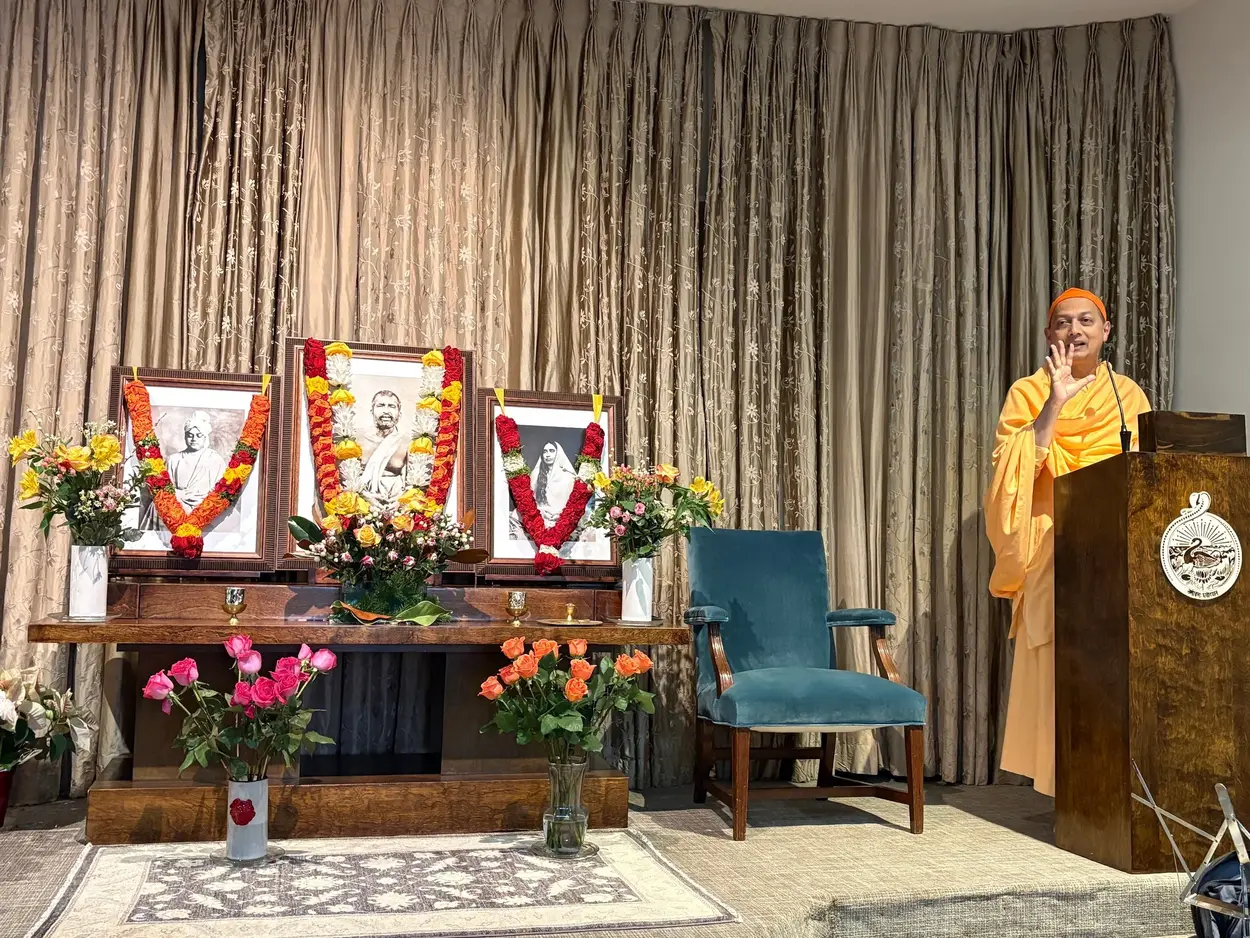
This lecture frames “no mind” as the spiritual pivot point between duality and bondage on one side, and non-duality and liberation on the other. Gaudapada’s move is striking: he reduces the ancient problem of samsara (struggle and suffering) to something immediate and practical—the movement of the mind, especially the mind’s habit of reaching outward to grab what it likes and push away what it fears.
Let’s walk through the argument as a living insight rather than a technical doctrine.
1) The Three Everyday States: Where Samsara Appears—and Where It Doesn’t
Vedanta begins with something you can verify right now: your life unfolds through three repeating states:
- Waking (jagrat)
- Dreaming (svapna)
- Deep sleep (sushupti)
In waking and dreaming, we unmistakably experience subject-object duality: I am here; the world is there. In both states, life feels like a stream of attraction and repulsion—what the tradition calls raga and dvesha. We chase what we want, avoid what we dislike, and worry about what might happen. That tension—desire, fear, striving, frustration—is what Vedanta calls samsara.
Deep sleep is the surprising exception. When you are fully asleep—no dreams, no inner narration—there is no felt struggle. Even someone who is ill, burdened, or overwhelmed experiences a kind of temporary relief in deep sleep. Why? Because the usual subject-object split is not experienced there. With no clear “I” standing apart from a world, the battle quiets.
So Gaudapada’s observation looks compelling: dvaita (duality) and samsara go together, while advaita (non-duality) and moksha (freedom) go together.
But deep sleep isn’t liberation. It’s a pause. The moment you wake, the whole structure returns—body, history, problems, desires. Gaudapada points out that in deep sleep duality persists in a seed form (like data stored in a computer powered down). The mind is not active, but its potential remains intact.
So what we need is not a temporary switch-off. We need a transformation.
2) The Problem Under the Problem: Why Duality Feels Like Bondage
When Vedanta says “duality,” it doesn’t mean simply “there are many things.” It means the felt certainty that:
- I am a limited individual
- Everything else is outside me
- The world determines my completeness and safety
From that perspective, the mind’s default program kicks in:
- Acquire what will complete me.
- Avoid what will harm me.
- Protect the story of “me.”
This is not merely philosophy; it is the engine of daily stress. Even when life is pleasant, the mind is busy managing outcomes. And because the world changes—health, relationships, money, status, time—this management never truly ends.
If duality is the root of the struggle, then non-duality is not a mystical luxury. It becomes a practical liberation: remove the mistaken sense of separation and the mind stops fighting reality.
But how?
3) Gaudapada’s Key Link: Mind and Duality Are Joined
Gaudapada offers a sharp diagnosis:
Where there is mind, there is duality.
Where there is “no mind,” duality is not grasped.
He states that everything moving and unmoving—everything we call “the world”—appears within the field of experience shaped by the mind. The mind is the stage where “me versus that” is enacted. Therefore, no mind (amanibhava) becomes the doorway to non-duality.
At first glance, that sounds like the yogic solution: silence the mind. Patanjali’s definition of yoga is famously “the cessation of mental modifications.” The yogic route is to still the mind through discipline: posture, breath regulation, sense-withdrawal, concentration, meditation, and eventually samadhi. When the mind becomes perfectly still, the world is not perceived in the usual way, and the witness seems to shine.
But Gaudapada does not settle for “shut it down.” His concern is that blankness can be temporary. You can enter samadhi and return; you can go to sleep and wake. If liberation depends on a particular mental state, it is fragile.
So Gaudapada proposes something more durable: a mind that is free while functioning.
4) “No Mind” Is Not Unconsciousness: It Is Non-Grasping
Here is the heart of the teaching: no mind does not mean no thoughts. It means no compulsive reaching—no inner clutching at objects as if they were separate sources of fulfillment or threat.
Gaudapada’s formula is:
- Realize the truth of the Self (Atman)
- Then the mind ceases its “grasping” (sankalpa)
- When there is nothing “out there” to grab, the mind becomes non-grasping (agraha)
- This is “no mind”: a mind that can work without bondage
To make this vivid, Swami Sarvapriyananda uses an unforgettable parable.
5) The Princess of Kashi: How Desire Dies Instantly When Duality Collapses
A young prince finds an old portrait labeled “The Princess of Kashi.” He becomes enchanted. He decides: I must marry her or I will never be happy. He pines. He loses interest in everything else. Finally a wise minister investigates and reveals the truth:
That “princess” was the prince himself—years ago, dressed as a girl for a court play.
The shock is not just humorous; it is metaphysical. The prince’s desire vanishes instantly. Not because he has forcibly suppressed it, and not because he has trained himself to think differently over years. It disappears because the basis of desire collapses:
- There is no separate “other” to possess.
- The object of longing was never outside him.
This is Gaudapada’s point. Duality manufactures craving and fear. When the mind believes fulfillment is elsewhere, it generates sankalpa: “I must get this.” When it believes danger is elsewhere, it generates dread: “I must avoid that.”
But if the truth is non-duality—if the world is not separate from the Self—then the mind’s grasping loses its logic. The mind still operates, but it no longer clutches at experience as salvation or doom.
That is “no mind.”
6) The Yogic vs Vedantic Difference: Switch Off the Movie or Recognize the Movie?
Both yoga and Vedanta aim at freedom, but they differ in emphasis.
-
The yogic approach often resembles: “Stop the movie.”
Quiet the mind so the distressing projection ends. -
The Vedantic approach is: “Know it is a movie.”
Keep your eyes open, but see the truth of what you are seeing.
If you forget it’s a movie, you suffer. If you remember it’s a movie, even intense scenes do not bind you the same way. The screen is untouched by whatever appears on it.
Vedanta insists: the goal is not to annihilate experience, but to discover the unchanging reality in and through experience. That discovery makes you free, not because the world disappears, but because its power to imprison you disappears.
7) Viveka: The Practical Engine of “No Mind”
How does one gain this freedom? Gaudapada’s method is viveka—spiritual discrimination.
Sri Ramakrishna’s famous answer to the question “How can I fix my mind on God?” includes three sweeping instructions:
- Sing God’s name and glories (bhakti)
- Meditate in solitude (raja yoga)
- Practice viveka and vairagya (jnana yoga)
Viveka is not moral judgment; it is discernment between:
- the eternal and the non-eternal
- the unchanging and the changing
- the real and the appearance
The Mandukya framework makes this accessible through your own experience of waking, dreaming, and deep sleep:
- The waking “I” appears and disappears.
- The dream “I” appears and disappears.
- In deep sleep, even the sense of self is absent.
Yet something persists across all three: the light of awareness, the fact that experience is known. Vedanta calls that underlying reality Turiya—not “a fourth thing” among three, but the one reality that appears as all three.
From this angle, the self is not the waking person, not the dream character, not the blankness of deep sleep. The self is the consciousness in which all these states come and go.
When that recognition becomes stable, the mind’s obsession with grasping loosens. The mind stops treating changing objects as ultimate anchors. It becomes usable, but not enslaving.
8) “Asparsha Yoga”: The Yoga of No Contact
Gaudapada gives this path a striking name: Asparsha Yoga, the “yoga of no contact.”
Why no contact? Because in non-duality, there are not truly two separate realities that can touch each other. The classic Vedantic analogies make the point:
- Rope and snake: the false snake cannot harm the rope.
- Desert and mirage: mirage water cannot wet even a grain of sand.
- Clay and pot: there is only clay; “pot” is a name-form-use, not a second substance.
- Gold and ornaments: gold does not become “four” when you count ornaments; it is their reality.
Similarly, samsara cannot damage the Self—because samsara is an appearance in the Self, not a second entity.
The enemy of the illusion is not the real substratum. It is knowledge—the recognition of what is real.
That is why Gaudapada can sound uncompromising. He is not trying to polish the illusion; he is trying to dissolve the mistaken grasp at its root.
9) What Changes in Daily Life? A Mind That Works Without Bondage
If “no mind” is not blankness, what does it look like practically?
It looks like a mind that still:
- plans,
- chooses,
- loves,
- works,
- responds,
- creates,
but without the chronic inner posture of:
- “I must secure myself through outcomes,”
- “I am incomplete without this,”
- “I am threatened by that.”
This is why the teaching emphasizes fearlessness. Enlightenment is described not merely as insight but as abhaya—fearlessness. You no longer experience life as a fragile isolated unit in a vast universe. You understand yourself as the vastness in which all experiences arise.
And because of that, the mind becomes “no mind”: not because it stops, but because it stops clutching.
10) The Summary: The Mind Becomes Free by Seeing Non-Duality
Gaudapada’s argument can be condensed into a few powerful steps:
- Duality and samsara are linked.
- Mind and duality are linked.
- Therefore, liberation requires “no mind.”
- But “no mind” is not sleep, trance, or suppression.
- “No mind” is a non-grasping mind born of Self-knowledge.
- Viveka reveals the Self as the one reality (Turiya) in waking, dreaming, and deep sleep.
- When the Self is known, sankalpa falls away because there is no separate “other” to grasp.
- The result is freedom in life—eyes open, mind functioning, yet unbound.
This is the most radical and tender promise of Advaita: not that you will escape experience, but that you will discover what you are in the midst of experience—so thoroughly that the mind, while active, no longer binds you.
In that sense, “no mind” is not the end of life. It is the end of bondage.
Om Shanti, Shanti, Shanti.
You will get Vedanta updates in your inbox.
Occasional reflections on Vedanta. Unsubscribe anytime.