Jnana Yoga: The Path of Knowledge and Its Practical Power
Swami explains Advaita: you’re already Brahman; ignorance causes bondage; insight frees, supported by other yogas.
Swami Sarvapriyananda of the Vedanta Society of New York presents a strikingly direct vision of spiritual life: Jnana Yoga, the path of knowledge in Advaita Vedanta. The talk begins with the traditional prayer, “Lead us from the unreal to the real, from darkness to light, from death to immortality,” and then it delivers what Advaita is famous for: an uncompromising claim about who we already are.
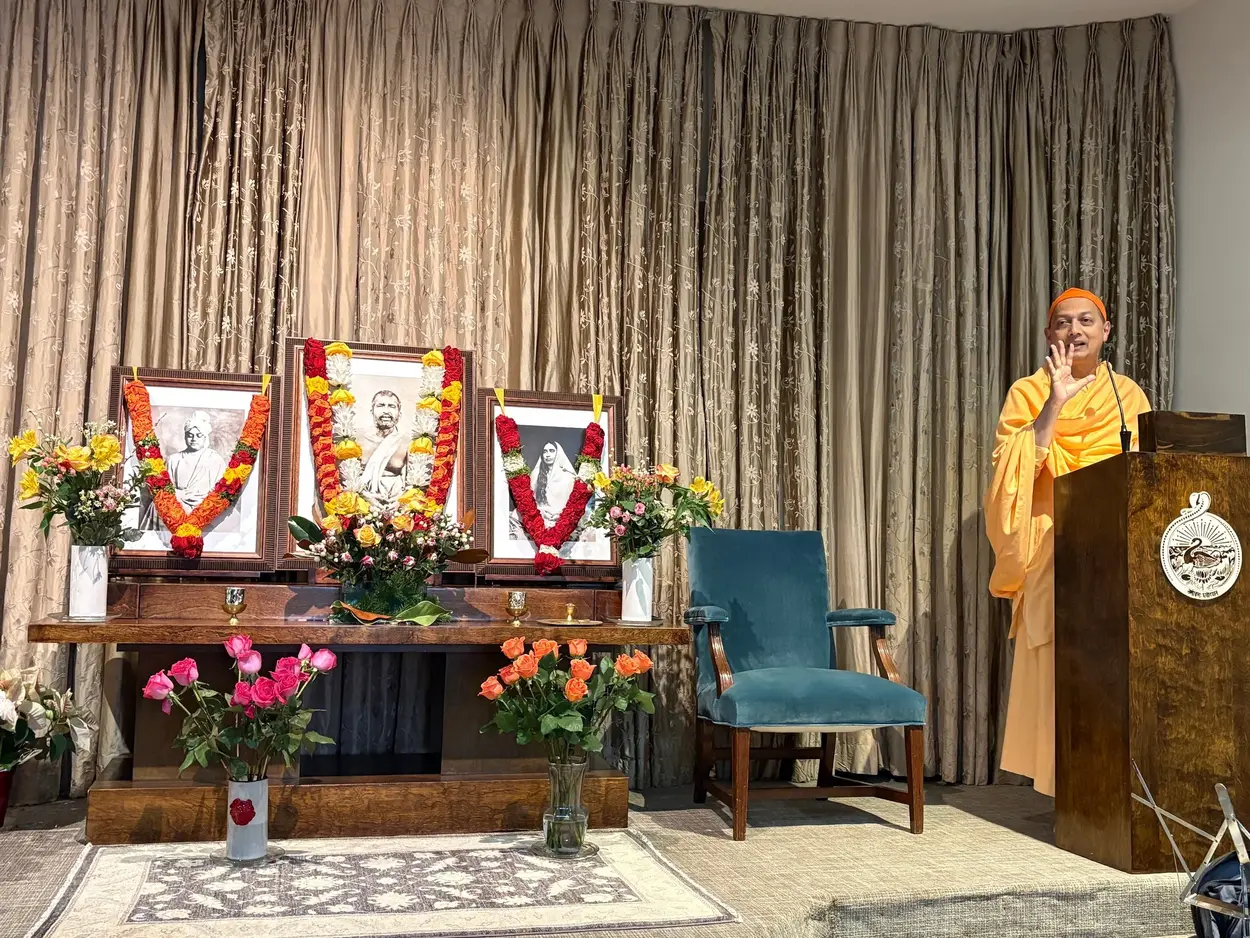
Advaita does not primarily say, “Become free.” It says, “You are free.” It does not say, “Become one with God.” It says, “You are one with God.” The goal of spiritual life, then, is not manufacturing liberation in the future. It is correcting a present error.
The First “Bombshell”: You Are Already That
Swami Sarvapriyananda frames Advaita’s central claim in the classic formula:
Brahman satyam, jagat mithya, jivo brahmaiva na aparah. Brahman alone is real, the world is an appearance, and the individual self is not different from Brahman.
This is not offered as poetry or distant theology. It is offered as a fact that is true right now, as true for you and me as for Sri Ramakrishna, Holy Mother Sri Sarada Devi, Swami Vivekananda, and all realized souls. The only difference, he emphasizes, is not reality itself, but our relationship to it. The realized know it. We do not.
So what is the problem? The problem is the felt conviction, “I am this limited person.” We might say, “Perhaps ultimately I am Brahman, but right now I have a life to fix. I need years of practice. I need to become worthy.” Advaita responds: That very feeling is the error.
The Root of Error: Ignorance, and Its Cure: Knowledge
Why do mistakes happen? Swami Sarvapriyananda uses the traditional example: a rope is mistaken for a snake. The error exists because the rope is not known as a rope. The remedy is not fighting the snake but removing ignorance through knowledge.
That is the logic of Jnana Yoga:
- Error comes from ignorance.
- Ignorance is removed by knowledge.
- What is needed is knowledge of our real nature.
Vedanta, then, does not “create” your true Self. It points it out.
He quotes a compact Vedantic saying:
Praptasya prapti, nivrittasya nivritti. Vedanta gives you what you already have, and removes what was never there.
Three Stories That Make the Point Unforgettable
To show how truth can be hidden in plain sight, he shares vivid stories.
Mulla Nasruddin and the Donkey
A border guard repeatedly searches Nasruddin, convinced he is smuggling something, but finds nothing illegal. Years later, retired, the guard asks what Nasruddin was smuggling. The answer: “The donkey.” The obvious was overlooked because the mind searched in the wrong place.
The Washerman and the Diamond
A poor washerman finds a diamond but uses it to scrub clothes, not knowing its value. Only when a jeweler recognizes it does the washerman’s life change. The point is sharp: the solution to poverty was present all along, but unrecognized. Similarly, the inner awareness that could dissolve our deepest suffering is already present, yet we use it unconsciously for seeing, hearing, thinking, desiring, enjoying, and worrying, without understanding what it truly is.
The Tenth Man
Ten people cross a river and count only nine because each forgets to count himself. A wise person points out, “You are the tenth.” This becomes a powerful metaphor for the Self: we search for completeness “out there,” forgetting the one who is searching.
The Second “Bombshell”: Knowledge Means Insight, Not Information
Swami Sarvapriyananda is careful about the word “knowledge.” In everyday language, knowledge can mean collecting facts or reading many books. Jnana Yoga is not that. He prefers calling it Insight Yoga. It is not a library of ideas; it is a single decisive recognition.
That is why the question “Now what do I do?” can reveal a deeper misunderstanding. If the method is insight, the goal is not a new activity but a clear seeing.
He illustrates this with monastic stories. A newly initiated monk asks a great teacher, “Now what do I do?” The teacher laughs, essentially saying: That question shows you have not yet understood. Another story: after receiving the great identity statement Aham brahmasmi (“I am Brahman”), monks asked how many times it should be repeated like a mantra. The president of the order replied: “It is not for repetition, it is for realization.”
The Third “Bombshell”: Liberation Is Immediate and Effortless (With Fine Print)
Advaita boldly claims that the truth is available right here, right now, and in its own nature effortless. If you can recognize yourself as pure awareness, you do not need to travel anywhere inwardly or outwardly. The radical text Ashtavakra Gita states that if you can see yourself as not the body and rest in awareness, you are free now.
But Swami Sarvapriyananda adds crucial balance. Many modern “direct path” approaches repeat the effortless message while dismissing other yogas. Yet traditionally, India understood something subtle: even if the truth is immediate, the mind must be prepared to receive it.
He puts it in a memorable phrase: the transmitter may be working, but the receiver is not tuned. Karma Yoga, Bhakti Yoga, and Raja Yoga help tune the receiver by purifying the mind and steadying attention. For the Jnana Yogi, Bhakti is especially valuable because the heart may resist what the intellect understands.
This addresses a common frustration: “I understand Vedanta, but I cannot live it.” The intellect may agree, yet desires and emotional patterns keep pulling us into old identities. Bhakti works at the heart level, redirecting desire toward God and inviting grace, so insight can become stable and embodied.
A Practical Method: Drik Drishya Viveka (Seer and Seen)
Swami Sarvapriyananda then demonstrates how insight is grounded in immediate experience. One method is Drik Drishya Viveka, the discernment between the seer and the seen.
The logic unfolds in stages:
- Eyes see forms. The book is seen, the eyes are the seer.
- Mind observes the senses and body. The eyes become objects known to the mind.
- You are aware of thoughts and emotions. If thoughts are known, you are the knower of them.
- The ultimate seer is never seen. The witness consciousness cannot be turned into an object. It is not “unknown,” it is “more than known,” because it is the very light by which all knowing happens.
This shifts identity away from body, breath, and mind, toward the witnessing awareness that remains present through seeing and not seeing, thinking and mental blankness, activity and stillness.
From Duality to Non-Duality: The Second Step
The first step can resemble Sankhya: consciousness distinct from nature, witness distinct from world. Advaita goes further by asking: Have you ever experienced a universe apart from awareness? Experience itself requires consciousness. The “world without consciousness” is not something we can ever verify experientially.
So Advaita concludes: the world is not an independent reality standing apart from awareness. It is an appearance in awareness, like a dream appearing in the dreamer. Swami Sarvapriyananda connects this to modern discussions too, mentioning the “hard problem of consciousness” associated with David Chalmers: we can correlate brain activity with experience, but explaining how matter produces subjective awareness remains deeply unresolved. He also notes Galen Strawson’s provocative reversal, sometimes called the “hard problem of matter,” where matter becomes increasingly elusive under analysis, while consciousness is the one undeniable given.
Advaita’s move is not anti-science. It leaves transactional reality intact, where science operates successfully. It simply points to a deeper ground: consciousness as the fundamental reality in which all appearances arise.
The Pot and the Clay: A Clear Advaitic Map
To make the “second step” concrete, he offers the pot-clay analogy:
- Start with the pot.
- Learn the pot is made of clay.
- Investigate and find clay everywhere in the pot.
- Realize there is no separate “pot substance,” only clay, with name and form.
Likewise, we start with world, body, and mind. We discover consciousness as their reality. We then see nothing can be established apart from consciousness. Finally, even “cause and effect” dissolves at the deepest level, leaving non-dual Brahman alone.
And yet, life continues normally. Language continues normally. You still say “pot,” you still drive the car, eat food, do your work. The difference is inward: one reality is recognized everywhere.
Closing Reflection
Jnana Yoga, as Swami Sarvapriyananda presents it, is not a spiritual fantasy or a distant promise. It is a disciplined clarity. It tells you that what you seek is already present as the awareness reading these words. The practices of life then become supports that purify and steady the mind so this recognition can become unmistakable.
Advaita’s message is daring, but it is also tender: you are not broken, not lacking, not waiting to become whole. The work is not to manufacture freedom, but to remove the misunderstanding that hides it.
And with that recognition, the ancient prayer at the start of the talk becomes intensely personal: from the unreal to the real, from darkness to light, from death to immortality, peace, peace, peace.
You will get Vedanta updates in your inbox.
Occasional reflections on Vedanta. Unsubscribe anytime.