Teachings of Ramakrishna: The Avatar as Liberator, Doorway, and Living Guide
Sri Ramakrishna, as avatar and guru, frees karma, reveals Brahman, focuses devotion, dispels doubt.
A spiritual gathering often begins with a simple human warmth: good morning, namaste, and gratitude that so many have come together. In this talk, even the calendar itself becomes a teaching. The celebration is for Sri Ramakrishna’s birthday, yet it is not the exact day. It has been arranged for convenience, and it coincides with Shivaratri—already a sacred night of worship. That overlap becomes symbolic: devotion is not imprisoned by a date, and the Divine is not confined to a single name. One devotee says it plainly: worship of Shiva and worship of Sri Ramakrishna feel identical. Behind such statements is a profound Vedantic intuition—many forms, one Reality.
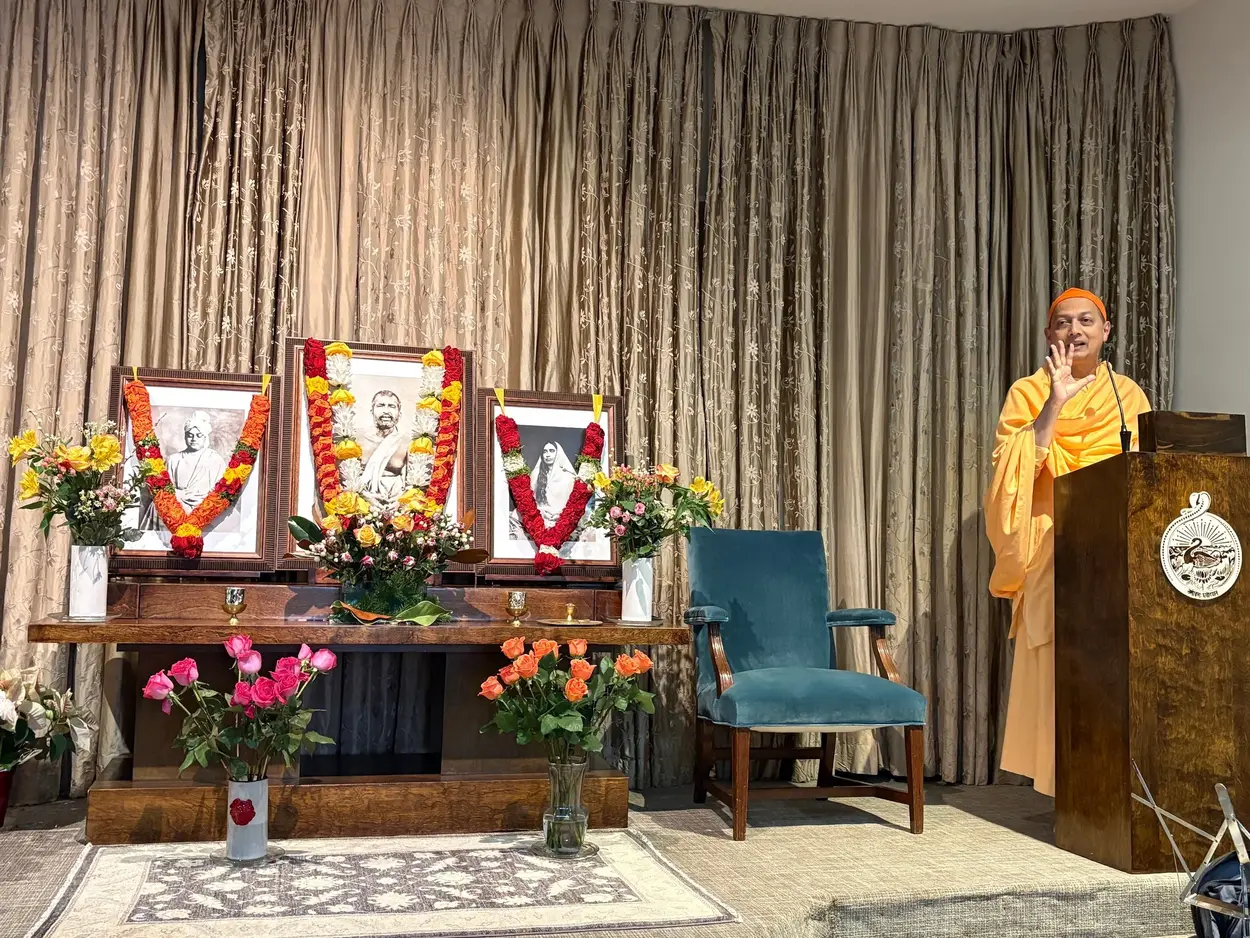
But the speaker is careful: the theme is not merely “the life and teachings” of Ramakrishna as a historical figure. The intention is deeper and more daring: to ask what he truly is to the seeker. Not only who he was, but what he represents in the spiritual life—what an avatar means, and why it matters when your days are filled with ordinary pressures, doubts, and repeated struggles.
1) A Celebration That Points Beyond a Date
The talk draws on a remarkable source: a contemplative work by a senior monk, Swami Bhajanananda, who described his writing as if it were guided from within—almost as if Sri Ramakrishna himself were working through him. Whether one takes that literally or poetically, it expresses a living idea: the spiritual presence is not only remembered; it is experienced.
2) The First Claim: “Giver of Moksha” Isn’t a Compliment—It’s a Function
The boldest assertion comes early: Sri Ramakrishna is described as the Lord of moksha—the one who possesses and bestows liberation. This is not merely praise. It proposes a specific spiritual function: to free beings from bondage.
“Moksha” is often translated as salvation or liberation, but the talk clarifies its heart: freedom from samsara—the cycle of repetitive becoming, driven by forces we do not fully control. The point is not to make life sound pessimistic. It is to name a truth most people sense: even our best days carry the shadow of fragility, and even our victories come tied to anxiety—because they can be lost.
If moksha is the “most auspicious treasure,” then to call Ramakrishna the “Lord of that treasure” is to say: he is not merely inspiring; he is a means of release.
This theme becomes emotionally grounded through a story about Belur Math, the monastery established by Swami Vivekananda. The image is tender: the relics of Sri Ramakrishna were carried in devotion and installed, accompanied by a prayer that his presence remain for ages “for the welfare of humanity.” The speaker then addresses a quiet worry many modern seekers feel: Are we included? If a hymn says “for disciples and disciples’ disciples,” does that mean later generations are excluded?
The answer is reassuring: the lineage is not a closed club. Anyone who is drawn to the teachings, who feels pulled by that current of devotion and truth, belongs to the living stream. The real issue is not formal membership; the real issue is transformation.
3) Why We Need Help: Karma as the Deep Weight Under Our Life
The talk then becomes practical, almost stark: why do so few people become free? Why do spiritual methods exist in abundance—meditation, devotion, inquiry, ethics—yet progress often feels slow?
The traditional answer is karma.
Karma is not presented as fatalism or superstition. It is framed as a moral-causal structure: actions shape tendencies, and tendencies generate outcomes. In this view, life is not random. We inherit consequences from a long past, and that past shapes the “shape” of a life—health or fragility, resources or lack, relationships and their patterns, even certain doors that open or stay closed. The talk emphasizes that across Indian traditions—Hindu, Buddhist, Jain—karma is a shared premise even when they disagree about many other things.
A key distinction is introduced:
- Sanchita karma: the vast storehouse of accumulated karmic seeds.
- Prarabdha karma: the portion “activated” to produce this particular life.
This framing explains why pure willpower is not enough. We are not completely free to design ourselves from scratch. Choices matter, yet the field of choices itself is shaped by deeper conditions.
The speaker uses a memorable line from Vivekananda: chains of gold bind as tightly as chains of iron. Good karma can create comfort, but comfort can become its own prison. Bad karma causes pain, but even pleasure can become attachment, anxiety, and fear of loss. Either way, bondage continues.
At this point, the talk makes a provocative claim: the “doom” that an avatar saves us from is not an external catastrophe but a deeper inevitability—the momentum of karma that keeps us circling.
4) The Avatar Difference: A Saint Can Guide You—An Avatar Can Break the Lock
Here we reach the talk’s central distinction: what differentiates an avatar from a saint?
A saint can inspire, teach, and model spiritual life. But the speaker insists there is a limit: a saint does not, by personal power, rewrite the karmic structure binding others. God alone is described as karma-adhyaksha—the one who presides over karma. If the universe runs by moral causality, then the One who administers that causality can also suspend, soften, or dissolve its consequences for a seeker who takes refuge.
This idea echoes across traditions. The talk draws parallels with Christianity: redemption, forgiveness, release from a burden carried for lifetimes. It quotes the Bhagavad Gita’s promise of refuge—“take shelter in me, and I will free you.” It also cites the New Testament invitation—“Come unto me… and I will give you rest”—not as permission to be lazy, but as liberation from the inner weight that makes life feel like endless labor.
Sri Ramakrishna’s own metaphor is vivid and local: the avatar is like “French territory” during colonial times. If you crossed into Chandannagar, British police could not arrest you. Similarly, the “karma police” cannot seize you in the refuge of the incarnation. It is a playful metaphor for a serious claim: grace creates a protected space where the karmic grip loosens.
The Holy Mother’s teaching adds nuance. Karma does not simply vanish in a cheap transaction. The law is strict. Yet grace can radically change the intensity: what might have been a spear becomes a pinprick. The goal is not a discount on suffering; the goal is a spiritual acceleration that makes liberation realistic.
5) The Avatar as Doorway: Seeing Infinity Through a Human Form
The talk then moves from karma to revelation. Even if the Upanishads declare the Absolute and philosophy describes Brahman, that knowledge can remain abstract—true yet distant. So how is the Infinite revealed in a way that transforms the heart?
Here the avatar is described as a doorway—an opening in the wall of maya. The wall is our ordinary perception: we see only the finite, struggle within it, and assume that is all there is. The avatar is like a hole in that wall: through it, one glimpses infinity. And if the opening is large enough, one can “pass through”—enter into a living connection with the Infinite and return renewed.
The talk parallels this with Jesus’ statement: “I am the door.” In both images, the point is not geometry. The point is access: the Infinite becomes intimate.
A beautiful exchange illustrates the logic. Swami Vivekananda, in an early skeptical mood, argues that God is infinite and therefore unknowable. Sri Ramakrishna replies: why must you know all of God? If you take a bath in the Ganga at one ghat, you truly have bathed in the Ganga. You do not need to bathe from the glacier source to the ocean. In the same way, to truly know God “at one point” is enough for transformation. The avatar makes that “one point” available.
6) Ishta Devata: Why Focus Matters More Than Variety
Now the talk becomes psychologically wise: even if the Divine is infinite and approachable in countless forms, the human mind requires focus. Without focus, the spiritual life becomes a series of shallow beginnings.
This is where the Hindu concept of Ishta Devata appears: the chosen ideal. Not because other forms are false, but because the heart needs one deep relationship. The avatar becomes an aradhya rupa—an adorable form suited for devotion, love, worship, surrender, and intimacy.
Sri Ramakrishna’s own spiritual experiments are cited as proof of inclusivity, not as a model for casual mixing. When he practiced devotion to Kali, he was wholly Kali-centered. When he practiced Islam, he removed Hindu images and lived the discipline sincerely. The lesson is not “try everything at once.” The lesson is: each path works when entered completely.
A parable seals the point: a man digs six shallow holes, chasing easier places, and finds no water. Had he persisted in one spot, he might have struck a spring. Spiritual practice works like that. Choosing an Ishta is choosing depth over distraction.
In the Ramakrishna tradition, this focus becomes a living culture: actions, worship, service, and daily life are offered inwardly—Ramakrishna arpanamastu—“may this be offered.” The devotion becomes less about occasional ceremony and more about transforming the inner orientation of life.
7) The Mantra: The Avatar’s Presence in “Seed Form”
A modern skeptic might ask: “Is this just looking at pictures and telling yourself comforting stories?” The talk answers with a practical method: mantra initiation.
The avatar is not merely a memory. The tradition holds that the Ishta becomes present through mantra—given by a guru, cultivated through repetition, and gradually revealed as living spiritual power. A senior monk’s striking phrase is quoted: with Ishta-mantra, one has been given God “in seed form.” The seed must be watered with practice until it becomes a reality in one’s consciousness.
The talk treats mantra as both accessible and sacred. It avoids casually disclosing what is traditionally private, but it explains its structure: a sacred syllable, the divine name, and sometimes a “seed” sound associated with spiritual energy. The point is not secrecy for its own sake; the point is that some practices deepen best through direct guidance.
Importantly, the talk emphasizes that initiation is not a magical shortcut. It is a powerful support—practically essential even if not philosophically mandatory—because it stabilizes focus and connects the seeker to a living lineage.
8) How the Avatar Acts: Freedom, Selflessness, and Power Across Time
In the latter part, the talk contrasts ordinary action with the action of an avatar.
First: we act under karmic pressure; the avatar acts from freedom.
Second: our action is mixed with self-interest; the avatar’s action is selfless.
Third: we act from ego; the avatar’s action arises from a deeper center—either the “cosmic I” or a complete surrender where only God is the doer. Sri Ramakrishna’s language often expresses the second style: “Not I, but Thou.” He compares himself to a machine moved by the Divine Operator. This is not passivity; it is ego-transcendence.
Sri Ramakrishna offers a subtle image: the ego is like a stick placed in flowing water—it divides the one stream into “this side” and “that side.” For the enlightened, the remaining “I” is like a line drawn on water—immediately erased, no longer dividing reality. This hints at the spiritual psychology of liberation: suffering decreases not only because circumstances change, but because the dividing ego dissolves.
Fourth: the avatar’s influence is extraordinarily powerful and lasts beyond a single lifespan. Empires fade, reputations shrink, and the noise of a century becomes a footnote. Yet the presence of an avatar grows across generations, because it does not rest on social power. It rests on spiritual potency.
The talk even introduces an esoteric Vaishnava view: earlier avatars may become harder to access as centuries pass, while the most recent avatar remains more immediately available to seekers—closer in the subtle dimension of spiritual experience. One may accept this literally or treat it as a poetic way of saying: each era needs a living, culturally resonant doorway to the Infinite.
9) The Avatar as Adi Guru: A Living Lineage That Dispels Doubt
Finally, the avatar is presented as Adi Guru—the primal teacher. Spirituality is not only emotion; it is knowledge and transformation. The talk cites scriptural themes: the Divine teaches the knowledge of liberation and establishes a lineage through which that knowledge flows. In this sense, the avatar is not merely a figure to admire but the source of a living transmission.
This matters especially in an age of skepticism. The talk acknowledges modern doubt—famous atheist critiques, rational challenges, and the difficulty of believing in God without embarrassment. Instead of attacking skepticism, it suggests a spiritual confidence rooted in experience: the avatar becomes a “weapon” against doubt—not by argument alone, but by the living demonstration of spiritual possibility.
Swami Vivekananda’s striking phrase is invoked: Sri Ramakrishna as the great arrow that destroys the demon of doubt. Doubt about God, doubt about realization, doubt about scripture, doubt about spiritual experience—these can paralyze a seeker. The avatar’s presence, teachings, and the living tradition formed around him become a remedy.
10) Bringing It Home: What This Means for a Seeker Today
If all this remains theory, it has missed the point. The talk is ultimately an invitation:
- Recognize the weight you carry. The deepest burden is not just stress; it is the momentum of habit, fear, attachment, and karmic conditioning.
- Accept help without shame. The spiritual path is difficult alone. Grace is not weakness; it is realism.
- Choose a focus. The mind becomes deep when it stops scattering. A chosen ideal is not exclusion; it is commitment.
- Practice consistently. Not with anxiety, but with steady devotion.
- Connect to a living lineage. A teacher, guidance, and practice protect the seeker from drifting into vague inspiration without transformation.
In the end, the talk closes with prayer—not as a decorative ritual, but as the natural expression of spiritual longing: may the great beings purify the heart, soften the karmic burden, reveal truth, and carry us across the ocean of becoming into freedom.
The promise is not that life will become problem-free. The promise is more radical: that liberation is possible, and that the doorway to that liberation is not only a distant philosophy—but a living presence that can be approached, loved, and realized.
Om Shanti.
You will get Vedanta updates in your inbox.
Occasional reflections on Vedanta. Unsubscribe anytime.