Mindfulness Meditation: Training Attention for Awakening
Swami teaches Buddhist mindfulness: breath-focused attention, four stages, counting, joyfully returning from distraction toward awakening.
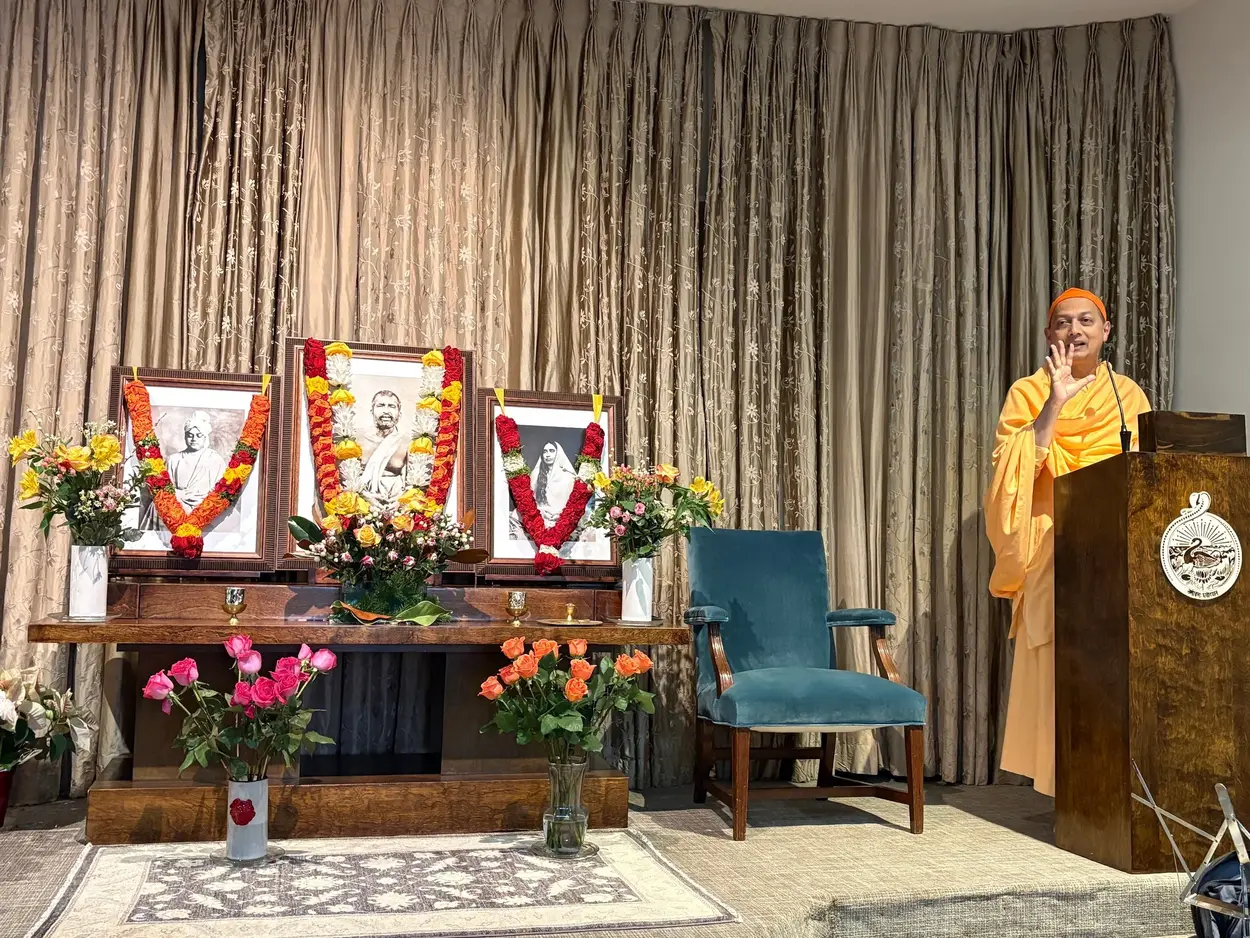
In a packed meditation hall near New York, Swami Sarvapriyananda begins the way the ancient traditions often begin: with a prayer for inner clarity, a wish to move from confusion to truth, from heaviness to light, from fear to freedom. Then he immediately addresses a modern reality: mindfulness has become mainstream in the West, especially in the United States. People use it for stress relief, better sleep, sharper focus, even for looking and feeling younger. Those benefits are real. But Swami Sarvapriyananda gently re-centers the conversation on the original intent behind these methods: awakening, enlightenment, God-realization, freedom from suffering.
This is important because the same technique can be practiced at two very different depths. At one level, it is a tool for wellness. At a deeper level, it is part of a serious spiritual quest. Swami’s point is not to dismiss the everyday benefits, but to make sure we do not forget what these practices were designed to deliver: a lasting solution to the restlessness and dissatisfaction that follow us, even when life looks fine on paper.
“I give them what they want…”
To make this feel human and practical, Swami shares a story about Maharishi Mahesh Yogi teaching meditation in the New York area decades ago. Maharishi spoke openly about the practical advantages: less stress, better health, more calm. When questioned by fellow monks in India, he is said to have smiled: “I give them what they want, so that they will want what I want to give them.”
It is a clever line, but also a compassionate one. Many of us first approach meditation because we are tired, anxious, distracted, or overwhelmed. If meditation helps with those things, that is not a shallow outcome. It can be the doorway. The deeper promise comes later: not just managing life, but understanding life, and ultimately understanding ourselves.
The roots: Buddha, Asanga, Kamalashila, and the “ten stages”
Swami frames this session as Buddhist mindfulness, with roots going back to the Buddha himself, and later systematic development in India and Tibet. He mentions the monk Asanga, who lived centuries after the Buddha, and the philosopher-meditator Kamalashila, who composed Bhavanakrama (“The Stages of Meditation”). In this framework, mindfulness is not just “being present”; it is a gradual training of attention through ten stages, moving from scattered awareness toward stable meditative absorption and insight.
Most modern mindfulness, Swami notes, stays in the early stages, often the first and second. That is exactly what he chooses to teach in this session: something direct, simple, and workable, while still connected to an ancient map that can take a lifetime to explore.
He also points to a contemporary guide that many practitioners have found helpful: The Mind Illuminated by John Yates (Culadasa), a neuroscience-trained teacher who organizes the practice around those same ten stages and explains the terrain with unusual clarity. The book can feel encyclopedic, Swami admits, but it is authentic and thorough.
Why the breath? Because it is always there
The object of this meditation is the breath. And Swami’s tone here is almost disarming: the breath is a perfect anchor because it requires no imagination, no belief, and no special preparation. You do not have to manufacture anything. You do not have to visualize, repeat words, or build a mood. The breath is already happening. It is steady enough to be reliable, yet changing enough to reveal something profound: impermanence.
He even points to a modern phrase that captures the fragility of life: “When breath becomes air.” One moment the breath is living experience; the next, it is just air. Breathing quietly reminds us of the most basic rhythm of change, and that is why it has been spiritually meaningful for so many centuries.
The breath is also portable. Once you understand the technique, you can practice anywhere: at home, on a walk, sitting on a train, even in the middle of a difficult day.
The key is not the breath. It is attention.
Swami repeats an essential correction that many people miss: mindfulness meditation is not about “doing something with the breath.” The breath is not the achievement. The training is attention itself.
Your attention is the valuable thing. The breath is simply the anchor that teaches attention to stay.
The four-stage transition into mindfulness
Swami lays out a four-stage movement from ordinary scattered awareness into stable attention on the breath. It is not complicated, but it is structured, and the structure matters because it respects how minds actually work.
Stage 1: Settle into presence. Begin by taking a workable posture. Not rigid, not sloppy: steady and easeful. Swami uses a helpful image: imagine holding a bowl filled to the brim with water. Any unnecessary movement creates ripples; too much movement spills the water. In the same way, a settled body helps a settled mind.
With eyes closed (or slightly open, looking downward if that works better), simply notice what is present: sounds, sensations, and the mental stream of thoughts and feelings. Do not become a commentator. Do not chase each sound into a story. Just note what arises, and let it pass.
Stage 2: Bring the body to center stage. Now shift attention deliberately to the body, scanning from head to feet. Sensations become the foreground. Everything else can remain, but it is allowed to fade to the periphery. When you notice tension in the face, neck, or shoulders, relax it immediately. If there is pain or strain, do not fight it. Adjust if you truly need to. The point is calm alertness, not endurance.
Stage 3: Move to the breath as movement in the body. Among all sensations, one thing is clearly moving if you are sitting still: breathing. Let attention narrow from “the whole body” to “the breath throughout the body.” Feel it in the nose, chest, and belly. Watch the belly expand and contract. Do not force the breath. If it is shallow, let it be shallow. If it deepens naturally, allow it. The instruction is gentle observation.
Stage 4: Focus at the nostrils. Finally, bring attention to the breath at the tip of the nose, the subtle sensation at the nostrils. Do not follow the breath out into space and back again. Just stay with the sensation right there: coolness on the in-breath, warmth on the out-breath, or whatever you notice. Thoughts, sounds, and sensations can still arise. They are not enemies. Let them remain in the background while you return, again and again, to the anchor.
This is where the actual meditation begins.
“That’s it.” And why it is not as easy as it sounds
Swami jokes about a cartoon where a teacher says: “Calm your mind and follow the breath.” Then, “That’s it.” The student looks confused: “That’s it… and then what?” The teacher repeats: “Nothing. That’s it.”
It sounds almost too simple, but it is deceptively simple, because the mind does not like staying with one subtle object. Very quickly distraction appears. Swami does not treat this as failure. He treats it as the normal training ground.
Counting: a simple tool to stabilize attention
To support the first stages, Swami recommends a straightforward counting method up to ten. After each full breath cycle (in-breath and out-breath), mentally note “one.” Then “two,” “three,” up to “ten.” If you lose track, if doubt appears (“Was that seven or eight?”), start again at one. Do not push past ten, because counting can become mechanical and the mind can wander while the numbers continue.
Counting is not the goal. It is scaffolding. Once attention steadies, drop the counting and remain with the breath at the nostrils.
The cycle: distraction, forgetting, wandering, awakening
Swami describes what typically happens when we practice:
- Attention on breath
- Distraction arises
- Forgetting happens (we forget the breath entirely)
- Mind wandering (seconds or minutes pass)
- Awakening (“Oh!” we remember and return)
His advice at the moment of awakening is strikingly kind: treat it as joy. Celebrate it. That “coming back” is a small taste of the meaning of the word Buddha, “the awakened one.” Each return is a small awakening. A little happiness at that moment makes the practice sustainable.
A helpful slogan: relax, find joy, observe, let it come and go
Swami offers a compact instruction that can apply to many meditation styles:
- Relax
- Look for joy
- Observe
- Let it come, let it be, let it go
An itch, a worry, a memory, a sound in the room, a wave of sleepiness: let it come. Do not resist. Let it be without making it the center. Let it go without commentary. Then return to the breath.
Routine matters because the mind is a creature of habit
In questions, Swami emphasizes the practical wisdom of consistency. Meditate at the same time each day if you can. Sit in the same place. Use the same posture. The mind learns patterns. Over time, it begins to “expect” stillness at that hour, in that corner, on that seat. This reduces friction and supports depth.
How does something so neutral lead to enlightenment?
Swami’s answer is that the breath is only the entry point. The training is awareness itself. As attention stabilizes, clarity grows. You begin noticing the mind’s habits, its reactivity, and the subtle ways suffering is manufactured inside. The practitioner moves from reacting to responding. Over long practice, deeper insights can arise: the changing nature of sensations, thoughts, and emotions, and the possibility of freedom from being pushed around by them.
The breath is the doorway. Awareness is the real path.
Closing: simple, ancient, and deeply serious
What Swami Sarvapriyananda offers in this New York retreat setting is refreshingly grounded. No metaphysical demands. No complicated belief system. Just a careful method: posture, presence, body awareness, breath awareness, and finally steady attention at the nostrils, supported by counting and guided by kindness toward distraction.
And beneath that simplicity is a serious promise: not merely a calmer day, but a clearer mind, a freer heart, and the gradual uncovering of a peace that does not depend on circumstances.
You will get Vedanta updates in your inbox.
Occasional reflections on Vedanta. Unsubscribe anytime.