Stillness and the Self: How Brahman Reveals Itself When the Mind Falls Quiet
Stillness ends mental distortion; Brahman is recognized as ever-present, even amid active mind.
A thoughtful question arrives from Joyrup Bhattacharya in London, framed not as a debate but as lived intuition. He speaks of a rare closeness to saints and sadhus, and of a lineage connected with Anandamayi Ma—remembered by countless seekers as a realized mystic whose presence itself felt like teaching. Yet the question he asks is not about biography or tradition. It is about a paradox at the heart of spiritual life:
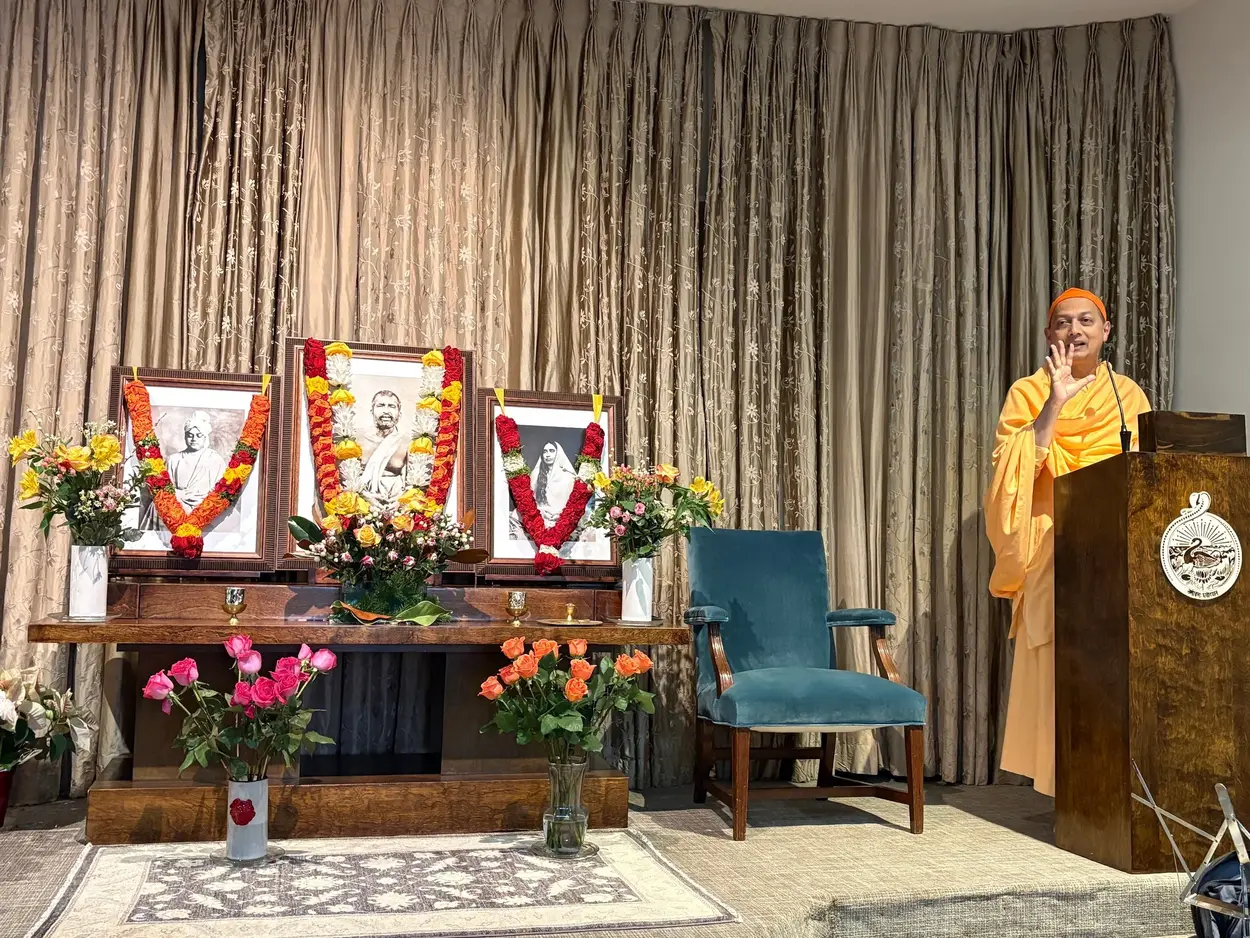
If Brahman (the supreme reality) is beyond name and form—beyond thought and perception—then how can Brahman be known at all? And if stillness is the closest approximation to Brahman, what exactly happens in that stillness when the mind is no longer “doing” anything?
This question matters because many sincere seekers reach a point where concepts begin to feel like an obstruction. They have read enough to suspect that language can only gesture. They have practiced enough to sense that restless inner commentary refracts something deeper into fragments. And yet, when they reach for stillness, a new doubt appears: if the mind stops, who remains to recognize anything?
The answer offered by the Swami in this exchange is both affirming and clarifying: yes, the intuition is right—and also, the situation is more subtle than it appears at first.
1) Why names and forms feel like a “refraction”
A central insight in nondual traditions is that the mind does not merely describe the world; it formats it.
- Thinking tends to label and classify. It turns raw presence into “this” and “that,” “mine” and “not mine,” “good” and “bad.”
- Perceiving tends to separate. It divides an apparent field into objects, distances, boundaries, and identities.
If Brahman is truly “without a second,” then the moment we divide reality into separate items—whether by words or by perception—we create a kind of overlay. It is not that perception is evil or thinking is wrong; it’s that these functions naturally operate by differentiation. They create a world of many.
That is why stillness has always been compared to truth. When the constant slicing-and-labeling relaxes, reality is no longer filtered into fragments. In that calm, the seeker senses something that feels closer to the undivided.
But here a sharp question arises: if stillness is so close to Brahman, why doesn’t ordinary deep sleep count as enlightenment?
2) Deep sleep: silence without realization
In deep sleep, the mental chatter stops. The “I”-sense disappears. The personal story vanishes. Even the burden of the world seems absent. If the mind being active is the problem, then sleep looks like a perfect solution.
And yet everyone wakes up. The same habits reappear. The same anxieties return. The same sense of limitation comes back online. Deep sleep is peaceful, but it does not liberate.
This distinction is crucial:
- Deep sleep is quietness without knowledge.
- Spiritual stillness aims at quietness with awareness.
If sleep were the answer, the most enlightened beings would be the best sleepers. But spiritual traditions insist on something different: not the collapse of experience into blankness, but the discovery of the ground of experience itself.
So when someone says, “Stillness reveals Brahman,” the implied meaning is not “absence of mind equals truth.” It is “absence of distortion allows recognition of what was always present.”
3) The yogic model: calm the ripples so the depth becomes visible
The classical yogic path—beautifully summarized by Patanjali’s definition of yoga as the stilling of mental modifications—takes the mind seriously. It recognizes that attention is usually scattered, reactive, and colored by habit. In that state, even if the truth is present, it is not seen.
A common image is the lake:
- When water is turbulent or muddy, the bottom cannot be seen.
- When the water becomes calm and clear, the bottom is visible.
The teaching is not that the bottom is created by calmness. The bottom was always there. Calmness simply stops the surface drama from obscuring it.
This model makes sense to most seekers. They have experienced how agitation thickens the world and how peace makes things transparent. So the yogic path emphasizes disciplined practice: meditation, concentration, and a gradual deepening into stillness that is conscious rather than sleepy.
And yet the questioner’s doubt returns: if the mind is still, who “knows” Brahman?
4) A complication: enlightened beings function with minds
Here the Swami introduces a powerful corrective.
Consider the lives of the Buddha, Ramana Maharshi, Sri Ramakrishna, or other realized beings. They did not remain frozen in trance. They walked, spoke, taught, laughed, ate, served, organized communities, and responded to people.
So the mind clearly functioned. Perception continued. Thoughts appeared when needed. Yet the truth was not lost.
This observation forces a deeper conclusion:
Mental activity cannot be the ultimate obstacle.
If mind-activity were the final barrier, then liberation would require permanent samadhi—continuous shut-down of thought and perception. That would make daily life incompatible with realization. But the testimony of sages suggests the opposite: realization can be stable through activity.
So what is the real obstacle?
5) Ignorance, not activity, is the primary problem
Advaita Vedanta (and many Buddhist analyses) say the primary obstacle is not that the mind moves; it is that we misunderstand what we are.
The mind moves in a particular way: it claims ownership. It says, “I am the doer,” “I am the feeler,” “I am the one who lacks,” “I am the one who must secure myself.” This is not just thought; it is a deep habit of identification.
Ignorance means we mistake the changing for the self.
When realization occurs—whether through meditation, inquiry, devotion, or grace—the core confusion is exposed. One sees, not as a theory but as a recognition, that awareness is not a product of thought. It is the condition in which thought appears. It is not damaged by the mind’s changes any more than a screen is damaged by the film projected upon it.
From that point, mental activity can continue without re-establishing ignorance. Thoughts still arise, but they do not define the Self.
6) The movie-screen metaphor: why stillness helps, and why it isn’t the final state
To explain how realization can remain even when the mind is active, the Swami uses an everyday metaphor: a child in a cinema.
Imagine a child who does not understand what a movie is. The child sees spaceships, planets, battles—so vivid that it is easy to take the images as the reality. Then the child asks, “Where is the screen?” But wherever the parent points, the child points to an image and says, “Is that the screen?”
How can the parent show the screen when the film covers it?
One way is simple: pause the movie. Turn off the projection. When the lights come on, the screen is obvious.
This is why stillness is valuable. It is like that pause. It gives a direct, unmistakable glimpse of what is always present but usually overlooked.
Then the movie begins again. But something has changed: the child now knows the screen is there even while images appear. The child is no longer fooled in the same way.
In the same manner, a deep meditative breakthrough can show the “screen” of awareness. After that, perception and thought return, but they no longer have the power to convince us that we are merely the projected story.
The mind can move, and yet the ground is known.
7) Is it memory, or is it lived recognition?
A subtle point arises: after a meditative breakthrough, is one merely remembering a past experience (“That was Brahman”) or actually perceiving the truth now?
The Swami suggests something like recognition rather than memory.
Recognition is different from recollection. If you met someone yesterday and see them today, you are not merely remembering; you are seeing them now and recognizing them as the same person.
Similarly, after realization, ordinary experience is not merely decorated with a philosophical label. It becomes transparent to its ground. Life continues, but its meaning shifts. One does not need to “hold” Brahman in the mind the way one holds a concept. The recognition is immediate, because it concerns what is most intimate: awareness itself.
8) Different models, different temperaments: yoga, bhakti, and Advaita
The Swami then widens the lens: stillness is a powerful doorway, but it is not the only doorway.
The yogic approach
It emphasizes silencing the mind to remove distortions. It is disciplined, methodical, and often suited to those who resonate with concentration and interior depth.
The bhakti approach
A devotee might say: “Why stop thought entirely? God gave me a heart and mind. Let the world’s thoughts fall away, yes—but let the mind be filled with love of the Divine.”
Here the “dissolution of mind” happens not by blankness but by absorption. The mind becomes one-pointed through devotion. Instead of stopping movement, bhakti redirects movement toward the beloved.
The Advaita approach
Advaita insists that ignorance is the core issue, so the primary medicine is knowledge—not mere information, but transformative understanding through inquiry. Stillness can support inquiry, but inquiry itself can also reveal the ever-present reality, even amid activity.
These are not mutually exclusive. Many great lives embody all three: a capacity for meditative depth, a heart of devotion, and clarity of nondual insight.
9) Anandamayi Ma and the “no two” teaching hidden in plain speech
The question begins with a reference to Anandamayi Ma, and the Swami brings her back in a striking way.
Mystics often teach without sounding “philosophical.” Their words can be simple, playful, even pun-like—yet carry profound nonduality. The Swami shares a line attributed to Anandamayi Ma that turns on the “two-ness” hidden in ordinary language: when “two” is present, samsara is present; when “two” is absent, freedom is present.
Whether expressed through refined metaphysics or casual speech, the point is the same: duality is the felt assumption behind bondage. Release comes with the collapse of that assumption—not necessarily the collapse of everyday functioning.
10) So how does revelation happen “without the mind”?
We can now answer the question directly, in a way that preserves the spirit of the dialogue.
Revelation does not require the mind to manufacture Brahman. Brahman is not an object produced by thought. Rather:
- The mind’s ordinary activity creates distortion—names, forms, ownership, separation.
- Stillness reduces distortion, making the ground clearer.
- In that clarity, ignorance can break, and reality is recognized.
- After recognition, the mind can function without obscuring reality, because the basic confusion has been corrected.
So when the questioner says, “When individuality disappears, the light shines upon itself,” that is essentially correct. But we should add one refinement: it’s not that light begins shining; it’s that what was always shining is no longer misread.
The Self does not need the mind’s permission to be present. The mind needs the Self in order to appear at all.
11) The practical takeaway: use stillness, don’t imprison truth inside it
A warning is embedded in the Swami’s playful story: if you make samadhi the only place you can access reality, you have unintentionally put the beloved in a “jail” called meditation. Then daily life becomes exile.
The mature aim is not to escape life into silence, but to let silence clarify what is true—so that life can be lived from that truth.
Stillness is precious. It is often the doorway. But the destination is not a permanent pause; it is stable recognition.
Conclusion: “Yes, you are right”—and keep going
The Swami’s response begins with wholehearted affirmation: the question is well-formed, and the intuition is sound. Thinking does refract. Perception does divide. Stillness is close to the nameless.
But the deeper teaching is liberating: even when the mind returns to activity, truth need not vanish. Once ignorance breaks, the play of mind becomes like images on a screen—vivid, functional, meaningful in its domain, yet unable to obscure the ground.
That is why the sage can speak, laugh, teach, and serve—without losing the center.
Stillness is not the manufacture of Brahman. It is the easing of distortion so the ever-present can be recognized—first in quiet, and then in everything.
You will get Vedanta updates in your inbox.
Occasional reflections on Vedanta. Unsubscribe anytime.