Karma Yoga: Spiritualizing Work to Dissolve Selfishness and Live the Four Yogas Daily
Four yogas diagnose bondage differently: selfishness, desire, scattered mind, ignorance; offer practical liberation.
“Lead us from the unreal to the real.
Lead us from darkness unto light.
Lead us from death to immortality.”
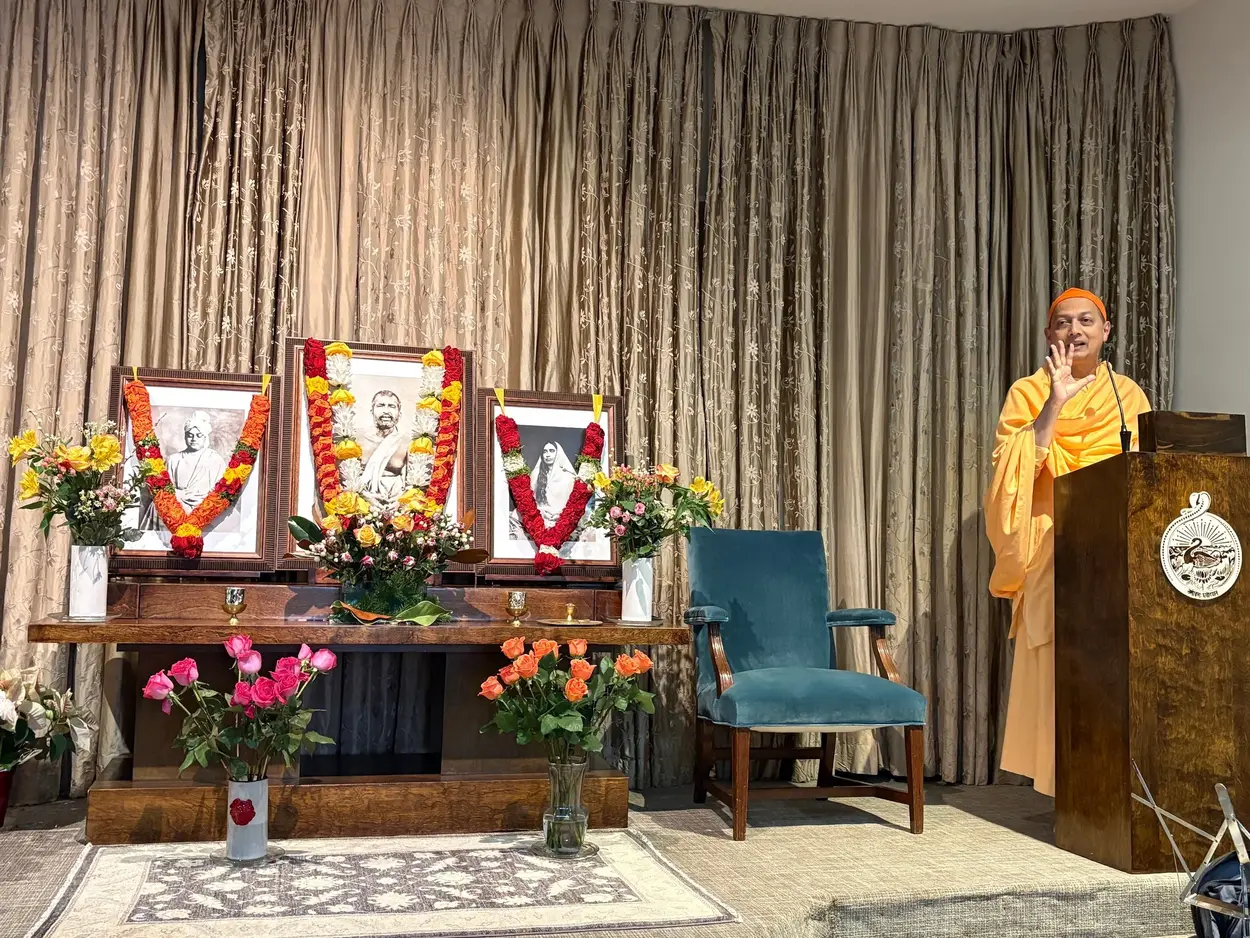
This invocation is not a poetic ornament placed at the beginning of a talk. It is a compass. It tells us what spiritual life is trying to do: reorient us from confusion to clarity, from fragmentation to wholeness, from fear to freedom. And if we look carefully at the tradition of Vedanta—as lived and taught in the modern world—we find that the “entire range” of spiritual life can be understood through one elegant framework: the four yogas.
These four are not four religions, nor four competing theories. They are four pathways that address the human condition from four angles:
- Karma Yoga: the way of work and service
- Bhakti Yoga: the way of love and devotion
- Raja Yoga: the way of meditation and inner discipline
- Jnana Yoga: the way of knowledge and inquiry
Why four? Because spiritual life is not one-size-fits-all. But more importantly, because the problem is not conceived in one single way. The “solution” you seek depends on what you think the “problem” is. The four yogas are like four medical specialists, each diagnosing the core issue differently—and therefore prescribing a different remedy.
What is striking is that each diagnosis is plausible, each remedy is powerful, and together they cover the whole spectrum of spiritual growth.
A simple key: the problem defines the path
A useful way to understand the four yogas is to ask: What exactly is the obstacle to freedom? The yogas answer differently:
- If the problem is selfishness, the remedy is unselfishness → Karma Yoga
- If the problem is desire flowing outward, the remedy is desire redirected to God → Bhakti Yoga
- If the problem is a scattered mind, the remedy is a focused mind → Raja Yoga
- If the problem is ignorance about who we really are, the remedy is knowledge → Jnana Yoga
Each yoga is a complete spiritual paradigm. Each is spiritual life in its own language. And each is practical—because it aims to transform the one place where bondage happens: the mind’s sense of “I” and “mine.”
Karma Yoga: from selfishness to unselfishness
Karma Yoga begins with a blunt diagnosis: the root problem is selfishness.
Not selfishness in the ordinary moralistic sense—like greed or rudeness—but a deeper selfishness: the automatic identification with this limited body and mind as “me.” From that identification flows the endless project of securing, defending, pleasing, and promoting this little personality.
Most of our days, months, and years are spent working for one central goal: make this “me” comfortable. We rarely question why the spotlight of concern is fixed so intensely on this one organism, this one story, this one set of preferences.
“Where in all of this is ‘I’?”
Sometimes, life offers a moment of pure insight.
Imagine a doctor—an oncologist—who spends his life reading scans of the body. He can identify bones, tissue, organs, structures. He understands the internal landscape with scientific precision. Then one day, looking at X-rays, he is struck by a question so simple it becomes explosive:
“In all of this, where is ‘I’?”
Not “where is the brain,” not “where is the heart,” but where am I—the one who is seeing, thinking, choosing, fearing, hoping? The body is a collection of parts. Which part is the “I”? The question is obvious only after it has hit you once.
The baby’s profound mistake: “This is… I!”
Another scene: a mother teaching her 17-month-old daughter how to name the world. The baby learns quickly: cloud, plane, toy bear. Each object is pointed out and labeled: this is that.
Then the mother shows a photo of the baby on the phone. “Who is this?”
And the baby does something fascinating. She doesn’t respond as she did with the bear or the plane. She doesn’t treat the photo as just another object. She points to the photo and, with total certainty, says:
“I.”
That one syllable carries the entire human story. Everything else is “this,” but the body-image is “I.” We identify so automatically with the body that it feels like reality itself. Yet the doctor’s question returns: which part is the “I”? The body can be examined, photographed, scanned. But the witness—the “I” that knows—cannot be found as a body-part.
Vedanta calls this misidentification the root of samsara: the endless cycle of dissatisfaction, fear, grasping, and loss. From “I am this body-mind” comes “mine”: my house, my reputation, my success, my people, my possessions. The circle of “mine” expands, but the center remains the same: the body-mind identity.
A shift from “mine” to “all”
Spirituality, in Karma Yoga, is the movement from this narrowed “mine” to a widened sense of belonging. A memorable phrase contrasts two ways of relating to people:
- “My nephew, my niece” — worldliness, attachment, possessiveness
- “All are my beloved” — compassion, divinity, reverence
It is the same set of people, the same world—only the vision changes. Karma Yoga trains this vision through action. It asks you to work, not as a prisoner of “me and mine,” but as a servant of something larger: humanity, truth, God, the Divine in all.
And this is why Karma Yoga is unique among the yogas: it is not private. Meditation may be invisible. Devotion may be interior. Philosophy may remain in the head. But Karma Yoga touches the public world. It engages with people and problems directly, where the ego is most easily triggered—and therefore where transformation is most needed.
Why Karma Yoga matters so much today
Modern life is saturated with work. Whether you are in a family, a workplace, or even a monastery, activity consumes time and energy. If spirituality is limited to a few minutes of prayer or meditation—while the remaining hours are spent in stress, competition, and restlessness—spirituality will always feel secondary, fragile, and easily defeated.
If “spiritual life” is a small compartment, the larger compartments will dominate.
Karma Yoga refuses that split. It says: make everything spiritual. Not by labeling your work as holy, but by transforming the inner motive: from self-centeredness to self-transcendence.
Work is not automatically Karma Yoga
Here we must clear a common misunderstanding. Doing a lot of work does not make someone a karma yogi. A person may be industrious, successful, and wealthy—and still be driven entirely by ego, craving, and fear.
Karma Yoga is not “being busy.” It is a spiritual discipline. It requires preparation: ethical training, inner refinement, and a higher goal. History offers examples: Gandhi, Martin Luther King Jr., Vinoba Bhave—people whose outward work was powered by inward ideals and inner sacrifice.
Karma Yoga is not an easy shortcut for those who struggle with meditation or faith. Like every yoga, it demands depth.
What does “karma” mean here?
The word “karma” is often translated as “work,” but in Karma Yoga it means something more specific. Not all activity is karma in this spiritual sense.
For an action to count as “karma” here, several conditions are involved:
- It is done by a living, sentient being (not a machine).
- It involves agency—a feeling of “I am doing.”
- It involves experience of results—enjoying or suffering outcomes.
- It has a moral dimension—good/bad, right/wrong, and freedom of choice.
- It produces consequences—what is traditionally called karma-phala, the “fruit” of action.
A computer can do astonishing tasks, but it does not feel triumph or humiliation. A chess program can win, but it does not rejoice. The human player experiences joy or pain. That link between agency and experience is part of what binds us.
Karma, in this sense, is a chain we wear along with the body. And every tradition in Indian philosophy—Hindu, Buddhist, Jain—takes this law seriously: intentional actions shape future experience.
Yet Vedanta also insists: all of this belongs to the realm of bondage. Spirituality aims at something beyond the machinery of reward and punishment. It aims at freedom.
The two movements of religion: outward and inward
Vedanta makes a classic distinction: Pravritti and Nivritti.
- Pravritti: the outward movement—engaging ethically with the world
- Nivritti: the inward movement—seeking transcendence, liberation, enlightenment
Most public religion emphasizes Pravritti: be moral, be ethical, live responsibly, sustain society. That is necessary. Families and organizations cannot survive without it.
But the core of spirituality—taught by saints, mystics, and sages—belongs to Nivritti: the quest for something beyond even the best worldly life. Beyond success, beyond comfort, beyond morality itself (not against morality, but beyond it): moksha, nirvana, God-realization.
Now here is a crucial point: ordinary moral work in the world is not yet Karma Yoga. It is good and necessary, but it still often aims at worldly goals—profit, security, recognition, social stability. Karma Yoga belongs to Nivritti. It turns work into a yoga—a path to liberation.
Shankara and Vivekananda: two emphases, one destination
A common confusion: “Did Shankara downplay Karma Yoga?” The answer is subtle.
Shankara’s emphasis is on knowledge: the problem is ignorance, the solution is knowledge of the Self. But Shankara also insists that knowledge does not work in an unprepared mind. If the mind is impure, scattered, or dull, teachings slip off like water off a stone.
So Shankara’s approach can be pictured as a sequence:
- Impure mind → purification → Karma Yoga (chitta-shuddhi)
- Scattered mind → concentration → meditation/upasana
- Ignorance → knowledge → Jnana Yoga (hearing, reflection, deep contemplation)
In this framework, Karma Yoga is essential, but it is primarily preparatory—a purifier that makes the mind fit for realization.
Swami Vivekananda, while rooted in Advaita, places a different emphasis. He teaches: freedom can be approached through work, love, meditation, and philosophy—one or more, or all together. His Advaita is often expressed not only as “the world is appearance” but as “the world is a manifestation of the One.”
Instead of only saying “the snake is false,” he highlights “the snake is nothing but the rope.” In other words: see the Divine everywhere. Engage the world as a field of spiritual practice.
This perspective naturally elevates Karma Yoga: if the Divine shines in all beings, then serving beings becomes serving God. “Serve all, knowing them to be Shiva” becomes not a slogan but a spiritual perception.
An enlightened person, it is said, is the one who can truly call the world “real”—not as separate from God, but as God appearing in forms. The world we cling to is dreamlike. The world seen through realization is luminous.
How to proceed: believe, then know
A practical question arises: To “know” the Divine in all beings, don’t you have to be enlightened?
Yes. To know it completely requires realization. Until then, we proceed by a form of trust—but not blind belief. It is closer to the trust you place in a teacher and a textbook: you assume there is truth here, you don’t grasp it yet, and you work to understand.
Bhakti leans more heavily on faith. Jnana leans on understanding. Karma Yoga often begins with intention: “Let me act as if this is sacred,” until experience deepens and perception transforms.
The three effects of karma: why action matters
Karma, in this spiritual sense, has three effects:
- Immediate outer effect: the visible result in the world
- Feed a hungry person; hunger is removed.
- Inner psychological effect (samskara): the impression left on your mind
- Repeated generosity makes generosity natural.
- Cosmic result (karma-phala): the longer-term consequence that returns as experience
- Pleasant or unpleasant results, shaped by ethical quality and intention.
From a spiritual viewpoint, even “good results” remain within the realm of limitation. Heavens and hells are not ultimate. They are still part of the “mess” of cause and effect. Spiritual freedom is not merely better experiences; it is freedom from being trapped by experience.
Three levels of Karma Yoga: renunciation in stages
Karma Yoga itself deepens through levels of renunciation:
- Phala-tyaga: renunciation of results
- Work as worship; offer outcomes to the Divine.
- Karma-tyaga (in the inner sense): renunciation of preference about the work
- Neither seek nor avoid; accept duties as forms of worship.
- Kartritva-tyaga: renunciation of doership
- The deepest level: “I am not the doer.” Nature acts; the Divine acts through nature.
The Bhagavad Gita expresses this radical insight: nature performs actions; the Self is actionless. The devotee phrases it more personally: “All is Thy will.” At this level, the sense of burden dissolves. Work is no longer ego’s project. It becomes the movement of the whole through this body-mind.
This is not easy. It is not a slogan. It is a realization that requires maturity. But it reveals why Karma Yoga can be a full path: it does not stop at ethics and service; it culminates in freedom from doership itself.
The four yogas as one integrated life
It would be a mistake to treat the four yogas as compartments: “I am a karma yogi” or “I am a jnana yogi.” In practice, most lives require all four.
- Work purifies and softens selfishness.
- Love redirects desire toward the highest.
- Meditation steadies attention and reveals depth.
- Knowledge ends the fundamental confusion about who we are.
The four yogas are four lenses on one truth. They are different ways to educate the heart and mind until the Self shines unobstructed.
And when that Self is known—not merely believed—the final instruction becomes simple and fearless:
Far beyond name and form, the Atman is ever free.
Know thou art That.
A closing reorientation
If spiritual life is reduced to a weekend retreat or a few minutes of practice, it will always feel fragile. The genius of the yoga framework is that it turns the whole of life into practice. Your work, your relationships, your attention, and your understanding become instruments of liberation.
The four yogas are not four escapes from life. They are four ways to transform life into a path—until the prayer becomes lived experience:
From the unreal to the real.
From darkness to light.
From death to immortality.
Om Shanti, Shanti, Shanti.
You will get Vedanta updates in your inbox.
Occasional reflections on Vedanta. Unsubscribe anytime.