Seeing God in Everything: A Rational Spirituality for Daily Life
Vedanta teaches: see God everywhere, dissolve desire-driven suffering, and live freely, compassionately daily.
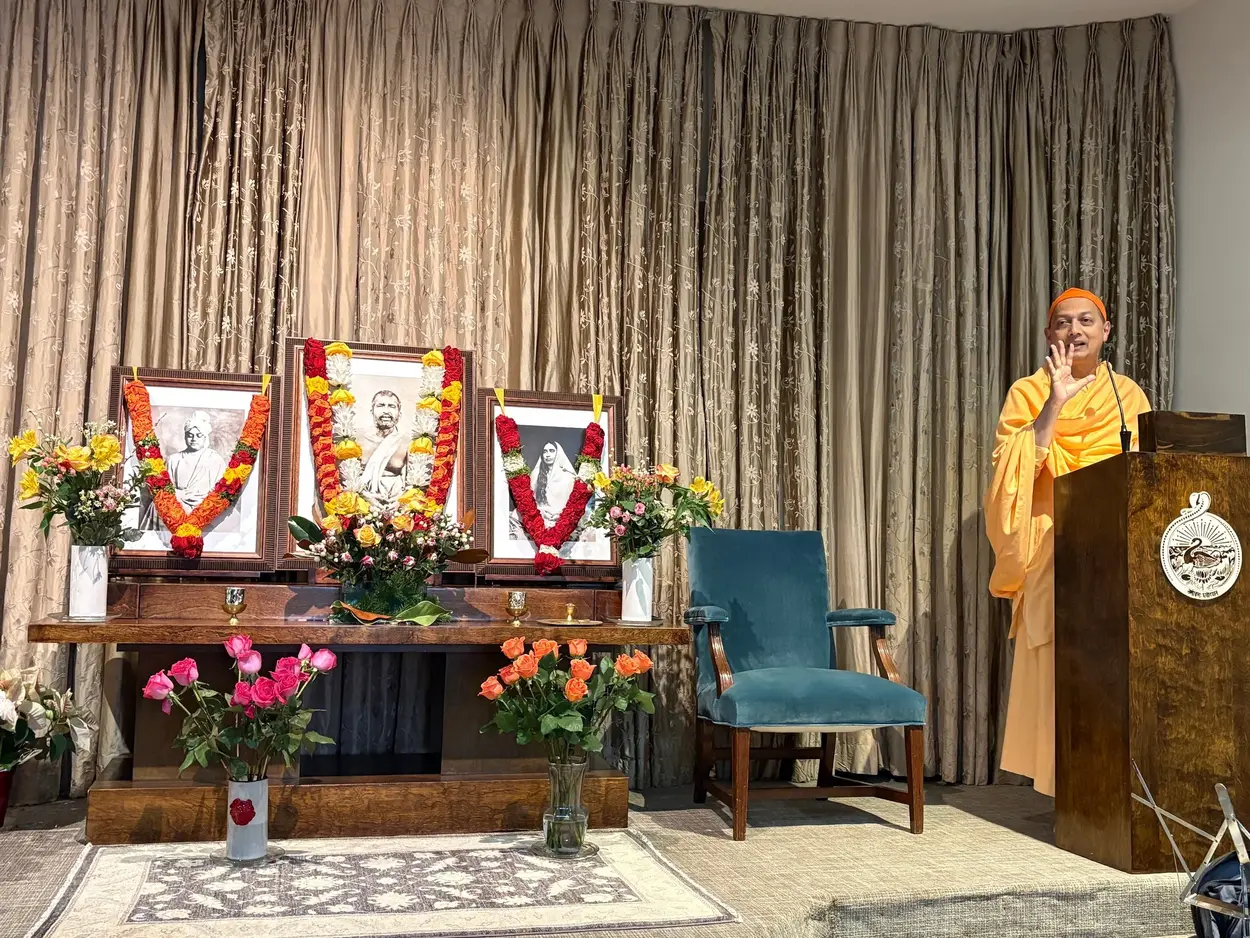
A reflective article inspired by a guided meditation talk on the Isha Upanishad and Swami Vivekananda’s “Jnana Yoga” vision.
The problem we all recognize: suffering, again and again
Most philosophies begin with a question. Most spiritual traditions begin with a wound.
You do not need to read a scripture to know that life carries suffering. Even when things are “fine,” some unease remains in the background: the next worry, the next loss, the next demand, the next fear. If one difficulty ends, another arrives; if a pain heals, a new anxiety appears; if one conflict settles, a fresh tension rises elsewhere. And the scale is not only personal. There is suffering in families, in workplaces, in societies and nations, and in our relationship with the natural world. The modern mind sees global crises and recognizes a hard truth: the causes of distress are not limited to individual mistakes. Suffering seems woven into the experience of living.
So we do what human beings always do: we search for solutions.
Some solutions are practical and necessary—healthcare, education, economic stability, emotional maturity, justice, community. Yet even after sincere effort, a deeper question remains: is there a way to be free inwardly, even while life continues outwardly? Is there a kind of happiness that does not depend on the next event? Is there a peace that does not collapse when circumstances change?
Religions have traditionally answered “yes.” They speak of a reality beyond suffering—moksha, nirvana, salvation, enlightenment—using different names but pointing to the same promise: freedom from bondage and a permanent ending of sorrow.
And then a modern person, honest with themselves, pauses.
If the world is what we experience as real right now—this body, these responsibilities, these relationships, this environment—how does it make sense to say: “Give up the world and gain God”? If God is only a belief or a theory to us at the moment, while the world is vividly present to our senses, the proposal feels like trading the real for the uncertain.
This is where Swami Vivekananda’s approach becomes so strikingly relevant. He does not dismiss the promise of religion. He challenges the framing.
If spirituality is offered in a way that seems to require rejecting life—rejecting beauty, joy, work, love, and all ordinary human experience—it will not satisfy a thoughtful mind. Worse, it may produce a distorted spirituality: either a headlong plunge into sense-driven living (“only this world is real”), or an escape into denial (“this world is bad; run away from it”). Both are extremes, and both fail.
The core insight of Vedanta—especially as Vivekananda presents it—is that the real solution is neither indulgence nor escape. It is a transformation of vision.
Why “giving up the world” often feels like a bad bargain
Many people inherit an impression of religion that sounds like this:
“This world is full of problems. The solution is elsewhere. Believe, obey, and after death you will reach the Real.”
Even when the teaching is sincere, it may sound like an unreasonable demand. We are being asked to abandon what we know for what we only hope. It can resemble a cure that harms the patient—like swatting a mosquito with a blow that destroys something essential in the process. If the “solution” requires discarding life itself, then the cure feels worse than the disease.
This is why thoughtful skeptics often reject religion—not necessarily because they deny mystery, but because they refuse an irrational exchange. They suspect that religion is asking them to shut down their intelligence.
Yet Vivekananda argues that true spirituality should engage both the heart and the head: reason and devotion, feeling and clarity. He insists that Vedanta can meet the modern mind precisely because it does not demand blind belief. It invites investigation and lived verification.
And its answer is bold:
Do not reject the world. Do not worship the world. See the Divine as the reality of the world.
The “deification of the world”: the Isha Upanishad’s startling claim
The talk that inspires this article revolves around a central Vedantic idea often summarized from the Isha Upanishad:
“All this—whatever moves in this universe—is pervaded by the Lord.”
At first glance, the phrase can be misunderstood as naïve optimism: “Everything is God, so just think positive.” That is not the point.
The point is not to paste a comforting label over pain. The point is to see more deeply what reality actually is.
Vedanta’s claim is not that the universe is nice. It is that the universe is divine in its essence—not because every event is pleasant, but because the ground of existence is one infinite reality.
In other words, spiritual life is not about painting holiness on top of life. It is about uncovering what is already true.
If that sounds abstract, Vedanta uses vivid metaphors to make it practical.
Sandalwood: you don’t spray fragrance; you reveal it
Imagine a block of sandalwood. If a dull layer forms on its surface, it may smell unpleasant. But the true fragrance is not imported from outside. The fragrance is inherent. With steady rubbing, the outer layer is removed and the natural scent emerges.
Vedanta says: you do not “add God” to the world like perfume. You remove ignorance, and the truth that is already present becomes evident.
Gold and ornaments: the mistake is searching for gold “apart” from the necklace
A child looks into a jeweler’s safe and reports: “No gold here—only necklaces and bracelets.” The child assumes gold must be a separate substance. The father smiles: “Bring any ornament. It is all gold.”
This is the key. We often search for “God” as if God must be separate from life. But if the Divine is the underlying reality, then searching for it apart from life is like searching for gold apart from ornaments.
This is the “third option” Vivekananda emphasizes:
- If you cling to the world as final reality, you miss the Divine.
- If you reject the world to find God elsewhere, you miss the Divine.
- If you see the Divine as the reality of the world, you find what you were seeking without fleeing life.
What happens to renunciation when everything is pervaded by God?
A common misunderstanding is that spirituality demands abandoning family, career, relationships, and responsibilities. Many people fear that serious spirituality means becoming dry, joyless, or withdrawn.
Vedanta offers a more subtle renunciation.
Renunciation is not primarily about changing your address; it is about changing your identification.
If you believe happiness comes from grasping objects, praise, control, or possession, you become a restless seeker. Desire grows. Fear grows. The mind is pulled outward. Even when you gain something, anxiety shifts to maintaining it. Even when you lose it, grief deepens into a story: “I am incomplete.”
But if you recognize the Divine as the reality within all experience—within yourself and within others—then the compulsive need to “complete yourself” through external acquisition begins to fade.
This is why the Isha Upanishad pairs its vision with a striking instruction:
Live with renunciation—do not covet.
That does not mean: “Live without beauty or comfort.” It means: “Stop assuming your fulfillment depends on possessing what is outside you.”
When you see the same reality everywhere, coveting becomes illogical. What would it mean to grasp at “more” when the ground of your being is already fullness?
The Princess of Kashi: desire collapses when identity shifts
One of the most powerful teaching stories is deceptively simple.
A prince sees an old portrait of a beautiful “princess” and becomes obsessed: “I must have her.” He suffers until a wise minister reveals the truth: the portrait was actually the prince himself, dressed as the princess in a childhood performance.
The obsession evaporates instantly—not because the prince got what he wanted, and not because the beloved object died, but because the “other” was never truly other.
Vedanta says our cravings often resemble this. We chase objects, status, or relationships as if they contain the missing piece of ourselves. But the true “missing piece” is not outside. It is the recognition of what we are.
When the Self is known—when inner fullness is glimpsed—desire changes character. Life continues, work continues, love continues, but the frantic grasping loosens. The heart becomes less desperate, more spacious, more free.
A deeper meaning of “the world is appearance”
Vedanta sometimes uses language that can sound dismissive: “the world is illusion,” “the world is appearance,” “the world is maya.” Many misunderstand this as nihilism, as though Vedanta is saying: “Nothing matters.”
That is not the mature reading.
Two purposes are often emphasized:
- Dispassion: If something cannot give lasting fulfillment, clinging to it will hurt. Recognizing its limitations generates inner freedom.
- Direction: Calling the world an “appearance” points to the underlying reality—like recognizing a snake as a rope does not merely remove fear, it reveals what was always present.
The rope does not appear after you correct the error. The rope was always there, even while you were afraid. Similarly, the Divine is not something you manufacture by becoming spiritual. It is what is already real, even when you do not see it.
This is why the teaching “God is in everything” is not sentimental; it is radical. It claims that the sacred is not postponed to some distant heaven or future enlightenment. The sacred is here—hidden by misunderstanding.
How can consciousness be “still” and yet “faster than the mind”?
The Isha Upanishad expresses the Self in paradox: unmoving, yet faster than the mind; nearer than the nearest, yet farther than the farthest.
Paradox is not decoration—it is a pointer. The Self cannot be captured by ordinary categories, because the Self is the condition of all categories.
Consider electricity. Electricity does not “spin” like a fan or “shine” like a bulb in itself. Yet through devices, it appears as spinning and shining. Without electricity, the fan and bulb cannot function at all.
Likewise, pure consciousness does not walk, speak, or laugh in itself. Yet through body and mind it appears as all these activities. And without consciousness, no experience exists whatsoever.
So the Upanishad says: it does not move, yet all movement depends on it. It is still, yet it is “ahead” of every mental event because every mental event appears within it.
This is not mystical poetry for its own sake. It is meant to turn your attention inward: not to a concept, but to the immediate fact of awareness.
Before any thought arises, awareness is present. Before any sensation is interpreted, awareness is present. That awareness is not distant. It is not theoretical. It is the most intimate reality you know—yet you rarely notice it because you are always focused on its contents.
If this vision is true, how do we live?
Here the talk becomes intensely practical.
If you accept—even as a hypothesis—that one reality pervades everything, then how should you live?
A common fear is: “If everything is God, why act at all? Why work? Why care?”
Vedanta replies: you can finally act without being imprisoned by action.
When work is driven by insecurity, craving, fear, or ego-protection, it entangles the mind. But when work flows from inner fullness—when you no longer use work to prove your worth—action becomes freer, cleaner, more compassionate, and less exhausting.
The Isha Upanishad even celebrates active life:
Live fully—work in this spirit—live a long life of meaningful engagement.
Work becomes worship when you see the One in the many.
This is not a denial of ethics. It is the deepest foundation for ethics. When you see others as not separate from your own reality, compassion stops being a moral project and becomes a natural expression.
A practical entry point: if you can’t see God in everything, start with one
There is also a compassionate realism in Vivekananda’s approach.
“See God in everything” may feel too vast at first. The mind rebels: “In that person? In that situation? In this pain?”
So an alternative is offered: begin with one.
Choose one form of the Divine that your heart can love: a personal ideal, an incarnation, a symbol, a sacred name, a practice that awakens reverence. Hold to it deeply. Let it become real in your life—not merely as an idea but as devotion, gratitude, remembrance.
Then, gradually, let the boundaries soften.
The same love that begins in one place expands. First you see the Divine in what you adore. Then you begin to glimpse the Divine in what you tolerate. Then, unexpectedly, you begin to see the Divine even in what you once resisted.
This is not imagination. It is training perception—like learning to hear subtle music after years of noise.
Why we forget: the world “punches us in the nose”
Even if we agree with these teachings intellectually, daily life challenges them. A harsh word, an unexpected problem, a betrayal, a loss—suddenly the mind rushes into anger or fear. The lofty vision disappears.
Vedanta does not insult us for this. It explains it. Habit is strong. Identification with the body and ego is ancient. The mind moves toward pleasure and away from pain like an animal moves toward grass and away from a stick.
So the prescription is simple, though not easy:
- Hear these truths again and again.
- Reflect until they become clear.
- Meditate until they become intimate.
- Practice in small ways until they become natural.
Even a little practice changes the quality of fear. A little practice loosens anxiety. A little practice makes you less reactive and more steady. The teaching does not demand perfection before it offers benefit. It works the way exercise works: small daily effort produces real strength.
The fruit: freedom from hatred, delusion, and the sting of sorrow
The Isha Upanishad describes a person who sees all beings in the Self and the Self in all beings. From that vision, two outcomes are emphasized:
- No hatred—because harming another begins to feel like harming your own reality.
- No delusion, no grief—because separation was the root of fear, and separation collapses in the light of oneness.
This does not mean such a person becomes passive or numb. It means they become inwardly unshakable. They still respond, still act, still care—but the response does not come from panic. It comes from clarity.
And this may be the heart of the message:
The world does not have to be rejected for God to be found.
God does not have to be postponed for peace to be real.
You do not have to wait for a future perfection to live with meaning.
The invitation is to look again—deeper—at what you already experience.
To see the gold in the ornament.
To recognize the rope where fear projected a snake.
To uncover the fragrance that was always present.
And then to live in a way that reflects that truth: less grasping, less fear, more steadiness, more love, more freedom.
Closing reflection: the infinite here, the infinite now
The concluding spirit of this teaching is not bleak renunciation. It is fullness.
Not emptiness, but completion.
Not escape, but illumination.
Not denial of life, but transfiguration of life.
If the Infinite is truly the ground of everything, then the search for wholeness is not a chase across the world. It is a recognition—quiet, profound, and practical—that what you seek is nearer than the nearest.
And the life that follows from this recognition is not smaller.
It becomes blessed, purposeful, and fearless—because it rests not on fragile circumstances, but on the unchanging reality shining through all circumstances.
Peace, peace, peace.
You will get Vedanta updates in your inbox.
Occasional reflections on Vedanta. Unsubscribe anytime.