Bhagavad Gita’s Real Promise: Lasting Happiness Beyond Pleasure, Power, and Success
Gita teaches lasting happiness: stop chasing externals, awaken inner Self, act courageously toward moksha.
The opening mood of the Bhagavad Gita can feel surprising if you approach it expecting a book about religion in the conventional sense, or a text meant to teach strategy, leadership, or even morality. The setting is dramatic: a battlefield, armies facing each other, and a warrior, Arjuna, suddenly collapsing into doubt. Yet the real subject of the Gita is not war. The battlefield is a stage—an intense backdrop used to reveal something far more universal: the human search for lasting happiness and the permanent ending of suffering.
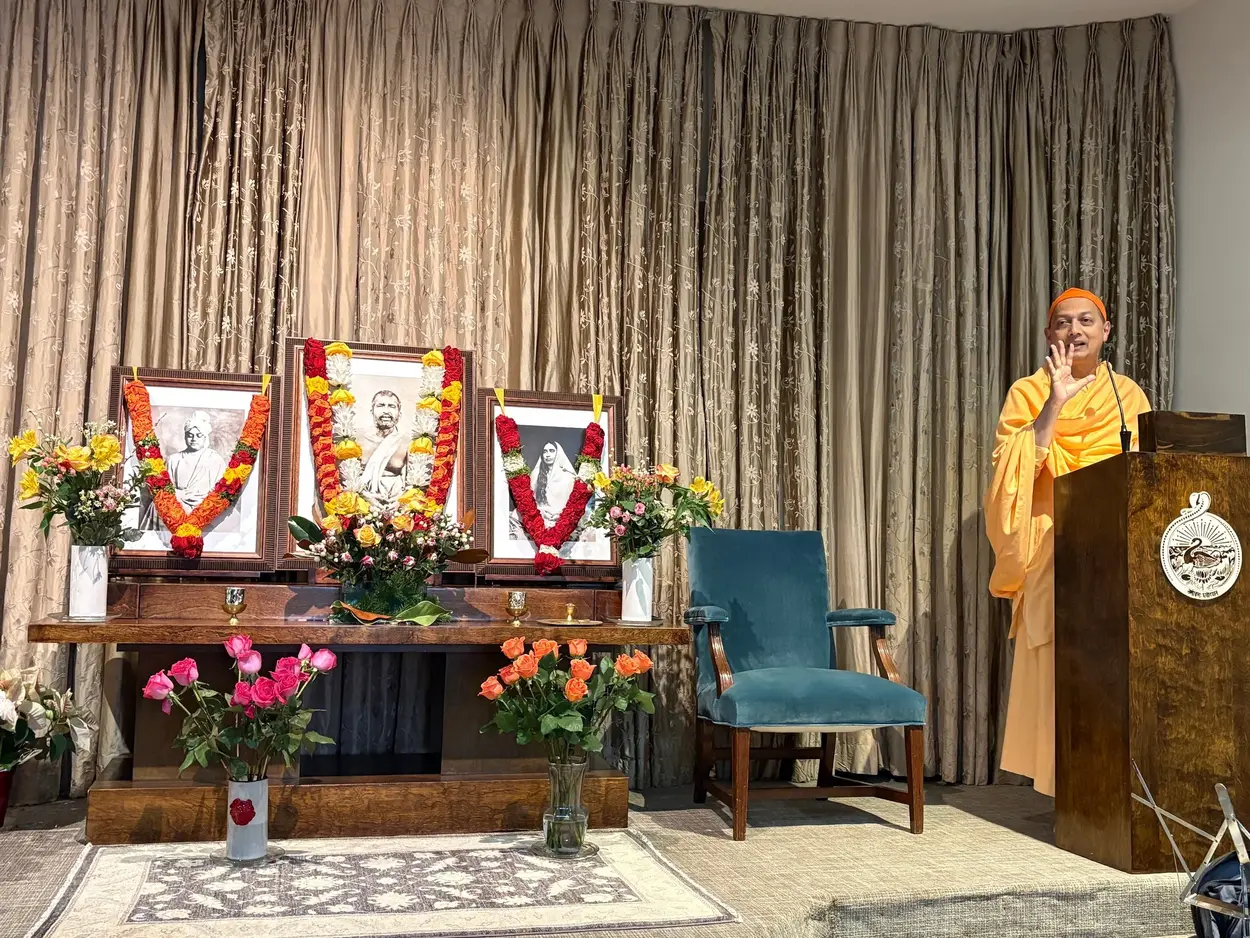
Long before modern conversations about “purpose,” “well-being,” or “inner peace,” spiritual teachers in India framed life’s central question with startling clarity. Sri Ramakrishna famously said the goal of human life is God-realization. Swami Vivekananda expressed it in a way that feels modern and empowering: the goal is to manifest the divinity within us. Both statements point to the same conclusion, but many of us instinctively resist it.
If someone asks, “What is the goal of life?” our immediate reaction is often polite agreement—maybe that is the highest goal—followed by a quiet inner objection: “Not right now.” Right now, we think, life is about earning money, caring for family, building a career, staying healthy, enjoying relationships, and finding a reasonable level of happiness. These are not wrong. In fact, they are deeply human. But if we examine them honestly, we discover that they are driven by one central motivation: the desire to feel fulfilled and to escape suffering.
Whether we pursue that fulfillment through worldly means or spiritual practice, the impulse underneath is the same. We want happiness. We want peace. We want freedom from the aching sense that something is missing.
Looking for Happiness in the “Outside World”
In our early attempts at solving the problem of unhappiness, we usually assume the solution lies outside us. When we feel poor or insecure, we think wealth will fix it. When we feel lonely, we believe a relationship, marriage, or a wider social circle will finally make us whole. When we feel unnoticed, we chase recognition and status, imagining that being seen and praised will cure the inner emptiness.
The mind makes a simple calculation: “I feel incomplete because I lack something. If I obtain it, I will become complete.” This assumption fuels countless decisions—some wise, some impulsive, many exhausting. We reach for a quick burst of pleasure, like a snack, entertainment, or a pleasant social moment, hoping it will provide relief. Or we pursue bigger achievements—career growth, financial security, influence, admiration—believing that the next milestone will deliver stable happiness.
Yet life teaches a painful lesson: even when we get what we want, the satisfaction doesn’t stay. The mind quickly moves the goalpost. It searches again. And again.
It is here that the Bhagavad Gita enters—not as a moral lecture, not as a history lesson, and not as a manual for worldly victory, but as a guide to a deeper solution. The Gita says, in effect: What you are seeking does exist—real happiness, lasting freedom from suffering—but you are searching in the wrong place.
The Gita as a Moksha Shastra
The Gita belongs to a category of texts called a moksha shastra: a scripture concerned with liberation. Moksha means freedom—freedom from the cycle of dissatisfaction, fear, and sorrow; freedom from the inner compulsion that makes us chase temporary relief again and again; freedom from the suffering that returns no matter how cleverly we arrange our external circumstances.
This is an important point to understand early. The Gita is not primarily about teaching people how to have a more enjoyable worldly life—though it can make your life steadier and wiser. It is not a book whose main purpose is to help you “win” in the conventional sense. It may offer insights that improve your decision-making, but it does not exist to turn you into a multi-millionaire, a celebrity, or a corporate champion. If your question is, “Will this help my career?” the Gita might indirectly benefit you, but that is not its promise.
Its promise is something more radical: permanent freedom from suffering and a kind of happiness that does not depend on external conditions.
That is why comparisons to the Buddha’s quest feel natural. Buddhism begins with the recognition of suffering and the question: “Is there an end to this?” The Gita also addresses the same foundational human concern, though through its own language and framework.
Dharma, Artha, Kama: The Three Worldly Goals
The Gita’s teaching becomes especially clear when we see how human pursuits are traditionally categorized. Most worldly activity can be grouped into three aims:
- Kama — pleasure, enjoyment, immediate satisfaction.
- Artha — wealth, power, accomplishment, status, security.
- Dharma — morality, duty, decency, religious merit; the good we do, which is believed to generate beneficial results.
These three can cover an enormous range of human goals. Even seemingly complex ambitions often reduce to them: pleasure and comfort (kama), success and stability (artha), and being a good person or living rightly (dharma).
In many traditional frameworks, dharma supports artha and kama: live well, do good, and you will gain favorable outcomes—more stability and enjoyment. But even if all three succeed, one problem remains: none of them guarantees lasting peace. Pleasure fades, wealth cannot protect us from every loss, and even moral success does not remove existential anxiety. Life still changes. Bodies age. Relationships shift. The mind remains restless.
Spiritual life begins when we see this clearly—not cynically, but honestly: we have tried and tried, and the deep hunger remains.
Not a War Text, Not Just “Gita for Management”
Because the Gita is set on a battlefield, it is easy—especially for outsiders—to misread it as a text endorsing violence. Yet in the vast tradition of commentaries spanning more than a millennium, the war is treated as context, not the point. The struggle is symbolic: it reflects the inner conflict, the moral and psychological pressure of real life, the tension between duty and emotion, fear and courage, confusion and clarity.
This matters because modern minds often latch onto what feels controversial: “Why is God telling someone to fight?” But a long tradition within India has understood the battlefield as the scene where life’s hardest questions arise. That is why figures like Mahatma Gandhi could find inspiration in the Gita for non-violence and inner strength. The Gita’s center is not aggression; it is liberation.
Similarly, the Gita is sometimes marketed as a guide to productivity, leadership, stress reduction, or organizational success. There is truth in the fact that the Gita contains timeless wisdom that can improve life. But those benefits are secondary. If we reduce the Gita to a self-help toolkit, we miss what it is really trying to do: take us beyond the endless cycle of patching external life in hopes of fixing internal dissatisfaction.
The Gita does talk about action, discipline, meditation, and stability. But it talks about them as means toward moksha—enlightenment, freedom, inner completeness.
Two Essential Questions of Spiritual Life
A striking connection appears when we bring in a scene from the life of Sri Ramakrishna. In the Gospel, a student asks two questions that capture the heart of spiritual practice:
- How do I keep my mind on God?
- How do I live in this world?
These two questions are also the Gita’s heartbeat. One is inward—attaining the deepest realization. The other is practical—how to live, act, and serve in the midst of daily life. Spirituality is not only about transcendent experience; it is also about embodying it.
Arjuna, standing in crisis, becomes the representative of every human being who has reached a breaking point. His battlefield is not just a historical moment; it is the moment when life forces us to confront our deepest confusion.
Why the Gita Begins with a Breakdown
Arjuna begins confidently. He is a warrior, trained, respected, prepared. He asks Krishna to position the chariot so he can see who has come to fight. Krishna, acting with deliberate psychological precision, places the chariot where Arjuna must face the people he loves most: elders, teachers, relatives. The reality hits him like a wave.
Suddenly the “cause” and the “strategy” do not feel as clean as they did before. He imagines victory with a hollow taste: what is the point of triumph if those for whom he would enjoy it are gone? His bow slips from his hands. He sits down overwhelmed, stuck between two truths: duty demands action, but the heart recoils from the cost.
It is a profoundly human moment. Many of our greatest crises are exactly like this. We can intellectually justify a decision, yet emotionally we cannot move. Or we feel morally pulled in two directions. Or we see our own patterns clearly, yet lack the strength to change them. The mind becomes paralyzed.
And in that paralysis, something important is still missing: Arjuna has not yet asked for help.
Krishna’s First Words: Not Philosophy, but a Wake-Up Call
When Krishna finally speaks, he does not begin with lofty metaphysics. He begins with something closer to common sense—a sharp shock meant to break paralysis.
He essentially says: “How has this weakness come over you at this critical moment? This is not worthy of you.” He points out the practical consequences in the language of Arjuna’s world: this collapse will not bring honor, it will not help him, it will lead to shame and failure.
Then Krishna delivers a line that a modern listener might mistake for mere motivational coaching: Do not yield to faint-heartedness. Stand up. Take action.
Swami Vivekananda emphasized the deeper meaning here. No teacher can help us—no scripture, no saint, no philosophy—unless we are willing to move from helplessness into sincere effort. Grace and guidance become effective only when a person chooses, even slightly, to participate in their own transformation.
This is the turning point between two types of suffering:
- The suffering where we still believe we know the solution (“If I just avoid this, run away, rearrange the outside…”)
- The suffering where we finally admit, “I don’t know what will truly free me. Please guide me.”
Krishna does not pour spiritual instruction into a mind that has not become receptive. He waits for the moment of surrender—not passive surrender, but the honest admission of confusion paired with willingness to change.
That is why, in this teaching, the first requirement is not brilliance or scholarship. It is readiness. Readiness to stand up from inner collapse. Readiness to act. Readiness to learn.
The Difference Between Knowing and Changing
A striking example appears through the contrast between Arjuna and his adversary, Duryodhana. Duryodhana, in a moment of rare honesty, admits something that many people quietly recognize in themselves: “I know what is right, but I don’t feel like doing it. I know what is wrong, but I cannot stop myself.”
That is the tragedy of being trapped in one’s own impulses. It is also the reality behind addiction and compulsion. Knowledge alone does not save us. Self-awareness alone does not liberate us.
Arjuna will later ask a related question, but with a crucial difference: “Why do people do wrong even when they don’t want to? What is the force that drives them—and how can we change?” That question contains hope. It contains humility. It contains the desire for transformation.
And that is the camp Krishna responds to.
The Gita as the Essence of Vedanta
Tradition places the Gita among the foundational texts of Vedanta, alongside the Upanishads and the Brahma Sutras. The Upanishads are profound and often poetic, dense with insight. The Gita takes that essence and offers it in a more accessible and practical form, harmonizing multiple paths of spiritual life.
Rather than pushing one narrow approach, it integrates what later teachers described as the major yogas:
- Jnana Yoga — the path of understanding and knowledge
- Bhakti Yoga — the path of devotion and love
- Karma Yoga — the path of selfless action
- Raja Yoga — the path of meditation and inner discipline
This harmony is part of why the Gita has attracted such a long and rich tradition of commentaries—from Shankaracharya to Ramanuja to Madhva, and countless others. Different philosophical frameworks have drawn different meanings, like travelers drawing water from a deep well. Instead of forcing the Gita into one system, the tradition suggests something more generous: the revelation comes first, and interpretive frameworks arise later.
Beginning Where the Teaching Truly Begins
The Gita’s brilliance is that it does not remain theoretical. It begins in the heat of life, in confusion, in emotional conflict. And it pushes the seeker toward the necessary first step: stop surrendering to weakness.
This is not a denial of pain. It is an insistence that pain must become fuel for awakening. Arjuna’s breakdown is not an ending—it is the gateway. When he finally says, with honesty, that he does not know what is truly good for him and seeks Krishna’s guidance, the real teaching begins.
In that sense, the Bhagavad Gita is not merely a scripture we read. It is a mirror. It shows us our own patterns—our search for happiness in the external world, our repeated disappointment, our inner paralysis, our half-hearted attempts at change. And then it offers a promise that is both challenging and liberating:
What you seek is within. Real peace is possible. But it begins when you stand up—when you become willing to transform, not just rearrange your circumstances.
That willingness is the first opening of spiritual life. From there, knowledge, devotion, meditation, and action become powerful supports. Without it, even the greatest teachings remain beautiful ideas.
The Gita’s first gift is therefore not an answer to every question. It is the awakening of the seeker: the moment you stop negotiating with your own weakness and decide to move—one step at a time—toward liberation.
You will get Vedanta updates in your inbox.
Occasional reflections on Vedanta. Unsubscribe anytime.