Dissolution of the Mind: Why Vedanta’s Freedom Feels Like Lightness
Mind dissolution means spiritualizing the mind—through inquiry, devotion, service, and meditation—into lasting freedom.
The chant that opens many Vedantic talks is not a poetic decoration. It is a map. “Lead us from the unreal to the real, from darkness to light, from death to immortality.” It begins with honesty: our ordinary life feels mixed—some clarity, some confusion; some joy, some heaviness; some love, some fear. The prayer asks for a transformation that is both profound and practical: not merely new ideas, but a new way of being.
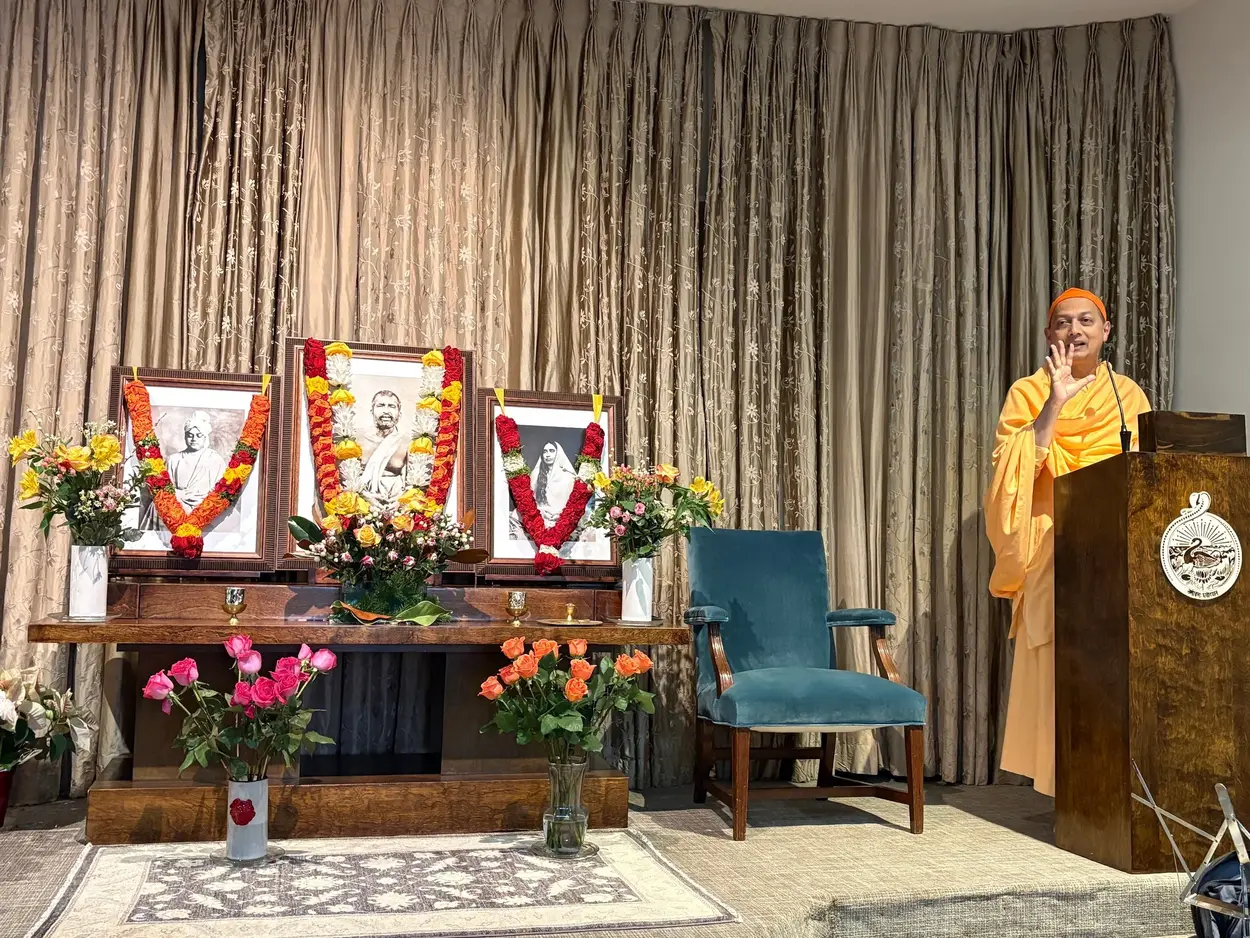
In that spirit, an ancient-sounding phrase is introduced with an almost comical edge: “dissolution of the mind” (often named manolaya or even manonāśa, “destruction of the mind”). The words can sound alarming, as if spirituality were a campaign against thinking. But in Vedanta, these expressions point to something far more humane: a mind that is no longer burdened, no longer enslaved, no longer tossed around by every impression. The paradox is that what looks like “losing the mind” is actually gaining a brighter, freer, and kinder life.
The Joke Behind the Fear
The talk begins with humor for a reason. Jokes defuse a deep misunderstanding: spirituality is not meant to turn you grim. When someone hears “dissolution of the mind,” they may imagine becoming blank, numb, or detached in a cold way. Yet the tradition suggests something almost opposite—what emerges is a life that feels lighter and, in a sense, “hilarious,” not as mockery but as inner ease.
There is a subtle insight here. A mind weighed down by anxiety, guilt, fear, and compulsive wanting cannot genuinely relax into happiness. Even moments of pleasure carry the tension of “What if I lose this?” or “What if it doesn’t last?” But the sages speak of a freedom where the mind is unburdened—awake, responsive, compassionate—and yet not internally cramped.
This is why spiritual masters often display a surprising cheerfulness. Not because they are insensitive, but because they are no longer chained to the endless commentary of the ego. A famous saying captures it well: a sad renunciate is missing the point. If spirituality is real, it should soften the inner knots, not tighten them.
Enlightenment Has Two Meanings
The talk offers a clever way to reframe enlightenment: “light” has two meanings.
- Light as illumination: the truth is revealed. You understand what you truly are.
- Light as lightness: you feel unburdened. Life becomes less heavy.
Most people associate enlightenment only with the first sense—knowledge, insight, realization. Vedanta certainly values that. It insists that the deepest ignorance is mistaking ourselves to be only a body-mind entity trapped in the world. But Vedanta also insists on the second sense: if realization does not bring inner freedom, if it does not reduce fear and sorrow, something remains incomplete.
This is where the “dissolution of the mind” becomes relevant. It is not a denial of intelligence. It is the removal of the mind’s compulsive cling—its tendency to identify with every thought, every sensation, every wave of emotion as “me” and “mine.”
When Non-Duality Stays in the Head
A striking diagnosis appears in the talk: sometimes people study non-duality for years—read the texts, understand the arguments, even teach others—yet become shaken when life delivers hard knocks. Illness, grief, failure, conflict, aging—these can expose a gap between intellectual conviction and lived freedom.
The tradition recognizes different levels of reality: the ultimate, the transactional world of everyday life, and the purely mental world of imagination and error. The danger is that one’s spirituality becomes trapped at the “mental” level—non-duality as a sophisticated concept rather than a transforming truth. It can remain an elegant philosophy that does not penetrate the reflexes of fear, craving, and grief.
So the question arises: How does understanding become liberation? How does insight become steady, not just inspiring in a lecture but stabilizing in life?
The Three Pillars of Liberation While Living
A classic Advaitic analysis (presented in the talk through the lens of traditional texts) describes three components of jīvanmukti—liberation while living:
-
Realization of truth (tattva-bodha)
The recognition: “I am not merely the body and mind. I am awareness itself.”
This is the illuminating side of enlightenment. -
Exhaustion of compulsive tendencies (vāsanākṣaya)
Not only dropping obvious cravings, but weakening the deeper momentum of “I must have this to be okay.”
Desires can be worldly or “otherworldly”—the hunger for status, experiences, even spiritual achievement. -
Dissolution of the mind (manolaya / manonāśa)
Not the destruction of cognition, but the mind’s release from compulsive outward fixation—so it can rest in the truth at will.
The implication is clear: insight is essential, but the proof of insight is stability—freedom from being internally dominated.
What “Dissolution” Actually Means
If the mind is not literally destroyed, why use such strong words?
Because what is dissolved is the mind’s false sovereignty—its habit of behaving like the boss of your life. The mind constantly reacts: chasing, resisting, replaying, predicting, judging. It becomes a noisy “manager” that never stops talking.
In “dissolution,” that manager is gently demoted. The mind remains functional—often more functional than before—yet it no longer rules as the center of identity. The mind becomes, in an old phrase, “spiritualized.” It becomes a refined instrument rather than a restless master.
A memorable line from the talk highlights this: the body may suffer, but it is the mind that becomes saintly. The body is designed to change, age, and eventually break down. The spiritual work is not to demand perfection from the body, but to cultivate a mind that can remain clear, kind, and steady even amid bodily or worldly difficulty.
Two Great Approaches: Stillness and Inquiry
The tradition describes two broad paths toward this transformation:
1) The Yogic Way: Still the Mind
Yoga defines itself as the quieting of mental movements. The logic is simple: when the mind’s fluctuations settle, the witnessing awareness shines unobstructed. In deep absorption (samādhi), the world-experience fades from attention, not by force against the world, but by inward stabilization.
This is not dullness. The talk emphasizes that authentic samādhi is not sleep or anesthesia. It is often described as the most alert state, yet still.
2) The Vedantic Way: See the Truth Even While the World Appears
Vedanta offers another possibility: you can realize the underlying reality through inquiry and understanding, even while life continues. The “movie” of experience can keep playing, yet you recognize the “screen” as the constant basis.
However—and this is crucial—the talk warns against using this as an excuse. “Eyes-open non-duality” can become a convenient slogan that collapses into ordinary worldliness if it is not backed by inner capacity. To prevent self-deception, Vedanta strongly values the ability to turn inward, to rest in awareness, to switch off the movie—not externally, but in one’s own experience.
In other words: even if your philosophy says the world is the screen, you should still be able to sit quietly and know the screen directly.
The Tortoise Skill: Withdrawing at Will
A vivid image appears from the Bhagavad Gītā: the steady person can withdraw the senses like a tortoise draws in its limbs. This points to a concrete skill: you should be able to step back from compulsive engagement—whether it is the phone, the gossip, the mental argument, the emotional surge.
Without this capacity, we live as servants of servants: awareness is enslaved by the mind, and the mind is enslaved by the senses. “You must look, you must taste, you must react.” The mind becomes a puppet. Dissolution of the mind means cutting the strings.
It does not mean becoming indifferent in a heartless way. It means becoming free enough to respond wisely rather than react blindly.
Bhakti and Karma: Dissolution Through Love and Service
The talk refuses to reduce spiritual life to one technique. It shows that “dissolution of the mind” can appear in different forms:
Devotion: Absorption in the Divine
A devotee may say: “Why silence thoughts? Let my thoughts be filled with God.” Singing, prayer, worship, remembrance—these can absorb the mind so thoroughly that ordinary anxieties lose their grip. The mind becomes “dissolved” in love, not by suppression but by sweetness.
A key condition is emphasized: freedom from anxiety. If your devotion increases but anxiety remains chronic, something is incomplete. The devotional vision says: if the divine reality sustains the universe, it can sustain you too. Trust is not naïve; it is a spiritual practice.
Selfless Action: Dissolution of Self-Centeredness
Karma yoga dissolves the narrow “me-first” mind by turning life into service. When you serve the divine in others—feeding the hungry, educating the uneducated, helping the distressed—your identity expands. The ego’s obsession with personal gain is gradually eroded.
The talk makes an important moral correction here: inner joy does not mean indifference to suffering. In fact, genuine compassion is more likely to arise from inner freedom than from sentimental overwhelm. It is easy to cry at distant tragedies and yet be unkind to the person beside us. Real compassion translates into action, steadiness, and sustained care.
The Fire-Sacrifice Within: A Practical Vedantic Method
One of the most powerful sections of the talk offers an inner practice using the imagery of a Vedic fire ritual.
The idea is simple, yet radical:
-
Offer the world into the senses
Everything you experience as “out there” arrives as seeing, hearing, taste, smell, touch. Your lived world is inseparable from these modes of experience. -
Offer the senses into the mind
Without attention, the senses do not truly “deliver” experience. You can look and not see if the mind is elsewhere. -
Offer the mind into consciousness
Thoughts, emotions, memories, ego-sense—these appear in awareness. The mind is not an independent entity; it is a pattern appearing in consciousness.
This is “dissolution”: a step-by-step inward merging. The “three worlds” become like a straw offered into the fire of awareness. Not because the world is denied, but because the assumption of an independent, external reality loses its grip in direct experience.
A helpful pointer is given: the dream proves that the mind can generate a world without external inputs. In waking life, too, what you experience is always filtered and assembled within awareness. Recognizing this turns the mind inward. And when the mind turns inward, it becomes less enslaved.
A memorable encouragement is offered: worrying about the world is the mind’s work; illuminating the mind is the witness’s work. When your concern shifts from “Why is the world like this?” to “Why is my mind reacting like this?” you are already stepping into the witnessing stance.
Five Ways the Mind Becomes Free
The talk concludes by summarizing five practical avenues for dissolving the mind’s bondage:
- Inquiry: repeatedly trace experience back to awareness—world to senses, senses to mind, mind to consciousness.
- Devotion without anxiety: love the divine with trust, not with constant inner bargaining.
- Letting go of desires: not only small cravings, but the deeper dependence on outcomes for peace.
- Breath discipline (with care): steadying breath can steady mind, but it should be practiced responsibly and ethically.
- Satsanga: the company of the spiritually mature—where the mind naturally turns inward, inspired by living examples.
Each method aims at the same result: a mind that can rest in truth, not just talk about it.
The Real Test: Can You Be Shaken and Still Stand?
Vedanta is uncompromising about one point: the goal is not an impressive philosophy. The goal is freedom in life—freedom that remains when illness comes, when loss comes, when life surprises you.
The promise is not that problems disappear. The promise is that you are no longer internally dominated. You can be active, compassionate, engaged—yet inwardly unburdened. This is why enlightenment is not only illumination, but lightness.
So the “dissolution of the mind” is not a threat. It is an invitation: to live with a mind that is refined, steady, and kind; to be free from compulsive fear; to be capable of silence; to be capable of love; to be capable of service; and to recognize, again and again, the awareness that is already whole.
The mind does not have to be your jailer. It can become your instrument. And when it does, life—without becoming shallow—can begin to feel strangely, quietly, deeply… light.
You will get Vedanta updates in your inbox.
Occasional reflections on Vedanta. Unsubscribe anytime.