Asango’ham: The Unattached Self
Mandukya teaches your true self is timeless awareness beyond waking, dream, and deep sleep states.
The ancient prayer—Lead us from the unreal to the real, from darkness to light, from death to immortality—is not merely poetic. It is a diagnosis and a direction. It suggests that our daily life contains a subtle confusion: we take something shifting to be solid, something dependent to be independent, something limited to be our deepest identity. Vedanta calls this confusion avidyā—not ignorance in the sense of lacking information, but ignorance in the sense of mistaken identity.
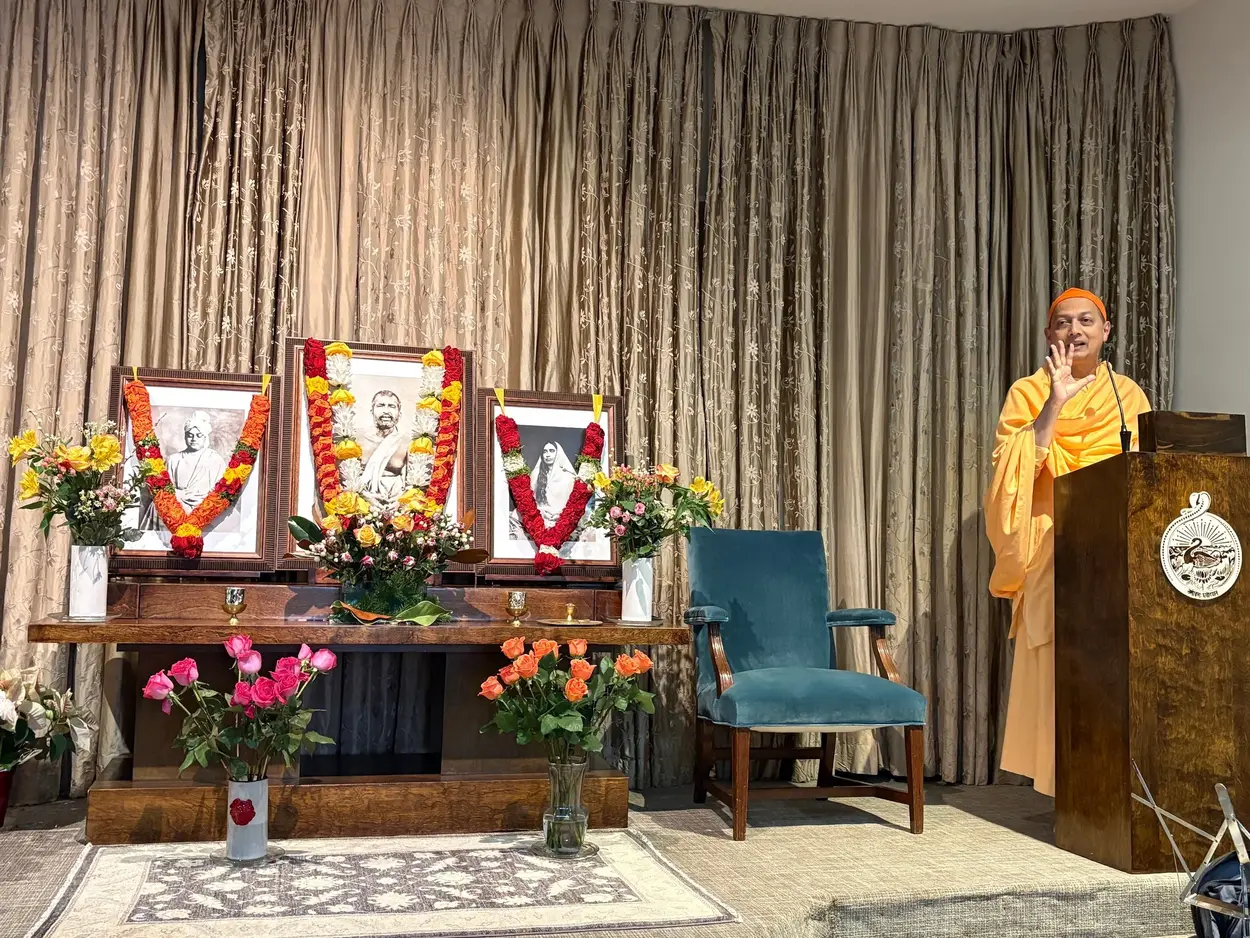
Swami Sarvapriyananda frames today’s theme with a single, startling declaration:
Asango’ham — I am unattached.
At first glance, it sounds impossible. Our lives look like webs of attachments: family, responsibilities, ambitions, possessions, reputation, memories, fears, loves. Even if we try to detach, we often feel the tug of longing and the sting of loss. So what could it mean to say, with confidence, “I am unattached”?
Vedanta answers by changing the meaning of the word “I.” If “I” means this body and mind, attachment is unavoidable. But if “I” means what Vedanta insists it truly means—the witnessing awareness behind body and mind—then non-attachment is not a moral achievement; it is a fact.
To understand this, we begin not with abstraction but with what is most intimate: the undeniable sense of existence.
1) The First Fact: “I Am”
Before any belief, before any worldview, before any philosophy, there is a simple certainty:
I am.
This is the most basic truth you cannot escape. You may doubt your opinions. You may question your memories. You may revise your identity and roles. But the raw sense of being—the luminous “I am”—remains the foundation on which everything else stands.
The Upanishads express it beautifully: By that shining, everything else shines; by its light everything is lit up. Your life’s world—work, people, thoughts, hopes—appears only because this “I am” is present. If it were absent, nothing would be known, nothing would matter, nothing would appear.
So Vedanta begins here: not with theory, but with presence.
Then comes the next step:
What is the nature of this “I am”?
The teaching we are exploring claims: its true nature is asanga—unattached.
2) Why the Body Cannot Say “Asango’ham”
The moment you say “I,” your attention rushes to the body. That is the first and most common identification: I am the body.
But notice what follows from that assumption:
- The body depends on air, food, sleep.
- The body is affected by heat and cold.
- The body is vulnerable to viruses, aging, injury.
- The body is woven into an environment and cannot exist apart from it.
A body cannot be “unattached.” It is intimately entangled with the world. Even the simple act of breathing proves relationship. Even a minor fever proves vulnerability. Even hunger proves dependency.
So if “I” equals body, then the phrase “I am unattached” becomes nonsense. The body is not an independent witness; it is a participant in nature.
Vedanta therefore says: you are aware of the body, but you are not identical to it.
That awareness is where the teaching begins to turn.
3) Why the Mind Cannot Say “Asango’ham”
Suppose you shift from body to mind. You might say: “Perhaps I am the mind—my thoughts, feelings, personality.”
But the mind is also not detached:
- A small physical discomfort changes the mind’s mood.
- Other people’s words change the mind’s state.
- Success and failure stir pride and anxiety.
- Memory fades, attention wavers, emotions rise and fall.
The mind is a sensitive instrument, constantly moved by conditions. If “I” equals mind, then “I am unattached” is again impossible. The mind attaches, resists, grasps, recoils.
So Vedanta makes a sharper distinction:
You are aware of the mind, but you are not identical to it.
And this leads to the central Vedantic discovery:
The real “I” is awareness itself—the witness of body and mind.
4) The Witness: Where “Asango’ham” Becomes True
Now we come to the turning point: the recognition that what you truly are is not an object in experience, but the knower of experience.
You do not see awareness as you see a chair. You cannot measure it like you measure temperature. Yet it is undeniable because every perception, thought, and feeling is known only by its light.
This is why Vedanta calls it Sākṣī—the witness.
And the witness has a remarkable property: it illuminates everything but does not cling to anything.
To make this vivid, the tradition uses precise, almost playful examples.
5) Upādhi: When Something Nearby Seems to “Transfer” Its Qualities
A key Advaitic concept introduced in the talk is Upādhi—often awkwardly translated as “limiting adjunct” or “incidental adjunct.” The translation is less helpful than the example.
Imagine:
- A clear, colorless crystal.
- A red flower placed behind it.
From a certain angle, the crystal appears red. Put a yellow flower, it appears yellow. The crystal seems to “borrow” color.
But nothing actually happened to the crystal. It never became red. It remained clear. The “redness” was only an appearance caused by proximity.
This is Upādhi.
Now apply it inwardly:
Awareness is like the clear crystal—luminous, present, neutral.
The body and mind are like the colored flower—full of qualities, changes, conditions.
When body and mind are “near” awareness (meaning, when they appear in awareness and are not distinguished from it), awareness seems to take on their features:
- Body qualities: “I am tall,” “I am tired,” “I am sick.”
- Mind qualities: “I am anxious,” “I am angry,” “I am happy,” “I am depressed.”
But awareness itself is not tall or short. How can consciousness be skinny or overweight? Awareness is not ill or healthy; those belong to the body. Awareness is not sad or joyful; those are movements in the mind.
The mistake is not that body and mind exist. The mistake is that their qualities are mistaken as you.
When this is seen, the phrase “Asango’ham” begins to mean something precise:
Even while body and mind appear, awareness is unattached to their changing states—just as the crystal is unattached to the flower’s color.
6) The Light Analogy: Illumination Without Stickiness
Consider light.
Light reveals everything in a room: walls, people, furniture. If the room is empty, light reveals emptiness. If the room is crowded, light reveals the crowd. Yet light does not “stick” to objects. When people leave, the light does not leave with them.
More importantly, light is not stained by what it illuminates:
- It does not become dirty by shining on a dirty pot.
- It does not become holy by shining on a sacred vessel.
In the same way, awareness reveals the body’s conditions and the mind’s emotions, but it does not become those conditions or emotions.
This is not motivational talk. It is a direct invitation to check your experience:
- A wave of sadness arises.
Awareness knows sadness.
Sadness is an object known.
Awareness is the knower.
When you genuinely see this, something loosens. The sadness may still exist, but it no longer defines you. It becomes more like weather passing through a sky.
This is the first practical gift of non-attachment: freedom from ownership of passing states.
7) The Screen Analogy: Not Only Witness, But the Ground of Experience
The light analogy is helpful, but it has a limitation: light is different from what it illuminates. Vedanta goes further. It says awareness is not merely a witness; it is also the ground on which all experience appears.
Here the movie screen analogy becomes powerful.
On a cinema screen you may see:
- tragedies and comedies,
- wars and romances,
- floods, explosions, heartbreak and triumph.
Yet the screen remains unchanged. It allows everything, resists nothing, clings to nothing. It is open.
But notice something deeper:
The movie has no independent reality apart from the screen.
The screen gives the movie its “place to appear.”
In this sense, awareness is not just the light shining on life; it is the Adhiṣṭhāna—the underlying basis of the whole display.
Swami Sarvapriyananda’s point is radical and intimate:
Everything in your life—people, thoughts, sensations, success, failure—appears in the field of your awareness. Your “I am” is the ground on which your life-world stands.
From this standpoint, non-attachment is not coldness. It is spaciousness.
8) The Big Question: If You Are the Ground, Why Aren’t You Affected?
A reasonable doubt arises:
If wood is the basis of a table, scratching the table scratches the wood.
If water is the basis of waves, polluting waves pollutes water.
So if awareness is the basis of experience, why doesn’t experience harm awareness?
Vedanta answers with another crucial concept:
Vivarta — Appearance Without Real Transformation
Vivarta means appearance: something seems to become something else, without actually transforming into it.
A rope mistaken for a snake does not become poisonous.
A mirage does not wet desert sand.
A screen does not become the hero or villain.
The movie is not “as real” as the screen. It is a display—convincing, vivid, emotionally gripping—but not a transformation of the screen into those objects.
Similarly, Vedanta claims the world of experience is a display in consciousness: vivid, lawful, meaningful in daily life, but not ultimately capable of altering awareness itself.
This is why the dream example is so instructive:
In a dream you may lose everything, suffer humiliation, face terror.
But when you wake up, you are untouched.
Why? Because the dream-world was an appearance in the mind.
Vedanta says waking life has a similar relationship to deeper reality: it is an appearance in awareness. Therefore, the reality is not damaged by the appearance.
And so “Asango’ham” becomes coherent:
I am the awareness in which all appearances arise and subside, and I remain untouched by them.
9) The Everyday Proof: Nothing Truly Stays
Even before philosophy, life itself teaches impermanence.
People pass through our lives. Objects come and go. Roles shift. Skills fade. Bodies age.
Even the deepest attachment—such as a mother’s love for her infant—cannot prevent sleep. In deep sleep, the mother forgets everything, including what she loves most, and rests peacefully. This does not mean she lacks love. It means that at the core level, awareness is free even from the strongest storyline.
The startling observation is:
Not only are you unattached to things—things are unattached to you.
We suffer because we try to hold what cannot be held. We cling to what is, by its nature, flowing.
When you recognize this fact, non-attachment stops being a grim discipline and becomes realism. It is not “renouncing life.” It is seeing life as it is.
10) The Trap of Holding: Attachment Captures the One Who Clings
The talk includes a striking image: when you grip something tightly, you do not only hold it—you are also held.
Holding creates captivity.
This is why attachment often feels like anxiety: you are trying to freeze what is designed to move. You want permanence from impermanent things. You want security from what changes.
And so the ancient wisdom says: let go—not because you must become emotionless, but because freedom is your nature.
Non-attachment is not indifference; it is inner independence.
11) Vivekananda’s Four A’s: The Shape of a Liberated Life
Swami Vivekananda’s four ideals—shared in the reminiscence described in the transcript—form a practical constellation:
- Abhaya — fearlessness
- Ahimsa — non-violence
- Asanga — non-attachment
- Ananda — bliss
Notice the inner logic:
Attachment breeds fear: fear of loss, fear of change, fear of death.
Fear breeds aggression, which threatens non-violence.
When attachment loosens, fear loosens.
When fear loosens, the heart becomes gentler.
And when the grip relaxes, a natural joy emerges—not because life is perfect, but because you are not imprisoned by life.
So Ananda is not a prize given by the world. It is the fragrance of the Self when the knots of clinging dissolve.
12) Satchidananda: What the Unattached “I Am” Really Is
The teaching culminates in a classic Vedantic phrase:
Satchidananda — Existence, Consciousness, Bliss.
- Sat: pure being, the undeniable “is-ness” of experience.
- Chit: pure awareness, the knowing light in which all appears.
- Ananda: not a passing thrill, but the fullness of limitless being-awareness.
Why call it bliss? Because limitation is suffering. Being confined—by fear, by identity, by scarcity—hurts. When the “I am” is known as limitless, the felt pressure of limitation eases. That ease is Ananda.
Here is the subtle brilliance: bliss is not manufactured; it is uncovered.
Conclusion: “Asango’ham” as a Living Practice
The phrase Asango’ham is not meant to become a slogan. It is meant to become a recognition.
You do not have to “switch off the movie.” You do not have to avoid life. Vedanta does not demand spiritual bypassing. It invites clarity.
Life will still have challenges: illness, uncertainty, relationship tensions, economic pressures. But you can meet them from a deeper place:
- Solve what can be solved.
- Endure what must be endured.
- Enjoy what comes.
- Release what goes.
All while remembering:
I am the witness.
I am the ground.
I am untouched.
Asango’ham.
When this is not merely an idea but a lived insight, fear softens, the heart steadies, and a quiet joy becomes possible—because you are resting in what does not change.
May that recognition become clear—not later, not elsewhere, but here, now, in the very “I am” that is already shining in you.
Om Shanti Shanti Shanti.
You will get Vedanta updates in your inbox.
Occasional reflections on Vedanta. Unsubscribe anytime.