Awakening to Reality: The Buddha’s Four Noble Truths and the Practical Path Beyond Suffering
The Buddha’s Four Noble Truths diagnose suffering, trace craving, and offer liberation through Eightfold Path.
Om.
Lead us from the unreal to the real, from darkness unto light, from death to immortality.
Om peace, peace, peace.
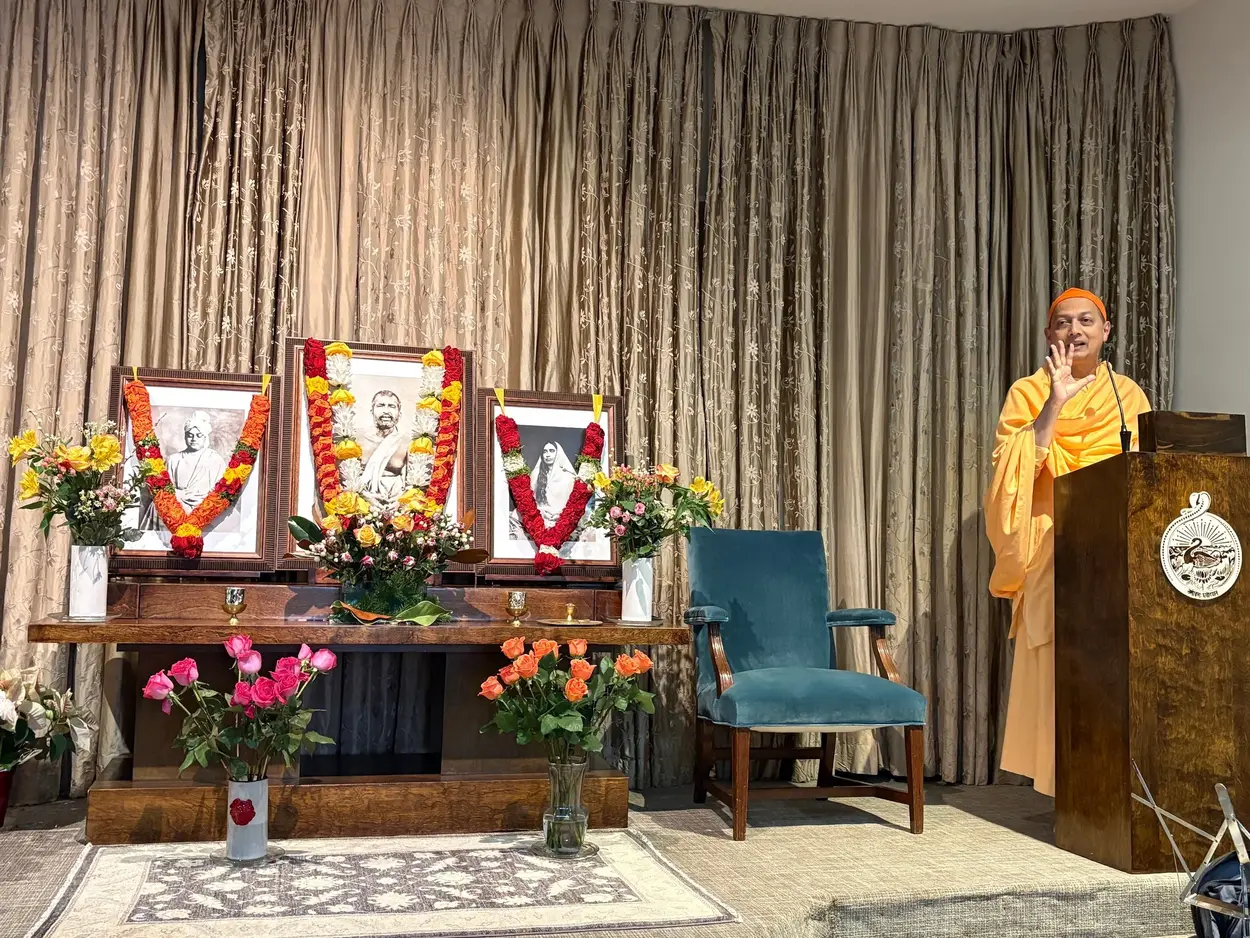
It is possible to speak about the Buddha for hours and still feel that we have only touched the edge of a vast ocean. One can recount the moving events of Siddhartha’s life—the sheltered prince, the shock of encountering old age, illness, and death, the renunciation, the long search, the breakthrough under the Bodhi tree. But the Buddha did not become great because his story is dramatic. He became great because of what he discovered and, more importantly, because of what he offered: a clear diagnosis of the human predicament and a practical method to transcend it.
There is a striking story, often retold, that captures the uniqueness of the Buddha’s awakening. After enlightenment, as he walked toward the first people he would teach, a young shepherd boy saw him and was stunned by what he perceived—a calm radiance, a profound steadiness, a presence unlike ordinary human restlessness. The boy did not ask the usual question, “Who are you?” He asked, “What are you?” It is a question that suggests the boy sensed something beyond personality or social identity. Are you a god? the boy wondered. Are you an angel? Are you a human being? The Buddha’s reply, as the story goes, was quietly radical: “No.” And then he offered a word that becomes a mirror for the rest of us: “I am awake.”
That single phrase can be read in two ways. First, it describes what he had become—one who sees clearly. Second, it implies what the rest of us often are—sleeping, dreaming, stumbling through life on autopilot, mistaking shadows for solid reality, and being surprised again and again by the pain built into a changing world. The Buddha’s invitation is not to believe in him as a savior. It is to awaken.
The Turning of the Wheel: A Teaching for Real Life
The Buddha’s first teaching is traditionally called the Dharma Chakra Pravartana Sutta—the discourse on “turning the wheel of Dharma.” The image is powerful: once set in motion, the wheel continues to roll, carrying the force of insight across generations.
To whom did he teach first? Not to kings or scholars, but to five ascetics who had practiced severe austerities with him. They were not initially sympathetic. They believed he had “given up” when he abandoned extreme self-mortification. But when they saw his tranquility and clarity, they listened. The Buddha’s very presence became evidence that he had found something real.
His first message to them was the “middle path”—a refusal of two extremes that often trap spiritual seekers: indulgence on one side and harsh self-torture on the other. Neither luxury nor excessive austerity leads to liberation. Spiritual maturity is not measured by how much you punish yourself, nor by how much comfort you can accumulate. It is measured by freedom—freedom from compulsive craving and compulsive aversion.
From there, the Buddha delivered what would become the foundation of Buddhism: the Four Noble Truths. They are “noble” not because they are pleasant, but because they are liberating. They do not flatter us; they wake us up. They do not offer escape through fantasy; they offer transformation through understanding.
The Four Noble Truths are often memorized in school as a neat list. But the Buddha did not teach them as theory. He taught them as a lived map—a method to observe, understand, and uproot suffering.
First Noble Truth: The Reality of Dukkha
The first truth is blunt: there is dukkha—often translated as suffering, dissatisfaction, stress, or unease. It includes obvious pain, but it also includes something subtler: the fundamental incompleteness that haunts ordinary life even when everything appears fine.
The Buddha’s own life illustrates how this truth first dawned. As a prince, Siddhartha was shielded from harsh realities. His father tried to prevent the very experiences that awaken serious spiritual inquiry. Yet life cannot be quarantined forever. When Siddhartha encountered old age, disease, and death, it was not merely sadness that shook him. It was recognition: this is not an exception; this is the pattern of embodied life.
In the modern world we often live inside a similar insulation. Systems of medicine, assisted living, and social convenience keep suffering out of sight. Ambulances take the sick away. Hospitals hide the raw struggle behind walls of privacy and procedure. Elderly relatives may be cared for elsewhere. Even poverty and homelessness are pushed away from places where we prefer to feel comfortable. This insulation can make daily life smoother—but it can also reduce wisdom. When suffering is hidden, we imagine it is rare. Then when crisis bursts into visibility—during a pandemic, a disaster, or personal loss—we feel shocked, as if reality has betrayed us. From the Buddha’s perspective, reality has not changed; our awareness has.
Three Ways of Understanding Suffering
Buddhist analysis often moves in layers. One helpful way is to see suffering in three depths:
-
The suffering of suffering
This is straightforward: physical pain, sickness, injury, grief, fear, anxiety, depression. Even animals experience it, and humans add mental complexity—worry, guilt, resentment, dread. We have many partial cures: medicine, entertainment, comfort, distraction. But none are permanent. Hunger returns. Illness returns in new forms. Anxiety returns in new costumes. -
The suffering of change
This is deeper and more unsettling. It points out that the pleasures we chase are unstable. What feels delightful today fades tomorrow. A new possession becomes ordinary. A relationship shifts. A job that once felt exciting becomes exhausting. Youth and health decline. Even our preferences change. We do not suffer only because pain exists; we suffer because we expect what changes to remain satisfying. The problem is not change itself—enlightened beings still live in a changing world. The problem is our grasping: we cling to the changing as if it were reliable. -
Pervasive suffering
This is the most fundamental level: the unease built into unenlightened identification with the body-mind. Buddhism often speaks not in terms of a permanent soul but in terms of the five aggregates (skandhas)—form (the body), sensations, perceptions, mental formations (habits and karmic tendencies), and consciousness as ordinary awareness. When we grasp these as “me” and “mine,” we set up the entire machinery of fear, craving, defensiveness, and struggle. In this state, even happiness is “infected” by anxiety because we feel it might be lost.
Another Lens: Eight Forms of Suffering
A later analytic lens (associated with Tibetan scholastic traditions) lists eight kinds of suffering:
- Birth
- Old age
- Disease
- Death
- Contact with what is unpleasant
- Separation from what is pleasant
- Not getting what one wants
- The deep suffering rooted in clinging to the aggregates as self
It is fascinating how these compress into one another. Many sufferings can be summarized as either meeting what we don’t want or losing what we do want. And these can be summarized further as the frustration of desire: something in the mind expects a certain reality, and reality refuses to comply. Underneath that, the deepest root is misidentification—clinging to a constructed “self” that must be protected and satisfied.
Four Characteristics: Impermanence, Suffering, Emptiness, Selflessness
Buddhism also analyzes the first truth through four marks:
- Impermanence (anitya): everything changes. Not only over years, but moment to moment.
- Suffering (dukkha): clinging to impermanent conditions produces dissatisfaction.
- Emptiness (shunyata): things do not exist independently “from their own side”; they arise dependently.
- Selflessness (anatman): there is no permanent, separate controller-self either inside the aggregates or apart from them.
These are not meant as gloomy thoughts. They are meant as liberating clarity. If you stop at “life is suffering,” you get pessimism. But Buddhism is not a despair philosophy. It is a cure.
The Buddha as Physician: Diagnosis, Cause, Cure, Treatment
A beautiful way to understand the Four Noble Truths is to see them as medical steps—precise, compassionate, and practical:
- Identify the disease: suffering exists.
- Find the cause: suffering arises from craving.
- Confirm the cure: cessation is possible.
- Apply the treatment: follow the path.
This is why the Buddha’s teaching feels so modern: it is direct, testable, and grounded in experience. It asks for investigation, not blind belief.
Second Noble Truth: The Cause of Suffering—Craving
The second truth states: there is a cause of suffering, and it is craving (tṛṣṇā / taṇhā)—literally “thirst.” This thirst has two obvious faces and one deeper face.
- We crave pleasure and avoid pain.
- We crave control—over people, outcomes, identity, reputation, security.
- Deeper still, we crave continued existence in a particular form: “Let me be this, let me remain, let me not be erased.”
Craving is fueled by ignorance—not merely lack of information, but a mis-seeing of reality. We cling to what cannot hold us.
Dependent Origination: The Chain That Binds
Buddhism is famous for its deep exploration of causality, often summarized in a principle: “When this arises, that arises; when this ceases, that ceases.” If suffering has causes, then removing causes dissolves suffering.
One classic expression of this is the twelve-link chain of dependent origination—a map of how samsaric life perpetuates itself:
- Ignorance (avidyā)
- Volitional formations (karma / saṃskāra)
- Consciousness (vijñāna as rebirth-linking awareness)
- Name-and-form (nāma-rūpa)
- Six sense bases (ṣaḍāyatana)
- Contact (sparśa)
- Feeling (vedanā)
- Craving (tṛṣṇā)
- Clinging (upādāna)
- Becoming (bhava)
- Birth (jāti)
- Old age and death (jarā-maraṇa), along with sorrow and lamentation
Even if the details feel complex, the heartbeat is simple: ignorance generates patterns, patterns generate experience, experience generates craving, craving generates clinging, clinging generates the momentum to become, and so the cycle repeats.
Here lies a stunning practical insight: to end the cycle, you don’t fight every link. You target the root—ignorance. Remove ignorance, and the chain collapses.
Third Noble Truth: Cessation—Nirvana Is Possible
The third truth brings hope grounded in realism: cessation exists. This cessation is called nirvana (nibbāna)—often described as extinguishing, like a flame blown out. But what is extinguished?
Not awareness in the shallow sense of “I disappear into nothing,” but rather the fires of craving, ignorance, and compulsive grasping. If those fires go out, suffering goes out. What remains is freedom.
Buddhist traditions describe nirvana differently. Some emphasize the inexpressibility of the liberated state: it is not “going somewhere,” because “somewhere” belongs to the spatial imagination of ordinary mind. Others describe the continuity of enlightened compassion—especially in Mahayana traditions, where the enlightened mind may remain engaged in the world for the sake of beings.
Many traditions also distinguish nirvana with residue—enlightenment while the body continues due to past causes—and nirvana without residue, after the body’s end. However one frames it, the essential claim remains: freedom is possible.
Theravada and Mahayana: Two Ideals, One Compassionate Aim
Buddhism has multiple streams, but two broad ideals are often contrasted:
- Theravada often emphasizes the ideal of the arhat—one who becomes free through disciplined practice, ending the cycle of suffering.
- Mahayana elevates the ideal of the bodhisattva—one who seeks awakening not only for oneself but for the liberation of all beings, cultivating wisdom and compassion together.
The bodhisattva ideal is breathtaking: even after realizing freedom, one continues to serve, teach, and help, not out of compulsion, but out of boundless compassion rooted in wisdom.
Fourth Noble Truth: The Path—The Eightfold Way
The fourth truth states: there is a path leading to cessation. The Buddha did not ask people to admire nirvana as a poetic idea. He offered a practical program: the Noble Eightfold Path.
It can be grouped into wisdom, ethics, and meditation:
Wisdom
- Right View (samyak dṛṣṭi): understanding the Four Noble Truths; seeing reality more clearly.
- Right Intention/Resolve (samyak saṅkalpa): commitment to renunciation, goodwill, and non-harming.
Right view is like a map. A map does not walk for you, but without it you may walk in circles. And right resolve is the decision to stop being casual about awakening—to make liberation the central aim.
Ethics
- Right Speech (samyak vāc): truthfulness, kindness, restraint from harsh or divisive speech.
- Right Action (samyak karmānta): non-violence, integrity, responsibility, restraint.
- Right Livelihood (samyak ājīva): earning in ways that do not exploit, deceive, or harm.
Ethics here is not moralism. It is purification. A mind soaked in dishonesty, cruelty, or addiction cannot easily become steady and clear. The path is not a hobby layered on top of a harmful lifestyle. It is a full transformation.
Meditation
- Right Effort (samyak vyāyāma): disciplined energy to prevent unwholesome states and cultivate wholesome ones.
- Right Mindfulness (samyak smṛti): clear awareness of body, feelings, mind, and phenomena—often anchored in breath.
- Right Concentration (samyak samādhi): deep meditative stability that supports insight.
Mindfulness has become popular in modern culture, sometimes stripped of its spiritual context. In Buddhism, mindfulness is not merely stress relief. It is a tool for liberation. It reveals how craving forms, how reactions arise, and how freedom becomes possible in the very moment we observe rather than blindly follow.
A Beautiful Logic: Two Chains, One Liberation
Notice the elegance of the Buddha’s approach:
- Suffering has a cause: craving.
- Freedom (nirvana) has a cause: the path.
The path leads to cessation. Cessation undermines craving. When craving fades, suffering dissolves. This is not random hope; it is systematic transformation.
One might even say the Buddha offers a “technology of awakening”—not mechanical, but practical. If you live it, it changes you.
Applying the Teaching Today: A Pandemic Mirror
A modern crisis like a pandemic can become a stark teacher. It breaks our illusions of control and forces us to see vulnerability, mortality, interdependence, and uncertainty. From a Buddhist perspective, the shock is not that suffering appears, but that we forgot it was always there. The crisis becomes a reminder: life is not guaranteed, bodies are fragile, and plans are brittle. This does not have to lead to fear. It can lead to wisdom.
The first noble truth becomes undeniable. The second becomes visible: we see how craving for certainty, normalcy, and control creates inner turmoil. The third becomes a possibility: can we find peace even when conditions are unstable? And the fourth becomes urgent: can we practice now, not someday?
Buddhism does not ask us to deny grief or pretend pain is unreal. It asks us to see clearly, respond skillfully, and cultivate a mind that is not enslaved by compulsive reactions.
The Buddha’s Invitation: Wake Up, Here and Now
Perhaps the most inspiring aspect of the Buddha’s teaching is its dignity. It treats human beings not as helpless sinners and not as powerless victims, but as capable practitioners. The Buddha can point; you must walk. The Buddha can illuminate; you must see.
And the destination is not abstract. It is deeply intimate: a mind no longer compelled by thirst, a heart no longer enslaved by fear, a life grounded in clarity and compassion.
The Buddha’s calm radiance—what startled the shepherd boy—was not a mystical costume. It was the natural expression of a mind freed from craving and confusion. That freedom is what the Four Noble Truths promise, and what the Eightfold Path makes practical.
May this teaching, simple and profound, inspire us to look honestly at suffering without despair, to understand craving without shame, to trust that freedom is possible, and to practice the path with sincerity. May we awaken.
Om Shanti Shanti Shanti.
You will get Vedanta updates in your inbox.
Occasional reflections on Vedanta. Unsubscribe anytime.