Why Does a Loving God Allow Suffering?
Teen challenges suffering; Vedanta explores evil, karma, impermanence, and urges compassionate action plus liberation.
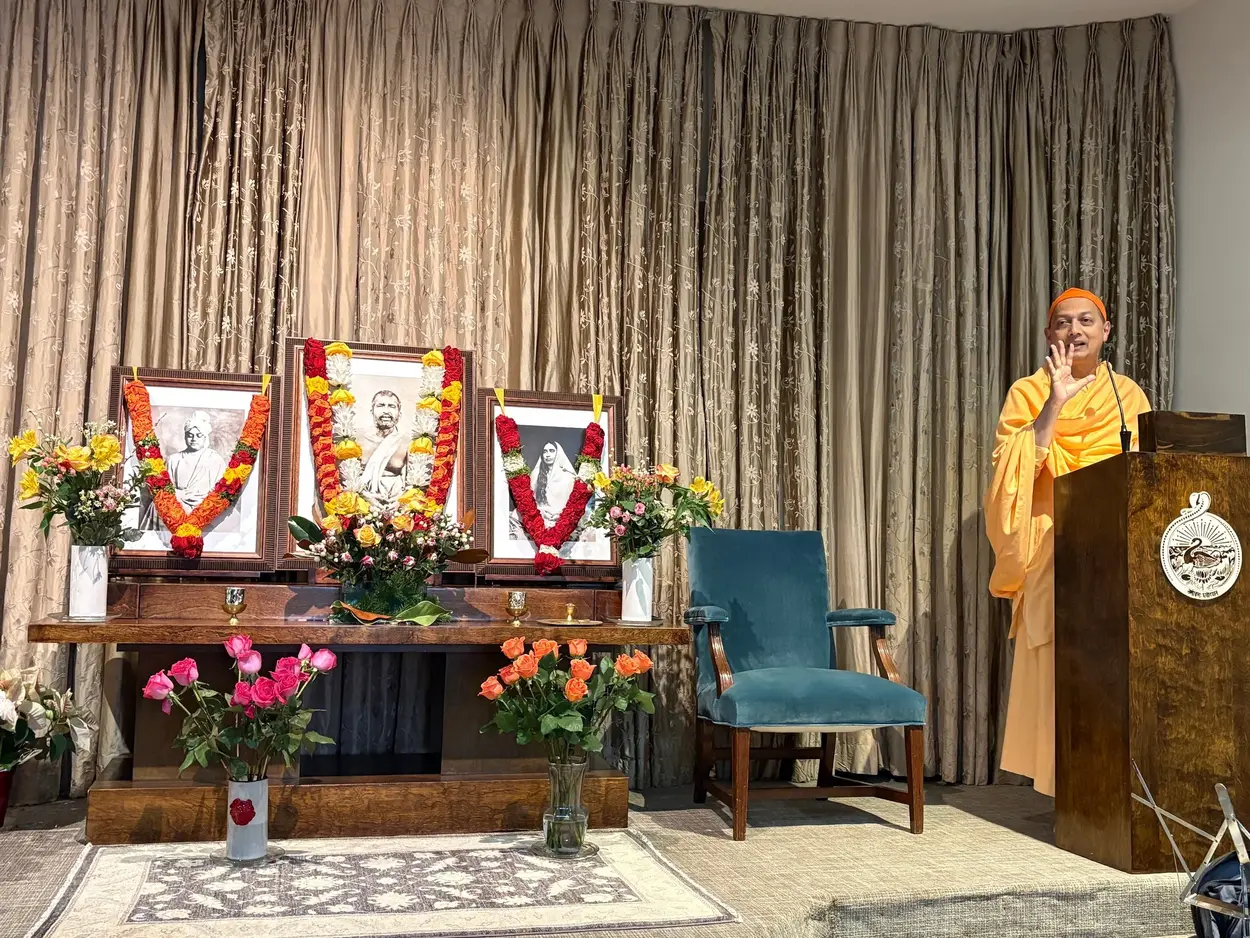
A fourteen-year-old asked a question that has haunted human beings for as long as we’ve prayed, hoped, and tried to make sense of life: If God is the creator, and if God is loving, and if God grants happiness to those who seek the divine—then why is there so much suffering? And if one path to God is to serve the poor and the needy, doesn’t that make the poor into a “test” for the rest of us? Isn’t it unfair—even biased—that some people must live lives of struggle so that others can become “good”?
It is hard to imagine a more honest question. It refuses easy sentimentality. It refuses the comforting habit of turning suffering into a moral lesson for spectators. It also contains a deep intuition: the suffering person is not a prop in someone else’s spiritual story. They, too, long for happiness, dignity, and security. Why shouldn’t the divine “grant that” as readily as it grants spiritual inspiration to those who are seeking?
This question points directly to what philosophers and theologians call the problem of evil—one of the oldest and most difficult challenges in religion.
The Problem of Evil: The Puzzle in Its Strongest Form
The problem becomes sharp when we combine three traditional claims about God:
- God is all-powerful (omnipotent): God can do anything that is possible to do.
- God is all-knowing (omniscient): God knows every fact, including every pain, injustice, and heartbreak.
- God is loving (benevolent): God wills the good of creatures; God is not indifferent to suffering.
Now place beside those claims the everyday reality of the world:
- Children suffer and die.
- Animals suffer without the ability to interpret their pain as “character building.”
- Natural disasters destroy lives without regard for virtue.
- Injustice persists across generations.
If God knows suffering and can remove it and loves those who suffer—why does God not remove it?
To understand why this is so difficult, consider a simple comparison. Human parents often love their children deeply and do not want them to suffer. But parents are limited: they cannot control disease, accidents, other people’s choices, or the fragility of life. Their love is real, but their power is not infinite.
The question becomes much harder when we imagine a “heavenly parent” who is loving and unlimited in power and fully aware. Why doesn’t such a being prevent suffering—especially the suffering that seems pointless and undeserved?
That is the core of the problem.
And what makes the teenager’s question especially piercing is its moral sensitivity: it refuses to treat the poor as a convenient stage on which the spiritually ambitious can perform goodness.
Many Answers Exist—and Many Feel Unsatisfying
Across religions and philosophies, people have offered many responses. Some are comforting. Some are clever. Some are emotionally powerful. Yet many are also vulnerable to objections.
One common response is:
“Suffering Builds Character”
You sometimes hear that suffering is meant to strengthen us—like the struggle of a butterfly emerging from a cocoon. The idea is that difficulty develops resilience, maturity, compassion, and spiritual depth.
It is true that some people grow through hardship. Many would say their trials shaped them into wiser, kinder, more grounded human beings. But the objection arrives immediately:
- How does suffering “build character” in a baby who dies?
- How does starvation strengthen a child who never gets the chance to grow?
- How does the suffering of animals produce moral transformation in those animals?
If suffering sometimes produces growth, it also sometimes produces trauma, despair, and destruction. So this explanation cannot account for suffering in general, and certainly not for the most brutal forms of it.
This is why thinkers developed an entire field—sometimes called theodicy—that tries to defend God’s goodness in a world full of pain. It is as if the universe has put God on trial, and humans are assigned the difficult job of both prosecution and defense.
But a serious, honest observer often feels: the best arguments still leave an ache.
So we turn to the approaches found in Indian traditions, where the problem is faced with its own distinctive tools.
The Indian Traditions: Karma as a Standard Response
In Hinduism, Jainism, and many schools of Buddhism, a widely known answer is the law of karma.
In simple form, karma means: actions have consequences. What we experience now—pleasant or unpleasant—arises from causes, including choices made in this life and, in many traditional accounts, previous lives.
This response shifts the “blame” away from God. God is not assigning suffering like a cruel examiner. The world operates through moral causality. Pain is not divine favoritism; it is the unfolding of cause-and-effect.
But karma is also emotionally complicated.
When good fortune arrives, many people accept it without question: “Great—why analyze it?” But when misfortune arrives, we demand an explanation: “Why me?”
The karma teaching attempts consistency: if we accept causality in pleasant outcomes, we should also accept it in unpleasant outcomes. Yet it can feel harsh if interpreted simplistically, as if every suffering person “deserves” their suffering.
That interpretation can easily become morally dangerous. It can numb compassion. It can justify social indifference. It can quietly imply: “They brought it on themselves.”
A more careful understanding is needed.
In its mature forms, karma is not meant to be a weapon for judging others. It is meant to be a framework for understanding how causes ripple forward—and for inspiring ethical responsibility. It says: our actions matter; the moral universe is not random; choices shape experience.
Still, the teenager’s question remains: even if karma explains why suffering occurs, does it justify it? Does it make a loving God coherent?
Many people feel karma alone does not “solve” the emotional weight of innocent suffering. And thoughtful teachers acknowledge that.
Some scholars have noted that Indian philosophy itself contains many answers, not just karma. A careful survey of world traditions yields dozens of proposed responses. Yet even with many options on the table, the unease remains: none feels airtight.
That honesty is important. If a response feels too neat, it probably isn’t facing the full reality of suffering.
A Deeper Buddhist Insight: Impermanence Makes Suffering Inevitable
Another approach, especially associated with the Buddha, goes deeper than assigning a moral cause to specific events. It begins not with “Who caused this?” but with “What is this world like?”
The Buddha’s insight is often summarized as:
All compounded things decay.
Everything that comes together eventually comes apart. Everything constructed is unstable. Bodies age. Relationships shift. Desires change. Health deteriorates. Circumstances flip. Even the things we love most cannot be held forever.
From this perspective, suffering is not merely a punishment or a test. It is woven into the fabric of impermanence. We suffer because we attach to what cannot remain fixed.
We love something—and time changes it.
We rely on something—and it breaks.
We build an identity—and life disrupts it.
Seen this way, the world produces suffering not primarily because someone is “bad,” but because transience is the rule.
At first this can sound gloomy. But it carries a hidden clarity: if suffering is rooted in impermanence and attachment, then the solution is not merely rearranging external circumstances. The solution is a transformation of understanding—freedom from clinging, awakening to what is not subject to decay.
This is why, despite the stark diagnosis, Indian spiritual traditions are often deeply optimistic. Not because they deny suffering, but because they insist:
A solution is possible.
They name it in different ways: moksha, kaivalya, nirvana. The vocabulary differs, but the spirit is similar: liberation is real.
This brings us closer to a specifically Vedantic response.
Is God Using the Poor as a “Test” for Others?
Now return to the teenager’s moral concern:
If serving the poor is a path to God, doesn’t that imply the poor exist so that others can become virtuous?
A mature spiritual response must reject that framing.
No—human beings are not created to be instruments for someone else’s spiritual progress.
Suffering is not a theatrical stage set up by God so that others can collect moral points. A world in which some are designed to suffer so others can be saintly would not be a morally admirable universe. And the teenager is right to call that out.
A more realistic spiritual understanding is this:
- The world contains suffering—through ignorance, impermanence, natural forces, social injustice, and the complex web of causes and conditions.
- In that world, you and I face a choice: we can become hardened, selfish, numb, and indifferent—or we can become compassionate, responsible, and wise.
- Helping others is not about passing a divine test. It is about responding to reality in the best way we can, while transforming ourselves in the process.
This shift matters. It moves from a “God designed suffering to evaluate me” mentality to a “I live in a world where suffering exists; how will I respond?” mentality.
In other words, service is not about turning the suffering person into a tool. It is about refusing to turn your own heart into stone.
The Limits of What We Can Fix—and the Importance of What We Can Do
Another sobering point appears here: no one—not even the greatest spiritual figures—has “solved” the world’s suffering in the sense of permanently erasing it from history. The world remains complex. Injustice continues. Disease persists. Loss returns in new forms.
This can sound discouraging until we recognize what it implies:
You are not responsible for fixing the universe alone.
You are responsible for doing what you genuinely can.
That might mean:
- feeding someone who is hungry,
- mentoring someone who is lost,
- donating wisely,
- building systems that reduce harm,
- showing up with dignity and respect,
- working for justice in practical ways,
- offering presence, not pity.
You cannot eliminate all suffering. But you can reduce suffering in your sphere. And even when you cannot reduce it, you can refuse to add to it through cruelty, neglect, or indifference.
This is one of the quiet truths of spiritual maturity: the goal is not grandiosity. The goal is sincerity.
Where Vedanta Ultimately Points: Two Levels of Response
Vedanta often handles difficult questions by distinguishing two levels:
1) The Practical (Ethical) Level
At the level of daily life, suffering is real. Hunger hurts. Grief hurts. Exploitation hurts. At this level, compassion and responsibility are not optional. They are the minimum decency of being human.
So the Vedantic response here is straightforward: Do good. Help where you can. Reduce harm. Serve others. Not because God is testing you, but because suffering is present and compassion is the right response.
Moreover, service transforms the helper—not as a selfish spiritual strategy, but as a natural result. When you genuinely help, you expand beyond the prison of self-absorption. You become less dominated by ego and fear. You become more human.
2) The Ultimate (Liberating) Level
At a deeper level, Vedanta says that the final answer to suffering is not merely rearranging circumstances, because every circumstance is unstable. True freedom is discovering what you are beyond the changing conditions of body, mind, and world.
This does not erase compassion; it purifies it. It does not make suffering “unreal” in a dismissive way; it makes suffering no longer the dictator of your inner identity.
In that liberation, you are no longer crushed by the world’s instability, because you are rooted in what does not decay.
Vedanta calls that freedom moksha.
A Honest Conclusion: We Live in a Sea of Suffering—So Do the Best You Can
The teenager wanted to know whether God is biased—whether the poor are used as moral obstacles so others can become good.
A truthful spiritual reply is not a neat equation. It does not pretend that every tragedy can be justified. It acknowledges that the problem of suffering is real and heavy, and that many proposed “answers” feel incomplete.
And yet, it offers something practical and something profound:
- Practically: Don’t treat the suffering person as a spiritual instrument. Treat them as a person. Help where you can.
- Spiritually: The world’s pain need not turn you cynical. A deeper freedom is possible—one that is not dependent on the world becoming perfect.
In the end, perhaps the most honest posture is this:
We stand in a world where suffering exists.
We did not design it.
We may not be able to explain every instance of it.
But we can choose our response.
We can choose compassion over indifference.
We can choose service over selfishness.
We can choose inner awakening over despair.
And if there is one thread that runs through the Indian traditions—Vedanta, Buddhism, Jainism, Sikh teachings and more—it is this: even if the world’s diagnosis is sobering, the final message is not hopelessness.
A solution is possible.
That promise does not make the suffering of the poor into a “test.”
It makes your life into an opportunity—an opportunity to become more awake, more kind, and more free, even in the midst of an imperfect world.
You will get Vedanta updates in your inbox.
Occasional reflections on Vedanta. Unsubscribe anytime.