Sri Sarada Devi's Birthday: The Holy Mother of Jayrambati
The Holy Mother's life, her teaching of forbearance and universal motherhood, and how her birthday is kept worldwide.
She was married at five to a priest the world would come to know as Sri Ramakrishna, and on a night at Dakshineswar he worshipped her with the sixteen offerings due to the Divine Mother herself and laid the fruits of all his spiritual practice at her feet. She then spent decades in near-invisibility — cooking, serving, rising before dawn and sleeping after everyone else — and emerged, after his passing, as something the tradition had perhaps never seen: a village widow in a white sari who became the guru and the mother of a worldwide movement, the one to whom the fiercest monks of the Ramakrishna Order bowed as to their own mother. Her name is Sri Sarada Devi, the Holy Mother. Her birthday is kept not on the civil date of her birth — 22 December 1853, in the Bengal village of Jayrambati — but on her birth tithi, Agrahayana Krishna Saptami, which the tradition follows as it drifts against the civil calendar. This guide tells her story: the child of Jayrambati, the years in the little Nahabat room, the Mother of the Order, the teaching she left in a handful of sentences, and how her birthday is kept — at Belur Math and Jayrambati, in centres around the world, and quietly, at home.
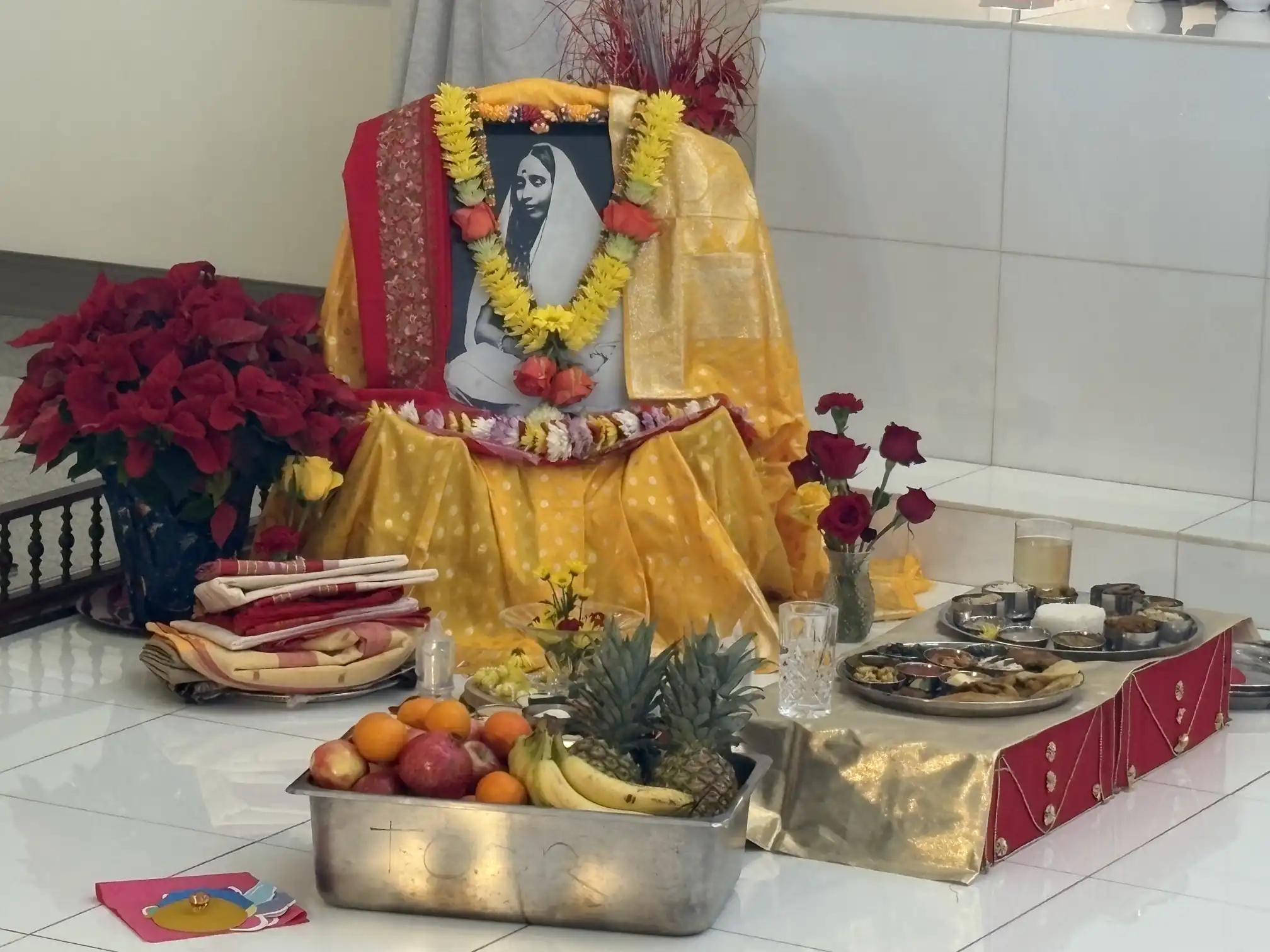
The Holy Mother’s Birthday Celebrations Worldwide
Every listing below is taken from the institution's own published programme or official festival calendar. Times are local to the venue. Where an institution keeps the day but has not published its time, the listing says so rather than guessing.
India
- Ramakrishna Math, Belur Math (Howrah) — Wednesday 30 December — the Holy Mother's birthday, from the Math's official List of Celebrations. The Math publishes the day rather than a clock time.
- Sri Ramakrishna Math, Chennai — Wednesday 30 December — Holy Mother Sri Sarada Devi Jayanti, from the Math's Festival Calendar. The calendar gives the observance rather than a clock time.
- Ramakrishna Math and Ramakrishna Mission, Viveknagar (Agartala) — Wednesday 30 December — the Holy Mother's birthday, from the centre's own List of Celebrations. No clock time is published.
Singapore
- Ramakrishna Mission, Singapore — Wednesday 30 December — Sri Sarada Devi Jayanti, from the Mission's Festival Calendar. The calendar gives the observance rather than a clock time.
Australia
- Vedanta Centre of Sydney, Ermington (Sydney) — Wednesday 30 December — the Holy Mother's birthday, from the centre's own published programme: the morning puja begins at 8:45 am, with homa at 11:30 am, pushpanjali (flower offering) at 12:30 pm and prasad at 1:00 pm; in the evening, Aratrikam and Sarada Nama Sankirtanam at 6:30 pm, a talk on the Holy Mother at 7:15 pm and prasad at 8:15 pm.
Germany
- Vedanta Gesellschaft, Berlin — the society keeps the Holy Mother's Puja together with Kalpataru Day at its year-end retreat: Thursday 31 December, 10:30 pm — discourses on the Holy Mother and the significance of Kalpataru Day; Friday 1 January, 10:45 am — the Kalpataru Day and Holy Mother Puja, followed by lunch prasad at 12:00 noon. From the society's own retreat programme.
United States
- Vedanta Society of New York, New York — Wednesday 30 December — Sri Sarada Devi's birthday in the society's own Festival Calendar. The calendar notes that only some of its listed celebrations are held at the centre, and refers devotees to the society's monthly bulletin for the services it holds.
- Vedanta Society of Southern California, Hollywood — Sunday 27 December — Sri Sarada Devi Puja, the society's public celebration of the Holy Mother's birthday, from its own Calendar of Observances; the birthday tithi itself falls on Wednesday 30 December. No clock time is published in the calendar.
- Vedanta Society of Greater Houston, Houston — Friday 1 January — the society keeps the Holy Mother Sri Sarada Devi's Birthday together with its Kalpataru Day celebrations, from its own published list of confirmed events. No clock time is published.
The following centres are not yet listed, because their programmes for the Holy Mother's birthday had not been published (last updated 15 November 2026): Sri Sarada Math in Dakshineswar and the Matri Mandir at Jayrambati, which has no official page of its own; the Ramakrishna Maths in Bengaluru and Hyderabad, the Ramakrishna Mission in Delhi and its Institute of Culture at Golpark; and the Vedanta societies and centres of San Francisco, Seattle, Chicago, Boston, Toronto, London and Durban.
1. A Child of Jayrambati
Sri Sarada Devi was born on 22 December 1853 in Jayrambati, a small village in the Bankura district of Bengal, and the place never left her, even when the world began to come to her door. She was the eldest child of Ramachandra Mukhopadhyay and Shyamasundari Devi, a poor Brahmin couple whose wealth consisted of a small holding, a reputation for piety, and a house that was open to neighbours and strangers alike. Ramachandra eked out a living from farming and priestly work; Shyamasundari managed a household in which scarcity was familiar but never allowed to harden into bitterness. Into this house, as the first of several children, came a daughter who would in time be worshipped across the world as the Holy Mother, yet who always spoke of Jayrambati as home and of herself, simply, as a village woman.
Her childhood was not sheltered. In rural Bengal a daughter of a poor family worked, and Sarada worked from the time she was small: she helped in the house, tended younger children as brothers and sisters arrived, gathered fodder, assisted in the fields, and learned early the arithmetic of a household where rice must be measured and nothing wasted. Yet the biographies agree that something in the child set her apart, and it was not precocity of speech or cleverness. It was a stillness. She was found, more than once, sitting quietly in contemplation when other children were at play, absorbed in a way that her elders noticed without quite understanding. She loved worship. Like many village girls she made and adored images of the Goddess, particularly Lakshmi, and her play itself often took the form of puja, with flowers, water, and scraps of offering arranged with grave seriousness. The line between game and devotion, in her, seems never to have been sharp.
The same temperament showed itself outwardly in an instinct to feed and to share. The biographies remember a child who would give away her own food to one hungrier, who was distressed by the suffering of animals and people alike, and who took a child’s part in the hospitality for which her father’s house was known. This was not sentimentality; it was formed, as such things usually are, by example. Ramachandra and Shyamasundari were poor, but they belonged to that class of village householders for whom feeding a guest or a beggar was not charity superadded to religion but religion itself in its most ordinary dress. Their daughter absorbed the lesson so completely that, decades later, presiding over a great religious movement, she would still measure a household, and a heart, by how it fed people.
The defining episode of her childhood, as the biographies tell it, came in a time of famine. Hunger moved through the countryside, and families that had lived by their fields found themselves with nothing. Ramachandra had a small store of rice laid by, and instead of hoarding it he had it cooked into khichuri, the simple mixture of rice and lentils that can be stretched to feed many, and served to the starving who came to his door. They came in numbers, villagers and strangers, sitting in rows to receive a hot meal they could not have obtained anywhere else. The child Sarada took her place in the work. Her task, remembered in detail long afterwards, was to fan the eaters as they ate and to help serve the food, which was often too hot for famished people to take slowly. She laboured until her small arms ached, and when the meal for others conflicted with her own, the claims of the guests came first.
It is worth pausing over the scale of that scene, because everything in her later life is present in it in miniature. There is the same refusal to turn anyone away. There is the same conviction that God is served most directly in the person at the door. There is the same physical tirelessness, offered without display and without any sense that something extraordinary was being done. And there is the same anonymity: the glory, such as it was, belonged to her father’s house, not to her. Those who later watched her at Jayrambati and Calcutta, feeding disciples, visitors, servants, and the poor from morning to night, recognised the continuity. The famine kitchen of her childhood and the Mother’s kitchen of her maturity were, in spirit, one room.
Her education, by any formal measure, was almost nothing. Village girls of her station were rarely sent to school, and Sarada’s schooling was the house, the field, and the shrine; whatever reading she acquired came later in life, picked up slowly and with effort, and she never pretended to book-learning. Yet the want of it plainly did not matter. She grew up instead inside the oral wealth of Bengal — the epics and Puranas recited in village gatherings, the songs of wandering singers, the lives of saints and the stories of the Goddess told at festival time — and she carried that wealth in memory with a fidelity that later astonished the learned men who sat at her feet. She knew the country the way country people know it, plant by plant and tank by tank; she knew the village goddess Simhavahini, whose shrine stood at Jayrambati and to whom the neighbourhood turned in sickness and fear; and she learned there the unselfconscious, all-embracing piety of rural Bengal, in which the divine is not argued about but fed, bathed, dressed, and loved. Scholars would one day come to her for the subtleties of philosophy and go away remarking that she settled in a sentence, out of that store, questions they had debated for years.
Village tradition also wrapped her birth and childhood in signs and wonders, as it does for those it comes to revere, and the biographies preserve dreams and portents reported by her parents. But the surer portrait is the human one: a grave, tender, industrious girl, formed by poverty without being narrowed by it, taught by worship without being made strange, and prepared by a childhood of service for a life in which service would become, quite literally, her throne. Nobody in Jayrambati, watching her carry water or fan the famine-stricken, could have guessed what she would become. She herself, looking back, never spoke as though she had guessed either. That may be the most characteristic thing of all.
2. The Marriage at Five — and Its Strange Fruit
Sarada was married at the age of five, as was then common in her world, to Gadadhar Chattopadhyay of Kamarpukur, a neighbouring village a few miles away. The match, ordinary in form, was extraordinary in every other respect. Her bridegroom was a young man in his early twenties who had become a priest of the goddess Kali at the temple of Dakshineswar, on the Ganges north of Calcutta, and who was already known — and by some already whispered about — for ecstatic states of devotion so intense that ordinary people were unsure whether to call him a saint or a madman. His family, troubled by his absorption in God and hoping that marriage would anchor him to the world, had sought a bride for him; and he himself, the tradition relates, had indicated where she was to be found. The little girl at Jayrambati, keeping house and playing at worship, was joined for life to a man whose life belonged wholly to the Divine Mother.
For years the marriage existed mostly as a bond at a distance. The child remained with her parents, growing up in the world she knew, while her husband at Dakshineswar passed through spiritual disciplines of an intensity that few have attempted and fewer survived with their sanity intact. She heard reports of him — of his weeping for the Mother, his trances, his indifference to food, dress, and opinion — and a young wife’s anxiety grew in her. Was he mad, as some said? What would her life be, bound to such a man? The biographies do not hide this period of uncertainty, and it matters: her devotion to Sri Ramakrishna, when it flowered, was not the reflex of a sheltered girl but the settled conviction of a woman who had questioned, travelled, seen for herself, and chosen.
Her journeys to Dakshineswar were made on foot and by boat, in the company of relatives, through country roads — journeys of real hardship for a village girl who had rarely left home. On one early visit, still a young girl, she was received by him with tenderness and instruction; he taught her, the accounts say, everything from household management to meditation, attending to her with the care of a teacher forming a disciple and the solicitude of one who knew what her future would demand of her. On a later journey, undertaken as a young woman anxious about the rumours of his madness, she fell ill with fever on the way and pressed on regardless; in her delirium she received, the biographies relate, a consoling vision of a divine woman who assured her and sped her on. She arrived at Dakshineswar and found her husband not mad but radiant, and he, delighted at her coming, nursed the fever from her himself. From that arrival her life at the temple truly began.
Then came the night that stands at the centre of the whole story, the event by which Sri Ramakrishna himself set the seal on who she was and what she would be. On a night of the worship of the Divine Mother, in his room at Dakshineswar, he seated his young wife in the place of the Goddess and performed the Shodashi Puja — the solemn worship of the Mother in her aspect as the beautiful Tripurasundari, the divinity in the form of a woman of sixteen. He offered the flowers, the food, the ornaments of worship to her as to the deity herself; he prayed to be awakened in her; and at the rite’s end he laid at her feet, in surrender, the fruits of all his spiritual practice — his austerities, his visions, his hard-won realisations — together with his rosary, and prostrated before her. During the worship she had passed, the accounts say, into a deep samadhi, wholly identified with the Goddess who was being adored; and when it was over, the priest too was absorbed in contemplation for hours. Between them, nothing remained of an ordinary marriage at all.
It is difficult to overstate what that night means for everything that followed. An ordinary reading of her life might see a saint’s wife, honoured for her husband’s sake. The Shodashi Puja forbids that reading. By it, Sri Ramakrishna declared, in the most public language his tradition possesses — ritual worship — that the Divine Mother he had sought all his life was present in this village woman; and by surrendering to her the fruits of his sadhana he made her, deliberately, the inheritor and continuator of his spiritual power. When, after his death, thousands came to her for initiation and found in her a guru of unmistakable authority, they were not improvising a consolation. They were acting out what he had enacted that night. He also, characteristically, left her free: he asked her, in those years, whether she had come to draw him back to the world, and on her answering that she had come only to help him in his path, the matter rested. Their union remained celibate, a companionship of prayer. The strange fruit of the marriage at five was a motherhood vaster than any family — she would be, as he foresaw, the mother of all who came.
The Shodashi Night
Of all the nights in Sri Sarada Devi’s life, one stands apart, and the tradition returns to it the way a family returns to the story of its own founding. It happened at Dakshineswar, in Sri Ramakrishna’s small room by the Ganga, on a night the biographies place within her first long stay with him after she had come from Jayrambati as a young wife of eighteen. She had travelled to him, in part, because disturbing reports had reached her village: that her husband’s absorption in God had unsettled his mind, that he had forgotten the ordinary world altogether. What she found was not madness but a sanctity so complete that the ordinary categories of married life quietly fell away. The night of the Shodashi Puja was the moment that falling-away was made solemn, deliberate, and sacred.
Ramakrishna had spent years in worship at the Kali temple, passing through discipline after discipline, until the Divine Mother was for him not an image but a living presence. On this night he resolved to offer a formal worship of the Goddess not in the temple but in his own room, and not to an image but to Sarada herself. The rite he chose was the Shodashi Puja, the worship of the Goddess as Shodashi, one of the ten great forms of the Mother, whose name points to the sixteen items of offering with which the deity is honoured in full ceremonial completeness. Nothing was to be abbreviated. She was seated on the decorated seat prepared for the Goddess, and he went through the worship as a priest goes through it before the shrine: the invocation, the offering of the sixteen items, the presentation of flowers, food, and light, each act performed with the gravity he brought to the temple itself.
What the accounts describe next is the heart of the matter. As the worship proceeded, Sarada passed out of ordinary awareness. She did not faint, and she did not sleep; the biographies describe an absorption, a stillness so profound that she seemed no longer present as the village girl who had seated herself there, but taken up into the very presence that had been invoked. She remained in that state, the accounts say, for a long time, and Ramakrishna, completing the worship, entered the same depth beside her. The priest and the deity, the husband and the wife, rested together in a silence that the tradition has never tried to explain further than by pointing at it.
Then came the act by which the night is remembered. At the close of the worship, Ramakrishna offered at her feet the fruits of his entire spiritual practice. The rosary he used for his repetitions, and with it, in intention, everything his years of discipline had won: the visions, the realisations, the hard-earned nearness to the Mother, all of it was laid down before her. The biographies record the sense of his prayer without ceremony: that the Mother enshrined in the temple and the Mother seated before him might be one, and that she should awaken for the welfare of the many. He was not, in his own understanding, honouring his wife with a compliment. He was completing his sadhana by surrendering it, and the one to whom he surrendered it was the young woman from Jayrambati whom the world had given him as a bride.
What did the night do to her? She was eighteen, largely unlettered, formed by a village childhood and by a marriage that had so far consisted mostly of absence. The biographies are restrained here, as she herself was restrained all her life; she rarely spoke of the night, and when she did, it was without display. But something in her own understanding of herself had been settled beyond disturbance. She had not been told that she was worthy of reverence; she had been worshipped, by the one person whose judgement she trusted absolutely, with the full apparatus of the temple. A dignity entered her that never depended on circumstance again. In later decades she would endure widowhood, poverty, illness, neglect, and importunity, and those who watched her noticed that none of it reached the centre of her. The tradition traces that unreachability, in part, to this night: she knew who she had been declared to be, and she simply lived from it, without argument and without announcement.
This is why the tradition treats the Shodashi night, and not the wedding, as the true marriage of Ramakrishna and Sarada. The wedding had been arranged in childhood by families, as weddings then were; it joined two households. The night at Dakshineswar joined two lives to a single purpose, and it did so on entirely new terms. The marriage was not consummated in the ordinary sense and never would be; instead it was consecrated. He gave her not a household but a mission, and he gave it by the only method he trusted, by worship. She received not a husband’s protection but a guru’s whole inheritance, placed at her feet before she had asked for anything at all. Everything that followed in her life, the decades of receiving all comers as her children, can be read as her slow, faithful unpacking of what was handed to her that night, seated as the Goddess, in a small room, by the river.
3. The Years at Dakshineswar
The stage of Sarada Devi’s married life at Dakshineswar was one of the smallest rooms ever to hold a great soul. She lived in the Nahabat, the narrow music-tower chamber of the temple complex, a space so confined that she could barely move within it once her few belongings, her cooking things, and for a time her mother were accommodated. From this cell, screened from view as custom required, she conducted the hidden half of Sri Ramakrishna’s Dakshineswar years. The temple saw the Master — ecstatic, teaching, surrounded by disciples and curiosity-seekers. It was the Mother, unseen, who fed that world.
Her day began long before dawn. She rose in the small hours, completed her bath in the Ganges while darkness still hid her from the eyes of the temple servants and priests, and set about her work. She cooked — for her husband, whose digestion and health demanded food prepared with particular care; for the devotees who came in growing numbers and stayed through mealtimes as a matter of course; for visitors, relatives, and casual callers whom no one at Dakshineswar ever thought of sending away unfed. She ground spices, she carried and cleaned, she served, and she did it all from behind the screen of the Nahabat, so retiring that many who came daily to see the Master went home unaware that she existed. On crowded festival days she watched the proceedings through a small opening, content — the word is the biographies’ own insistence — to remain unknown. If her life had ended at Dakshineswar, it might have seemed a life of pure effacement. In fact it was an apprenticeship conducted at the highest level, and the teacher knew exactly what he was doing.
For the crowds streaming past her door contained the whole of humanity in epitome, and she observed it all. The mad came to Dakshineswar, and the saintly; the learned and the simple; wealthy patrons in carriages and penniless wanderers on foot; respectable householders and women of the streets; Hindu devotees of every sect, and seekers who fit no sect at all. She saw her husband receive them all with the same love, saw him discern the spiritual state of each at a glance, saw him rebuke, console, embrace, and transform. She absorbed, in those years, an education in human nature that no book could give, and it shows in the later record: when she herself became the teacher, nothing a disciple confessed could surprise her, and no one who came to her — however fallen, however strange — was beyond the reach of her patience. She had already seen them all, from behind the screen, being loved back to life.
Among those she fed, without yet knowing what it meant, were the young men who would become the swamis of the Ramakrishna Order. Narendranath — the future Vivekananda — and his brother disciples came to Dakshineswar as students and seekers, hungry in every sense, and the food that sustained their visits came from her hands. They knew her then, if they knew her at all, only as the Master’s wife behind the screen, a presence inferred from the meals that appeared. Years afterwards they would marvel at the arrangement: that the Mother had been feeding them from the beginning, before they had any idea she was their Mother at all. It is the pattern of her whole life in little — the gift given first, the understanding arriving much later.
Behind the service ran her own spiritual practice, formal and sustained. Sri Ramakrishna initiated her, gave her instruction in meditation and in the repetition of the divine name, taught her mantras and the methods of worship, and watched over her progress with close attention. He adjusted her practice to her nature, spoke to her of the highest truths he had realised — of the identity of the soul with God, of the hollowness of worldly attachment — and tested her detachment in small ways, as a goldsmith tests gold. She performed her japa and meditation in the interstices of labour, in the early morning dark and the pauses of the kitchen, and attained, the tradition affirms, depths of realisation equal to his own, though her genius was to wear them invisibly. Those who lived with her later testify that in meditation she too would become utterly absorbed, forgetful of the body; but unlike her husband she returned from those depths to a kitchen that needed her, and saw no contradiction between the two.
The training had a purpose beyond her own liberation, and in his last years he made it explicit. Sri Ramakrishna told her, in substance, that the work he had begun would not end with him; that she would have to carry it forward, and carry it to far more people than he himself had reached in his lifetime; and he charged her with the spiritual welfare of the devotees who would come. It was an astonishing commission to lay on a shy village woman who had spent her life behind a screen, and she received it the way she received everything, without protest and without display. He also gave her detailed instruction about those who would come to her — that none was to be turned away, that those who sought refuge were to be given it. The Mother of the coming Order was being formed, lesson by lesson, in the Nahabat.
His passing in 1886 broke the world of Dakshineswar open. At Cossipore, where he spent his final months, she served through his illness; and with his death she became a widow in a society that had a fixed and narrow script for widows: the white sari, the discarded ornaments, a life of austerity at the margins, perhaps a pious retirement at Vrindavan among the widows who ended their days there in prayer. She felt the pull of that script — the biographies preserve her grief, and her moment of preparing to lay aside the coloured border of her sari and her gold bangles — and she set it aside. The tradition relates that in that crisis her husband made his will known to her heart: she was not to spend her widowhood as the world spent it. Whether one reads this as vision or as the crystallisation of everything he had trained her for, the decision is the hinge of her life. She would remain in the world he had left her, not as a relic of him, but as his successor in the work — the Mother to whom his children, and their children, were to come. The white of widowhood she did in time wear, as she wore everything, simply; but the retirement it was meant to signify, she refused forever.
The Nahabat: A Room the Size of a Life
Visitors to Dakshineswar walk to the temple, to Ramakrishna’s room, to the Panchavati, and many of them pass the Nahabat without a glance. It is a modest two-storey building at the edge of the temple garden, built for music: its upper room was meant for the playing of instruments during worship, and beneath it, at ground level, is a small room with a narrow screened veranda. In that ground-floor room, barely large enough for the life it held, Sri Sarada Devi lived for the better part of her Dakshineswar years, more than a decade in all, and the biographies return to it with a kind of awe that the temple itself does not always command.
The scale of the room is the first fact. It was small, low, and close, with the cramped veranda its only extension, screened so that the young wife of the temple’s priest could live unseen, as custom then required. Her belongings were few. The space had to serve as bedroom, kitchen store, sitting room, and refuge, and it had to do so while its occupant observed a seclusion so strict that many who visited Dakshineswar regularly for years never once saw her. Devotees would later marvel that the Mother of the whole movement had spent its founding years within a few square yards of floor. The discomforts were real: heat, confinement, the damp of the river’s edge, and above all the absence of any hour that was fully her own.
A day in that room, as the biographies reconstruct it, began before anyone else’s. She rose in the deep of the night, while the temple grounds were still dark, and went quietly to bathe in the Ganga, so as to be back within her screen before the world woke. Then the work began, and it was work on a scale that grew relentlessly. In the early years she cooked for Ramakrishna, whose digestion was delicate and whose food she prepared with a nurse’s care, carrying it to his room herself. As his fame spread, the household around him swelled: devotees arrived daily, young disciples began to stay, meals had to be found for whoever came, and the kitchen of the movement was, in practice, her room and her hands. She cleaned rice, ground spices, cooked, served, washed, and made beds for guests, and she did it invisibly, from behind the screen, so that many who ate her food for years knew the cooking but not the cook.
She slept, the accounts say, after everyone else. When the singing and talk in Ramakrishna’s room finally ended and the temple fell quiet, there were still vessels to set right and preparations for the morning to make. And in the interstices of this labour she kept her own spiritual practice, the prayer and repetition of the name that he had given her, fitted into a life that offered no retreat and no assistance.
The room also held a quieter function that the biographies do not let the reader miss: it was a place of waiting that became a place of intercession. Devotees who could not reach Ramakrishna, or who hesitated before his intensity, brought their troubles to the screen of the Nahabat instead. Women especially found their way to her veranda, and from behind it she listened, advised, consoled, and sometimes simply fed a sorrowful visitor and sent her home steadied. Nothing about this ministry was announced; it grew the way shade grows around a tree. By the time the Master’s health failed, there were already those who had learned that the small room at the garden’s edge was not an annex to the real work happening elsewhere. It was one of its two centres, and for some temperaments it was the more approachable one. He knew what her days cost. The biographies record his tenderness toward her and his occasional sharpness with devotees on her behalf, and they record too his deeper recognition: that the woman in the Nahabat was not merely serving the work. In his judgement, conveyed to the disciples in his own way, she was carrying it.
That is the claim the Nahabat makes on the reader’s attention. The Dakshineswar years had two poles. In the temple and in his room, Ramakrishna was visible: ecstatic, teaching, drawing the young men who would become his monastic disciples, the public wonder of the place. In the Nahabat, screened and silent, Sarada was invisible: feeding every one of them, sustaining the body of the community while he formed its soul. A movement is not made by teaching alone; it is made by meals that appear, by a door that is always, in effect, open, by someone whose service never has to be negotiated. The Nahabat was the engine room, and its engineer asked for nothing, not even to be seen. When, after his passing, she emerged to become the Holy Mother to thousands, no one who had eaten from that room was surprised. She had been doing the work all along, at the size of a single small room, and the room, in the end, proved large enough to hold the world.
4. The Mother of the Order
Widowhood freed Sarada Devi, though no one at the time would have used the word. In the years after 1886 she undertook the pilgrimages that a devout widow might make — and made them entirely in her own manner. She travelled to Vrindavan, the land of Krishna, where she spent about a year among its temples and its communities of widows, living in prayer; it was there, the tradition holds, that in the intensity of her meditation the distinction between her own will and her husband’s presence dissolved, and she returned confirmed in the work before her. She went to Varanasi, the city of Shiva, and worshipped at its shrines; she went to Puri, and stood before Jagannath. These journeys mattered to her formation — she saw the breadth of Hindu devotion with her own eyes, and met the poor pilgrims of India as one of themselves, travelling simply, eating what was offered, enduring heat, crowding, and discomfort without complaint. But the pilgrim was already becoming a destination. Even on the road, people began to seek her out.
She settled chiefly at Kamarpukur, her husband’s village, and at her own Jayrambati, dividing her later life between the villages and Calcutta. At Jayrambati her life looked, from the outside, like that of any village widow of slender means: she husked paddy, she cooked, she managed a difficult household that included her brothers and their families, she bore with quarrels and petty trials that would fill pages of any honest biography. The biographies do not varnish these years; the Holy Mother’s sanctity was exercised not in a hermitage but amid the noise, ingratitude, and friction of an ordinary Bengali joint family, and she insisted on doing her share of its labour to the end of her strength. Yet into this unpromising setting the stream began to flow — at first disciples of the Master who came for her blessing, then their friends, then strangers who had only heard of her — until the village courtyard at Jayrambati became one of the great spiritual courts of modern India, and the rice she cooked with her own hands was received as sacrament.
What they came for, above all, was initiation. Sri Ramakrishna had given the mantra to comparatively few; his widow gave it to thousands. She initiated householders and monastics, men and women, the learned and the illiterate, Brahmins and those the world called low, Indians and, in time, seekers from distant countries — anyone who came with sincere longing. This was no ceremonial courtesy. By the standards of her time and place, a widowed woman acting as guru in her own right, seated in spiritual authority over monks and scholars, was a quiet revolution, and it proceeded without argument because its warrant was something everyone present could feel. She gave the mantra with few words and great tenderness; she took upon herself, her disciples believed and she herself more than once acknowledged, the burden of those she accepted, sometimes suffering in body for what she had assumed. Her instructions were brief, practical, and utterly unsentimental: pray, meditate, repeat the name, do your work, endure. She was, those who received it testify, less like a teacher delivering a system than like a mother handing over, from her own store, the one thing needful.
The Master’s own disciples understood her place before the world did. Swami Vivekananda, who of all of them saw furthest, held her in a reverence that even his reverence for his Master did not exceed in kind: he regarded her as the living embodiment of the Divine Mother, sought her blessing before his great journey to the West, and refused, in her presence, even the assertion of his own spiritual stature. The young monks of the new Order — the brother-disciples and their successors — came to her as children to a mother and as soldiers to the one authority whose word none of them disputed. It was they who gave her the title by which the Order knows her still: Sangha-janani, the Mother of the Order. The name was exact. When quarrels threatened, her word settled them; when the work faltered, her patience steadied it; when a monk was in spiritual danger, it was to the Mother that he was sent, and her forgiveness was the Order’s court of final appeal. She reproved rarely, forgave instantly, and loved, by every account, without a single exception anyone could name.
Her motherhood respected none of the boundaries her society took for granted. Among those who attached themselves to her at Jayrambati was Amjad, a Muslim villager with a past in dacoity, who came first, as such men did, within the orbit of her brothers’ household, and stayed to become her devoted child — eating food from her hands, serving in her house, and mourned by her, in the end, as a son. She made no distinction in her feeding or her tenderness between the Brahmin scholar and the Muslim labourer, the respectable matron and the woman the village condemned; her scoldings, which could be sharp, fell only on pretence and cruelty. Devotees who watched her receive a visitor of doubtful reputation and send him away comforted sometimes needed the reminder she embodied rather than stated: that she had come, as her husband had before her, not for the righteous but for anyone who was tired of being lost. It was this more than anything — more even than the initiations — that made ordinary people claim her. The learned could admire her; the broken could belong to her.
Nor did she confine that motherhood to human beings. At Jayrambati she kept and fed animals with the same personal attention she gave to guests, knew them by name and temperament, and grieved at their deaths; visitors remembered her anxiety over a calf or a cat as readily as her anxiety over a disciple’s fever. It sounds like a small thing, and in her it was not small at all, but the plain overflow of a vision in which nothing living stood outside the circle of the Mother’s regard. The theologians of the tradition have a term for that vision. The villagers who watched her had a shorter one: they called her Ma.
The founding years of the Ramakrishna Math and Mission — the monastery at Belur rising on the Ganges, the Mission’s hospitals, schools, and relief works spreading across India — were therefore seen twice: once from the front, in the reports of the swamis who built them, and once from her side of the river, in the prayers, the small gifts, the anxiously followed news, and the streams of visitors at her door. She laid her blessing on the new institutions without annexing them; she visited Belur and was worshipped there; she watched the Order take the form her husband had prophesied and her own motherhood had made emotionally possible — for it was she, more than any constitution, who held his quarrelling, grieving, headstrong children together as a family after his death. In Calcutta a house was built for her at Baghbazar so that the devotees of the city could reach her; there, and at Jayrambati, she spent her last years receiving all who came, rising before dawn to meditate, spending the day in giving, and refusing to the end any comfort that separated her from the sorrows of her children. Her health, spent in that service, declined; and at Baghbazar, in July 1920, surrounded by the Order she had mothered into being, the Holy Mother passed away. She left no writings, no system, no organisation of her own founding. She left something harder to make and harder to destroy: a family that still calls her, simply, Ma.
5. Two Dates for One Birthday
Anyone who looks up the birthday of Sri Sarada Devi will meet two dates, and may for a moment suspect an error. Reference works give her birth as 22 December 1853; yet the Ramakrishna Math and Mission, the Vedanta societies, and her devotees around the world keep her birthday on a day that wanders — early in one season, later in another, and in the present season it falls on 30 December. Both dates are correct. They are answers to two different questions, asked by two different calendars; and the small puzzle they make is, in its way, a fitting doorway into her festival, because it shows at once how her life is recorded by history and how it is kept by love.
The first date is the civil one. She was born at Jayrambati on 22 December 1853, and that is the date a biography prints, the date by which her life is placed among the other documented lives of her century. It does not change. It belongs to the solar calendar by which births are registered and anniversaries of birth are ordinarily reckoned in the modern world: the earth completes its circuit, the day returns, and the birthday comes round with it. If the matter stopped there, her birthday would be kept on 22 December every year, as the birthdays of most historical figures are.
But India keeps its festivals by an older reckoning, and the tradition that celebrates her follows that reckoning. Hindu religious observance is governed by the tithi, the lunar day. A tithi is not a day of the week or a date on the wall calendar; it is a phase in the measured relationship between sun and moon — the time the moon takes to move a fixed measure further from the sun — so that thirty tithis make one lunar month, and the months themselves are named and ordered differently from the months of the civil year. Because the lunar year is shorter than the solar year, a festival fixed by tithi slides against the civil calendar, now earlier, now later, corrected from time to time by an intercalary month, exactly as the great feasts of India have always moved within their seasons. Every Hindu festival that a general reader knows — the birthdays of Krishna and of Rama, the nights of Shiva and the days of the Goddess — is fixed in this way, by tithi rather than by date.
Sri Sarada Devi was born, by that reckoning, on the seventh tithi of the dark fortnight of the month of Agrahayana — Agrahayana Krishna Saptami. Agrahayana, also called Margashirsha, is the lunar month that straddles late autumn and early winter in Bengal, the season of the new rice and the first cold; the dark fortnight is the waning half of the month, when the moon shrinks night by night toward its disappearance. It is on the recurrence of that tithi, not on the anniversary of the civil date, that the Ramakrishna tradition celebrates her birth — her janma-tithi — at Belur Math, at Jayrambati, and in centres and homes wherever her children are found. Hence the wandering date: in the present season the tithi falls on 30 December, and on that day, rather than on the 22nd, the temples will be decorated, the special worship offered, and the crowds fed.
There is something more than calendrical custom in the choice, and it is worth a general reader’s notice. To keep a birthday by tithi is to say that the event belongs not merely to biography but to the sacred year — that it recurs the way the moon recurs, woven into the same rhythm as the feasts of the gods. It places the village girl of Jayrambati, deliberately, in that company: her birth is celebrated not as a date in a register but as a holy day in a living calendar. Nor does the tradition lose the civil date in doing so. The 22nd of December stands in every life of her, undisputed; it is simply not the day of the feast. The historian and the devotee are not in disagreement. They are keeping, each in their own way, the same birth.
The place of the feast, above all others, is Jayrambati itself. There, on the very spot where the house of Ramachandra Mukhopadhyay stood and where his daughter was born, rises the Matri Mandir, the temple of the Mother — a shrine built over her birthplace, so that the pilgrim who comes for her birthday stands, in the most literal sense, where she first drew breath. The village she never ceased to call home, the fields she worked as a child, the tank and the lanes she knew, surround the temple still; and when her janma-tithi comes round, computed by the moon as it was in the year of her birth, Jayrambati fills with her children from every part of the world. Two dates, one birthday: the calendar of the world records when she was born, and the calendar of the moon decides when her family gathers. Both, in their fashion, are acts of remembrance — and she, who in her lifetime turned no one away, would surely have received the puzzled reader of either date with the same patience, and fed him before explaining anything at all.
6. The Mother’s Teaching: No One Is a Stranger
Every teacher leaves behind a doctrine, but Sri Sarada Devi left behind something harder to classify and harder to imitate: a relationship. She did not found a school, expound a system, or argue a metaphysics. She mothered. The men and women who came to her — monks of the Ramakrishna Order, householders from Calcutta, villagers from Jayrambati, the respectable and the disreputable alike — did not describe themselves as her students. They described themselves as her children, and she accepted the description not as a courtesy but as a fact of her own being. Her teaching, the centre of everything the tradition remembers about her, can be stated in a single claim that she lived before she ever spoke it: motherhood, taken seriously and without limit, is itself a complete spiritual path.
The tradition records the claim in her own words. When a devotee marvelled that she received with equal tenderness people of blameless life and people whose lives were anything but blameless, her disciples recorded her answer in a form that has been repeated ever since: “I am the mother of the virtuous, I am the mother of the wicked.” The sentence deserves to be weighed slowly. It is not a statement about tolerance, and it is not a policy of open doors. A policy can be reconsidered; a mother cannot. She was not saying that she had decided to accept all who came. She was saying what she was. The wicked son does not cease to be a son by being wicked, and the mother does not audit his worthiness before she feeds him. In her understanding, the relationship came first, and conduct — his and hers — followed from it, never the other way round.
This is why those who lived near her insisted that she did not count faults. Counting faults is the ordinary arithmetic of human affection: we keep a ledger, mostly unconsciously, of kindnesses given and received, of slights remembered and merits weighed, and we pay out our love according to the balance. A mother of young children does not keep this ledger, because the child’s need, not the child’s merit, is what summons her. Sarada Devi extended that refusal of arithmetic to everyone who entered her rooms. Disciples recalled that she could listen to a confession of genuine wrongdoing and respond to the suffering inside it rather than to the offence around it. The wrong was not denied — she was never sentimental, and she could be plain about foolish and harmful behaviour — but the person was never reduced to the wrong. The fault belonged to the deed and to the past; the child belonged to her, in the present, entirely.
Her last recorded message gathers the whole of this teaching into a few sentences, and it is right that the tradition treasures it as her final word. She was dying, and a devotee begged her for a message to live by. As her disciples recorded her words, she answered that if you want peace of mind, you should not find fault with others; you should rather find fault with yourself, and you should learn to make the whole world your own, for no one is a stranger — the whole world is your own. It is a remarkable testament, because there is nothing in it about God, ecstasy, or liberation. The last thing the Holy Mother chose to say to the world was a piece of moral housekeeping: peace is available, and the obstacle to it is the fault-finding mind. The person who spends the day cataloguing the defects of neighbours, colleagues, and family has built the prison he then complains of living in. The person who turns the same scrutiny inward finds, paradoxically, that the world outside grows gentler — not because others have changed, but because the war she was waging against them has ended.
Learn to make the world your own: the phrase repays attention. She did not say learn to renounce the world, though she honoured renunciation and mothered an order of monks. She did not say learn to endure the world, though endurance was her genius. She said make it your own — take it into the relationship of kinship, the way one takes in a child. What is one’s own is not judged from outside; it is cared for from inside. A stranger’s noise in the street is an irritation; one’s own child’s noise is simply the sound of the house. The events may be identical. The relationship decides what they mean, and therefore what they do to the mind. Her teaching proposes that kinship is not a fact we discover about a few people but a discipline we practise toward all people, until the category of stranger quietly empties.
It would be a mistake to read this as mere sweetness. Universal motherhood, as she practised it, was demanding in both directions. It demanded of her an availability that consumed her days: the cooking, the listening, the gifts pressed into departing hands, the letters answered, the quarrels soothed, the monks fed before they knew they were hungry. And it demanded of her children a corresponding honesty. To be mothered by Sarada Devi was not to be excused; it was to be seen. Devotees remembered the particular discomfort of her gentleness — that she knew their faults better than their accusers did, and loved them in full knowledge, which left them nowhere to hide and nothing to perform. Many teachers can make a disciple feel small. She had the rarer power of making people feel known, and then making that knowledge feel like safety rather than exposure.
Underneath the practice stood a conviction she shared with the whole Vedantic tradition, though she expressed it in a mother’s idiom rather than a philosopher’s. If the divine is present in every being, then every being stands in a relation to us that precedes our preferences. The monk expresses this as the oneness of the Self. Sarada Devi expressed it as family. The metaphysics and the motherhood arrive at the same doorstep: there is no one whose welfare is finally foreign to ours, no one outside the circle of concern, no stranger. Her originality was not in the doctrine, which is as old as the Upanishads, but in the completeness with which a village woman with almost no formal education embodied it in the transactions of an ordinary day — in who got fed, who got forgiven, who got a place to sleep, and who was told, at the end, that the whole world was his own.
That is why her birthday is not kept as the commemoration of a doctrine but as the celebration of a presence. The teaching of Sri Sarada Devi cannot be separated from Sri Sarada Devi, because its entire content is a way of being with people. She left no commentary and founded no lineage of argument. She left a standard against which her children, and now their spiritual descendants, measure the temperature of their own hearts: whom have I made a stranger today, and what would it cost to take that person in? The question is simple enough for a child to understand and exacting enough for a lifetime. It is, the tradition insists, the question she herself answered every day of her adult life, and the answer is the reason the world calls her Mother.
The Radhu Years: Compassion With a Difficult Face
Every saint’s life has a chapter that resists admiration, and in Sri Sarada Devi’s life that chapter is named Radhu. In her later years at Jayrambati, the Holy Mother’s household included her brother’s widow, Surabala, whose mind was disordered and whose behaviour could be suspicious, erratic, and hard. Surabala had a daughter, Radhu, and it was Radhu whom Sarada took to raise as her own. The arrangement sounds simple in summary. In daily life it meant that the elderly Mother, herself frail and often ill, attached her heart, by deliberate choice, to a child who would grow into a difficult, demanding, and frequently ungrateful charge, within a household periodically stormed by the mother’s unstable moods.
The tradition attaches a particular significance to this attachment. The biographies relate that Ramakrishna, during his lifetime, had shown her that she needed some object of personal affection to hold her in the world for the work that remained after him; without such an anchor, her mind, wholly drawn to the divine, might simply leave the world too soon. Radhu became that anchor. The attachment was therefore not an accident of family duty, and Sarada did not receive it as one. She understood it as the instrument by which she had been kept among her children, and she honoured it even when it cost her most. When devotees, watching her exhaustion, wished the burden lifted from her, she would not hear of discarding it; the sense the biographies convey is that she regarded the whole painful tie as given, and what was given was not to be negotiated.
Nor should the arrangement be sentimentalised as a Mother’s indulgence of a charming child. Radhu grew up. The biographies trace her into a marriage that Sarada arranged and supported, into motherhood, into long stretches in which the grown woman remained dependent, querulous, and convinced of grievances that her aunt-by-love had neither caused nor could cure. The burden did not diminish as the Mother’s own strength diminished; if anything it concentrated. To carry a difficult child is common. To carry a difficult adult, whose difficulties have hardened into character, while one’s own body is failing and one’s house has become a place of pilgrimage, is a discipline of a different order. Sarada carried it without ever converting it into a story of her own sacrifice, which is perhaps why the biographies, struggling to convey those years, settle so often for simple inventory: the errands run, the demands met, the scenes weathered, the girl defended against other people’s exasperation as fiercely as she was ever corrected.
The daily texture of those years is what her devotees cannot forget. There were importunities without end: Radhu’s illnesses, real and exaggerated; her demands, her resentments, her claims on the Mother’s time and money and attention, pressed precisely when the streams of visiting devotees also pressed. There were scenes of disorder from Surabala that the whole village could hear. There was ingratitude of the specific, intimate kind that only family can deliver, the kind that argues that service owed is service worthless. And there was Sarada’s own body, ageing and unwell, rising to meet all of it without a day’s exemption. The biographies record no explosion, no repudiation, no moment when the Mother set down the burden and called it unjust. They record instead a patience so continuous that it stops looking like restraint and starts looking like nature.
It would be easy to mistake this for temperament, as if she were simply a woman who could not be provoked. Her devotees insist on the harder reading, and the record supports them. Forbearance in her was not the absence of feeling; it was feeling fully registered and then governed, year after year, by a principle she taught openly: that no one is a stranger, that the whole world is one’s own. A teaching like that is cheap in a discourse and priceless in a kitchen. Radhu was where the teaching was audited. Anyone can make the world her own in the abstract; Sarada had to make her own an unwell, importunate household, without audience, without relief, and largely without thanks, and she had to do it not on a retreat but on an ordinary Tuesday, and then again on Wednesday. Her forbearance was practice the way a musician’s scales are practice: daily, repetitive, and invisible in the final performance, except that here the performance was the whole of the rest of her life.
This is why the unglamorous chapter carries, for those who love her, a weight that the ecstatic chapters cannot. Visions can be doubted and miracles disputed, but a difficult niece is a fact, and decades of unbroken patience with her are a fact of another order. The Radhu years show what her compassion cost when it had a face she could not choose, a voice that did not soothe, and a claim that did not expire. The Mother who told the world that no one is a stranger had first proved it at home, on the hardest case her own family could provide, and she proved it the only way such things can ever be proved: not by saying it, but by not stopping.
7. The Strength That Does Not Raise Its Voice
If motherhood was the form of Sarada Devi’s teaching, forbearance was its substance. The Sanskrit word her tradition reaches for is sahanshilata — the capacity to bear: to bear heat and cold, praise and blame, difficulty and delay, and above all to bear with people, without the bearing curdling into resentment or hardening into pride. Many virtues announce themselves. Forbearance is invisible almost by definition; its triumphs look like nothing happening. No harsh word was spoken. No door was closed. No grievance was nursed into a story. To understand the Holy Mother’s greatness, her disciples insisted, one had to learn to see this nothing — to recognise that the calm surface of her days was not the absence of provocation but the mastery of it.
She had material to work with. Her life offered provocation in nearly every register. There was poverty, of the grinding rural kind: the years at Jayrambati when the household ran on what devotees sent and what the fields gave, when she husked paddy, carried water, cooked for whoever arrived, and stretched a small store of rice across an unknown number of mouths. There was illness, recurrent and wearing, borne largely in silence because the machinery of the household stopped when she stopped. There were difficult relatives, most famously the troubled niece whose care fell to her for years — a responsibility that brought disturbance, expense, and public embarrassment, and which she never surrendered to anyone else or to bitterness. And there were the devotees themselves, arriving in numbers, arriving unannounced, arriving with demands that ranged from the reasonable to the impossible, each convinced that the Mother’s time and strength were naturally his to claim. She received them all. The tradition’s memory is unanimous that complaint was simply not among her instruments; people who lived with her for years strained to recall an instance of it and failed.
Her own image for the virtue, as her disciples recorded it, was the earth. The earth bears everything: it is dug, burned, built upon, and fouled, and it answers with harvests. She counselled patience on this model — not the patience of gritted teeth, which is only anger on a schedule, but the patience of a nature so grounded that injury does not reach the centre. The distinction matters. Suppressed resentment is a debt that collects interest; everyone who has practised it knows the eventual explosion or the slow poisoning of affection. What she modelled was different: a genuine non-retaliation of the heart, in which the offence was absorbed, understood, and released, often with a clearer sight of the offender’s own unhappiness than the offender possessed. She would explain people to themselves, finding the fear or the hunger underneath the behaviour that had exasperated everyone else, until the behaviour became pitiable rather than hateful. It is very difficult to remain angry at someone whose suffering you have been helped to see.
Those closest to the centre of the tradition understood exactly what they were witnessing. Swami Vivekananda, who did not distribute superlatives carelessly and who measured everyone against the superhuman standard of Sri Ramakrishna himself, held that in this particular strength the Mother surpassed even the Master. His assessment, in substance, was that Ramakrishna’s fire was visible and world-shaking, while hers was the greater marvel precisely because it burned without flame or smoke: he regarded her silent endurance, sustained across an entire lifetime of obscurity and labour, as a spiritual achievement of the first order, and he instructed the young Order, in effect, that it did not yet know the measure of the one who mothered it. Coming from Vivekananda — the lion of the Ramakrishna movement, a man constitutionally devoted to strength — the judgement carries its full weight. He did not praise her for being gentle instead of strong. He praised her because he recognised her gentleness as strength in its most concentrated form.
The tradition has a word for that concentration: Shakti, the power of the divine itself, ordinarily pictured in motion — creating, preserving, destroying, storming through the universe in the forms of the great Goddesses. Sarada Devi presents Shakti at rest, and the stillness is not a lesser degree of the power but one of its complete expressions. The still centre is what makes the wheel’s turning possible. In her the devotees saw the same energy that they worshipped in Kali and Durga, turned entirely toward nourishment: the power that in one form tears down worlds, in another form gets up before dawn to cook for them. This is why her forbearance never reads as weakness in the records. Weakness endures because it must; there is no alternative. She endured when alternatives existed — she could have withdrawn, refused, complained, claimed the privileges her position offered — and chose, daily, the harder freedom of bearing without hatred. Every such choice was an act of sovereignty disguised as submission.
It is worth asking what this virtue asks of those who celebrate her birthday, most of whom are not monks and do not aspire to sanctity of her order. The honest answer is: a beginning, at the scale of an ordinary life. Her forbearance was not built in a day of heroism but in decades of unrecorded mornings, and its modern practice looks correspondingly undramatic — the reply not sent in anger, the relative borne with one more season, the colleague’s failure met without the secret pleasure of superiority, the grievance allowed to die of neglect instead of being fed. She would have been the first to refuse a grander programme; grandeur was never her idiom. But she would also have insisted, gently and without retreating, that the small beginning is not a small thing. The earth does not bear the world in a single act. It bears it continuously, which is the whole of the secret, and the whole of the difficulty, and — her life is the tradition’s evidence — the whole of a strength that does not need to raise its voice to be, in the end, the strongest thing in the room.
8. Work as Worship, Prayer as Love
No one who watched Sarada Devi for a single day could have mistaken her for a teacher who set spirituality and housework on opposite sides of a wall. Her days were an almost unbroken sequence of tasks: rising in the darkness before dawn, bathing, sitting for worship and meditation while the house slept, then moving into the long labour of feeding people — cleaning rice, cutting vegetables, cooking, serving, washing, storing, planning the next meal around the next uncertain arrival — and in the interstices of that labour receiving devotees, answering their questions, and giving initiation to those she judged ready. If a visitor had asked where the temple was, the honest answer would have been that he was standing in it, and that its liturgy was already under way in the kitchen. Her teaching on work is therefore not a theory she propounded. It is a description of her own life, offered to people whose lives, like hers, were mostly made of tasks.
The first principle, as her disciples recorded her counsel, is that work is a protection. An idle mind, she observed in substance, does not rest; it broods. It circles its injuries, rehearses its anxieties, manufactures offences out of neutral events, and arrives at evening exhausted by battles nobody else witnessed. Work interrupts the circle. The hands occupied in a definite task give the mind a definite object, and much of what presents itself as spiritual despair is, in her unsentimental diagnosis, simply an unoccupied mind feeding on itself. She was notably reluctant to let devotees abandon their duties in the name of devotion, and young men intoxicated with the ideal of renunciation sometimes found the Mother unexpectedly firm: the longing to drop everything was examined, and not always approved. The wheel of work, she taught, must be turned; it is not escaped by wishing, and the attempt to leap over it usually lands a person in a worse servitude — to his own restless thoughts.
The second principle transforms the first from hygiene into worship. Work done for its own sake, for the people it serves, without the anxious clutching at recognition or result, ceases to be the opposite of prayer and becomes a form of it. She modelled this in the least glamorous possible arena. The cooking was worship because of the spirit in which it was done and the mouths it was destined for; the account-keeping, the husking, the nursing of the sick, the cleaning of rooms for guests — all of it was performed as service offered to the divine in the persons at hand. This is the practical meaning of her universal motherhood translated into labour: if no one is a stranger, then no task done for anyone is secular. The tradition calls this karma yoga, the yoga of action, and it possesses libraries of commentary on the subject. Sarada Devi’s commentary was a kitchen that fed a movement for forty years.
Her guidance on prayer and meditation proper was cut from the same practical cloth. To devotees who asked about japa — the repetition of the divine name or of the mantra received at initiation — she counselled regularity over intensity. The mind is not conquered by occasional sieges; it is won by daily attendance. A modest practice kept every day, at the same hour, in the same place, does what heroic spasms of devotion cannot, because the mind trusts what returns. She warned, in substance, against bargaining with God: prayer offered as a transaction — devotion tendered in exchange for health, success, or the removal of troubles — corrupts both parties to the exchange, turning God into a merchant and the devotee into a customer perpetually dissatisfied with the goods. Prayer, in her teaching, is an expression of love and a means of remembrance; its fruit is the transformation of the one who prays, and that fruit ripens on its own schedule. She was equally clear-eyed about dryness. Every practitioner passes through seasons when meditation feels like sitting in an empty room, and her counsel was to sit there anyway, as one keeps an appointment with a beloved whose train is late — the keeping of the appointment is itself the devotion, and feelings are weather, not climate.
For householders — who formed the great majority of those she taught — all of this assembled into a complete rule of life that required no monastery. Hold the family together; that, she taught in substance, is the householder’s first sadhana, and it is accomplished by forbearance and service rather than by authority. Bear with the difficult member. Let the small offence pass uncounted. Serve first and eat afterward. Keep the daily practice short enough to survive a busy life and regular enough to survive a distracted one. Money, children, ageing parents, strained marriages — she treated none of these as distractions from the spiritual life, because in her teaching they were its very substance, the curriculum itself. Several generations of Bengali householders, and now their counterparts across the world, have found in this rule something rare: a spirituality that does not ask them to apologise for their lives.
Underneath every particular counsel ran her famous practicality, the habit that may be her most useful legacy of all. She tested teachings against life. A doctrine that could not survive contact with a sick child, a short purse, or an unkind neighbour was, for her purposes, not yet understood. She distrusted spiritual experiences that made people worse at home, meditation that inflated the meditator, and renunciation that merely relocated selfishness to a quieter address. The test she applied was almost agricultural: look at the fruit over time. Is this person becoming more patient, more truthful, more useful, more free of complaint? Then the practice is sound, whatever its name. Is he becoming more particular, more fragile, more convinced of his own advancement? Then something has gone wrong, whatever its pedigree. It is the pragmatism of a woman who spent her life among real consequences, and it gives her teaching its enduring flavour — unpretentious, unsparing, and oriented entirely toward what actually helps a human being live.
9. The Gospel of the Holy Mother
For a teacher who wrote nothing, Sarada Devi has left the world a surprisingly full record of her voice. The Ramakrishna tradition possesses two great streams of remembered conversation: the Gospel of Sri Ramakrishna, in which the schoolmaster Mahendranath Gupta preserved the Master’s talk day by day, and the corresponding record of the Mother, gathered in the volumes known in English as Sri Sarada Devi, the Holy Mother and in the collections drawn from the memoirs of her disciples. Together the two records form the living scripture of the movement — not scripture in the sense of revelation dictated from above, but something rarer and more intimate: the sound of sanctity talking across a table, in a kitchen doorway, at the end of a long day of work, about God and about dinner with the same undivided attention.
The preservation was the work of many hands over many years. Her monastic and householder disciples wrote down what they remembered — conversations at Jayrambati and at Udbodhan House in Calcutta, answers given to individual visitors, remarks made to attendants in the course of ordinary tasks — and these notebooks and memoirs gradually converged into a body of testimony whose consistency across independent witnesses is itself part of the evidence for its reliability. In the twentieth century the work of gathering and translating this material for the wider world was carried forward by the monks of the Order, conspicuously by Swami Nikhilananda, whose translations and whose biography of the Holy Mother introduced her to English readers and set her voice beside the Master’s in the libraries of the West. The Bengali records kept at Udbodhan, the publishing house of the Ramakrishna Math that stands across from the house where she lived her Calcutta years, anchored the tradition at its source; from those pages, edition by edition and language by language, her conversations have travelled to readers she could never have imagined, in countries she never saw.
To open those volumes is to enter the rhythm of her days, and the days are worth describing, because in her case the setting is inseparable from the teaching. At Udbodhan House in Baghbazar, the modest Calcutta residence built for her by Swami Saradananda, her mornings began long before the city’s. She rose while it was still dark, bathed, and completed her worship and meditation in the small shrine room before the household stirred. Then the door began to open, and in a sense it never closed again until night. Devotees arrived from early morning — office workers before their trains, mothers with children, students, widows, monks down from Belur Math, strangers who had heard of her in distant districts and arrived with nothing but an address and a sorrow. They were fed. They were listened to. Those who sought initiation received it, individually and without fee or fanfare: the mantra whispered, the instructions given, the new disciple sent away with a practice, a blessing, and usually something to eat on the journey. Between visitors there were letters to dictate, stores to inspect, vegetables to cut, a household to run on slender means with a mother’s exact economy. The Gospel of the Holy Mother reads the way it does — intimate, unhurried, alighting on the largest questions in the middle of the smallest errands — because that is how the words were actually spoken.
The initiations deserve a moment of their own, for they mark a quiet revolution. In the India of her time, the giving of mantra — formal spiritual initiation — was overwhelmingly the prerogative of male teachers, and the notion of thousands receiving it from a widow in a sari, seated on the floor of a small Calcutta house, would have struck many as irregular. She did not argue the point with anyone. She simply gave, to men and women, monks and householders, the respectable and the fallen, what each had come asking for, and the monastic Order her husband had founded accepted her authority in the matter as it accepted it in everything: completely, and as a matter of course. The disciples she initiated formed, over time, a second family beside the Order itself — householders in every walk of life whose inner lives were quietly reorganised around the name she had given them and the standard of conduct her example set.
What gives the record its peculiar power, though, is not the doctrine but the particulars — the compassion documented in incidents too small for legend and therefore wholly convincing. The tradition preserves, among many, the memory of a thief who came to her house in the guise of a devotee and was discovered; where others saw a matter for the police, she saw a hungry man whose hunger had made his choices for him, and the story ends not with punishment but with food and with a dignity handed back to him that he had not expected to receive. It preserves, likewise, her refusal to turn away the difficult devotee — the demanding, the unbalanced, the one whose visits everyone else dreaded — on the ground, in substance, that if she did not bear with such a one, who would; the door that closes against the troublesome, she understood, closes against precisely those for whom a mother exists. Episode after episode in the memoirs shows the same pattern from different angles: the fault seen clearly, the person received wholly, the response addressed to the need underneath the behaviour. Read in bulk, the Gospel of the Holy Mother becomes a kind of casebook in applied non-judgement, compiled not by a theorist but by the witnesses of a practice.
That is the final reason the record matters. Hinduism has never lacked philosophy, and the Ramakrishna movement has never lacked saints; what it possessed in Sarada Devi, and what her Gospel uniquely preserves, is holiness at the temperature of daily life — sanctity that can be consulted about a son’s examinations, a daughter’s marriage, a failing business, a dry meditation, a difficult mother-in-law, and that answers every question by returning the questioner to patience, to work, to prayer, and to the refusal to make anyone a stranger. Her birthday is therefore the natural occasion on which her children open these volumes again. The conversations are the closest thing to her presence that the earth still holds, and the tradition reads them the way families read the letters of a mother who has gone into the next room: not for information, but for company, and for the steadying sound of a voice that always knew what to say.
Her Last Message, Word by Word
Days before her passing in July 1920, worn by illness and by a lifetime of giving, Sri Sarada Devi left her disciples a final message. The tradition has preserved it with unusual care, returning to it as her testament, and it is short enough to be held entire in the memory. As her recorded last message, it runs: “If you want peace of mind, do not find fault with others.” It continues, in the same attested form: “Learn to make the whole world your own. No one is a stranger, my child; the whole world is your own.” Between those two movements lies a third that binds them, the turning inward: rather than finding fault with others, find your own faults. Four clauses, one breath. The tradition treasures them because nothing in them is new to her teaching, and that is precisely the point. A testament does not introduce; it gathers.
Begin with the condition she sets: if you want peace of mind. She does not promise peace as a reward for virtue, or offer it as a temperament some are born with. She treats it as something her listener already wants and is failing to reach, and she locates the failure in a habit so ordinary that most people never examine it. The habit is fault-finding. Notice the exact placement of the blame. The message does not say that others have no faults; the Mother, who had lived with Surabala and Radhu, was under no illusion on that subject. It says that the inspection of others’ faults is the mechanism by which peace is lost. Every act of fault-finding rehearses a separation: the fault is there, in them, and I am here, clean, observing. Her whole life had taught the opposite motion, and her last words simply refuse, one final time, to let her children live in that separation.
Then the order turns, and the order is everything. Before the world may be embraced, the gaze must come home: find your own faults. This is the clause readers most often hurry past on their way to the beautiful ending, and it is the clause that makes the ending possible. She knew the counterfeit version of her teaching well, the expansive love of humanity that costs nothing because it examines nothing. Self-examination first is not humility as decoration; it is load-bearing. The one who has honestly located her own faults cannot hold another’s faults at arm’s length, because the distance has collapsed. Compassion, in her logic, is not a generosity the pure extend to the flawed. It is what remains when the examiner discovers she is standing in the same dock. Only a peace built on that discovery is stable, because it no longer depends on other people improving.
From that ground, and only from that ground, the message opens its arms: learn to make the whole world your own. She says learn, and the word deserves its full weight. This is not a feeling she is commanding, since feelings cannot be commanded, but a skill, acquired the way she acquired it in the Nahabat and at Jayrambati, by practice, in kitchens and sickrooms, over years. And then the closing cadence, the sentence by which the whole world now knows her: no one is a stranger. It is stated as fact, not aspiration. In her recorded message the world is not invited to become her family; it is declared already to be so, and the only task left to her children is to stop living as if it were otherwise. The whole world is your own: the message ends where her life began, in the certainty that kinship is not made but recognised.
There is one more feature of the message that its preservation history underlines. It was not delivered from a platform or written for publication. It was spoken in a sickroom, to grieving disciples, by a woman who knew she was leaving them and who also knew the precise temptation they would face the moment she was gone: the temptation to guard her memory by finding fault with one another, to let devotion curdle into faction. Read against that setting, the message is also a practical act of protection for the community she was leaving behind. She bound her children to one another by the only bond she trusted, the disciplined refusal to stand apart in judgement. The Order and the household she left would face real divisions in the years that followed, as every living tradition does; the message stands in their midst still, less like a memorial plaque than like a tool left deliberately within reach.
Count the movements and the whole of her teaching is there. Peace, desired and misdirected. Fault-finding, refused. Self-examination, embraced. The world, claimed as one’s own. It is the Shodashi dignity with its eyes open, the Nahabat service carried into a sentence, the Radhu patience explained at last by its author. Her disciples received it as dying words, but nothing in it behaves like an ending; it behaves like instructions for an ordinary morning, which is what she always gave. That is why the tradition keeps it as her testament rather than her farewell. A farewell closes a life. This message hands the life on, clause by clause, to anyone willing to do the clauses in order.
10. The Mother and the Master
Every account of Sarada Devi eventually arrives at a question of rank, because the tradition she mothered makes a claim about her that goes far beyond reverence for a saint’s wife. The Ramakrishna movement does not honour her as the Master’s consort, his helpmeet, or the custodian of his memory, though she was all three. It honours her as his Shakti — his power, his counterpart, the other half of a single divine descent — and it grounds that claim, significantly, not in the devotion of later generations but in the words and acts of Sri Ramakrishna himself. To understand her birthday as her tradition keeps it, one must understand what the Master said she was, and what he did about it while he lived.
The act came first, and it was extraordinary. At Dakshineswar, in the years of his most intense spiritual practice, Ramakrishna performed the worship of Shodashi — one of the great forms of the Divine Mother — and he performed it with his young wife in the seat of the Goddess. Let the weight of that settle. This was not a blessing, a compliment, or a ceremony of marital honour. In the ritual grammar of the tradition, the person seated in that place is not representing the Goddess; for the duration and purpose of the worship, she is invoked and adored as the Goddess, with the full apparatus of mantra, offering, and prostration that the rite prescribes. The man whom India would come to regard as one of its greatest God-intoxicated saints placed his own wife upon the altar, worshipped her as the living Divine Mother, and laid the fruits of all his spiritual disciplines at her feet. The tradition has never treated this as a beautiful gesture. It treats it as a disclosure: the Master, who was held to know what he was doing in such matters better than anyone alive, identifying in public and in ritual form exactly who it was that had come into the world beside him.
His words matched his worship. He spoke of her, as the tradition records, as his Shakti — the power without which the divine play of his own life could not unfold, and without which, he indicated, his work in the world would remain unfinished. The relationship he described was not that of a teacher and a disciple, though he also guided her practice with meticulous care; nor of a prophet and a follower. It was the relation of a flame to its heat. What he realised in ecstasy, she would embody in endurance; what he proclaimed in the fever of God-intoxication, she would administer for decades in the sanity of a household; the movement he ignited in a handful of young men would be mothered into permanence by her. He knew, and sometimes said in substance, that after his passing the burden of that family would fall to her, and that she was equal to it — a prophecy the subsequent history of the Ramakrishna Order reads like a verification, since it was her presence at its centre, her authority acknowledged by every senior monk, and her blessing sought at every turning that held the young brotherhood together through its most fragile years.
The devotees’ reading added a further name. In the tradition’s memory, the Master remarked that Sarada had come as Saraswati — the goddess of learning and wisdom — in order to give knowledge to the world; the remark is preserved and paraphrased in the accounts of his circle, and it captures something his followers observed in her for themselves. For the striking fact about her teaching, already noticed in these pages, is that an unschooled village woman answered the questions of scholars, monks, and sceptics with a precision that left them silent, and did it without ever opening a book in their presence. The tradition reads that effortless wisdom as the sign of what she was: not knowledge acquired, but knowledge embodied — Saraswati not as the patroness of learning but as its source, dispensing understanding the way a mother dispenses food, in portions exactly fitted to the one who asks. Whether a reader receives this theologically or simply as the language devotion uses for an observed fact, the observed fact underneath it remains: the wisdom was there, it was inexhaustible, and it was hers.
Out of these materials the tradition composes its central image: the Holy Trio. Thakur, the Master; Maa, the Mother; Swamiji, Vivekananda, the son and apostle. The three are not a committee, and the image is more than affectionate shorthand. It is the movement’s way of stating that the truth it carries arrived complete in three registers, no one of which suffices alone. In Ramakrishna stands the realisation itself — God known directly, in form after form, with an intensity that still scorches the pages of his Gospel. In Vivekananda stands its proclamation — the lion’s roar that carried the message across India and to the West, organised it into an Order, and set it to work serving the poor as God. And in Sarada Devi stands its incarnation in daily life — the proof, conducted over a long lifetime and in full public view, that the highest realisation can wear an apron, keep accounts, absorb insults, and feed a family. Remove any one and the picture distorts: realisation without proclamation stays in one garden in Bengal; proclamation without incarnation becomes a lecture; incarnation without the other two is merely a good woman. Together, her children say, they show what the divine looks like when it decides to live among human beings in every mode at once.
This is why the Order she mothered has always placed her beside the Master, and never behind him. Their shrines tell the story in space: her image stands with his, their birthdays crown the calendar together, and the monks who would not dream of beginning a venture without his blessing seek hers in the same breath. It is not the courtesy of a movement toward a founder’s widow. It is the considered judgement of the tradition, ratified by Ramakrishna’s own worship of her and by forty years of her government of his family after his death, that the descent was double from the beginning. Her birthday, kept each year at Jayrambati where she was born, at Belur Math where the Order keeps its heart, and in Vedanta centres across the world, is the festival of that judgement. It celebrates a woman who hid her glory so successfully that it took the world decades to notice her husband had been right about her all along — and who, being told at the end that she was worshipped as the Divine Mother herself, is recorded to have deflected the honour back toward the devotees’ own faith with the humility that was, to the last, the surest sign of what she was. The Master worshipped her and called her his Shakti. Her children have simply declined, ever since, to correct him.
11. How the World Keeps the Holy Mother’s Birthday
Of all the birthdays in the Ramakrishna calendar, the Holy Mother’s is the one that most resembles her own life: it is kept everywhere, and it is kept quietly. The day is fixed not by the civil calendar but by the lunar reckoning — the birth tithi, Agrahayana Krishna Saptami, the seventh day of the dark fortnight in the month of Agrahayana — so it moves gently through the late autumn and early winter of the Gregorian year, announced in the printed calendars of the Order and looked for by devotees the way one looks for a family anniversary rather than a public holiday. Wherever the Ramakrishna Math and Mission has a centre, and wherever a Vedanta society gathers in her name’s wider family, the day is observed. It asks for no procession through city streets and no spectacle. It asks, instead, for worship, for remembrance, and above all for feeding people — which is to say, it asks the world to do for one day what she did every day of her life.
The shape of the celebration is remarkably consistent from centre to centre, because it follows the pattern of her own days. It begins before dawn, with the early morning worship and the ringing of bells in the shrine, when the temple is still dark and the first devotees arrive wrapped against the cold. Her portrait or image, garlanded and set in the place of honour, presides over the day; in the temples where she is worshipped in an enshrined image, she is bathed, dressed, and offered worship with the full courtesy due to the Divine Mother herself, for that is how the tradition has always regarded her. As the morning advances there is special puja, performed slowly and in detail, with flowers, incense, lamps, and the foods she was known to love. At the great centres a homa follows — the sacred fire kindled in the temple hall or courtyard, oblations offered with Vedic mantras, the smoke rising while the congregation sits in rows and watches, as villagers once watched the fire in her own small world at Jayrambati.
The centre of the day, though, is not ritual but recollection. In the afternoon or evening the hall fills for readings: passages from her life, and above all from her recorded conversations — those unhurried talks at Jayrambati and in the little room at Udbodhan where she answered questions about prayer, about suffering, about family quarrels, about the restlessness of the mind, in language so plain that a child could follow it and so deep that monks have pondered single sentences for years. The readings are interspersed with devotional singing, for she loved song, and the bhajans and kirtans of the day carry the particular tenderness that belongs to songs addressed to a mother rather than to a king. Somewhere in the programme, in almost every centre, there is also a talk — a monk or a scholar tracing her life from the village girl Sarada to the Holy Mother of a worldwide order — and the audience, many of whom have heard the story every year of their lives, listens as if for the first time.
And then, invariably, there is the feeding. Prasad is distributed to all who have gathered, and at centre after centre the birthday is marked by the feeding of the poor — meals served to hundreds who come not as devotees but simply as guests, seated and served with the same care as the invited. This is not an ornament added to the festival; it is the festival’s heart, the one observance she would have recognized without explanation. She spent her life at the stove and the serving place — cooking for Sri Ramakrishna, for his disciples, for the stream of villagers and strangers who arrived at her door at every hour — and she measured a household’s devotion by how it fed people. A birthday that did not feed anyone would not be hers.
At Belur Math, the headquarters of the Order on the bank of the Ganga, the day gathers its fullest form. Her temple there — the first of the great shrines raised at Belur — is the centre of the worship, and devotees arrive from Kolkata and far beyond from the early morning, ferries and trains delivering them through the winter mist. The special worship, the homa, the readings, the singing, and the distribution of prasad unfold on the scale of a monastery that has kept this day for generations, yet those who have attended for years remark on the same paradox: even at its largest, the celebration retains an odd domesticity, the air of a family gathering in a mother’s courtyard rather than a state occasion. The monks serve; the devotees sit on the ground; the Mother is garlanded; and the whole vast institution seems, for one day, to remember that it began as a household.
If Belur is the festival’s grandeur, Jayrambati is its home. In her birth village, the Matri Mandir — the Temple of the Mother — rises over the very spot where she was born, a white shrine in the middle of paddy fields and mud-walled houses, on the site of her father’s modest home. On her birthday the village lanes fill with pilgrims walking the last stretch on foot, as she herself walked them; the crowds pass the pond she knew, the neighbour’s houses she visited, the paths between Jayrambati and Kamarpukur that she travelled all her life. The celebration here has a character found nowhere else, for the villagers keep it not as the birthday of a distant saint but as the birthday of a daughter of the village who became the mother of the world. The worship in the Matri Mandir, the singing, the feeding of the assembled devotees — all of it takes place in the landscape of her childhood, within sight of the fields where she carried food to her father and cut grass for the cattle. Pilgrims speak of the day here as a homecoming in both directions: she came home to this village all her life, fleeing the city’s crowds whenever she could, and on her birthday the world comes home to her.
A few miles away, Kamarpukur — Sri Ramakrishna’s birthplace — keeps the day in its own temple, and the two villages, bound together in the double pilgrimage of the tradition, share the season between them; many devotees time their journey to be present at both. And in Kolkata itself, the observance has a third, intimate station: Udbodhan House in Baghbazar, the small house built for her by Swami Saradananda, where she lived for long stretches of her later years and where, in a room barely large enough for a bed and a prayer seat, she gave initiation to thousands. The celebration at Udbodhan is necessarily small — the house is small — and those who climb its narrow stairs on her birthday, past the office of the journal that still bears the house’s name, feel they are keeping the day not at a monument but in her own parlour, in the very air of her household.
Beyond India, the day travels with the diaspora of the Order. Vedanta societies and Ramakrishna centres in North America and Europe, in Australia and Fiji, in Mauritius, Singapore, South Africa, Japan, and wherever else the movement has taken root, mark the birthday with the same essential grammar adapted to local circumstance: a special worship or a commemorative service, readings from her teachings in translation, a talk on her life, devotional music, and a shared meal. Where the tithi falls on a weekday in a working city, the public celebration is often gathered onto the nearest convenient day, but the observance itself is not omitted; the societies keep her birthday as they keep the Master’s and Swami Vivekananda’s, as one of the fixed stars of their year. In many a small centre the congregation is a few dozen people in a hired hall or a converted house, and the celebration is correspondingly simple — a garlanded photograph, a reading, a song, a plate of food offered and shared — yet it is recognizably the same festival that fills Belur, reduced to the scale of her own little room.
There is one peculiarity of timing that the Western centres cherish. Her birth tithi, wandering through the season of Agrahayana, very often falls in the weeks around Christmas, and the Ramakrishna tradition in the West has long kept Christmas Eve as well — a custom reaching back to the Master’s own disciples, who worshipped Christ with fervour, and maintained in the monasteries to this day, where the birth of Jesus is honoured with readings and carols and a decorated shrine. So in a Vedanta centre in London or New York or San Francisco, the season may hold both celebrations within days of each other: the birthday of the Holy Mother of Jayrambati and the birthday of the child of Bethlehem, kept by the same small congregation, with the same flowers and lamps. Nobody in the tradition finds this strange. She herself, who accepted every sincere approach to God as she accepted every person at her door, would have found it entirely natural — two birthdays of divine tenderness, celebrated by one family, in one warm room, against the winter dark.
And beneath all the public observance, in every country, runs the quietest layer of the festival: the individual devotee keeping the day alone. A photograph garlanded on a home shrine. A chapter of her life read before work. A meal cooked a little more carefully and shared a little more widely. No centre records this observance and no calendar announces it, but those who know the tradition best suspect it may be the largest celebration of all — thousands of small households, on every continent, keeping a village mother’s birthday in the way she kept every day of her life: without noise, without display, and with something warm set before whoever comes to the door.
12. The Holy Mother in the Wider World
For most of her life, Sarada Devi was almost entirely hidden. She lived behind the purdah of a conservative village society, her face covered before strangers, her days consumed by cooking, cleaning, and nursing; she founded nothing, preached nothing, and wrote nothing. When she died, she was known intimately to perhaps a few thousand people, nearly all of them within Bengal. That the girl from Jayrambati is now honoured on every continent — that her portrait hangs in shrines and study rooms from California to Cape Town, that her few recorded words are translated, quoted, and pondered by people who will never see Bengal — is one of the quiet astonishments of modern religious history, and it happened almost entirely after her lifetime, by the slow agency of memory, print, and the testimony of those who had known her.
Among the first to carry her beyond the circle of the Order was an Irishwoman. Sister Nivedita — Margaret Noble, the disciple who had followed Swami Vivekananda from London to India to devote her life to the education of Indian women — met the Holy Mother in Kolkata and never recovered, in the happiest sense, from the meeting. In her letters home she refers to Sarada Devi again and again simply as the Mother, and her private writings return to her with a kind of wonder: here was a woman with no education, no travels, no public presence whatsoever, who yet possessed a serenity so complete, a dignity so unforced, and a love so entirely without littleness that Nivedita, who had known great minds on two continents, placed her among the very greatest souls she had encountered. What struck the forthright, energetic Irish disciple was precisely the opposite of her own temperament — a stillness that was not passivity but power held in perfect repose, a sweetness that never once curdled into weakness or sentimentality. When Nivedita opened her small school for girls in Baghbazar, it was the Holy Mother who blessed the undertaking and prayed for it, and the school remembered that blessing as its true foundation. Through Nivedita’s letters and the memoirs of the Western disciples who followed her to the little house in Baghbazar, the first portraits of Sarada Devi — tentative, reverent, wondering — began to travel outward into the wider world.
Yet her significance in that wider world rests on something larger than the affection of disciples. Sarada Devi stands in history as one of the very few women to have exercised supreme spiritual authority within a major religious tradition while holding no office, commanding no institution, and claiming nothing for herself. Consider the simple facts. She was married as a small child, educated hardly at all, and widowed in her early thirties in a society that expected a widow to vanish into austerity and insignificance. Instead, in the decades after Sri Ramakrishna’s passing, she became — by the free recognition of everyone around her — the final court of appeal of his entire movement. The monks of the Ramakrishna Order, men of formidable learning and renunciation, prostrated before the village widow and sought her instruction; they called her the Mother of the Order, and they meant it as a description of fact, not a courtesy title. Swami Vivekananda himself, before sailing for America on the voyage that would change the religious map of the West, took care to receive her blessing, and the tradition has always understood that he did so because he regarded her sanction as the one he could not do without. She gave initiation — the mantra, the formal bond of discipleship — to thousands of men and women, monks and householders alike, an act that in her time and place was the exclusive preserve of male gurus. She gave it without fuss, without fee, and without ever requiring the recipient to be worthy first; her own explanation, in substance, was that a mother does not wait for her children to become good before she takes them on her lap. In an age when the spiritual authority of women is debated in conferences, her life remains the tradition’s most eloquent exhibit: authority exercised entirely as motherhood, and therefore never resented, never resisted, and never diminished.
The mechanism by which her voice reached the world was print, and it worked slowly. During her lifetime almost nothing of hers was published; she discouraged attention and deflected praise with embarrassment. After her passing, her disciples began to set down what they remembered — the notebooks of devotees who had sat in her room at Udbodhan or under the trees at Jayrambati and treasured her words — and these recollections, gathered and ordered, became the books through which the world now knows her: volumes of her teachings and conversations, rendered into English by translators such as Swami Nikhilananda, whose biography introduced her to Western readers in full; the recorded conversations collected as the Gospel of the Holy Mother; and the great scholarly biography by Swami Gambhirananda, which established the documented outline of her life. Translation has done for her what travel never could: her conversations now circulate in many languages, and scholars of religion — particularly those studying women and religious authority, the spirituality of domestic life, and the modern transformation of Hindu tradition — write about her with increasing seriousness, finding in her a case that overturns their categories. She fits none of the usual moulds. She was not a reformer, not a mystic who left writings, not a founder. She was a householder’s widow who cooked and served and endured, and the world has had to enlarge its idea of sanctity to make room for her.
Her name also became, in time, an institution — and characteristically, an institution for women. In 1954, Sri Sarada Math was founded at Dakshineswar, on the bank of the Ganga not far from the temple garden where her life with Sri Ramakrishna had unfolded: a monastic order of women, in her name and under her patronage, its nuns wearing the same ochre cloth as the monks of the Ramakrishna Order and following a life of prayer, study, and service. Under its first president, Pravrajika Bharatiprana, and the sisters who built it, the Math grew into a flourishing order with its own sisterhood, the Ramakrishna Sarada Mission, carrying her name into schools, colleges, hospitals, and relief work across India and beyond. The significance is easy to miss if stated flatly: in a tradition where female renunciation had always existed at the margins, tolerated rather than organized, her name made it possible for women to renounce the world in an order of their own, governed by women, with the full dignity of the monastic life. Generations of women who never saw her have lived their whole spiritual lives under her name. It is the one monument she has, and she would have approved of its form — not a statue, but a household of women serving other women.
In Indian public memory she occupies a place quite distinct from that of the saints who fill the calendar with public festivals. Her portrait — the seated figure in the white-bordered sari, the face calm and half in shadow — hangs in millions of homes, very often as the third panel of a triptych: Sri Ramakrishna, the Holy Mother, Swami Vivekananda, the holy trio of the movement, garlanded together on household shrines from Kolkata apartments to village huts. Schools and colleges bear her name; hostels for girl students, charitable dispensaries, and study circles invoke her patronage; and Jayrambati itself, a village that appears on few maps, receives a ceaseless river of pilgrims who come to stand in the Matri Mandir and sit for a while by the pond. Bengal, which claims her most intimately, remembers her with a special tenderness, as the tradition’s Bengali heart — the one of the trio who never left its soil, never learned its languages of power, and spoke only its mother tongue. Yet the affection is no longer only Bengal’s, or only India’s. Her sayings travel now in a way that has nothing to do with geography, carried in books and retreats and quiet conversations wherever people are trying to learn patience, forgiveness, and the governance of a restless mind.
Why has her reputation grown rather than faded with time? Partly, it is the way of hidden lives documented by loving witnesses: the memoirs kept appearing, the record kept thickening, and each generation of readers has found the portrait more, not less, convincing. Partly, it is that she answers questions the present age asks with peculiar urgency. To householders who suspect that the spiritual life requires abandoning their duties, she demonstrates a sanctity achieved entirely within cooking, nursing, bookkeeping, and family friction. To the exhausted, she offers the example of a strength that never raised its voice. To those bruised by religious authoritarianism, she offers a guru whose whole method was acceptance — who corrected by loving, who set no one a standard she had not first embodied in obscurity, and whose severest recorded judgements were reserved for fault-finding itself. And partly, it is the sheer portability of her teaching. She left no system to master and no doctrine to defend; she left a handful of sentences and a life that verified them. A traveller can carry all of it in memory, and test all of it before nightfall. The wider world, which received Sri Ramakrishna through Vivekananda’s thunder and received Vivekananda through his lectures and letters, is receiving the Holy Mother last and most slowly — the way a household receives its mother, not as news, but as the presence that turns out, on looking back, to have been holding everything together all along.
13. Keeping the Mother’s Birthday at Home
Not everyone who loves the Holy Mother can reach a temple on her birthday, and the tradition has never suggested that this matters very much. Her own life was a domestic life, sanctified in kitchens and courtyards and sickrooms, and her birthday is perhaps the most home-keeping festival in the calendar — a day designed, as if deliberately, to be observed beautifully at the scale of a single household. What follows is the shape such an observance has taken in countless homes, adaptable to a palace or a bedsit, to a large family or to one person alone with her photograph.
Begin with the shrine, however modest. A photograph of the Mother — the familiar seated portrait — set in a clean place, with fresh flowers before it: this is the whole required apparatus. She loved flowers with a simple, unembarrassed delight, and a handful of white blossoms or a single garland placed before her picture in the morning sets the day’s tone more surely than any elaborate arrangement. Those who keep the day traditionally rise a little earlier than usual; the house is tidied the evening before, the shrine cleaned, the flowers bought or gathered, so that the birthday opens in freshness rather than hurry. A lamp may be lit, incense offered, and for a few minutes the household simply sits before her — not performing anything, just beginning the day in her company, the way her children at Jayrambati began theirs by coming to see whether Mother was awake.
Then let the day have her voice in it. The most characteristic home observance is a reading: a chapter of her life, or a stretch of her recorded conversations, read aloud — aloud, if possible, and slowly — at the family table or in the evening when the day’s work is done. Her conversations repay this treatment as few religious texts do. They are short; they are concrete; they answer, in a sentence or two, the very questions that arise in a household that week — how to pray when the mind will not settle, how to bear a difficult relative, how to go on serving when no one notices, how to forgive. Reading them aloud together does something a silent reading cannot: it lets her way of speaking enter the family’s own speech for an evening, so that her patience and her humour are, for a little while, the household’s standard of what can be said and how.
The centre of the home observance, though, is the stove — and this should surprise no one. Feeding people was her signature act, the sacrament she performed daily for sixty years, and the most faithful way to keep her birthday is to cook something simple and share it beyond the usual circle. It need not be a feast; she fed multitudes on rice, dal, and vegetables, and was made anxious not by simplicity but by the thought that someone might leave unfed. Cook the meal as an offering — a portion set before her photograph first, in the old manner — and then invite: a neighbour who eats alone, a student far from home, an elderly acquaintance, the family of the person who cleans the building. Or carry food out: a packet of cooked meals for those who sleep rough, a contribution delivered to a shelter kitchen. The point is the direction of the act — outward, toward whoever is hungry — and its manner: served by one’s own hands, without ceremony, and without keeping count of the credit.
Her birthday also invites one deliberate interior observance, small enough to be possible and hard enough to be real: an act of forbearance, chosen in advance and practised on purpose. She taught, in substance, that peace of mind is lost by finding fault with others and kept by overlooking faults as a mother overlooks them — not because the faults are imaginary, but because dwelling on them poisons the dweller. So choose, for her day, the person whose failing most reliably irritates you, and decline, for twenty-four hours, to rehearse the indictment. Bear the late arrival, the careless remark, the old grievance, in silence and without the inner commentary. It sounds like nothing; anyone who has tried it knows it is the day’s real homa, the offering that actually burns something. She, who bore a household of difficult, demanding, sometimes impossible people for decades without a recorded word of bitterness, is the right patron for the experiment.
Her counsel on prayer was equally practical, and her birthday is a natural day to take it up: regularity over intensity. She advised her children to keep a fixed practice — japa and meditation at set times, morning and evening, performed without fail whether the mind cooperated or not, as one keeps an appointment with a person one loves. On her day, then, sit for the practice at the appointed hour, even briefly; repeat the name or the mantra for the allotted count; and let the sitting be ordinary rather than exalted. That, she insisted, is how the mind is slowly trained — not by storms of devotion but by showing up, day after day, as she showed up at her stove and her prayer seat through every season of her life.
Two further observances belong to the day by simple appropriateness. The first is to honour the living mother within reach: visit your own mother if she is near, or call her; spend time with an elder who is often alone; let the birthday of the universal Mother send you, concretely, to the particular mothers and fathers whose hands once fed you. Devotees who have lost their mothers often keep the day by extending this care to someone else’s — an aunt, a neighbour, a resident of an old-age home for whom visitors are rare. The second is giving: a donation, however small, directed to feeding people — a food bank, a free kitchen, a school-meals charity, the annadana fund of a temple — given in her name and, if the giver follows her example strictly, given without the name attached. She gave constantly and unobtrusively, pressing food and cloth and coins into hands as if apologizing for the smallness of the gift. Her birthday fund, spent that way, would be spent as she spent everything: on other people’s hunger, quietly, before her own.
None of this requires a holiday, a journey, or an audience. It requires a photograph and some flowers, a chapter read aloud, a pot cooked a size larger than usual, one irritation borne in silence, one sitting kept at its hour, one telephone call, one gift aimed at somebody’s dinner. That is the whole of it — and it is, on inspection, not a reduced version of her birthday at all. It is her life, transcribed into a single day, in the only setting she ever really worked in: a home, with people to feed, faults to overlook, and a Mother’s picture watching over the stove.
14. The Mother Who Is Still Receiving
There is a small house in Baghbazar, in the north of Kolkata, that the tradition has never quite been able to think of as a monument. Udbodhan House was where she spent the last long chapter of her life, and what people remember about it is not its architecture but its door. The door was, in effect, never closed. From morning until late at night they came — monks and students, widows and householders, the devout and the merely curious, the respectable and the ruined — climbing the narrow stairs to the little room where an elderly woman in a white sari sat on the floor and received them, one after another, year after year. She initiated them, advised them, scolded them rarely, fed them constantly, and sent them away, as hundreds of memoirs testify in almost identical words, feeling that they had been taken on someone’s lap. She received the virtuous and the disreputable with the same hands, and when the fastidious wondered at it she explained herself in the saying her children have repeated ever since: “If my child gets covered with mud or dust, it is I who have to clean it and take him on my lap.” The house is a place of pilgrimage now, its stairs worn by visitors. But the odd truth the pilgrims report is that it does not feel like visiting the scene of something finished. It feels like arriving, still, at a door that has not shut.
This is the key to her birthday, and the reason the tradition keeps it as it does. A memorial day looks backward at a closed life; it honours what was done and is done. Her day refuses that grammar. Devotees do not speak of her, even now, in the past tense without correcting themselves — she is addressed in prayer as a living mother, petitioned as one petitions someone in the next room, thanked for interventions noticed in the small print of daily life. One may make of this what one will, theologically; but its practical effect is visible everywhere her birthday is kept. The festival has the warmth of a visit rather than the solemnity of a commemoration. People do not go to Belur or Jayrambati or the little centre on the other side of the world to remember her, exactly. They go to see her — to sit for a while in her company, to lay the year’s troubles and gratitudes before her photograph, and to come away, as her visitors always came away, fed. A birthday is the only festival that fits such a relationship, because a birthday presumes a person still present to be celebrated, and the whole tradition, in its bones, presumes exactly that.
There is something else a birthday presumes: a gift. And here the day issues its single, unmistakable invitation, for she stated the whole of her teaching herself, in the saying that has become her signature across the world: “Learn to make the whole world your own. No one is a stranger, my child; the whole world is your own.” That is her one-sentence gospel, and her birthday is the day the tradition sets aside for practising it rather than merely admiring it. Make the world your own — she did not mean possess it; she meant the opposite movement, the extension of the small circle we instinctively call mine until it includes the stranger, the difficult colleague, the unlovable relative, the person at the door. It is the doctrine she enacted when she took the leftovers of a disreputable visitor onto her own plate’s level of concern, when she mothered other women’s children and other families’ quarrels and a whole order of monks who called her, without irony, their Mother. No one is a stranger: it is the shortest creed ever preached and the longest to learn, and a birthday spent attempting even one act of it — one stranger treated as one’s own, one fault overlooked, one meal shared past the boundary of the family — is a gift carried to her in the only currency she ever accepted.
So the day ends as her days ended, without climax. The lamps burn down in the temples; the last of the prasad is distributed; the pilgrims leave Jayrambati along the darkening lanes, and the householders of a dozen time zones clear their small shrines and set the photograph straight for the night. Nothing has been concluded, and that is precisely the point. The monks of her Order still begin their mornings under her portrait; the women of Sarada Math still wear her name into classrooms and hospital wards; the children who sat in her lap have grandchildren who sit, in their turn, before her picture and feel inexplicably at home. The door at Udbodhan, one might say, proved wider than the house. It opens now in every place her birthday is kept — which is to say, wherever someone sets out a photograph, cooks more than the household needs, and decides, for one day and then perhaps for longer, that no one who arrives shall be a stranger. She spent sixty-six years receiving the world in a village and a small city room. The world, each year on her tithi, comes to receive her back — and finds, as all her visitors found, that she has somehow arrived first, and that the meal is already on.
You will get Vedanta updates in your inbox.
Occasional reflections on Vedanta. Unsubscribe anytime.