Holy Mother Sri Sarada Devi: No One Is a Stranger, Learn to Bear and Forgive
Holy Mother taught no one is a stranger, and forbearance turns ordinary endurance into lasting peace and freedom
There is a kind of teaching that does not arrive as an argument. It arrives as a person. Holy Mother Sri Sarada Devi taught very little in the way of formal lectures, and she wrote no book of her own. What she left was a life lived in full view of others, a life in which the highest Vedanta was not explained so much as enacted: in a small room at Dakshineswar, in a village house at Jayrambati, in a crowded Calcutta house where strangers arrived every day asking for initiation, food, medicine, comfort and a hearing. Those who came to her remembered not a doctrine but a presence — a mother who received everyone as her own child, who fed people before she ate herself, who bore years of hardship without bitterness, and who, when asked for the secret of peace, pointed in one direction only: do not find fault with others, bear what comes, and remember that no one is a stranger to you.
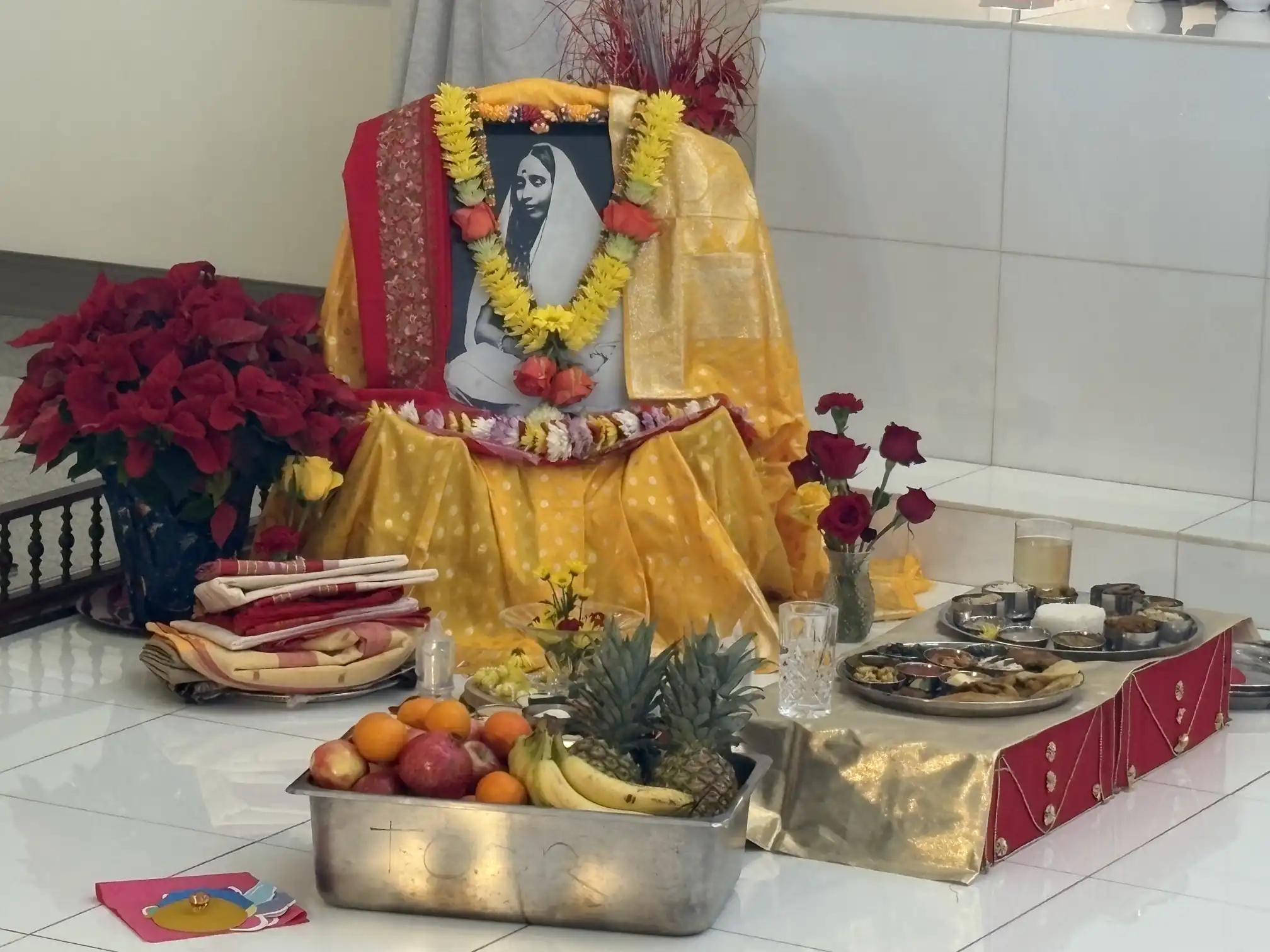
This article is about that teaching, and about the life that carried it. It is the first Friday article in the weekly rotation of figures who gathered around Sri Ramakrishna, and Holy Mother stands first in that rotation for a simple reason: without her, the Ramakrishna movement has no mother, and without a mother, its teaching of oneness remains an idea rather than a household. She was the spiritual consort of Sri Ramakrishna, worshipped by him as the Divine Mother, and after his passing she became the mother of the new monastic order and of countless household devotees, guiding them for thirty-four years. Her authority came from no office and no title. It came from the fact that those who lived near her saw, day after day, a person whose patience never broke, whose compassion made no distinction, and whose dignity survived poverty, illness and the relentless demands of other people’s needs.
The timing of this article is not accidental. This week brings the five days of Diwali, beginning today with Dhanteras, and on Sunday the worship of the Divine Mother as Kali and Lakshmi fills homes and temples across India and the diaspora. That festival belongs to the same Mother whom Ramakrishna worshipped and whom Sarada embodied in a human life. Yet the doorway into this article comes from a different quarter, and it is worth naming honestly, because it tests the very teaching Holy Mother left us. A large new study of meditation, published on 5 November 2026, found that four weeks of app-guided practice did no better than listening to music, on the measures it had set out to test. It is the kind of result that invites either discouragement or a shrug, and Holy Mother has something to say to both responses. She never promised quick results. She taught regular practice, patiently continued, and a life of forbearance in which the fruit ripens slowly and often out of sight. The first section of this article reports that study and lets it open the door. What follows is the house behind the door: her childhood and her coming to Dakshineswar, the worship that revealed her to Ramakrishna, her years as mother of the Sangha, her counsel against fault-finding, her work as worship, her teaching on meditation, her bearing of suffering, her guidance to householders and women, and a rule of practice for readers who want to live what she lived.
A note on method, because this subject invites invention. Where this article reports Holy Mother’s teachings, it paraphrases them in the article’s own words and names its sources, chiefly The Gospel of the Holy Mother, the collection known in Bengali as Sri Sri Mayer Katha, and Swami Nikhilananda’s standard life of the Holy Mother, Sri Sarada Devi, the Holy Mother. Nothing here is presented as a direct quotation unless the wording is that of a named source, and no teaching has been invented to fill a gap. Holy Mother’s life needs no decoration. It needs only to be told accurately, and then — the harder part — practised.
1. A Meditation Study That Found Little — and the Mother Who Expected Patience
This week a large, carefully designed study of meditation reported a result that few apps would choose for their advertising. The paper, Digital Meditation at Scale: A Randomized Citizen Science Trial Comparing Four Meditation Practices, by Helane Wahbeh of the Institute of Noetic Sciences and her collaborators, was published in BMC Psychology on 5 November 2026 (https://link.springer.com/article/10.1186/s40359-026-05869-5). It was preregistered, which means the researchers had written down in advance exactly what they expected each kind of meditation to do, so that the results could not be reshaped after the fact to fit the data. A total of 1,211 adults were assigned at random to one of five conditions for four weeks: app-guided loving-kindness meditation, mantra meditation, body scan, or nondual meditation, or a comparison condition in which participants listened to classical music. The researchers measured a wide range of outcomes before and after — well-being, mood, self-transcendence, nondual awareness, body awareness and compassion by self-report; attention and working memory by cognitive tests; and brain and heart measures including electroencephalography, heart rate variability and heartbeat-evoked potentials.
The headline result was null. No preregistered meditation-versus-control outcome survived correction for false discovery, and the statistical evidence for the brain-wave measures favoured the hypothesis of no effect. None of the four technique-specific predictions the researchers had made in advance was supported, and the four techniques did not differ from one another. Two self-report differences did appear on comparisons the researchers had not predicted — one concerning self-compassion and one concerning sleep quality — and participants practising mantra meditation showed faster working-memory reaction times than those practising the body scan. An exploratory analysis suggested that people higher in trait neuroticism may have gained more in cognitive speed than controls, a finding the authors themselves describe as hypothesis-generating, meaning it is a lead for future work rather than a conclusion. The authors were candid about the study’s limits: endpoint data were available for only 43 percent of those randomised, and the pattern of missing data was not random, which limits what can be inferred. Their conclusion, stated plainly, was that four weeks of app-based meditation was not superior to an active music-listening control across the psychological, cognitive and physiological measures they tested.
A result like this can be read in two shallow ways, and both miss what it actually says. The first shallow reading is triumphalist: meditation, it is said, does not work, and centuries of contemplative claims collapse before a spreadsheet. The second shallow reading is defensive: the study must be flawed, the measures insensitive, the app a poor substitute, and the tradition need not listen. Neither reading does justice to the study, which tested a specific thing — brief, app-delivered practice, over four weeks, in a general adult sample, against an active and pleasant control — and found that this specific thing did not produce the specific effects predicted. That is useful knowledge. It is also, read with older eyes, a very familiar piece of knowledge. No serious contemplative tradition has ever claimed that transformation arrives in four weeks, delivered by notification, measured at an endpoint. The traditions claim something slower and more demanding: that a mind is retrained the way a character is formed, by regularity sustained over years, by conduct aligned with insight, by patience through long stretches in which nothing seems to happen at all.
That is why this study opens a genuine door into the life of Holy Mother Sri Sarada Devi, and it is the door this article walks through. Holy Mother gave initiation to large numbers of people and instructed them in meditation, and the burden of her instruction, as the records of her conversations preserve it, was never intensity, novelty or experience-hunting. It was regularity. Practice at the appointed time, whether the mind cooperates or not. Repetition of the holy name and meditation continued through dryness, distraction and discouragement. Work done without resentment. Faults of others left alone. Suffering borne without complaint and without passing it on. She did not measure her disciples by their experiences, and she did not encourage them to measure themselves that way either. The fruit she pointed to was character: a person becoming more patient, more truthful, more able to bear other people and more able to serve them. A study that finds no quick fruit from a quick method would not have surprised her. It might even have confirmed her ordering of things — first the long formation of a life, and only within that life, slowly, the ripening of meditation.
There is a second point of contact, and it matters for fairness. One of the four practices the trial tested was loving-kindness meditation, and one of its outcome measures was compassion. Holy Mother’s entire life was, in effect, a long demonstration that compassion is not primarily a feeling generated in a sitting session. It is a way of seeing — seeing no one as a stranger — practised at a cooking fire, at a doorway crowded with visitors, at the bedside of difficult relatives, in the distribution of food when there was barely enough. The sitting practice and the daily conduct belong together in her teaching, and neither is a substitute for the other. The study’s null result for a stand-alone technique, offered to strangers through a screen for a month, leaves that integrated picture untouched. If anything, it underlines it.
So the doorway stands, and it is an honest one: a well-run study, published this week, telling a culture in a hurry that the inner life does not obey the schedule of an app. Behind the door is a woman who never hurried it either, and who had more to teach about patience than any headline. The rest of this article is her life and her teaching, told in full.
2. A Child of Jayrambati: Poverty, Work and an Unhurried Beginning
Sarada Devi was born on 22 December 1853 in Jayrambati, a small village in the Bankura district of Bengal, the eldest child of Ramachandra Mukhopadhyay and Shyamasundari Devi. The family was Brahmin and devout, and also poor in the plain material sense: a modest house, agricultural work, and the constant arithmetic of making a little rice and a few resources cover many needs. Nothing in her childhood resembled a seminary or a court. She grew up the way village girls of her time grew up, inside a working household, and the work began early. She helped in the home, looked after her younger brothers, gathered fodder, assisted in the fields at harvest, husked paddy, and learned the whole economy of a rural family from the inside — who eats first, what can be stored, what must be shared with a neighbour who has less, and how dignity is kept when there is not enough.
The standard biographies, above all Swami Nikhilananda’s Sri Sarada Devi, the Holy Mother, preserve a picture of a child marked less by prodigy in the dramatic sense than by steadiness, sweetness of temper and an unusual capacity to absorb herself completely in whatever she was doing, whether that was work, play with companions, or worship at the village shrines. Jayrambati had its temples and its festivals, and the child’s religious life was the religion of the village: the worship of the Goddess in her forms, the stories of the epics and Puranas heard from elders and travelling reciters, the rhythm of vows and offerings that ordered the agricultural year. Later teachers and scholars have sometimes gone looking in her childhood for omens, and the tradition does preserve family memories and local accounts that cast her birth and early years in a sacred light. This article will not build on omens. What can be said without embellishment is more useful: the qualities her whole later life displayed — endurance, frugality without miserliness, attention to whoever was in front of her, and a complete absence of self-importance — are exactly the qualities a poor, devout, working village childhood, met by a certain kind of soul, would be expected to form. The monastery, when it came, was built on a foundation the village had already laid.
Her marriage came in childhood, as was customary. In 1859, when Sarada was five years old, she was married to Gadadhar Chattopadhyay of Kamarpukur, the neighbouring village — the man the world would come to know as Sri Ramakrishna. He was twenty-three, already known locally as an eccentric and God-intoxicated priest of the Kali temple at Dakshineswar, on the Ganga north of Calcutta. The marriage had come about, the biographies record, through his own indication of Jayrambati as the place where his bride was to be found, and through the ordinary negotiations of the two families. For years after the ceremony the marriage existed mostly on paper and in occasional visits. The child bride remained at Jayrambati, growing up in her parents’ home, learning that her husband served a temple, that he was absorbed in God to a degree many found alarming, and that her life would in time be joined to his. She heard reports that worried her — that he behaved strangely, that his health and mind were doubted by some — and she formed the resolve, recorded in the biographies, that she would go to him not as a burden or a claimant but, if she could, as a help.
That resolve is the first adult fact of her life, and it sets the key for everything after. She did not approach Dakshineswar as a wife demanding the rights of a wife, in a situation that would have justified many demands. She approached it as a servant and a student approaches a teacher, and as a mother — though that word belongs to her future — approaches someone in her care. When she finally made the journey, she was eighteen, and she walked a good part of the way. What she found, and what she made of it, is the subject of the next section. But the childhood should be allowed to stand on its own first, because Holy Mother herself never treated it as a waiting room. The fields of Jayrambati, the siblings on her hip, the husking pedal and the village shrine were her first monastery, and the woman who later fed a movement had learned, before she ever saw Dakshineswar, how much work it takes to feed even one household, and how to do that work without complaint.
3. Dakshineswar and the Nahabat: A Small Room and a Vast Life
Sarada Devi came to Dakshineswar in 1872, at eighteen, and the temple complex on the eastern bank of the Ganga became, with interruptions, her home for well over a decade. What she found there was a situation without a script. Her husband was a priest of the Kali temple who had passed through years of intense spiritual disciplines and states that set him apart from ordinary life, who was attended by a growing circle of admirers and seekers, and whose marriage, both of them understood, was not to be a marriage in the ordinary sense. Sri Ramakrishna received her with courtesy, tenderness and complete honesty. He asked after her journey, attended to her health and rest, and in time instructed her — in prayer, in meditation, in the practices he judged right for her, and in the conduct of a life given to God. She, for her part, took up the service of his daily life: his food, prepared as his health required; his room and needs, insofar as his attendants allowed; and the hospitality of a place where visitors arrived at all hours expecting to be fed in body before they were fed in soul.
Her dwelling at Dakshineswar became one of the famous small spaces of religious history. For much of her time there she lived in the Nahabat, the narrow music-tower building at the northern end of the temple garden, in a ground-floor room so small that later pilgrims stand in its doorway and wonder how a life was lived in it. In that room she slept, kept her belongings, received — concealed from general view, as the customs of the time required of a respectable woman — and, once her day of service was done, pursued her own spiritual practice. The biographies describe a daily rhythm that began around three in the morning: bathing in the Ganga before the world was awake, then prayer and meditation in the darkness and quiet, then the long day of cooking and serving, and at its end, more prayer. The word austerity can sound like a performance. In her case it looked like a timetable, kept for years, mostly unseen.
Two things about the Dakshineswar years deserve emphasis, because later devotion has sometimes softened them into scenery. The first is the sheer labour. Cooking at Dakshineswar was not the preparation of a private meal; it was feeding a household that expanded without warning — disciples, visitors, festival crowds — on a wood fire, with ingredients that had to be fetched, cleaned, ground and portioned, often for a husband whose digestion was delicate and whose requirements were exact, and for guests whose arrival times were not. The second is the concealment. By the standards of her time and place, she lived in strict modesty, largely behind a screen, in every sense, known to many visitors only as the unseen presence from whom the food came and to whom Ramakrishna referred with reverence. A lesser person might have experienced that invisibility as erasure. The record shows something else: a woman building, in concealment, an interior life of great depth and an exterior reputation among those who did know her — the temple household, the women of the founder’s family, the early disciples — for inexhaustible patience and care.
It was at Dakshineswar, too, that she received her own formation as a spiritual practitioner, and the tradition is clear that Ramakrishna was her teacher as deliberately as he was anyone’s. He taught her prayers and mantras, guided her meditation, and watched her progress with the same attention he gave his young monastic disciples. What she learned, she learned the way she did everything: without display. There are no stories of her debating philosophy in the master’s room, no public discourses, no circle of her own during his lifetime. There is instead the picture, consistent across the sources, of a young woman in a tiny room by a great river, rising in the dark, serving all day, and sitting down at night to a practice no one was watching. When, after Ramakrishna’s passing, thousands would come to her for initiation and counsel, they were not coming to an improviser. They were coming to someone whose authority had been forged in fourteen years of exactly this — hidden, regular, unwitnessed fidelity. That is the pattern the meditation study in the first section fails to find in four weeks, and the pattern her whole life asserts: the slow work, done daily, is the real work.
Her Dakshineswar years were not continuous. She returned to Jayrambati and Kamarpukur for stretches — for her health, for family duties, and in the final period for the hardships that followed Ramakrishna’s illness and death at Cossipore in 1886. But Dakshineswar fixed the shape of her sanctity. It joined the village girl’s capacity for work to a contemplative’s capacity for stillness, and it placed both at the service of a man and a mission she had chosen, freely and with open eyes, over every easier life available to her. The next sections take up what Ramakrishna himself declared her to be, and what, after 1886, she became for everyone else.
4. Worshipped as the Mother: The Shodashi Puja and a Wholly Spiritual Marriage
Sarada was born on 22 December 1853 in the village of Jayrambati in Bengal, the daughter of Ramchandra Mukhopadhyay and Shyamasundari Devi, a simple and devout family of modest means. She was married in 1859, while still a small child, to Sri Ramakrishna, who was then living at Dakshineswar. The marriage was arranged in the manner of the time, and for many years the two lived largely apart, she in her village home and he in the temple garden on the banks of the Ganges. When she later came to live with him, what unfolded was not a household in the ordinary sense. It was a shared life ordered entirely around prayer, service and the recognition of the divine in one another.
The tradition is clear that the marriage remained wholly spiritual from beginning to end. Ramakrishna looked upon Sarada not as a wife in the worldly sense but as the Divine Mother in human form. She, for her part, understood her husband as a divine being whose work she was called to serve and to continue. There was no conflict between them on this point, no hidden sorrow recorded in the accounts, and no sense that either of them regarded the arrangement as incomplete. The biographers who knew her best describe a quiet and complete harmony, in which each of them honoured the spiritual purpose of the other.
The most famous expression of this understanding came in the Shodashi Puja, generally dated to 1872. On that night, Ramakrishna worshipped Sarada in the formal manner prescribed for the worship of the Divine Mother in the aspect of Shodashi, the goddess of sixteen, the youthful and all-pervading power of the universe. He seated her before him, offered flowers and other articles of worship, and addressed her as the Mother of the Universe. The accounts record that he entered into deep meditation during the rite and that the worship was carried out with complete seriousness and reverence, as an act of real devotion rather than as a symbolic gesture.
It is important to understand what this act meant within the tradition in which Ramakrishna lived. In the Shakta tradition, the Divine Mother is not an idea or a metaphor. She is the living power behind all creation, the energy through which the formless Absolute becomes the world. To worship a living person as the Mother was not, in Ramakrishna’s eyes, to flatter her or to elevate her by courtesy. It was to acknowledge what he perceived to be true about her nature. He had spent years in intense spiritual practice, worshipping the Mother at Dakshineswar in the form of Bhavatarini, and he had come to see the same Mother present in the woman who had been given to him as a wife. The Shodashi Puja was the public and ritual expression of a private and long-standing recognition.
For Sarada herself, the rite was not a moment of personal triumph. Those who recorded her later words describe her as having received it with humility and with a deepening sense of responsibility. She did not afterwards speak of herself in exalted terms. She continued to live simply, to cook, to clean, to serve, and to care for those who came to the temple. The worship did not remove her from ordinary life. It placed ordinary life itself under a new light. The cooking pot, the sweeping broom, the waiting at the door for a visitor, all became forms of service to the same Mother whom Ramakrishna had worshipped in her.
The marriage must be understood alongside this worship. Ramakrishna had told her plainly, according to the tradition, that he regarded her as the Mother, and she had accepted that understanding with complete willingness. In the years that followed, their life together was one of mutual service. He taught, guided disciples, and spent long hours in prayer and samadhi. She managed the small household that supported him, prepared his food with great care, looked after the needs of visitors, and maintained the discipline of the little room in which she lived. Neither sought anything from the other except the furtherance of the spiritual life.
Her home at Dakshineswar was the Nahabat, the small music tower at the edge of the temple compound. It was a cramped, low building, and her quarters there were very small. She lived in a tiny room, often with other women of the household, and carried on her daily work in conditions that would have been hard for anyone. The room was so small that she could barely move about freely, and she spent much of her time in quiet, unnoticed labour. Yet the accounts insist that she never complained about the Nahabat. She accepted it as the place assigned to her, and she made it a place of prayer. Her days there were ordered by the rhythm of the temple, the cooking, the cleaning, and the care of Ramakrishna himself, whose health required constant attention.
Her service to Ramakrishna was not limited to cooking and household work. She understood his spiritual states, his long periods of absorption, his sudden changes of mood, and his physical needs after intense prayer. She knew when to speak and when to remain silent, when to bring food and when to wait, when to receive a visitor and when to protect him from interruption. This kind of service required a sensitivity that cannot be learned from books. It came from years of close attention and from a devotion that treated every small act as worship. Those who watched her at Dakshineswar noted that she performed even the most menial tasks with a care and concentration that made them seem like acts of prayer.
Her austerities at Dakshineswar were real, though they were not performed for show. She ate very little, slept little, and spent long hours in prayer and meditation when her work allowed. She observed the disciplines of a devout Hindu wife of her time, fasting on prescribed days, keeping herself clean and modest in dress, and maintaining a life of strict simplicity. She did not advertise these practices. They were part of the fabric of her daily life, known to those who lived close to her but not paraded before visitors. Her austerity was not an end in itself. It was the natural expression of a life turned toward God, in which the body was kept disciplined so that the mind might remain free for prayer.
The spiritual marriage also shaped the way Ramakrishna spoke about her to his disciples. He did not present her as an ordinary wife to be honoured out of duty. He spoke of her as the Mother, and he urged his disciples to regard her in the same way. He told them that she would be their mother after he had gone, and that they should turn to her for guidance and for comfort. This instruction was not an afterthought. It was part of his preparation for the future of the movement he had begun. He knew that his own life was drawing toward its close, and he wanted his disciples to understand that the Mother would remain with them as a living guide.
Sarada, for her part, took this responsibility seriously long before she was called upon to exercise it in public. At Dakshineswar she received women devotees, listened to their troubles, gave them counsel in simple words, and offered them the reassurance of her presence. She did not lecture or preach. She spoke as a mother speaks, directly, gently, and with practical wisdom. Her counsel was often very simple: to pray regularly, to be patient, to bear difficulties without complaint, to serve others, and to keep the mind fixed on God. Yet those who received such counsel found that it stayed with them and helped them through difficulties that more elaborate teaching had not touched.
The Shodashi Puja, therefore, should not be remembered as an isolated event. It was the ritual centre of a life in which worship and service were the same thing. Ramakrishna worshipped Sarada as the Mother, and Sarada worshipped Ramakrishna as God, and both of them worshipped through the daily acts of cooking, cleaning, waiting, listening and caring. Their marriage is presented in the tradition as a teaching in itself: that the highest spiritual life does not require a departure from ordinary human relationships, but can transform those relationships from within, so that a marriage becomes a path to liberation rather than a bondage to the world.
This is why the Holy Mother is remembered not only as the wife of Ramakrishna but as the Mother of the tradition. The Shodashi Puja gave a formal name to what her life already showed: that the Divine Mother can be present in a human life lived with humility, purity and unceasing service. Her greatness, as the biographers describe it, lay not in display but in the steady, quiet, and complete offering of herself to the work that had been given to her. She asked for nothing, claimed nothing, and received everything that came to her as the will of the Mother whom she served.
In later years, when devotees asked her about the Shodashi Puja, she spoke of it with reserve, as one speaks of something sacred that should not be made into a topic of idle curiosity. She did not deny it, and she did not elaborate upon it. The tradition records her counsel that the true meaning of the worship is to be understood through practice rather than through discussion: to see the Mother in all beings, to serve her in all beings, and to keep the heart free from pride. That counsel, simple as it sounds, contains the whole teaching of her life at Dakshineswar.
The Nahabat years thus prepared her for what was to follow. They taught her patience in cramped quarters, endurance in hard work, attentiveness to the needs of others, and the habit of turning every act into prayer. They also taught her how to live without recognition. For years she was known only to a small circle, and she was content with that obscurity. She did not seek a public role. The public role came to her later, after Ramakrishna had passed, and it came because his disciples and devotees turned to her as the one person who could carry forward his work. When that time came, she was ready, not because she had prepared a public career, but because she had spent years in hidden service, learning the discipline that would allow her to serve openly without being changed by attention.
The marriage and the worship together form the foundation of her later life. Without the Shodashi Puja, the Mother of the Sangha is difficult to understand. With it, her later work becomes clear: she was not inventing a new role for herself after 1886, but continuing the role that Ramakrishna had already recognised in her, the role of the Mother who receives, nourishes, guides and protects all who come to her. The spiritual marriage was not a private arrangement between two people. It was the beginning of a motherhood that would extend, in time, to thousands of people who had never met Ramakrishna himself, but who would come to know him through her.
5. After 1886: Kamarpukur, Jayrambati and the Mother of the Sangha
Ramakrishna passed away on 16 August 1886, after a long and painful illness. His death left Sarada, then thirty-two years old, in a position that was difficult in every way. She was a widow in a society that imposed strict and often harsh restrictions upon widows. She had no children, no independent income, and no settled home of her own. The small circle of young disciples who had gathered around Ramakrishna were themselves without resources, and the future of his work was uncertain. For a time, it seemed possible that the movement would disperse, and that Sarada would be left to live out her days in obscurity and hardship.
She did not allow grief to turn into despair. The tradition records that, in the days after his passing, she was sustained by a sense of his continued presence and by his instruction that she should live on to carry forward his work. She understood that her life was not over with his death, and that the Mother whom he had worshipped in her had a task for her that was only beginning. This understanding did not remove her sorrow. Those who knew her describe a deep and abiding grief, borne with quiet dignity and without complaint. But the grief did not paralyse her. It deepened her compassion and made her more ready to receive others who came to her in sorrow.
Her first years as a widow were spent largely at Kamarpukur, the village where Ramakrishna had been born. Kamarpukur was a place of great hardship for her. She lived in great poverty, often without enough food, and she depended upon the help of relatives and the occasional gift of a devotee. The house there was small and in poor repair, and she had to manage alone, cooking for herself, drawing water, and maintaining the household with very little support. She also faced the social difficulties of widowhood, the restrictions on dress and food, and the expectations of a village community that did not always understand her situation.
Yet Kamarpukur was also a place of spiritual significance for her. It was Ramakrishna’s birthplace, and she felt his presence there in a special way. She spent her time in prayer and in the care of the small shrine that had been established in his memory. She received the few visitors who made their way to the village, and she gave them counsel and comfort as she had done at Dakshineswar. Her life at Kamarpukur was not a retreat from the world. It was a period of preparation, in which she learned to live with hardship and to depend entirely upon the Mother for her daily needs.
From Kamarpukur she moved, in time, to Jayrambati, her own birthplace. Jayrambati became her settled home for the rest of her life, and it is there that she is most closely associated in the memory of devotees. At Jayrambati she lived in the family home, in simple surroundings, and she built up a pattern of life that combined prayer, household work, and the reception of visitors. The house at Jayrambati was modest, and the work of maintaining it was considerable, but she made it a centre of spiritual life. Devotees began to come to her in increasing numbers, first from nearby villages and then from Calcutta and further afield, seeking her blessing, her counsel, and initiation.
Her life at Jayrambati was not easy. She carried heavy family burdens for decades. Her mother and other relatives lived with her or depended upon her, and she was responsible for their care as well as for her own household. Some of her family members were difficult, unwell, or demanding, and she bore with them with extraordinary patience. She also had to manage the practical problems of feeding a growing number of visitors, often with very limited resources. The tradition records many instances in which she went without food herself so that a guest might be fed, or in which she worked late into the night to prepare for visitors who had arrived unexpectedly.
The growth of her role as Mother of the Sangha was gradual and natural. It was not the result of a formal appointment or a public declaration. It happened because Ramakrishna’s disciples, both monastic and householder, turned to her again and again, and found in her the guidance they needed. The young monks who had been with Ramakrishna at Dakshineswar and at Cossipore regarded her as their mother in a literal sense. They wrote to her for advice, they visited her at Jayrambati and later at Calcutta, and they accepted her counsel as authoritative. Swami Vivekananda, who had become the leader of the movement after Ramakrishna’s passing, treated her with the deepest reverence and consulted her on important matters. He regarded her as the Mother of the order he was building, and he made it clear to others that her authority was to be respected.
The householder disciples also came to her, in large numbers. Men and women from Calcutta and from the villages came to Jayrambati seeking initiation, seeking relief from sorrow, seeking guidance in family difficulties, and seeking a blessing for their children. She received them all, regardless of their background or their past. She did not ask about their caste, their wealth, or their respectability before receiving them. She listened to each person as a mother listens, and she gave each person what she felt they needed: sometimes a word of counsel, sometimes initiation, sometimes simply the reassurance of her presence and her blessing.
Her initiations became one of the central features of her later life. She gave initiation to a very large number of people, both men and women, monastic and householder. The initiation was simple and direct. She gave the disciple a mantra, instructed them in the practice of prayer and meditation, and blessed them as her child. She did not impose elaborate conditions or demand a long period of preparation. She judged each person by their sincerity and their readiness, and she was willing to initiate those whom others might have regarded as unfit. The tradition records that she sometimes initiated people at once, even when they had come to her for the first time, because she saw in them a genuine longing for God.
Her guidance to her disciples was practical and direct. She counselled them to pray regularly, to repeat the name of God, to be honest in their dealings, to serve others, and to bear difficulties with patience. She warned them against pride, against gossip, against the desire for praise, and against the habit of finding fault in others. She taught them that spiritual life is not a matter of display or of extraordinary experiences, but of steady, daily practice, carried out with sincerity and humility. She also taught them to be kind to one another, to forgive readily, and to see the Mother in all beings, even in those who were difficult or unkind.
Her role as Mother of the Sangha also involved a responsibility for the welfare of the monastic order. She was concerned for the health and well-being of the monks, and she often sent them food, clothing, and other necessities. She inquired after them when they were ill, and she prayed for them when they were in difficulty. She also gave counsel on matters affecting the order, and her word was treated with respect by those who led it. She did not seek to govern the order in a formal way. Her authority was the authority of a mother, expressed through love, concern, and wise counsel, rather than through command.
At Jayrambati, her daily life followed a pattern that remained largely unchanged for many years. She rose early, prayed and meditated, attended to her household duties, cooked for her family and for visitors, received those who came to see her, gave initiation when appropriate, and spent the evening in prayer and in conversation with those who were present. Her health was often poor, and she suffered from various ailments in her later years, but she continued to work and to receive visitors as long as she was able. She did not spare herself, and she often worked beyond her strength in order to serve others.
Her life at Jayrambati also included long periods of residence in Calcutta, particularly in her later years, when her health required medical attention and when the growing number of devotees made it necessary for her to be more accessible. In Calcutta she lived in a house that was provided for her by devotees, and she continued the same pattern of life: prayer, household work, reception of visitors, initiation, and counsel. The change of place did not change her manner of life. Whether in the village or in the city, she remained the same simple, patient, and compassionate Mother.
The years after 1886 were thus not a period of retirement or of quiet widowhood. They were the years in which her public motherhood unfolded. The Shodashi Puja had recognised her as the Mother. The years at Kamarpukur and Jayrambati made that recognition real in the lives of thousands of people. She became the Mother of the Sangha not by claiming a title, but by living as a mother lives: feeding, sheltering, guiding, forgiving, and bearing with the weaknesses of her children. Her life in those years shows that true spiritual authority does not need to be asserted. It is recognised by those who experience it, and it grows naturally from a life of service and love.
She passed away on 20 July 1920, after a period of illness, in Calcutta. By that time she had become, for the Ramakrishna movement and for countless devotees outside it, the living embodiment of the Divine Mother. Her death was mourned widely, but her influence did not end with her passing. The tradition she had nurtured continued, and the memory of her motherhood remained a source of guidance and comfort for those who had known her and for those who came after. Her life after 1886, with all its hardship and all its service, stands as a teaching in itself: that widowhood, poverty, and obscurity can become, through devotion and patience, the ground of a motherhood that embraces the world.
6. No One Is a Stranger: Universal Motherhood in Daily Practice
The most striking feature of Sarada’s life, as remembered by those who knew her, is the universality of her motherhood. She received all who came to her, without distinction of character, caste, past or respectability. She did not ask a visitor about their background before offering them a seat, a glass of water, or a meal. She did not inquire into their past in order to decide whether they were worthy of her attention. She received each person as a child who had come to a mother, and she gave each person the same welcome, the same patience, and the same care.
This was not a theory she held, but a practice she lived every day. At Jayrambati and in Calcutta, visitors arrived at all hours, often without notice, often in large numbers, often tired, hungry, or distressed. She fed them, gave them a place to rest, listened to their troubles, and sent them on their way with her blessing. She did this for the learned and the unlearned, for the wealthy and the poor, for the devout and the doubtful, for those who had lived upright lives and for those whose lives had been marked by failure and wrongdoing. The tradition records that she was especially tender toward those whom society had rejected or whom others regarded as unworthy, and that she often said, in her own simple way, that she was the mother of the good and of the bad alike.
Her attitude toward caste is particularly noteworthy. In the Bengal of her time, caste distinctions were rigid and were observed with great strictness, even among devout Hindus. Sarada did not observe them in the same way. She received people of all castes, fed them, and treated them with the same affection. She did not make a public campaign against caste, and she did not preach about social reform in the manner of a modern reformer. She simply lived as a mother lives, and a mother does not ask about the caste of her child before feeding it. Her practice was more eloquent than any sermon. Those who witnessed it understood that, in her eyes, the distinctions that divided people in the world had no place in the household of the Mother.
Her reception of people whose past was troubled or whose character was flawed was equally free from judgement. She understood that human beings make mistakes, that they fall into bad habits, that they act out of ignorance or weakness, and that they often suffer more from their own failings than others suffer from them. She did not condone wrongdoing, and she did not pretend that it did not matter. But she did not reject the wrongdoer. She counselled them to turn toward God, to pray, to practise self-control, and to begin again. She gave them hope, and she gave them a place to start. The tradition records her counsel that a person who sincerely seeks the Mother will not be turned away, and that the Mother’s grace is available to all who ask for it with a sincere heart.
Her patience with difficult and unwell people around her was extraordinary, and it was tested daily. For decades she carried family burdens that would have exhausted a less patient person. Some members of her family were demanding, querulous, or unwell, and she bore with them year after year, attending to their needs, listening to their complaints, and caring for them when they were ill. She did this without resentment and without making a display of her patience. She regarded it as part of her duty as a mother and as a member of the family, and she performed it as she performed all her duties, quietly and without complaint.
The same patience extended to devotees and visitors who were difficult. Some visitors were importunate, some were argumentative, some were mentally disturbed, and some were simply rude. She received them all with the same calm and the same courtesy. She did not lose her temper, she did not raise her voice, and she did not turn anyone away because they were difficult to deal with. She understood that a person who is difficult is often a person who is suffering, and she responded to the suffering rather than to the difficulty. Those who watched her in such situations were struck by her ability to remain serene and kind, even when the person before her was behaving in a way that would have tried the patience of most people.
Her feeding and sheltering of devotees was a central part of her daily practice. She cooked for large numbers of people, often with very limited resources, and she made sure that no one who came to her house went away hungry. She paid attention to the smallest details: whether a visitor had eaten, whether they had a place to sleep, whether they needed medicine, whether they had enough money for their journey home. She often gave away her own food or her own bedding so that a guest might be comfortable. Her hospitality was not a formal duty. It was the natural expression of a motherhood that sees every guest as a child of the Mother and treats them accordingly.
Her care for the sick was also a marked feature of her life. She nursed family members and devotees when they were ill, often at considerable cost to her own health. She prepared medicines, sat by the bedside, and prayed for their recovery. She did this not as a professional nurse, but as a mother who cannot bear to see her child suffer. Her presence at the bedside was itself a source of comfort, and many who were ill found that her calm and her prayer helped them to bear their suffering with greater patience. She did not claim to heal by miraculous power. She healed, when she healed, by love, by attention, and by prayer.
Her universal motherhood was also expressed in her attitude toward people of other faiths and other backgrounds. She did not regard the devotees of other traditions as strangers or as outsiders. She received them with the same welcome as she received Hindus, and she spoke to them with the same kindness. The tradition records that she honoured the sincerity of all who sought God, whatever the form of their worship, and that she regarded all such seekers as children of the same Mother. This openness was not a matter of doctrine for her. It was a matter of lived experience: having known the Mother in her own life, she recognised the same Mother at work in the lives of others, in whatever form they worshipped her.
The practical counsel she gave to those who came to her was always simple and always directed toward daily life. The tradition records her counsel that the way to God is through steady practice, through honesty, through service to others, and through patience in difficulty. She counselled people to repeat the name of God regularly, to pray morning and evening, to be truthful in speech, to avoid gossip and fault-finding, and to be kind to those around them. She counselled mothers to care for their children with love and patience, husbands and wives to bear with one another, and those in service to do their work with sincerity. She did not give elaborate philosophical discourses. She gave the kind of counsel that a mother gives: practical, direct, and suited to the needs of the person before her.
Her teaching on forgiveness was especially important. She counselled her disciples to forgive readily, to forget injuries, and not to harbour resentment. She taught that holding a grudge harms the person who holds it more than it harms the person against whom it is held, and that forgiveness is a form of freedom. She herself practised what she taught. She forgave those who had wronged her, she bore with those who had been unkind, and she did not speak ill of others, even when she had cause to do so. Her example in this regard was more powerful than her words, and those who knew her learned forgiveness by watching her forgive.
Her teaching on patience was closely related. She counselled that patience is the foundation of spiritual life, and that without patience no practice can bear fruit. She taught that difficulties are to be borne without complaint, that delays are to be accepted without frustration, and that the results of practice are to be left to the Mother. She herself was a model of patience, bearing hardship, illness, family difficulties, and the demands of a growing circle of devotees with a calm that never seemed to fail. Those who came to her in impatience found that her presence itself taught them to wait, to endure, and to trust.
Her motherhood was also expressed in small, everyday acts that are easily overlooked in a formal biography. She remembered the names and circumstances of those who came to her, she inquired after their families, she sent them food when they were in need, she wrote to them when they were away, and she prayed for them regularly. She kept track of her children, as a mother keeps track of hers, not out of a desire to control them, but out of love and concern for their welfare. She rejoiced in their progress and grieved over their difficulties, and she made it clear to them that they were never forgotten.
The universality of her motherhood did not mean that she treated everyone identically. She understood that different people need different things, and she gave to each according to their need. To one she gave initiation, to another she gave counsel, to another she gave food and shelter, to another she gave simply her blessing and her presence. She did not impose a single pattern upon all. She responded to each person as a mother responds to each of her children, according to their age, their temperament, and their need. This flexibility was part of her wisdom. She knew that spiritual guidance must be suited to the person who receives it, and that a rigid rule applied to all would help none.
Her life thus offers a complete picture of what universal motherhood means in practice. It is not an abstract idea or a sentiment. It is a daily discipline of receiving, feeding, sheltering, listening, forgiving, bearing with difficulty, and praying for others. It is practised in the kitchen as much as in the shrine, in the care of a difficult relative as much as in the giving of initiation, in the quiet endurance of hardship as much as in the public reception of devotees. Sarada’s motherhood was universal because she did not set limits upon it. She did not say that her care extended only to the worthy, only to the learned, only to those of her own caste or community. She said, by her life, that no one is a stranger to the Mother, and that all who come to her are her children.
This is why her memory remains alive in the Ramakrishna tradition and beyond it. She is remembered not only for the Shodashi Puja, not only for her life with Ramakrishna, not only for her role as Mother of the Sangha, but for the daily, practical, and universal motherhood that she lived until the end of her life. She showed that the Divine Mother is not far away, to be worshipped only in temples and on festival days, but close at hand, in the person who feeds the hungry, shelters the homeless, forgives the wrongdoer, and bears with the difficult, year after year, without complaint and without seeking reward. In her life, the teaching of the Mother became a lived reality, and it remains, for those who seek it, a path that can be followed in the ordinary circumstances of daily life.
7. If You Want Peace: The Teaching Against Fault-Finding
Among the counsels most often remembered from Holy Mother Sri Sarada Devi, one returns again and again in the memories of those who came to her for help. It is simple enough to state in a single sentence, and difficult enough to practise for a lifetime. If you want peace, she told them, do not see the faults of others. See your own faults instead. Bear your own share. Let the habit of noticing what is wrong in other people fall away, and the mind will grow quiet.
The counsel sounds gentle, and it is gentle. It is also exacting. The Mother was not speaking of a vague niceness, or of pretending that wrong is right. She was speaking of a particular movement of the mind that she saw ruining the peace of sincere people every day. A person sits down to pray, and the mind at once begins its inventory of other people. Someone spoke sharply yesterday. Someone else was lazy, or careless, or proud, or ungrateful. The list grows longer the longer one attends to it. By the time the prayer is over, nothing has been prayed. The mind has simply been busy judging, and it calls that busyness discernment. The Mother saw this clearly, and she cut through it with a teaching that left no room for evasion. Peace does not come from correcting the world in thought. Peace comes from withdrawing the attention from the faults of others and turning it, firmly and humbly, toward one own conduct.
Those who recorded her words remembered that she returned to this point with many different people, in many different circumstances. A householder troubled by a difficult relative. A young monk irritated by a brother disciple. A devotee who could not forgive a slight. A woman exhausted by the behaviour of those around her. To each of them the Mother gave, in substance, the same direction. Do not dwell on the faults of others. If you must look, look at yourself. The reason she gave was practical as well as spiritual. The mind that constantly finds fault becomes restless, heated and hard. It cannot settle in meditation. It cannot love. It cannot rest. The person who practises not finding fault, by contrast, gradually finds that the mind softens. The same world remains, with the same imperfections, but the inner weather changes. That is the peace she promised, not a peace that depends on everyone else improving, but a peace that grows from within, in the very place where we actually have power.
It is important to understand what she did not mean. She did not mean that a person should become blind to wrongdoing, or that one should never speak a necessary truth. The Mother herself could speak plainly when plain speech was needed, and those who lived near her knew that her gentleness was not weakness. She corrected people when correction was due. She set boundaries when they were needed. She protected the vulnerable when protection was called for. What she warned against was something else entirely, something she recognised at once in the tone of a complaint. It is the compulsive habit of fault-finding, the pleasure taken in spotting what is wrong, the sense of superiority that grows from it, the endless rehearsal of grievances that keeps the mind tied to other people faults. Honest correction is different from this habit in its motive, its manner and its fruit. Honest correction aims at the good of the other person, it is spoken at the right time and in the right measure, and it leaves the speaker quieter afterwards, not more agitated. Compulsive fault-finding aims at vindication, it is spoken whether or not it can help, and it leaves the speaker more restless than before. The Mother teaching helps a person learn to tell the difference, not by a rule written on paper, but by watching the state of one own mind before, during and after speaking.
Forbearance, too, needs to be understood rightly, because it is easily confused with passivity. The Mother was the very image of forbearance. She endured hardship, misunderstanding, physical pain and the endless demands of a household of devotees without complaint. Yet her forbearance was not the forbearance of a person who had given up, or who could not act. It was the forbearance of a person who had mastered herself. She chose when to speak and when to remain silent. She chose when to endure and when to intervene. She bore what had to be borne, and she did what had to be done, and the two were never confused in her mind. Passivity, by contrast, is a kind of collapse. The passive person endures because she feels she has no choice, and the endurance breeds resentment. The resentment then leaks out in small cruelties, in coldness, in gossip, in the quiet punishment of those who cannot be confronted directly. The Mother forbearance bred none of these things. It bred patience, clarity and a surprising freedom. Because she was not ruled by reaction, she could see what a situation actually needed, and she could do it without bitterness. That is the difference worth learning. Forbearance is strength held in stillness. Passivity is strength abandoned. The first brings peace. The second only postpones the conflict and lets it grow underground.
Her own life supplied the ground for this teaching, and those who knew her could see that she spoke from experience rather than from theory. She had lived for years in circumstances that would have given anyone ample material for complaint. She had been poor. She had been ill. She had been misunderstood, even by people close to her. She had carried responsibilities far beyond her strength. And yet those who lived with her remembered not a complaining person but a person of extraordinary evenness, someone whose presence itself calmed a room. This was not because she had no opinions, or because she approved of everything she saw. It was because she had learned, over a long life, to let the faults of others pass through her mind without taking up residence there. She noticed, she understood, and she let go. The letting go was the practice. It was not a single decision but a daily discipline, repeated whenever the old habit tried to return.
The teaching also has a particular relevance for household life, which was the life most of her disciples lived. In a monastery, one can to some extent choose one companions. In a household, one cannot. A person lives day after day with the same relatives, the same neighbours, the same colleagues, the same irritations. The faults of others are not abstract. They are present at breakfast, at work, in the evening. The temptation to catalogue them is constant, and the catalogue feels justified, because the faults are often real. The Mother counsel meets the householder exactly here. She does not ask the householder to pretend the faults are not there. She asks for a change of attention. Notice your own part. Bear your own share. Do what is yours to do, and do it well. Leave the rest. The householder who practises this discovers something unexpected. The household does not necessarily change, at least not at once. But the householder changes. The mind that was once occupied with other people shortcomings becomes available for prayer, for work, for love. And strangely, when the fault-finding stops, relationships often begin to ease on their own, because the other person is no longer meeting a judge at every turn, but a companion.
There is also a deeper reason for the teaching, one that belongs to the heart of Vedanta. The habit of seeing faults in others rests on a sense of separation. I am here, correct and clear-sighted, and you are there, flawed and in need of correction. The more one indulges this habit, the more solid the separation becomes, until the world is divided into the righteous few and the faulty many, with oneself always on the right side of the line. The Mother teaching dissolves this division at its root. To see one own faults honestly is to remember one own incompleteness. It is to remember that the same human frailty one condemns in another lives, in another form, in oneself. That remembrance does not excuse wrongdoing. It humanises the person who sees it. Compassion becomes possible, not as a duty imposed from outside, but as a natural recognition. The other person is not a problem to be solved. The other person is a fellow traveller, struggling as I struggle, failing as I fail, and worthy of the same patience I hope to receive. From this recognition, peace follows, not as a reward for good behaviour, but as the natural state of a mind that has stopped dividing the world into judges and the judged.
Practically, the teaching can be taken up in small, concrete ways. When the mind begins its familiar inventory, pause. Ask one simple question. What is my share in this situation. It may be small. It may be only a tone of voice, a moment of impatience, a failure to listen. But naming it changes everything. The attention turns inward, where it can actually do some good. Another practice is to refuse the second telling. The first noticing of a fault may be unavoidable. The second telling, to oneself or to someone else, is a choice. The Mother counsel suggests choosing silence, not the silence of suppression, which breeds resentment, but the silence of letting the thought pass, like a cloud that does not need to be chased. A third practice is to balance the account deliberately. For every fault noticed, notice also something good in the same person, something true and specific, not a vague compliment but a real virtue, a real kindness, a real effort. This is not flattery. It is accuracy. No person is only their faults, and the mind that sees only faults is not seeing clearly. It is seeing selectively, and the selectivity is the problem.
The teaching also touches the question of speech. Much fault-finding lives in speech, in the casual remark, the knowing laugh, the story told to a third person, the complaint that masquerades as concern. The Mother was watchful about speech, and she advised her disciples to be watchful too. Before speaking about another person, consider whether the speech will help, whether it is true, whether it is necessary, and whether it is kind. If it fails these tests, let it go unsaid. This is not a counsel of fear. It is a counsel of freedom. The person who stops feeding the habit of fault-finding in speech soon finds that the habit weakens in thought as well. The mind follows the tongue, and the tongue can be trained. Over time, the silence that once felt like restraint begins to feel like rest. There is simply less noise in the mind, and in that quiet, prayer becomes possible again.
It is worth noting that the Mother did not present this teaching as a technique for self-improvement alone. She presented it as a condition for peace, and peace, in her understanding, was not a luxury for the spiritually advanced. It was the birthright of every sincere person, and the thing most needed in a troubled household, a troubled community, a troubled world. She saw people exhausting themselves in the effort to reform others, and she gently redirected the effort to the one place where reform is always possible, one own heart. That redirection is the heart of the teaching. Do not wait for others to become perfect before you become peaceful. Become peaceful, and let your peace be the contribution you make to a world that is sorely in need of it.
For those who take up the practice, the results are gradual and unmistakable. The first change is often simply a sense of lightness, as though a burden has been set down. The mind is less crowded. Sleep comes more easily. Prayer, which once felt like a struggle against distraction, begins to feel like a return home. Relationships soften, not because the other person has changed, but because the constant pressure of judgement has lifted. And over a longer time, something deeper happens. The practitioner begins to see people as the Mother saw them, not as collections of faults to be catalogued, but as souls on a journey, each carrying a burden the observer cannot fully see, each deserving of patience. That way of seeing is itself a form of worship. It honours the divine presence in the other person, even when the outer behaviour is difficult. It is, in the end, the practical form of the great Vedantic truth that the same Self dwells in all. To stop finding fault is not to stop seeing. It is to begin seeing truly, and to let that true seeing bring peace.
8. Work as Worship: The Kitchen, the Grain and the Serving Hand
If the Mother teaching on fault-finding shows the inner discipline of peace, her life of work shows its outer form. For Holy Mother Sri Sarada Devi, work was not an interruption of spiritual life. It was spiritual life, expressed in the language of the household. She cooked, she cleaned, she husked paddy, she ground grain, she fetched water, she served food to devotees who arrived at all hours, and she did it day after day for years, without complaint and without seeking recognition. Those who watched her understood, gradually, that they were watching karma yoga, the yoga of action, practised not in a temple or a monastery but in a kitchen, with a grinding stone and a cooking pot.
The setting matters, because it removes any excuse for separating work from worship. The Mother did not have the luxury of a quiet room set apart for meditation, nor a schedule arranged around her convenience. Her days were shaped by the needs of others. Ramakrishna needed his food prepared in a particular way, at a particular time, with a care that honoured both his fragile health and his spiritual state. Devotees arrived hungry, tired, sometimes unannounced, and they needed to be fed. The household needed cleaning, the grain needed husking, the lamps needed tending, the clothes needed washing. There was always more to do than there were hours to do it in. And yet those who lived with her remembered her work not as drudgery but as something luminous, as though the ordinary tasks themselves had been transfigured by the spirit in which they were done. The lesson is plain. Worship is not only what happens when the hands are folded. It is also what happens when the hands are busy, provided the heart is turned toward God.
Her cooking deserves particular attention, because it was the work most closely tied to her service of Ramakrishna. She prepared his meals with a care that went far beyond the merely culinary. She knew his tastes, his digestion, his moods, the days when he could eat only a little, the days when a particular dish would comfort him. She adjusted, she improvised, she made do with what was available, and she did it with a steadiness that never called attention to itself. Those who ate her cooking remembered its quality, but they remembered something else even more, the feeling that the food had been prepared with love. That feeling is not a sentimental addition to the work. In the Mother understanding, it is the work. Food prepared with resentment nourishes the body but disturbs the mind. Food prepared with love nourishes both. She taught by example that the cook state of mind enters the food, and through the food enters those who eat it. The kitchen, in this view, is not a place apart from the shrine. It is an extension of the shrine, and the person who cooks there is performing a sacred service, whether or not anyone names it as such.
The same spirit governed the heavier, less visible work. Husking paddy is hard, repetitive labour. It strains the back, it tires the arms, it covers the worker in dust. Grinding grain on a stone is no easier. Cleaning, sweeping, washing, carrying water, these are the tasks that no one applauds and everyone depends on. The Mother did them all, for years, often while unwell, often while exhausted, and she did them without the sense of grievance that so easily attaches to such work. Those who asked her how she bore it received, in substance, a simple answer. She offered the work to God, and the offering changed the work. The task remained the same. The hands still ached. The day was still long. But the inner complaint fell away, because the work was no longer being done for recognition, or for thanks, or for a sense of importance. It was being done as an offering, and an offering asks for nothing in return. That is the secret of karma yoga in its household form. The work does not need to be grand. It needs to be offered. When it is offered, even husking paddy becomes prayer.
Serving late arrivals deserves a word of its own, because it tests the spirit of work more sharply than any scheduled task. A person can prepare for work that is expected. It is much harder to welcome work that interrupts rest, that arrives when the day is done and the body is tired. The Mother was often called upon to feed devotees who arrived late, sometimes very late, hungry and in need of shelter. She rose, she cooked, she served, and she did it with the same warmth she would have shown at midday. Those who witnessed this were struck by the absence of resentment. There was no sigh, no pointed remark about the hour, no coldness that would have made the guest feel like a burden. The guest was received as a guest, and the service was given freely. This is a demanding standard, and the Mother did not impose it as a rule for others. She simply lived it, and in living it she showed what it looks like when work has truly become worship. The interruption is not an interruption. It is the worship arriving in another form, asking to be received.
Work offered without resentment is the heart of the matter, and it deserves careful thought, because resentment is the most common poison of household work. It grows quietly. A person works hard, and no one notices. A person sacrifices, and no one thanks her. A person carries more than her share, and others take it for granted. Resentment follows, understandably, and then the work itself becomes a source of bitterness. Every task is a reminder of ingratitude. Every demand is an insult. The Mother teaching, lived rather than preached, offers a way out of this trap, and it is not the way of working less or demanding more. It is the way of changing the audience of the work. If the work is done for human recognition, it will always be vulnerable to human ingratitude, because human beings are forgetful, distracted and imperfect in their thanks. If the work is done as an offering to God, it is no longer dependent on recognition. The offering is complete in itself. The worker is free, not because the work has become easy, but because the work no longer needs to be rewarded in order to be meaningful. That freedom is the reward, and it is available in the kitchen as surely as in the meditation hall.
This does not mean that a person should accept injustice silently or allow herself to be exploited without end. The Mother herself knew when to rest, when to ask for help, when to set a limit. Work as worship is not a doctrine of self-neglect. It is a doctrine of right motive. The question is not whether the work is hard, or whether others appreciate it, but whether it is being done with a heart turned toward God. When it is, the worker can also see clearly when a limit has been reached, and can act on that seeing without bitterness. The resentment that clouds judgement falls away, and what remains is a clear-eyed care for the work, for oneself, and for others. That clarity is itself a fruit of the practice.
There is also a lesson here about the dignity of manual work, a lesson the modern world badly needs. In a culture that honours mental work and despises manual work, that measures a person worth by income or status, the Mother life stands as a quiet rebuke. She, whom devotees revered as the Divine Mother herself, spent her days doing the humblest tasks of a household, and she did them as though they were the most important work in the world, because for her they were. The grinding stone, the cooking pot, the broom, these were not beneath her dignity. They were expressions of it. The teaching is not that everyone must do manual work, but that no honest work is beneath the dignity of a spiritual person, and that the spiritual person is known not by the grandeur of the task but by the spirit in which the task is done. The office worker, the teacher, the nurse, the parent, the cleaner, each of them has a kitchen of one own, a place where the daily tasks can be offered or can be resented, and the choice is made fresh every day.
The Mother example also corrects a common misunderstanding about karma yoga, the idea that it is a lesser path, a concession for those who cannot meditate. In her hands, karma yoga was not lesser at all. It was complete. It purified the mind, it dissolved the ego, it cultivated love, and it led to the same peace that meditation promises. The reason is that work, done rightly, does what meditation is meant to do. It takes the attention off the small self, with its demands and complaints, and turns it toward something larger. The cook who is absorbed in feeding others forgets herself. The server who attends to the guest need forgets her own fatigue. The worker who offers the task to God forgets the question of reward. That forgetting is not loss. It is liberation, in small, daily instalments, and over a lifetime it adds up to a profound freedom. The Mother life shows that the path of work is not a detour around the spiritual life. For most people, it is the spiritual life, in its most available form.
For the householder disciple, this teaching is immensely practical. The day is full of work that cannot be avoided. Meals must be cooked, children must be cared for, homes must be cleaned, jobs must be done. The question is not how to escape this work in order to be spiritual, but how to let the work itself become the practice. The Mother answer is to begin with a simple offering, made silently at the start of the task. This work is for God. Then to do the task with attention, not rushing, not resenting, not rehearsing grievances while the hands are busy. Then, when the task is done, to let it go, without demanding that it be noticed or praised. This is a practice that can be taken up at once, in the very next task, whatever it is. It requires no special knowledge, no special time, no special place. It requires only willingness, and the willingness grows with practice, as the worker discovers that the work, offered in this way, returns a peace that no amount of recognition could give.
The serving hand, finally, is the image that gathers the whole teaching. The Mother serving hand was not the hand of a servant in the demeaning sense. It was the hand of one who serves because she loves, and who loves because she sees the divine in the one served. When she placed food before a devotee, she was not merely feeding a body. She was honouring a soul. When she cleaned a room, she was not merely tidying a space. She was preparing a place where God could be remembered. When she husked paddy or ground grain, she was not merely producing food. She was participating in the great, humble work by which life is sustained, day after day, and she was doing it as an offering. That is the vision of work as worship, and it remains available to anyone willing to take up the next task, however humble, with the same spirit. The kitchen, the grain and the serving hand are enough. They always were.
9. Meditation with Patience: Japa, Dry Seasons and Regular Practice
If work was the Mother outer worship, meditation was her inner anchor, and her counsel on meditation is marked by the same practical wisdom that marks all her teaching. She did not present meditation as a feat for the few, or as a state to be seized by intensity. She presented it as a daily habit, to be kept with patience, through good seasons and dry ones, by people with busy lives and wandering minds. Her guidance to householder disciples, in particular, is a model of realism and compassion. She knew how little time they had. She knew how tired they were. She knew how often their minds refused to settle. And she told them, in substance, to practise anyway, regularly, quietly, without drama, and to trust that the practice itself, kept faithfully, would do its work in time.
Regularity over intensity is the first principle, and it is the one most often forgotten. The enthusiastic beginner wants to meditate for hours, to force the mind into stillness, to achieve in a week what a lifetime of practice slowly ripens. The Mother counsel points in the opposite direction. A short practice, done every day at the same time, is worth far more than a long practice done in fits and starts. The reason is simple. The mind learns by rhythm. A practice kept at a fixed time becomes a habit, and a habit becomes a refuge. The body learns to settle at that hour. The mind learns to expect the quiet. The day itself begins to arrange itself around that still point. Intensity, by contrast, exhausts itself. The person who meditates for three hours one day and not at all for the next week has not built a habit. She has performed an event, and events, however impressive, do not transform a life. Habits do. The Mother therefore advised her disciples to fix a time, morning and evening if possible, even if only for a short while, and to keep it as faithfully as they kept their meals. The comparison is apt. No one eats a week meals in a single day. The soul, too, needs its daily bread, in regular, manageable portions.
Japa, the repetition of the holy name, was the practice she most often recommended, and for good reason. It is simple, it is portable, and it can be done anywhere, by anyone, in any state of mind. The disciple need not wait for a quiet room or a settled mood. The name can be repeated while walking, while working, while waiting, while lying down at night. The Mother advised her disciples to take up japa with a fixed number if that helped, or simply to repeat the name with love and attention whenever they could. The point was not the count, though a count can steady a wandering mind. The point was the turning of the mind toward God, again and again, until the turning itself becomes natural. Japa is, in this sense, the householder meditation, the practice that fits into a crowded life because it does not demand that life be emptied first. It asks only that the name be remembered, and the remembering, repeated daily, slowly reshapes the mind from within.
Fixed times deserve emphasis, because they are the practical means by which regularity is kept. The Mother encouraged her disciples to choose a time for meditation and to protect it, as one would protect an appointment of great importance. Early morning, before the household wakes, is the time she most often favoured, and for good reason. The mind is fresh, the world is quiet, the day has not yet made its demands. Evening, too, has its place, as a time to gather the day and offer it back. The exact hour matters less than the fixity. A fixed time removes the daily negotiation with oneself, the endless question of whether to practise now or later, a question that later almost always answers. When the time is fixed, the decision is already made, and the mind can simply begin. That simplicity is a great mercy for the busy person, whose will is already tired from a day of decisions. The practice does not ask for a fresh act of heroism each morning. It asks only that one keep the appointment.
Dry seasons are the test of this counsel, and the Mother spoke of them with a candour that has comforted many. There are times when meditation feels empty, when the mind wanders without cease, when the name feels dry on the tongue, when no peace comes, no light, no sweetness. The beginner, meeting such a season, often concludes that the practice has failed, or that she has failed, and abandons it. The Mother counsel is to stay. The dry season is not a sign of failure. It is a normal part of the path, and often a necessary one. The mind, like the earth, has its seasons. There are times of growth that are visible, and times of growth that are hidden, when the roots are deepening though nothing shows above the ground. She is learning to practise not for the sake of experience, but for the sake of God, and that learning, though painful, is precious. The practice kept in dryness is worth more, in the end, than the practice kept only when it feels good.
The wandering mind deserves a word of its own, because it is the complaint most often brought to a teacher. My mind wanders. I cannot concentrate. I sit down to meditate, and within a minute I am thinking of work, of family, of money, of old quarrels. The Mother response, as remembered by her disciples, was reassuring and practical. Do not be discouraged. Do not abandon the practice because the mind wanders. The wandering is the mind habit, built over a lifetime, and it will not be undone in a week. The practice is not to prevent the wandering, which is impossible at first, but to notice it, gently, and to return, again and again, to the name or the form or the breath. Each return is the practice. Each return strengthens the muscle of attention, even if the return lasts only a moment before the mind wanders again. Over time, the intervals of stillness lengthen. The returns become easier. The mind, trained by a thousand gentle returns, begins to settle of its own accord. But the training takes time, and the Mother asked her disciples to give it time, without impatience and without self-condemnation. To scold the mind for wandering is only to agitate it further. To return gently is to teach it, and gentle teaching, repeated daily, is what the mind needs most.
Grace and effort must be held together, and the Mother teaching holds them together with a rare balance. On the one hand, she insisted on effort. Practice regularly. Keep the fixed time. Repeat the name. Do not give up. Effort is the disciple part, and it cannot be delegated. On the other hand, she insisted that the fruit of practice is not produced by effort alone. It comes by grace, in God own time, in ways the practitioner cannot foresee or control. The disciple can prepare the field, can sow the seed, can water it faithfully. But the growth is a mystery, and the harvest comes when it comes. This balance protects the practitioner from two opposite errors. The first is passivity, the idea that because grace does all, effort is unnecessary. The second is anxiety, the idea that because effort is needed, the result must be forced, measured, achieved on schedule. The Mother counsel avoids both. Practise faithfully, and leave the result to God. That leaving is itself a practice, and it is the hardest part, because it asks the practitioner to surrender the very thing she most wants, control over her own progress. Yet it is in that surrender that peace is found. The person who practises and surrenders is free, whether the meditation is sweet or dry, whether the mind is still or restless, because her peace no longer depends on the state of her practice. It depends on her faithfulness, and faithfulness is always within her power.
For householder disciples with little time, her guidance was especially gentle and practical. She did not ask them to abandon their duties in order to meditate. She asked them to weave meditation into the duties they already had. A few minutes in the morning, before the household stirs. The name repeated while cooking, while travelling, while doing the day work. A brief sitting in the evening, even if only for a short while. A moment of remembrance before sleep. These small practices, kept faithfully, add up to a substantial spiritual life, not because the minutes are many, but because the remembrance is constant. The Mother understood that the householder cannot live like a monk, and she did not ask him to. She asked him to live like a householder who remembers God, and that remembering, practised in the midst of work and family, is itself a high form of meditation. The test is not the length of the sitting. It is the continuity of the remembrance, the way the mind returns to God throughout the day, in the gaps between tasks, in the quiet moments, in the midst of activity itself.
Patience, finally, is the virtue that holds the whole teaching together. Meditation is not a transaction. It is a relationship, and relationships grow slowly, through faithfulness, through disappointment, through return. The Mother asked her disciples to be patient with themselves, with their minds, with their progress, and with God timing. She asked them not to measure their spiritual life by the experiences of a single sitting, or a single week, or even a single year, but by the slow, steady direction of the heart. Is the heart turning, however slowly, toward God. Is the mind growing, however gradually, quieter and kinder. Is the life becoming, however imperfectly, more honest and more loving. If the answer is yes, the practice is working, whatever the meditation felt like this morning. The disciple who takes up this counsel will find, over time, that meditation is not a task to be completed but a home to be returned to, day after day, in patience and in trust, until the returning itself becomes the peace that was sought all along.
10. Bearing What Cannot Be Changed: Illness, Poverty and Difficult People
The life of Holy Mother Sri Sarada Devi was not sheltered from hardship. From her earliest years in the village of Jayrambati to her final years in Calcutta, her days were marked by poverty, by bodily suffering, and by the constant presence of people who were difficult to live with. What makes her example so compelling for householders is not that she escaped these conditions, but that she bore them without bitterness, and turned the bearing itself into a form of worship.
Her childhood home was poor. The family lived simply, eating what the land provided, wearing plain cloth, and depending on the kindness of neighbours and the labour of their own hands. Sarada learned early that a meal might be thin, that a sari might be worn until it frayed, and that want was not a disgrace but a condition to be met with dignity. Those who knew her in later years remembered that she never spoke of poverty as an injustice done to her, and never treated simplicity as something to be escaped. She kept the habits of village life even when she lived in the city, cooking simply, wasting nothing, and finding sufficiency in little. The lesson she embodied was not a theory about poverty. It was a lived refusal to let scarcity sour the heart.
Illness came to her again and again, and it came in forms that could not be wished away. She suffered from fevers, from digestive troubles, from the weakness that follows long strain, and in her later years from more serious ailments that confined her to bed for long stretches. The accounts of her life describe a body that was often frail, and a will that remained steady through the frailty. She accepted treatment when it was offered, and she followed the advice of physicians, but she did not make her illness the centre of her household. Visitors who came to see her often found her sitting up to receive them even when she was unwell, listening with full attention, and sending them away comforted, while she herself returned to her bed. Her attendants worried over her, and urged her to rest, yet she measured rest against duty, and duty usually won.
There is a particular quality in the way she bore illness that deserves attention. She did not complain, but neither did she pretend that suffering was pleasant. She did not perform endurance for an audience. Her patience was quiet and practical. When pain kept her awake, she turned her mind to the Divine, and when the body recovered a little strength, she used it at once for others. Those around her learned that complaining multiplies suffering, while quiet acceptance leaves room for peace. She did not teach this by lecture. She taught it by the way she received a feverish night and a crowded morning with the same even temper.
Poverty and illness were only part of the burden. She also lived, for much of her life, among people who tested her patience daily. Her family included relatives whose demands were constant, whose tempers were sharp, and whose understanding of her spiritual life was limited. Some of them depended on her entirely, and treated that dependence as a right. Others resented the stream of visitors who came to see her, and made their resentment felt in small, wearing ways. Servants and attendants, too, could be careless or quarrelsome. The household at Jayrambati and later at Udbodhan was not a retreat of like-minded devotees. It was a real household, with all the friction that real households contain.
Her response to difficult people is one of the most instructive parts of her life. She did not avoid them, and she did not answer harshness with harshness. She listened, she served, and she set boundaries gently rather than by command. When a relative spoke rudely, she answered softly, or said nothing at all, and went on with her work. When a visitor was demanding or rude, she received the person with the same courtesy she offered to a saint. Those who watched her closely noticed that she never kept a ledger of offences. She did not store up grievances to be rehearsed later. Each day began fresh, and each person was met as they were in that moment, not as they had been yesterday.
This was not mere temperament. It was discipline. Patience, in her life, was not the absence of feeling. She felt irritation and weariness like anyone else, but she had trained herself not to let those feelings govern her speech or her actions. She understood that a sharp word spoken in a moment of strain can wound for years, while a soft answer can disarm a conflict before it hardens. Her household became a school in which forbearance was practised hour by hour, in the kitchen, at the door, and beside a sickbed. The teaching that emerged was simple and severe: if you cannot bear the people nearest to you, your devotion has not yet touched your daily life.
The Mother also bore the weight of other people’s sorrows. Devotees came to her with grief, with illness in their families, with failures in business, with quarrels at home, and with the fear of death. She listened to each story as if it were the only story in the world. She did not offer quick remedies or easy consolations. She prayed for them, she counselled patience, and she reminded them, in her own plain way, that suffering is part of human life and that the Divine does not abandon those who call with sincerity. Many who came to her in distress left with a lighter heart, not because their circumstances had changed, but because they had been heard by someone who did not flinch from their pain.
Her poverty, too, had a social dimension that is easy to overlook. As a widow in nineteenth-century Bengal, she lived under customs that were often harsh toward widows, restricting their food, their dress, and their freedom of movement. She observed the customs of her time with quiet dignity, but she did not let them define her. She wore the simple white cloth of a widow, ate simply, and lived modestly, yet her presence commanded a respect that no custom could confer or remove. Devotees who visited her did not see a figure diminished by widowhood. They saw a mother whose authority came from holiness, not from status. In this way her life quietly challenged the idea that a woman’s worth depends on her husband’s presence or on her wealth.
There were times when money was so short that the household had to make do with very little, and times when generous devotees offered gifts that she accepted with gratitude and distributed at once. She kept nothing for herself beyond what was needed. If food was sent, it was shared. If cloth was offered, it was given to someone who needed it more. Her generosity was not a performance of renunciation. It was the natural overflow of a heart that did not clutch at things. She understood that possessions become a burden when they are held tightly, and a blessing when they pass through open hands.
The discipline of bearing what cannot be changed is often misunderstood as passivity. In her life it was anything but passive. To bear illness without complaint required strength. To bear poverty without resentment required clarity about what matters. To bear difficult people without retaliation required a constant, watchful mastery of speech and temper. She was not resigned in the sense of giving up. She was steady in the sense of refusing to be pulled off centre by conditions she could not control, while acting with full energy where action was possible. When a sick person needed care, she nursed them. When a quarrel threatened the household, she intervened with a calm word. When a devotee needed guidance, she gave it plainly. Bearing and acting were not opposites for her. They were two sides of the same surrender.
Modern readers may wonder how such patience is possible without suppressing honest feeling. The accounts of her life suggest that she did not suppress feeling, but transformed it. Grief became prayer. Irritation became an occasion for self-examination. Weariness became a reminder to rest in the Divine rather than in one’s own strength. She did not deny that life is hard. She denied only that hardness gives us permission to become hard ourselves. That distinction is the heart of her teaching on forbearance, and it is why her example still speaks to householders who live with chronic illness, with tight budgets, and with relatives who are not easy to love.
Her bearing also had a communal effect. Households that live with a person of such patience slowly change. Tempers soften. The habit of complaint loses its audience. Servants who were careless become more careful. Relatives who were demanding learn, sometimes slowly, that demands do not produce the response they expect, while gentleness does. The Mother never set out to reform her household by argument. She reformed it by the steady pressure of her own example, day after day, year after year. Those who lived with her carried that atmosphere into their own homes, and the teaching spread not through books but through changed conduct.
To remember her in this aspect is to remember that holiness is not proved by escape from suffering, but by the quality of one’s response to it. She did not choose poverty, illness, or difficult companions. She chose, again and again, how to meet them. That choice, repeated across a lifetime, is what made her a mother to so many. The devotee who is ill, poor, or surrounded by difficult people does not need to look elsewhere for a model. The model lived in a village house and a Calcutta lane, cooking, nursing, listening, and bearing, and finding in that very bearing the presence of God.
11. A Teacher of Householders and Women
If Sri Sarada Devi is remembered first as the wife of Sri Ramakrishna and then as a mother to his devotees, she must also be remembered as a teacher in her own right, and especially as a teacher of householders and of women. Her guidance was not given from a pulpit or a lecture hall. It was given in kitchens, on verandas, and during the brief private moments when a visitor could speak with her alone. Because it arose from conversation rather than from treatise, it has a directness that still startles. She spoke to people about the lives they actually lived, in the houses they actually kept, with the duties they could not lay aside.
The central point of her teaching to householders was the dignity of household life itself. She did not treat the home as an obstacle to spiritual life, to be tolerated until one could escape to a monastery or a forest. She treated the home as a field of practice. Cooking for one’s family, caring for parents, raising children, nursing the sick, and earning an honest living were, in her view, forms of service that could be offered to God. The householder who performed these duties with devotion and without selfish attachment was, she taught, following a real spiritual path, not a lesser substitute for one. This affirmation mattered deeply to the lay devotees who came to her, many of whom felt guilty that they could not renounce the world as the monks had done. She relieved them of that guilt without lowering the standard. The standard was not escape. The standard was sincerity, selflessness, and remembrance of the Divine within the duties at hand.
To householders she counselled regular prayer and meditation, fitted to the shape of a working life. She did not demand hours that a parent or a labourer could not give. She asked for steadiness rather than display. A fixed time for remembrance, a sincere repetition of the divine name, and an honest effort to keep the mind returning to God through the day were, in her teaching, worth more than irregular fervour. She also counselled truthfulness, restraint in speech, and care with money earned by honest means. She warned against greed, against deceit in business, and against the quarrels that arise when families chase display and status. The household that lived simply, spoke truthfully, and remembered God was, in her eyes, already a place of worship.
Her guidance to women deserves particular attention, because it combined reverence for tradition with a quiet insistence on dignity, learning, and self-reliance. She lived in a society that often denied women education and confined them narrowly to the home. She herself had received little formal schooling in childhood, and had learned to read and write with effort as an adult. Yet she valued learning for girls, and encouraged families to educate their daughters. She understood that an educated woman could manage a household wisely, raise children well, and stand with confidence in a changing world. Devotees who sought her blessing for their daughters’ studies received it warmly. She did not see learning as a threat to devotion. She saw ignorance as no virtue at all.
Alongside education, she taught self-reliance. She encouraged women to develop skill with their hands, to understand the management of a household’s resources, and not to live in helpless dependence when effort could make them capable. Her own life modelled this teaching. She cooked, cleaned, managed stores, cared for the sick, and handled the practical affairs of two households with competence and calm. No task was beneath her, and no task defeated her. Women who visited her saw in her a proof that domestic work, done well, is not drudgery but discipline, and that a woman who can manage a home with intelligence and devotion possesses a strength that the world should honour rather than dismiss.
At the same time, she defended the spiritual capacity of women without qualification. In her presence, women were not treated as secondary seekers. She gave initiation to women as she did to men, heard their confessions of doubt and sorrow with the same seriousness, and expected from them the same sincerity. Many women devotees found in her a confidante they could not find elsewhere. They could speak to her of marital difficulty, of grief over a child, of fear, of longing for God, in language that only another woman, and a mother, could fully receive. She listened without embarrassment and without judgment, and answered from a wisdom that joined compassion to plain sense. For many of them, her room was the one place where their inner life was taken entirely seriously.
Her counsel on marriage and family life was balanced and free of illusion. She honoured devoted partnership, counselled patience within marriage, and reminded couples that forbearance at home is harder, and therefore more valuable, than any show of piety outside it. She did not encourage contempt for the body or for family affection. She taught that love within the family could be purified rather than denied, offered to God rather than hoarded selfishly. To parents she counselled kindness mixed with firmness in raising children, and example over preaching. To those in conflict with in-laws or relatives, she counselled the same discipline she practised herself, namely to bear, to forbear, and to refuse the pleasure of faultfinding.
She was equally clear about devotion within duty. A woman who rose early, completed her household work with care, and sat for prayer with a mind still full of resentment had, in the Mother’s teaching, missed the point. Devotion was not a compartment. It was meant to sweeten the whole day. The cooking could be an offering. The sweeping could be an offering. The care of an elderly parent could be an offering. When work is done in that spirit, the line between the shrine room and the kitchen thins, and eventually disappears. This teaching liberated many householders, and especially many women, whose days left them little time for formal worship, by assuring them that the Divine receives the work of their hands when it is given with love.
She also spoke, in her counsel, against fear and against dependence on omens and intermediaries. She directed seekers to direct prayer, to the repetition of the name, and to trust in the Divine Mother who hears her children herself. She discouraged the anxious search for miraculous shortcuts. Grace, in her teaching, meets steady effort. The devotee who prays sincerely, lives honestly, and bears difficulty patiently is already walking the path, whether or not extraordinary experiences come. Experiences, she implied by her own example, are not the measure. Character is the measure.
It is worth noting how she taught. She rarely gave long discourses. Her words were brief, often arising from a single question, and she illustrated them from ordinary life. A pot that must be scoured daily became a lesson on the mind. A lamp that must be trimmed became a lesson on vigilance. Because the images came from the home, householders remembered them in the home, at the very moment when they needed them. Her teaching method honoured the intelligence of ordinary people. She assumed that a mother managing a household, or a clerk managing a family on a small wage, could grasp the deepest truths if they were spoken plainly, and she was proved right by the lives her words changed.
The women monastics and laywomen who gathered around her in her later years formed, in effect, a community of learning. They served her, studied under her guidance, and carried her teaching into schools and homes after her passing. She trained them not only in devotion but in responsibility, entrusting them with real work and expecting it to be done well. In this quiet way she prepared the ground for the women’s monastic order that would later bear her name. The seeds of that institution lie in these years of practical training, in which devotion and competence were taught together, as one discipline.
For the modern householder, her teaching retains its force because it refuses two common errors. The first error is to treat spiritual life as an escape from responsibility. The second is to treat responsibility as an excuse for abandoning spiritual life. She rejected both. Duty without devotion becomes dry and resentful. Devotion without duty becomes sentiment and evasion. Joined together, duty performed as offering and devotion practised with steadiness, they form a path that can be walked in any home, in any station, by women and men alike. That path, taught by a woman who walked it in a village and a city lane, remains her distinctive gift to householders everywhere.
12. Udbodhan, the Last Counsel and Her Passing
In her later years, Holy Mother Sri Sarada Devi lived for long periods in Calcutta, in the house known as Udbodhan, in the Baghbazar neighbourhood. The house took its name from the journal published by the Ramakrishna movement, and it became, in effect, her home and her court, if a word so grand can be used for so simple a place. There she received the devotees of Sri Ramakrishna and a new generation of seekers who had never seen the Master in the flesh, but who came to his consort and found in her a living presence of grace.
Life at Udbodhan followed a rhythm of prayer, work, and reception. The Mother rose early, attended to her worship, and then gave herself to the household and to her visitors. Devotees arrived through the day, sometimes singly, sometimes in groups, sometimes in crowds that filled the house and the lane outside. They came from the city and from distant villages. They came in health and in sickness, in prosperity and in ruin. Rich householders and poor widows, students and merchants, monks and mothers with infants in their arms, all made their way to her door. She received them not in a grand hall but in her small room, often seated simply, her veil drawn, her voice soft, her attention complete.
Among the most important of her works at Udbodhan was the giving of initiation. Large numbers of devotees received spiritual initiation from her in those years, receiving a mantra and instruction in practice suited to their capacity and their station. She gave initiation to women and men alike, to the learned and to those who could barely write their names, treating each soul’s longing with equal seriousness. Those who received initiation from her often spoke of the peace that settled on them in her presence, a peace that outlasted the interview and steadied their practice for years. She did not make initiation a spectacle. It was given quietly, personally, as a mother gives what a child needs, and its fruit was expected to show itself in conduct rather than in claims.
The crowds placed a heavy strain on her health, which was never robust. Attendants tried to regulate the flow of visitors, but her compassion repeatedly overruled their caution. She would rise from rest to see someone who had come a long way, or admit one more visitor at the end of a long day, because she could not turn away a sincere seeker. The household learned to work around her mercy, preparing food, managing the queue, and caring for her in the intervals. Udbodhan in those years was both a shrine and a working home, and the two characters never separated. The cooking, the cleaning, the care of guests, and the worship proceeded together, as she had always taught that they should.
She also travelled, in those years, between Calcutta and her village, spending periods at Jayrambati where she was born and where her brothers and their families lived. The village visits kept her close to her roots, and gave rural devotees access to her that a city address alone would have denied them. Wherever she stayed, the pattern repeated itself: early worship, household work, and an open door. Her sanctity was portable because it was never dependent on setting. It depended only on her presence, and her presence was the same in a mud-walled village house as in the Udbodhan room in Calcutta.
As the years passed, her body weakened. Illness returned with greater force, and the periods of recovery grew shorter. Those close to her watched the change with sorrow, and prepared themselves, as best they could, for her departure. She herself met the decline with the same quiet acceptance she had shown toward every earlier suffering. She continued to receive devotees as long as strength permitted, and when she could no longer sit up for long, she still blessed those who were brought to her. The teaching of her final period was given less by words than by the spectacle of a holy life ending as it had been lived, in patience, in prayer, and in concern for others rather than for herself.
Holy Mother passed away on 20 July 1920, in Calcutta. The news spread quickly among the devotees of Sri Ramakrishna, in the city and far beyond it. Grief was widespread and deep, for thousands felt that they had lost not a public figure but their own mother. Her body was taken with reverence, and her funeral rites were performed according to custom, with monks and devotees in attendance. The sorrow of that day was real, but it was accompanied, in many accounts, by a sense of completion. She had lived a full span, had carried the burden of the Master’s work among householders for decades after his passing, and had left behind a community formed by her patience and her love.
In her final period she gave counsel that her disciples preserved with special care, and which has since been cherished as her last teaching. Paraphrased here from the accounts her devotees recorded, its substance is this. If a person longs for peace, that person must give up finding fault with others. Faultfinding, she taught, is a habit that poisons the mind that practises it, quite apart from whether the faults found are real. The one who constantly watches for the defects of others loses rest, while the one who learns to bear and to forbear gains a quiet heart. She urged her children to endure difficulty rather than to curse it, to forgive rather than to nurse injury, and to look upon their own shortcomings with at least as much attention as they gave to the shortcomings of their neighbours. Peace, in her counsel, is not found by arranging the world to one’s liking. It is found by purifying one’s own response to the world as it is.
Woven into that last counsel was the conviction that governed her whole life, namely that no one is a stranger. She regarded herself, in the understanding her devotees preserved, as the mother of all, of the virtuous and of the flawed alike, of the devotee who prayed daily and of the sinner who had forgotten prayer altogether. Motherhood, for her, was not a reward for good behaviour. It was a relationship that preceded behaviour and survived it. The erring child was not expelled from her care. If anything, the erring child needed it more. This universal motherhood is the key to her patience with difficult people, to her open door at Udbodhan, and to her refusal to keep a ledger of offences. A mother does not audit her children before loving them. She loves them, and the love itself becomes the means of their healing.
Her legacy after 1920 grew steadily. The devotees she had initiated carried her teaching into homes across Bengal and beyond. The monks of the Ramakrishna Order honoured her as Holy Mother, and her room at Udbodhan and her birthplace at Jayrambati became places of pilgrimage. Her recorded conversations, preserved by disciples who had listened carefully, circulated in print and formed the body of remembrance known as the Gospel of the Holy Mother, through which later generations have come to know her voice in paraphrase and recollection. Schools and charities in her name served the poor, and especially served girls and women, in keeping with her own valuation of learning and dignity.
The most distinct institutional expression of her legacy came in 1954, when Sri Sarada Math was founded at Dakshineswar, on the banks of the Ganga near the temple where Sri Ramakrishna had worshipped. Sri Sarada Math is the women’s monastic order in her lineage, a community of women renunciants who live a life of prayer, study, and service under her inspiration. Its founding, more than three decades after her passing, fulfilled in institutional form what she had begun in practice at Jayrambati and Udbodhan, where women had gathered around her, learned from her, and been entrusted by her with real responsibility. The order’s existence testifies that her influence was not only devotional but formative. She did not merely comfort women. She showed that women could embody renunciation, learning, and leadership in spiritual life, and the order she inspired continues that witness.
Her legacy is also carried, less visibly, in countless households where her counsel is practised without her name being invoked. A family that refuses faultfinding at the dinner table, a caregiver who bears a difficult patient without resentment, a woman who insists on her daughter’s education while keeping her devotion, all walk in a path she cleared. Institutions matter, and Sri Sarada Math matters greatly, but the Mother’s own measure was always the single heart and the single home. By that measure her work continues wherever patience replaces complaint and wherever a stranger is received as kin.
13. A Rule of Practice: Bearing, Serving and Seeing No Stranger
A life so quiet can seem distant from our own hurried days, and it is fair to ask how the example of Holy Mother Sri Sarada Devi can be practised by a reader who has a job, a family, and very little spare time. The rule offered in this section is this article’s application of her teaching, gathered from the pattern of her life and counsel. It is not presented as her verbatim instruction, and it should not be quoted as her words. It is a practical pattern for householders who wish to learn, in a small and steady way, the three arts that governed her days: bearing what cannot be changed, serving without keeping accounts, and seeing no one as a stranger.
The first element is a fixed time for meditation and prayer each day. Choose a time that your real life can keep, early in the morning if possible, and keep it as an appointment that is not traded away for lesser things. It need not be long. Twenty or thirty minutes, kept faithfully, will teach the mind more than occasional hours kept by mood. Sit in the same place, begin with a simple remembrance of the Divine, repeat the name or the mantra given by your teacher if you have one, and let the scattered thoughts settle without fighting them angrily. When the time ends, carry one sentence of resolve into the day, perhaps the resolve to bear one known difficulty without complaint. The Mother’s own steadiness was built on such daily return. A fixed time gives the rest of the day a centre, and a centre is what a difficult day most requires.
The second element is one act of unrecorded service each day. Choose a single useful act for another person, do it fully, and keep no record of it. Do not announce it, do not expect thanks, and do not store it as credit against a future grievance. It might be washing dishes that are not yours to wash, sitting with a sick neighbour, helping a colleague without being asked, or preparing food for someone who is tired. The smallness is deliberate. Grand gestures can feed pride, while a hidden act trains the heart in the exact virtue the Mother practised, namely service that expects nothing in return. Over months, this habit quietly dissolves the ledger-keeping mind. A person who serves daily without recording it finds it harder to resent, because resentment depends on accounts, and the habit has stopped keeping them.
The third element is a faultfinding fast. For a set period each day, or for one full day each week, refuse to find fault with any person, in speech or in thought. When criticism rises, notice it, and deliberately turn the attention to one’s own next duty or to a silent prayer. This is not a call to ignore real harm or to abandon honest judgment where safety or justice requires speech. It is a discipline against the casual, pleasurable faultfinding that fills conversation and corrodes peace. Her last counsel, as her devotees preserved it, placed this renunciation at the very centre of a peaceful life, and experience confirms her insight. The mind that stops auditing others becomes noticeably quieter within weeks. What the fast reveals is also sobering, for most practitioners discover how constant the habit had been, and discovery is the beginning of freedom from it.
The fourth element is an evening review. Before sleep, spend a few minutes looking back over the day with honesty and without self-hatred. Where did patience hold, and where did it fail. Whom did you serve, and whom did you dismiss as a stranger. What difficulty did you bear well, and what complaint escaped before you could catch it. Offer the day, with its successes and failures alike, to the Divine, ask pardon where pardon is needed, and resolve one specific improvement for tomorrow. The review should be brief and concrete. Its purpose is not guilt but training, the same training an athlete or a musician accepts without drama. The Mother bore a lifetime of difficulty not by a single heroic decision but by daily fidelity, and the evening review is how daily fidelity examines and renews itself.
These four elements fit together as one rule. The fixed meditation gives the day its centre. The unrecorded service gives the day its charity. The faultfinding fast guards the day against its most common poison. The evening review closes the day in honesty and hope. None of them requires wealth, leisure, or withdrawal from the world. All of them can be practised by a parent, a worker, a student, or a caregiver, in a city flat or a village house. That accessibility is faithful to her spirit, for she never made holiness depend on circumstances her children did not have. She made it depend on sincerity, which every person has, or can recover.
A word of caution belongs with the rule. Bearing, as she practised it, never meant submitting to cruelty or neglecting duties of protection. She bore illness, poverty, and difficult tempers. She did not teach anyone to remain passive before violence or injustice, and the householder who faces genuine harm should seek help, set firm boundaries, and act with the support of community and law. Forbearance governs our response to the ordinary frictions and unavoidable sorrows of life. It is not a command to endure what ought to be stopped. Keeping that distinction clear protects the teaching from misuse, and protects vulnerable people, especially women, from a false piety that the Mother herself, who valued women’s dignity and safety, would not have blessed.
Begin small, and begin where you are. A reader who is ill can begin with the evening review and a shortened time of prayer from bed. A reader in poverty can begin with the faultfinding fast, which costs nothing and gives much. A reader surrounded by difficult people can begin with one unrecorded service a day, offered precisely to the household that tests patience most. The rule is meant to be adapted to real conditions, as her own practice always was. What matters is not the size of the beginning but its regularity. Ten faithful minutes outweigh a grand plan abandoned by Friday, in spiritual practice as in everything else she taught by example.
In time, practitioners of such a rule often notice a change they did not directly aim at. Strangers begin to look less strange. The difficult relative becomes, first, a person to be borne, then a person to be understood, and finally, in some cases, a person to be genuinely loved. The complaining mind grows quieter. Service stops feeling like a tax and starts feeling like the natural movement of the heart. None of this is magic. It is the slow fruit of habits that retrain attention, and it matches, in a modest modern form, the transformation that visitors witnessed in her presence and carried home with them.
Her life began in a poor village house and ended in a crowded Calcutta home, and between those two dwellings she changed very little in outward circumstance and very greatly in the number of hearts that called her Mother. That is the final measure of her teaching. She did not gather followers by argument or by miracle. She gathered children by love that refused to exclude. To bear without complaint, to serve without recording, to fast from faultfinding, and to review the day in honesty are small doors into that large love. The reader who walks through them, day by day, will find that the path leads where her own life led, toward a heart in which no one is a stranger, because the Mother of all has made her home there, and every child who arrives is received as her own.
14. Conclusion: The Mother Who Made Oneness a Household
Every tradition is finally judged by the kind of human being it produces, and Vedanta in the modern age is judged, more than by any book or lecture, by three lives lived in Bengal within living memory of the modern world: a priest who worshipped God as Mother and found the same truth at the end of every path he tried, a monk who carried that truth across oceans and demanded strength from everyone who heard him, and a village woman who never crossed an ocean, never addressed a parliament, never wrote a book, and who nevertheless held the whole movement together for thirty-four years after its founder’s death by the simple, inexhaustible expedient of being a mother to everyone who came to her door. Holy Mother Sri Sarada Devi is not an appendix to the story of Sri Ramakrishna and Swami Vivekananda. She is its hearth. Movements survive on their hearths — on the places where people are fed, forgiven, rested and sent back to their work — and she understood, as few founders’ companions in any religion have understood, that her task after 1886 was not to repeat the master’s ecstasies but to keep his children alive, united and practising until the teaching could stand in the world on its own.
Her teaching, gathered from the conversations preserved in The Gospel of the Holy Mother and from the standard lives, can be carried in three sentences, all paraphrased here as this article has paraphrased them throughout. No one is a stranger; the world is your own, and everyone in it is yours to serve and to bear with. If you want peace, do not find fault with others; bear your own share of blame and trouble, and let other people’s failings rest with them and with God. And practice — prayer, japa, meditation, work offered without resentment — regularly, patiently, for years, trusting a ripening you may not be given to watch. None of this requires a monastery. All of it requires a lifetime. That combination is precisely her gift to householders, who form the great majority of her children then and now: she did not ask them to imitate her circumstances, only her direction.
The week in which this article appears gives her teaching two mirrors, and they are worth holding side by side as it closes. In one mirror, a festival: Diwali, beginning today, in which millions of households light lamps for the Mother as Lakshmi and, on Sunday night in Bengal, worship her as Kali — the same Divine Mother whom Ramakrishna worshipped at Dakshineswar and whom he declared he had found embodied in his wife. Sarada Devi’s whole life can be read as an answer to the question the festival poses: what would it look like if the Mother’s compassion did not descend for one night but stayed, in an ordinary house, for sixty-six years? In the other mirror, a laboratory: a careful study, published two days ago, reporting that four weeks of app-guided meditation did not outperform music on the outcomes it preregistered. Read together, the mirrors say one thing. The sacred is not an event and the inner life is not a technique. Both are a duration — a lamp kept lit, a practice kept daily, a door kept open — and Holy Mother’s distinction is that she kept all three for a lifetime, in poverty and in honour, in concealment and in fame, without once closing any of them against anybody.
She used to assure her children, in the tradition’s paraphrase, that they need never fear, because they have a mother. This article has avoided dressing that assurance in borrowed quotation marks, because its truth does not depend on exact words. It depends on the record: on the Nahabat room and the Jayrambati courtyard, on the fed strangers and the forgiven offenders, on the difficult relatives borne for decades and the thousands initiated and sent home with a practice and a blessing. Whoever reads that record carefully comes away with the same conclusion her children reached while she lived. The Self that Vedanta proclaims is not an abstraction when a human life consents to be governed by it. It looks like patience. It looks like work done for others without a ledger. It looks like a mother for whom, to the very end, no one was a stranger.
You will get Vedanta updates in your inbox.
Occasional reflections on Vedanta. Unsubscribe anytime.