Māyā And Śakti: The Enigma Powering Experience
Māyā explains appearance, limitation, and bondage; Śakti explains power, manifestation, and liberation pathways.
Māyā is one of Vedānta’s most practical ideas, because it speaks directly to everyday experience. We perceive a world of change, difference, and struggle, yet Vedānta points to an unchanging reality as the deepest truth. How can both seem true? Māyā addresses this tension by describing how appearance can be experienced vividly without being absolute. It is not a casual “illusion” slogan, but a careful framework for understanding perception, mind, and reality.
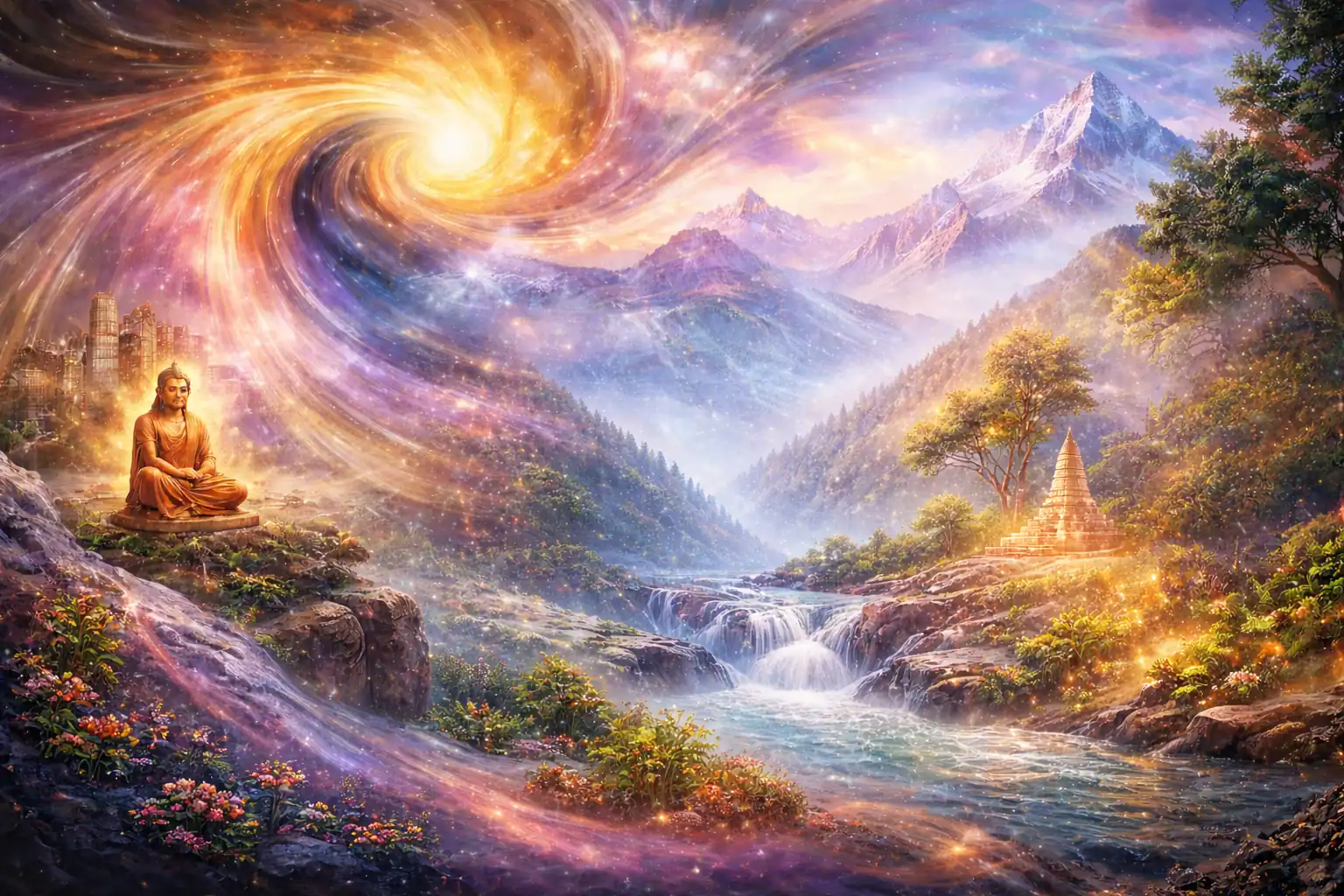
In many Indian traditions, Māyā is also spoken of alongside Śakti, the dynamic power that makes manifestation possible. Vedānta often uses this language to explain how the One appears as many, how the limitless seems limited, and how consciousness seems bound in individuality. The pairing “Māyā–Śakti” helps clarify that the same mysterious principle can obscure truth and also express creative order. Understanding this can reshape how you relate to suffering, effort, and freedom.
1. What Māyā Means in Vedānta
The word Māyā is used in multiple ways across Indian thought, but in Vedānta it generally points to the principle that makes the appearance of multiplicity possible without changing the underlying reality. If that sounds abstract, think of it as the “how” behind a familiar puzzle: the world is experienced as real and meaningful, yet it is also unstable, dependent, and constantly shifting. Vedānta tries to honor both facts without collapsing into either naïve realism (“only the world is real”) or mere fantasy (“nothing matters”).
Māyā is often described as:
- That which makes the One appear as many
- That which makes the limitless appear limited
- That which makes the changeless seem to undergo change
- That which creates mistaken identification (I am only this body, only this mind, only this story)
A key point: Vedānta does not typically say the world is “non-existent.” It says the world has a dependent kind of reality. It is real as experience, real as transaction, real as law and consequence, but not real in the absolute sense that the Self or Brahman is real. Māyā is the explanatory concept that prevents confusion between these levels.
2. Māyā as Māyā–Śakti
When you hear Māyā–Śakti, it is emphasizing that Māyā is also a power (Śakti). In other words, Māyā is not only “confusion”; it is also the capacity by which the universe can appear, function, and follow order. This is why the world is not random like a dream that dissolves immediately. It has structure: time, causality, ethics, learning, memory, patterns. Vedānta acknowledges that structure and attributes it to this power.
So Māyā is often seen as having two “faces”:
- Avarana Śakti (veiling power): hides the truth of the Self.
- Vikshepa Śakti (projecting power): presents the world of names and forms.
These are not two different substances. They are two ways the same principle functions. The veiling makes you forget or ignore the deeper reality; the projecting provides the compelling stage of experience where you live out identity, desire, fear, duty, love, and loss.
3. The Classic Illustrations and What They Teach
Vedānta uses examples not to prove a theory, but to sharpen how you look at experience.
Rope and snake
In dim light, a rope is mistaken for a snake. Fear arises, heart races, decisions follow. The snake never truly existed, yet the fear was real. When light comes, the snake disappears without needing to be “destroyed.” The correction is knowledge.
This captures Māyā’s logic: ignorance plus conditions create a mistaken reality that feels urgent and decisive. Liberation is not “killing the snake,” but seeing the rope.
Dream example
In a dream, you can run, argue, suffer, celebrate. The dream world follows a kind of internal causality. Yet when you wake up, you do not carry the dream objects into waking life. You carry impressions, emotions, maybe lessons. Similarly, Vedānta says: the world is experientially significant, but not ultimately absolute.
The teaching is not “dismiss life,” but “understand the level at which things are true.”
4. Three Levels of Reality
To avoid careless statements, Vedānta distinguishes levels:
- Pāramārthika (absolute): Brahman, pure reality, the Self.
- Vyāvahārika (transactional): the world, ethics, cause and effect, daily life.
- Prātibhāsika (illusory): hallucination, dream, rope-snake confusion.
Māyā most directly explains why the vyāvahārika world seems stable and coherent, while still being dependent on the absolute. This layered view prevents spiritual bypassing. You still honor responsibilities and consequences at the transactional level, while gradually recognizing the deeper ground that is not threatened by change.
5. Māyā and the Individual: Avidyā
Vedānta often distinguishes cosmic Māyā from individual ignorance (Avidyā).
- Māyā: the cosmic power, the matrix of names and forms.
- Avidyā: the individual’s mistaken self-understanding, the personal “I am limited” sense.
A helpful way to see it: Māyā is the global “field” that enables manifestation; Avidyā is how an individual mind gets entangled inside that field, mistaking a role for the whole Self.
From this, many inner patterns become explainable:
- Why you chase lasting satisfaction in changing objects.
- Why the mind creates a narrative identity and defends it.
- Why fear of loss persists even after achievements.
- Why knowledge can dissolve bondage without changing external circumstances.
6. Is Māyā “Evil” or “Bad”?
It is tempting to treat Māyā like a villain. But Vedānta is usually subtler. Māyā is the condition for experience, learning, love, art, discovery, and moral growth. The problem is not manifestation itself. The problem is misidentification within manifestation.
A knife can prepare food or cause harm. Fire can cook or burn. Similarly, Māyā as Śakti can enable beauty and order, while also enabling confusion and attachment. Vedānta’s focus is: learn to use the world without being owned by it.
This is why even after deep realization, ethical life is not optional. At the transactional level, actions matter. Character matters. Compassion matters. The insight into Māyā is meant to free you from compulsive grasping, not from responsibility.
7. Māyā, Karma, and Freedom
If the world is under Māyā, does karma still apply? Vedānta generally says yes, within the transactional domain.
Karma operates where doership and experience operate. As long as you identify as an individual agent, you experience the fruit of actions. This is not punishment; it is order.
Freedom unfolds as the grip of doership loosens:
- Before clarity: “I am the doer; I must control outcomes.”
- As clarity grows: “I act rightly; outcomes unfold within order.”
- With deep knowledge: “The Self is actionless; action happens in the field.”
This shift does not necessarily change your external life dramatically. It changes the internal center from which you live. Anxiety reduces because you stop trying to extract permanence from what is inherently changeful.
8. Māyā and Suffering: Why It Feels So Real
Vedānta takes suffering seriously. If Māyā is misunderstood as “nothing is real,” it becomes cold. But Vedānta’s point is different: suffering is real at the level where you experience it, and it is meaningful because it can motivate inquiry.
Suffering intensifies when:
- You demand permanence from impermanent things.
- You demand control over uncontrollable conditions.
- You locate your worth in roles and outcomes.
- You forget the witness-consciousness that remains steady.
Māyā is not merely an external “world illusion.” It is also the mind’s tendency to contract around identity: “This must not happen,” “I must become that,” “I cannot lose this.” Knowledge of Māyā does not erase pain instantly, but it usually reduces the secondary suffering created by resistance and obsessive narrative.
9. Māyā in Daily Life: A Practical Lens
Understanding Māyā can become a skillful, everyday lens:
When desire spikes
You can pause and ask: “Is this object truly giving lasting completeness, or is completeness being projected onto it?” This is not repression; it is discernment.
When fear rises
Ask: “What am I protecting right now? A role, an image, a possession, a storyline?” Fear is often the alarm of threatened identity.
When anger appears
Ask: “What expectation is being violated? What did I assume should be fixed?” Anger often comes from insisting the world match your mental map.
When grief arrives
Vedānta would not deny grief. It would gently remind you: love is real, relationship is real at the transactional level, and change is the law of manifestation. The deeper Self is not destroyed by change, yet the heart still processes loss. Both can be held.
10. Māyā–Śakti and Īśvara
In Vedānta, the cosmic order is often spoken of as Īśvara, the Lord, the intelligence governing the universe. Māyā is frequently described as Īśvara’s power of manifestation. This does not necessarily mean a mythological being with human traits; it points to the fact that the universe is intelligible, lawful, and coherent.
So the pairing becomes:
- Brahman: the absolute reality.
- Īśvara: Brahman associated with Māyā, appearing as the cosmic ruler and order.
- Jīva: consciousness associated with Avidyā, appearing as the individual.
Liberation is often described as seeing that the essence of the jīva is not separate from Brahman. The “difference” is an appearance created by ignorance. The methods of devotion, meditation, and inquiry help loosen the knot.
11. How Knowledge Removes Māyā’s Bondage
A crucial Vedānta claim is: bondage is removed by knowledge.
Not by traveling somewhere. Not by perfecting the world. Not by accumulating experiences.
Knowledge here is not mere information. It is direct clarity: “I am not limited to body-mind. I am the awareness in which body-mind appears.” When that recognition becomes stable, the force of Māyā changes. It is like a magician’s show: once you know the trick, you can still enjoy it, but you do not panic inside it.
This is why Vedānta emphasizes:
- Śravaṇa: listening to the teaching carefully.
- Manana: reflecting until doubts reduce.
- Nididhyāsana: deep contemplation until insight becomes firm.
All these practices are ways of bringing “light” to the rope, so the snake cannot keep returning.
12. Does Māyā Disappear After Realization?
Different sub-traditions describe this in different ways, but a common Vedāntic idea is:
- For the liberated, Māyā continues as appearance, but it no longer binds.
The world still appears, the body still functions, pain may still arise, but the sense of “I am trapped inside this” weakens or dissolves. The liberated person is said to live with a kind of inner spaciousness. Experience moves, yet the core is steady.
A simple analogy: waves do not frighten the ocean. The ocean is not trying to stop waves from happening. It understands itself as the depth that includes all motion.
13. Common Misunderstandings
“Māyā means nothing matters.”
Vedānta does not say that. Ethics, compassion, and duty remain meaningful at the transactional level.
“Māyā is a hallucination.”
Not exactly. The world is structured, consistent, and shared. Māyā is closer to “dependent appearance” than to “random fantasy.”
“If everything is Māyā, I can do anything.”
That is usually spiritual ego. Karma and consequences still operate where agency and harm operate.
“Māyā is outside me.”
Vedānta would say the deeper issue is misidentification inside. The world does not trap you as much as your clinging to identity does.
14. A Quiet Integration
If you want Māyā–Śakti to become more than philosophy, integrate it gently:
- Notice projection: where you project lasting fulfillment onto a changing object.
- Notice contraction: where identity tightens and demands control.
- Return to witness: the simple awareness that knows thoughts, feelings, and sensations.
- Act ethically: treat the transactional world as real enough to deserve care.
- Repeat inquiry: “What is unchanging here? What remains present through all states?”
Over time, the mind usually becomes less reactive. You still plan, work, and love, but you do not build your entire sense of self on fragile outcomes.
Conclusion
Māyā, especially when understood as Māyā–Śakti, is Vedānta’s way of explaining a profound paradox: reality is one and limitless, yet experience appears many and limited. Māyā is the power that makes this appearance possible, and the same power that can veil truth can also express order and meaning. The goal is not to hate the world, but to see clearly: live responsibly within experience, while recognizing the deeper Self that is free. In that clarity, life becomes lighter, more compassionate, and more honest.
You will get Vedanta updates in your inbox.
Occasional reflections on Vedanta. Unsubscribe anytime.