Durga Puja: Swami Ishatmananda on the Mother, Maya, and Freedom
Swami Ishatmananda explains Durga Puja as worship overcoming Maya, karma, ignorance, through devotion, joy.
On an autumn evening at the Vivekananda Vedanta Society of Chicago, Swami Isha Atmananda spoke during Durga Puja with a mood that felt both devotional and quietly practical. The morning worship had already been completed, and the evening program moved toward Sharad Puja and arati. Yet the talk did not stay only at the level of ritual. It gently opened into the meaning of worship itself: why we praise the Divine Mother, what the ancient stories are trying to teach, and how Durga Puja can become a training of the mind, not just a festival on the calendar.
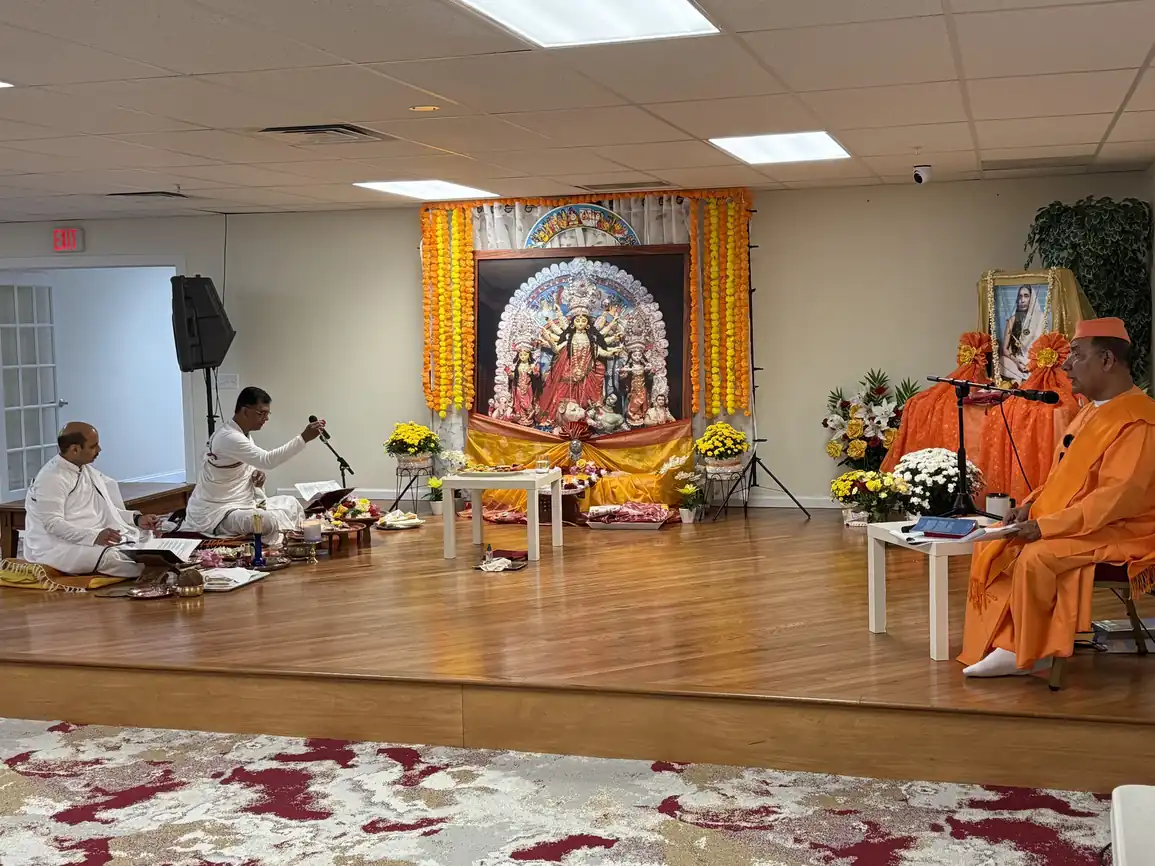
Durga Puja in Chicago: Swami Isha Atmananda on the Mother, Maya, and Freedom
A striking feature of his approach was the way he treated the opening hymns and salutations. He pointed out that these praises are not merely decorative. A “praise mantra,” as he explained it, paints a portrait of the Deity. It tells the worshipper whom they are approaching and what transformation they are seeking. In that sense, the hymn is like a map: it gives language to devotion, and it also gives direction to the inner life. When people chant together, they may begin with sound, rhythm, and feeling. But the words are also a kind of teaching. They describe the Mother as power, compassion, protection, and clarity, so the devotee can slowly recognize what they are really asking for.
The story that carries the philosophy
Swami Isha Atmananda turned to a classic narrative associated with Devi worship: the story of King Suratha. The king, once capable and respected, is defeated by outsiders and loses his kingdom. Worse, he discovers betrayal among his own circle, including people he expected to stand by him. He escapes into the forest, physically safe but inwardly restless. His mind keeps returning to the same burning question: “Why did my own people turn against me?”
In the forest he meets another exile, a merchant, a Vaishya, who has also been driven out, this time by his own family. Even after being insulted and expelled, the merchant cannot stop thinking of those who harmed him. He worries about their future, about whether they will ruin the wealth he built. Both men, in different ways, are trapped in attachment to what has already wounded them. Their bodies are in the forest, but their minds are still tied to the same household, the same court, the same old identities.
They eventually approach a sage, Medha Rishi, living in a forest hermitage. The Swami highlighted the symbolism: a king, a businessman, and a sage coming together. Administrative power, worldly success, and spiritual insight meet in one place. The king and merchant confess their confusion: they do not want to cling to the people who betrayed them, and yet they cannot stop. Why does the mind behave like this?
The answer comes in one word that carries an entire world of meaning: Mahamaya.
Mahamaya and the everyday spell of the mind
Swami Isha Atmananda explained Mahamaya as the Divine power that bewilders the mind, not as a cruel trick, but as the very mechanism by which the world-experience appears. People often blame relatives, society, and circumstances, and sometimes those causes are real. Still, beneath the surface, the deeper binding force is the mind’s own tendency to cling, to project, and to mistake appearances for reality.
To make this vivid, he shared a simple illustration: a tree seen through thick morning mist can be misread in multiple ways. A thief may see a police officer waiting to catch him. A monk may see a holy man absorbed in meditation. Someone else may see a loved one waiting in devotion. The object is one, but the interpretations multiply according to fear, desire, and expectation. This is Maya in daily life: the same world, filtered through our inner coloring, becomes many worlds.
He also noted that Indian thought describes Maya in different ways. In Vedanta, Maya is the power through which Brahman appears as the universe. In Tantra, Mahamaya is often spoken of with a distinct, personal grandeur as the Mother’s own sovereignty, actively shaping experience and drawing beings toward awakening through devotion, struggle, and insight. The difference in language is less important than the shared point: the mind does not automatically see clearly, and spiritual life is the gradual education of perception.
Kali Yuga outside, and the forest inside
From Mahamaya the Swami moved naturally to the atmosphere of Kali Yuga. He offered a familiar image from tradition: Kali appears outwardly refined, even aristocratic, but inwardly carries cruelty and confusion. The purpose of such descriptions is not to create despair, but to make people alert. In every age, the mind can be swept away by noise, rumor, and constant stimulation. Today that current often arrives through screens and relentless commentary. If we do not examine what enters our awareness, it shapes us.
He then brought in an important turning: the “forest” is not only an external place. The forest can also be the mind itself. Like a jungle filled with many kinds of trees and animals, the mind holds countless kinds of thoughts, impulses, and memories, some luminous and some disturbing. The teaching is not that a person must flee society, but that a person must learn where refuge truly is. If one takes refuge in the Divine through remembrance, prayer, and steady practice, the turbulence of the age does not have to invade the heart.
Durga’s form as a lesson in consciousness
Durga Puja is famous for its images, and Swami Isha Atmananda lingered lovingly on their symbolism. The ten arms are not meant to be taken as a physical puzzle, but as a spiritual statement: the Mother’s power is not limited. The weapons and emblems are not ornaments, but representations of forces that protect dharma and cut through inner bondage. Whether the Mother is shown riding a lion or, in some regions, a tiger, the meaning remains: she is mastery over fear and instinct, seated on strength.
Even the presence of other beings in the iconography becomes a teaching. The Swami suggested a broad, inclusive vision: consciousness is present everywhere, in animals, birds, reptiles, and in the living world around us. The Mother is not confined to one corner of life. She is the power that animates all.
This is why the festival holds a unique blend of grandeur and humility. In places like Kolkata, artisans craft magnificent forms for months, and yet after a few days they are immersed. The immersion is not disrespect. It is a reminder: the image is a doorway, not a prison. The sacred cannot be owned. It comes, it is adored, it dissolves back into the vastness, leaving the devotee with remembrance and renewed clarity.
What we ask for reveals who we are
In the story of Suratha, after worship, the Mother appears and offers a boon. Here Swami Isha Atmananda emphasized something psychologically sharp: what a person asks for reveals their nature. One devotee may ask for liberation, tired of chasing satisfaction through power and possession. Another may ask for strength, victory, or restoration of what was lost. The Mother responds, but the request shows the mind’s current level of longing.
He framed this with an insight that felt central to the evening: in ordinary life we pursue happiness continuously, yet happiness slips away when sought only through external arrangements. Devotion is not an escape from life, but it generally redirects the search toward the source of peace. When the mind turns toward the Mother, the devotee is gradually trained to recognize what truly satisfies.
Karma, speech, and the practical path
The Swami’s talk did not stay abstract. He spoke about karma as a binding principle, and he reminded listeners that karma is not only physical action. It also arises through thought and speech. A person may harm without raising a hand: through harsh words, careless whispering, and the subtle spreading of negativity. This is why spiritual life includes gentleness and restraint, not as moral decoration, but as self-protection. If the mind is to become clear, one must reduce the inner smoke created by harmful patterns.
Alongside that realism, he returned repeatedly to refuge: a simple, childlike reliance on the Mother. Success or failure, comfort or hardship, the prayer is that the Divine does not let go of the devotee’s hand. In that mood, worship becomes intimate rather than distant, as if the Mother is not a concept, but a living presence guiding the heart through storms.
Joy with discipline: the festival as shared strength
Swami Isha Atmananda also spoke warmly about the social dimension of Durga Puja. The tradition of new clothes, food, music, and community gathering is not superficial. It is part of the Mother’s gift. People need joy, and joy shared becomes strength. Still, he also acknowledged the realities of organizing celebrations in a modern setting: limited space, the need for registration, and the challenge of balancing inclusiveness with quality and safety. Even these logistical notes carried a subtle lesson: celebration becomes smoother when people cooperate, and cooperation itself is a form of worship.
He concluded the mood of the evening with chants and the sense of a community moving together toward arati, not just as a ritual closing, but as a collective offering. Durga Puja, in his telling, is a bridge: story carrying philosophy, image carrying symbolism, music carrying longing, and community carrying joy. In the end, the Mother is invoked for one essential miracle: that darkness in the mind, the inner asura of ignorance and clinging, is gradually removed, and the devotee learns to live in the world with the freedom of one who is staying in a hotel room, enjoying the view, yet not bound by ownership.
That is the gift Durga Puja points toward: not a denial of life, but a clearer way to live it, held in the Mother’s protection and guided by wisdom.
You will get Vedanta updates in your inbox.
Occasional reflections on Vedanta. Unsubscribe anytime.