Kathamrita: Free Will, Grace, and the Joy of Living Unbound
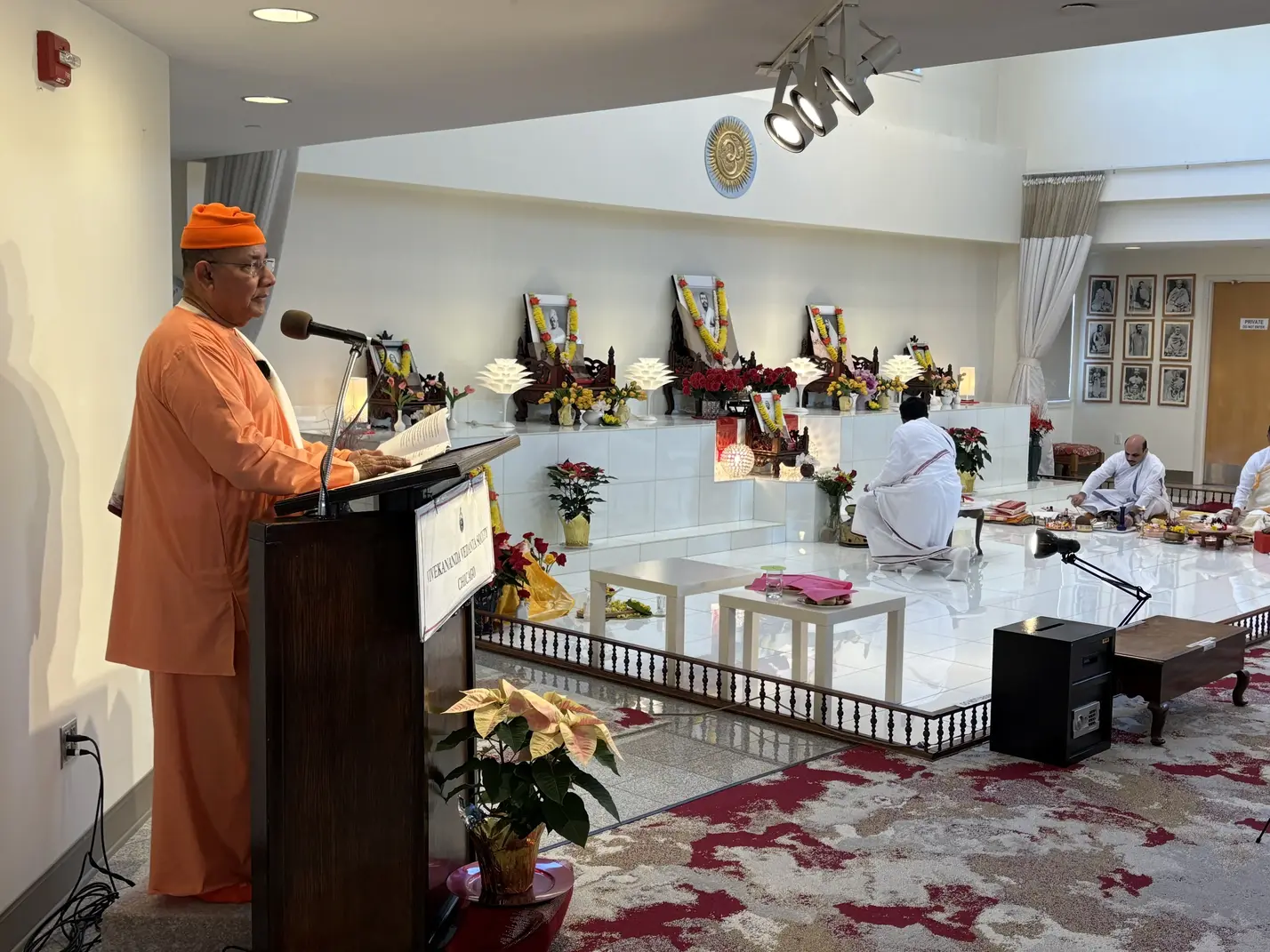
Reflections on a Bengali Kathamrita session by Swami Ishatmananda at Vivekananda Vedanta Society, Chicago.
On a quiet Sunday in Chicago, the Vivekananda Vedanta Society gathers for something beautifully old-fashioned and surprisingly modern at the same time: listening together to Sri Ramakrishna Kathamrita in Bengali. Swami Ishatmananda begins in a warm, practical way, explaining the rhythm of the monthly reading: usually the first Sunday, though this time it has shifted to the second. The tone is familial, as if reminding everyone, “Yes, we’re continuing; yes, we’re together.” And then he offers a simple conviction that sets the mood for the entire session: the more people hear and understand this text, the more auspicious it becomes for their lives.
Why “Panchama Veda”
He calls the Gospel of Sri Ramakrishna the “Fifth Veda.” Why such a bold name? Because, he says, “Veda” means knowledge, and the Kathamrita is packed with living spiritual knowledge, not dry theory. The four Vedas exist, the Mahabharata is sometimes called a fifth, but for him the Kathamrita deserves that title because every page and every line carries awakening. It is not merely a record of conversations; it is a manual for inner transformation, delivered through stories, humor, and piercing insight.
The Question That Returns: Free Will
That day’s reading turns to the Eighth Chapter, a section that continues a conversation on “free will,” written plainly in the text as free will in parentheses. The topic is evergreen because it sits inside our daily struggle: Am I steering my life, or am I being carried? Are my choices real, or is everything already decided? Swami Ishatmananda frames it through a striking Vedantic ideal: jivanmukti, liberation while living. He quotes the idea that this human birth is meant for that freedom, and then explains what it looks like: being in the world, doing what must be done, yet remaining untouched by inner bondage. Not escaping life, but becoming unchained within life.
The World as a Magic Show: Enjoy Without Being Captured
To make that state more imaginable, he uses an analogy that lands immediately. A magician performs tricks: we know it’s false, yet we enjoy it fully. A woman is “cut in half,” fear rises for a moment, then she reappears, and we laugh at our own tension. “If we could relate to the world like that,” he suggests, “knowing its shifting nature and still enjoying it,” a huge portion of suffering would lose its grip. The problem is not that events happen; the problem is our tight inner clinging. When we treat every passing wave as absolute reality, we drown. When we begin to see the “show” without hatred or panic, we breathe again.
Don’t Accept the Poison: The Power of Non-Reception
This is where he introduces a practical spiritual skill: not accepting what harms you. He retells a well-known Buddhist-style story: someone insults the Buddha harshly; the Buddha listens silently. Later he asks, “If you offer a gift and the other person does not accept it, to whom does it belong?” The answer is obvious: it remains with the giver. In the same way, if you do not receive the insult inwardly, it returns to the one who threw it. Swami Ishatmananda builds on this with an almost playful confidence: if someone is getting red-faced with anger while you remain calm, whose suffering is it really? In this way, spiritual life becomes less about winning arguments and more about refusing to drink poison handed to you.
“God is Doing Everything”: The Doorway to Jivanmukti
From there he returns to Sri Ramakrishna’s own language of devotion, which is often simpler, more intimate, and yet equally radical. Sri Ramakrishna tells devotees: “God is doing everything.” If that knowledge becomes steady, one becomes free. It sounds fatalistic at first, as if human effort is pointless. But Swami Ishatmananda carefully holds the paradox: surrender does not mean laziness. It generally means releasing ego, not abandoning responsibility. In Sri Ramakrishna’s view, the deepest peace comes when you genuinely feel: praise came by God’s will, blame came by God’s will, gain came by God’s will, loss came by God’s will. The waves rise and fall, but the heart rests in a larger hand.
Totapuri and the Shock of Shakti
To illustrate how stubborn the ego’s idea of control can be, he brings in the unforgettable episode of Totapuri, the non-dualist monk who was Sri Ramakrishna’s teacher in Vedanta. Totapuri did not accept the Divine Mother, did not accept “Shakti,” and yet life itself forced a lesson. In intense physical suffering, he tried to end his life by drowning in the Ganga, but could not find depth enough. Knee-deep water, again and again. He cries out in astonishment: “What is this divine maya?” The point is not to mock him. The point is to show that even a towering intellect can be humbled by the power of the Mother, the power that moves the universe. The event becomes a living parable: the world does not always obey our concepts. Something greater is at work.
Purushakar: The Effort That Invites Grace
And still, the talk does not leave us with a flat conclusion like “there is no free will.” Swami Ishatmananda introduces the necessary counterweight: purushakar, personal effort. He is very clear: without effort, even grace does not unfold fully. Sri Ramakrishna does not forbid effort; he refines it. He wants effort without ego, striving without arrogance.
One story makes it vivid. A cow is tied to a peg with a rope. It eats all the grass within the rope’s circle, then sees fresh green grass beyond. The cow strains, pulls, tries with all its might. It cannot uproot the peg, but the owner sees the sincere effort and loosens the rope a little. The cow reaches the grass. Our effort is like that: it may not “overpower” destiny, but it invites help. We pull, and grace loosens the knot.
Narada’s Trick: Turning Hell into Remembrance
Another story turns that same principle into comedy and devotion. Narada is told by Vishnu to go to hell. Narada asks where it is, and Vishnu points to a spot on a map. The moment Narada hears “this is hell,” he rolls on the ground there three times. Vishnu is startled: “What are you doing?” Narada’s logic is brilliant: if God says this is hell, then being there in remembrance of God makes it no longer hell for him. It is a stubborn, loving effort, and it melts the Lord’s anger into joy.
The Birds and the Ocean: Effort That Becomes a Call Heard by God
Swami Ishatmananda’s most expansive illustration is the story of the two birds and the ocean. The ocean steals their eggs with a wave. The birds beg; the ocean refuses. Then they decide: “We will dry up the ocean.” Absurd on the surface, yet spiritually accurate. Their sincerity draws other birds, then Garuda the king of birds, and finally Vishnu Himself. Vishnu raises a finger and commands the ocean to return the eggs, and the ocean obeys. The teaching is gentle but firm: grace arrives when effort becomes steady and sincere. Not because God is bargaining, but because the heart has aligned with what it truly seeks.
When Evil Happens: Vidyasagar’s Hard Question
At this point, the session widens into the moral complexity of the world. Someone like Vidyasagar asks a hard question: if God exists, why doesn’t He stop atrocities, why doesn’t He intervene when horrors happen? Swami Ishatmananda does not try to give a neat calculation. He says, in effect, that the chain of causes is far larger than our immediate view. What we see now is one slice; what preceded it and what will follow it are hidden. So, rather than demanding a full cosmic audit, Sri Ramakrishna’s path suggests a humbler prayer: “Mother, I don’t need to understand everything. Give me devotion at Your feet.” The aim of human life, he reminds, is God-realization or devotion. Everything else can be secondary.
Karma in Daily Life: Karma, Akarma, Vikarma
That devotion then expresses itself as right action, not escapism. Swami Ishatmananda speaks about karma in practical categories: bodily, verbal, and mental actions; and also karma, akarma, and vikarma. Vikarma is harmful action, even when done in the name of religion or social passion. He gives an example that feels painfully current: festivals or processions that block roads so completely that ambulances cannot pass, while people celebrate loudly, thinking they are doing something holy. If our joy becomes another person’s suffering, we should pause. True spirituality does not make us less responsible; it generally makes us more awake to consequences.
Vivekananda’s Balance: Liberation and Welfare Together
From that, he returns to Swami Vivekananda’s famous motto of service: “For one’s own liberation and for the welfare of the world.” This is where surrender becomes luminous. You accept that God is the doer, yet you also act as God’s instrument for good. You strive, but you do not inflate yourself. You serve, but you do not claim ownership of results. In the Bhagavad Gita’s closing vision, victory and welfare arise where Krishna’s grace and Arjuna’s effort stand together. That is the balance: grace plus sincere effort.
Closing: A Leaf in the Storm, a Heart in God
The beauty of this session is that it does not leave “free will” as a sterile philosophy problem. It turns it into a lived spiritual posture. Be like the leaf in the storm, Sri Ramakrishna says: carried by the wind, not broken by it. And yet, when the heart longs for truth, pull toward it with everything you have. Pray deeply. Work cleanly. Refuse to accept insults. Enjoy the world as a passing show without losing compassion. Then, little by little, bondage loosens.
In the end, the reading returns to its quiet center: prayer, mantra, and the shared feeling that these words are not merely literature. They are guidance. A community sits together in Chicago, reading a Bengali classic, and discovers that the questions inside the text are exactly the questions inside a modern mind. How do I live without fear? How do I act without ego? How do I trust without becoming passive? Swami Ishatmananda’s answer is steady: surrender to God’s will, practice sincere effort, and let devotion become both freedom and service.
You will get Vedanta updates in your inbox.
Occasional reflections on Vedanta. Unsubscribe anytime.