Maa Sarada Devi Jayanti: Quiet Strength, Living Compassion
Maa Sarada Jayanti honored her patience, forbearance, self-control, and compassion through talks, songs, prayer.
Chicago in mid-December can feel like a test of endurance. The air bites, the wind sharpens every step, and even a short walk outside can feel like a challenge. Yet on this cold day, devotees still gathered at the Vivekananda Vedanta Society of Chicago to celebrate Maa Sarada Devi’s birthday puja. Swami Ishatmananda began by noticing something simple and deeply meaningful: the weather may be harsh, but the pull of the Holy Mother is stronger. Her spirituality, purity, and love attract people even through discomfort and distance. That, he suggested, is itself a sign of her living presence in the hearts of devotees.
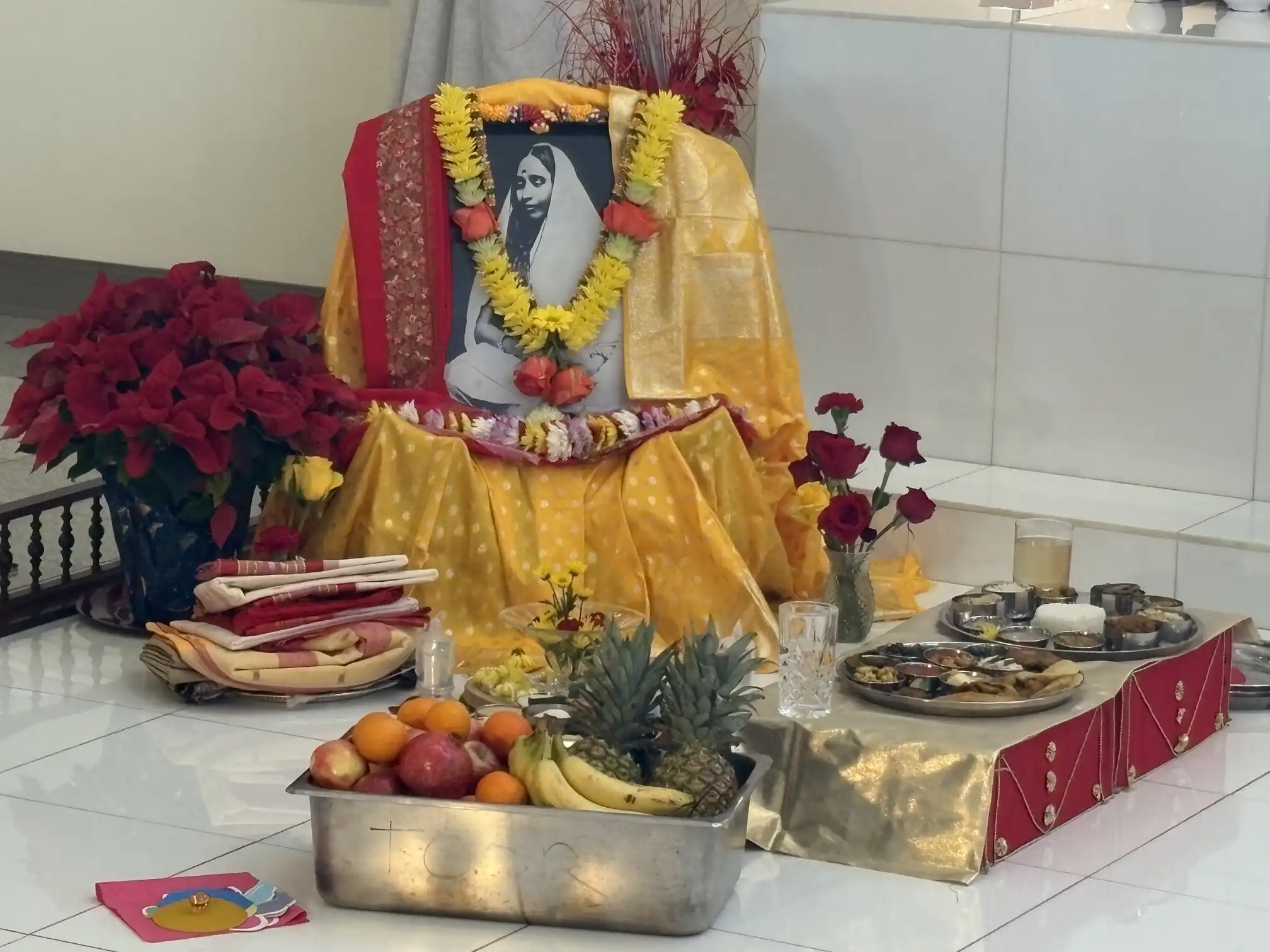
Before the program unfolded, Swami Ishatmananda invited everyone to begin with salutations to Sri Ramakrishna, Maa Sarada Devi, Swami Vivekananda, and the lineage of teachers. The tone was reverent and direct. This was not meant to be a cultural ceremony alone. It was a day to remember virtues, to learn, to pray, and to return inwardly to what Maa Sarada Devi represents: a life where holiness is not separate from daily responsibility, and where divine love expresses itself through patience, restraint, and compassion.
A Celebration Centered on Motherhood
A host welcomed the assembly and set the theme of the day with warmth and clarity. In many traditions, the deepest joy of life is connected to motherhood, not merely as a biological role, but as a spiritual quality: nurturing, protecting, absorbing burdens, and giving without conditions. Maa Sarada Devi’s life, the host explained, shows that true courage often appears not in outward power, but in patience, humility, selflessness, and an unshakable moral steadiness.
Her teaching was presented in simple terms: do your duty sincerely, speak gently, and keep God in your heart. In a fast and stressful modern life, these ideals feel especially relevant. Devotion is not limited to rituals, the host reminded everyone. It is revealed in how we live and how we treat people. The program would feature three reflections on key virtues seen in Holy Mother’s life: self-control, austerity, and compassion, along with devotional music that would allow the heart to participate as much as the mind.
Self-Control as Gentle Strength
The first speaker, Arpita Bose, reflected on self-control as manifested in Maa Sarada Devi’s life. She described self-control not as rigidity or suppression, but as a gentle strength that keeps love radiant. In Holy Mother, self-control was transformation: turning hardship into grace, attachment into spiritual instrumentality, and responsibility into service.
Arpita organized her reflection around three chapters: the austere years at Kamarpukur, Holy Mother’s relationship with Radhu, and her guiding influence in shaping the Ramakrishna Order.
In Kamarpukur after Sri Ramakrishna’s passing, Holy Mother lived a life of extreme simplicity, even privation, in the small hut connected with the Master’s earlier life. Arpita recalled the Master’s words that she would live there in simple ways, growing herbs, cooking plain food, and remembering God. Holy Mother did not stretch out her hand for money. She held fast to her dignity, remembering the counsel that dependence can become its own kind of bondage. Even when resources were scarce, she maintained worship, rose early, performed household work, and served guests, without complaint.
Arpita emphasized the inner victory here: Holy Mother faced loneliness, social criticism, and household strain, yet did not permit bitterness to enter. Her self-control included the power to endure insult without internal collapse. Even when villagers criticized her or gossiped, she did not respond with anger. When her situation required explanation, she held to what Sri Ramakrishna had instructed her, not from stubbornness, but from faith.
The reflection then moved to Holy Mother’s life with Radhu. Here self-control appears in another form: love that does not turn into resentment, even when tested. Holy Mother endured difficult behavior with astonishing patience, even using it as a field of spiritual practice. One anecdote captured this spirit sharply: in a moment of distress, Holy Mother asked how she could practice austerity without such tests. The point was not self-pity, but acceptance of spiritual life as something lived through real relationships.
Finally, Arpita described Holy Mother’s quiet authority in shaping the Ramakrishna Order. She is often remembered as the mother of the monastic disciples, yet her leadership was never harsh. When monks struggled, she guided through love rather than domination. She corrected authoritarian tendencies, encouraged practical preparation for service, and warned against pride. She showed that outer renunciation means little without inner detachment.
Throughout, Arpita returned to the essential message: self-control is not a wall that blocks life, but a force that purifies love. It begins in small actions, a restrained word, a patient silence, a sincere prayer.
Devotional Song: Emotion as Offering
After the first talk, the program included a Bengali devotional song offered with deep feeling. The lyrics, translated into English, portrayed the tenderness of a mother’s presence: the one who steadies the child in darkness, who stands beside them in storms, who lifts them when they fall, who never forgets even when the child forgets. The song was not presented as mere performance; it became a shared meditation. It reminded everyone that Maa Sarada Devi is remembered not only through historical facts, but through a lived sense of shelter and refuge.
Austerity as Forbearance and Inner Tapasya
The second speaker, Priti Gupta, spoke on austerity in Holy Mother’s life. She began by clarifying what austerity (tapasya) often means in popular imagination: dramatic practices, harsh bodily disciplines, or extreme renunciation. Yet Holy Mother’s life can appear outwardly ordinary, more like a householder’s routine than a monk’s austerities. And still, she possessed an ocean of spiritual experience. This suggests that her tapasya was largely inward: expressed through behavior, endurance, and constant remembrance of God.
Priti defined Holy Mother’s austerity primarily as forbearance: the ability to endure hardship without anxiety, complaint, or inner resistance, accepting everything as God’s will, God’s grace, or the fruit of past karma. She supported this with a traditional description of forbearance found in Shankaracharya’s Vivekachudamani: calmly enduring suffering without resistance or bitterness, without the mind collapsing into resentment.
She offered three examples.
The first returned to Kamarpukur, highlighting the loneliness and poverty Holy Mother endured after Sri Ramakrishna’s passing. She lived simply, grew vegetables, offered what she cooked, and spent long hours in japa. She patched clothes, accepted criticism silently, and did not seek pity or rescue. Even when her own mother urged her to stay elsewhere, she surrendered the situation to God rather than chasing comfort. The lesson was clear: forbearance is not passive weakness. It is faith expressed as inner steadiness.
The second example focused on Holy Mother’s household life in Jayrambati and the constant strain of family difficulties. She performed heavy domestic work and also guided devotees spiritually. She lived among quarrels and greed, illness and jealousy, and yet remained serene. Priti emphasized that Holy Mother deliberately modeled what it means to practice austerity as a householder: not escaping responsibility, but transforming it through remembrance of God.
The third example described a more explicit austerity: the panchatapa discipline (austerity of five fires) performed for several days, surrounded by heat under the blazing sun. Holy Mother later explained the reason in a striking way: she did it for the sake of others, because ordinary people cannot practice such extremes, yet they still need spiritual help. This is a profound theme: she endured not to display greatness, but to carry a burden on behalf of those who cannot.
Priti concluded with a powerful reversal: adversity becomes opportunity. Every difficult person, every illness, every loss, every responsibility can become a place of tapasya. Circumstances may or may not change, but the practitioner changes. Problems lose their sting. Life becomes more meaningful, more peaceful, and more surrendered.
Compassion as a Living Reality
The final speaker, Sarah Lidenstyle, spoke on compassion as the organizing principle of Holy Mother’s life. Compassion here was not treated as a slogan or an abstract ethical ideal. It was described as embodied, habitual, and transformative, the atmosphere of her very presence.
Sarah began with a quote attributed to Holy Mother: without compassion, a human being becomes beast-like; and sometimes compassion was so strong in her that she forgot herself. From there, she framed compassion in several dimensions: maternal care, moral hospitality, emotional availability, inclusive spiritual authority, and a willingness to absorb the suffering of others.
She traced compassion back to Holy Mother’s early life shaped by hardship: hunger, insecurity, labor. These experiences created sensitivity to vulnerability and a natural instinct to serve. Her compassion expressed itself through direct action: feeding, comforting, caring, and receiving people without discrimination.
A major theme was Holy Mother’s maternal mode of authority. She did not relate as a distant teacher commanding disciples, but as a mother who receives, holds, and guides. Her love extended beyond virtue and fault. The more fallen the child, the greater the claim upon the mother. This is compassion without judgment, a refuge for those who feel unworthy.
Sarah also described the way Holy Mother’s compassion crossed social boundaries of class, education, and status. She treated everyone with the same courtesy and care, not as ideology but as spiritual instinct. Her compassion quietly dissolved hierarchies by refusing to recognize spiritual inequality among people.
Perhaps the most striking dimension was her willingness to absorb emotional suffering. Many accounts describe devotees feeling relief simply by placing their grief before her. She listened without dismissing pain, and sometimes bore the weight of others in her own body and mind, yet continued to allow people to come to her because she did not want them to be deprived of comfort.
Sarah closed by emphasizing how compassion became a source of spiritual authority: people followed her guidance not because she demanded it, but because they felt safe in her love. Her compassion redefined holiness, showing that sanctity can be rooted in ordinary care, daily labor, and steady attention to suffering.
Swami Ishatmananda’s Closing Emphasis: Learn, Pray, Practice
As the program moved toward conclusion, Swami Ishatmananda returned to a central reminder. All these virtues are not meant to stay inside a ceremonial hall. They are meant to be carried into daily life. Spiritual life is tested in small moments: when we get agitated quickly, when we judge others, when we cling to irritation. Holy Mother’s life shows another possibility: restraint without coldness, endurance without bitterness, compassion without weakness.
The day ended with prayers and offerings, and the invitation to take part with sincerity. Maa Sarada Devi’s birthday puja becomes, then, more than remembrance. It becomes a quiet training in how to live: doing duty sincerely, speaking gently, keeping God in the heart, and learning to make the world one’s own.
You will get Vedanta updates in your inbox.
Occasional reflections on Vedanta. Unsubscribe anytime.