Swami Vivekananda’s Living Message Through Youth Voices
Youth voices renew Vivekananda’s message: strength, harmony, service, and inner divinity for all.
Some gatherings feel like a program. Others feel like a current, something you step into and it quietly carries you. The celebration at Vivekananda Vedanta Society of Chicago, had that second quality. The day unfolded as a tribute to Swami Vivekananda, but what made it memorable was not only the reverence. It was the way multiple generations, especially the young, spoke with clarity and ownership of Swamiji’s message, as if they were not repeating history but extending it.
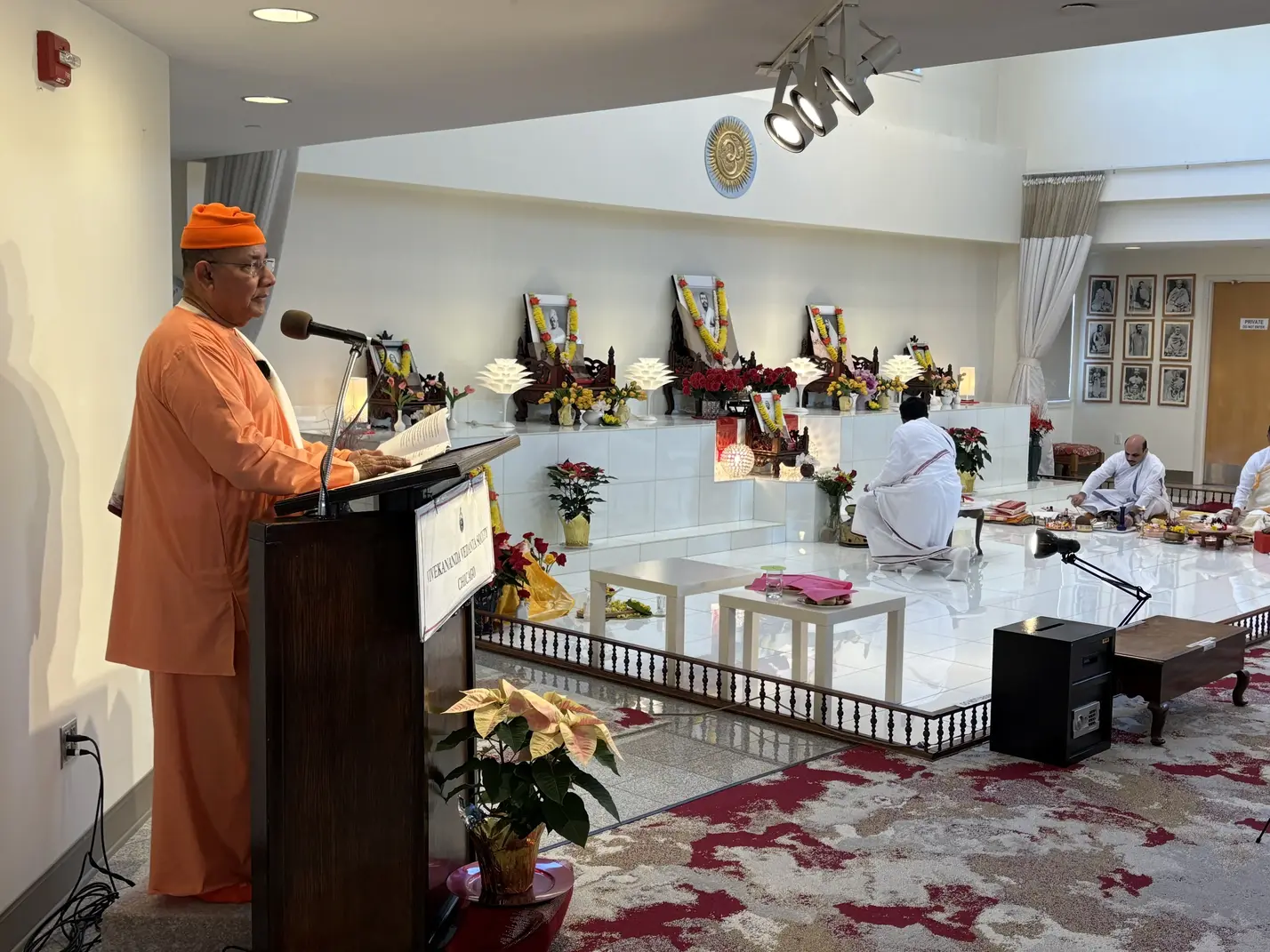
From the opening moments, there was a sense of purpose: to begin by offering pranam and to anchor the entire day in remembrance. The atmosphere was devotional and simple, with chanting and meditation setting the tone. A special focus was placed on Swami Vivekananda’s tithi puja, a way of remembering him that is not limited to admiration but asks for inner alignment. Swamiji was described as youthfulness itself: joy, energy, and fearless truth. The message was implicit but unmistakable: if we celebrate Vivekananda, we should do it by becoming a little more courageous, a little more sincere, and a little more useful to others.
A Beginning in Mantra and Meditation
The program began with chanting and a guided move into contemplation. The Sanskrit prayers were not treated as mere formality. They functioned like a shared entrance into a more inward space, a reminder that Vedanta is not just a philosophy to discuss but a truth to be lived and experienced. The mantra invoked Swami Vivekananda as a presence of knowledge and devotion, and the group meditation created a collective stillness. In a world where attention is constantly pulled outward, starting with quiet focus is itself a statement.
This grounding mattered because the rest of the program included speeches from students and young adults. Their words carried weight because they emerged from a setting that was not performative. It felt like a dialogue between tradition and today, between what was received and what is now being reinterpreted.
Youth Reflections: Vedanta as a Response to Modern Life
One of the most striking aspects of the celebration was how intentionally the platform was given to the younger generation. This was not symbolic inclusion. It was a real invitation: speak in your own way, explain why Swami Vivekananda matters to you. In doing so, the program demonstrated something Swamiji himself believed strongly: that the future is shaped when young people are trusted with responsibility, not merely entertained.
A high school student, Aditri Das, spoke about Swami Vivekananda’s lasting impact on youth, using both personal experience and Swamiji’s teachings. Her talk moved naturally between the universal and the immediate. She highlighted how Vivekananda challenged sectarianism, bigotry, and fanaticism, and she connected it directly to a modern culture of judgment, pride, and cruelty, often amplified through social media and peer pressure.
Her reflections on identity were especially relatable: being proud of one’s heritage while navigating environments where misunderstanding and mockery can appear casually, even in school settings. Yet the response she offered was not resentment. It was empathy, rooted in Vivekananda’s approach in Chicago: harmony is not built by force, but by understanding. She described learning to respond to criticism or ignorance not with defensiveness, but with patient explanation and openness, the same spirit Swamiji carried when he addressed a Western audience unfamiliar with Hinduism.
Aditri also explored Swamiji’s core message of inner divinity: “All power is within you.” For a young person, that statement is both uplifting and demanding. It does not allow someone to outsource their worth to approval, popularity, or validation. It suggests that the deepest authority is within, and that self-belief is not arrogance but recognition of what the Self truly is.
The Four Yogas, and Why Karma and Bhakti Matter Now
Aditri’s talk introduced a key Vedantic framework: the four yogas, karma, bhakti, raja, and jnana. She explained them not as separate religions but as different temperaments, different paths toward the same end: purification, clarity, and realization.
She focused especially on karma yoga and bhakti yoga, and this choice felt meaningful for a youth audience.
Karma yoga, she noted, is often misunderstood today. The word “karma” is casually thrown around as cosmic revenge or instant consequence. But karma yoga, in Swamiji’s sense, is work done as purification: action performed without selfish attachment, with an attitude that shifts from “I” to “Thou.” She linked this to a world where many young people are exhausted by distraction, chasing shallow goals, or using harmful behaviors to cope. In that environment, karma yoga becomes an antidote: act with integrity, serve without ego, and you will feel your own mind become cleaner and steadier.
Bhakti yoga, she explained, is intense love for God. But her framing was practical rather than sentimental. When love is pointed in the wrong direction, it becomes jealousy, obsession, insecurity, and social cruelty. When love is directed toward the divine, it becomes cleansing. This transformation of love becomes, in her view, the foundation for social harmony. If the heart is purified, society is purified. That’s not naïve. It’s Vedanta’s consistent claim: the world changes when the mind changes.
She ended by calling youth to choose actions wisely, because the “right actions lead to the right path.” In a setting filled with peers, elders, and teachers, this was not a generic motivational line. It carried a Vedantic weight: life is shaped by intention, character, and the direction of the heart.
Bhagavad Gita Recitation: Sacred Sound and the Discipline of Memory
The program included a Bhagavad Gita recitation by a young participant, and even in the rough transcription one can feel the care given to positioning, microphone, and helping the child feel confident. This small detail matters. It shows how a tradition sustains itself: not only through grand ideas, but through patient encouragement. The Gita was introduced as a spiritual dictionary, a phrase often used to convey how it can guide decision-making, duty, and inner steadiness.
Recitation also reveals something quietly powerful: the discipline of repetition and memory. In a digital culture where information is constantly consumed and forgotten, chanting and memorization train a different muscle. They build focus, reverence, and a personal relationship with sacred words.
A College Student’s Perspective: Strength, Responsibility, and “Stop Waiting”
Dev, speaking as a college student, offered a perspective that felt intensely contemporary. He described an experience many young adults know well: reaching a milestone, entering college, and suddenly feeling lost rather than triumphant. The path that seemed clear becomes uncertain. Everyone else appears confident. Identity feels unsettled.
His turning point was rediscovering Swami Vivekananda, not as a distant icon but as a voice that speaks with urgency. He emphasized that Vivekananda does not merely soothe. He challenges. He does not say, “confusion is fine.” He says, “be strong.” For Dev, this was the needed medicine. Faith in oneself should not come only after breakdown. Swamiji asks why we wait for bitter experiences before believing in our own capacity.
He quoted Swamiji’s bold call to strength, including the provocative line about getting nearer to heaven through football than through scripture. The point was not to diminish religion but to restore balance: spirituality without strength can become escapism. Strength is not ego, but discipline, courage, and readiness to engage with life.
Dev also shared the parable of the pearl oyster: take one truth, close the shell, go deep, and transform it into a pearl. In the age of constant distraction, this is an almost revolutionary instruction. Focus is spiritual discipline.
Most importantly, his talk was not theoretical. He described acting with intention: starting a student organization, taking leadership, applying for internships with confidence, pushing beyond comfort. This is where Vivekananda becomes practical. Not by magically removing struggle, but by teaching a person to stop waiting.
Pride, Pluralism, and Belonging: A Young Voice on Identity
Another high school speaker, Zaid Achin, spoke simply and warmly about why Swami Vivekananda inspires him. He mentioned Swamiji’s childhood mischievousness, which made him feel real, not unreal. That detail is important because many young people struggle to relate to saints portrayed as flawless. Vivekananda becomes approachable when we remember he was once a child, and yet grew into someone extraordinary through courage and compassion.
Zaid emphasized Swamiji’s message of unity, the famous Chicago greeting, and the timeless idea that all religions are paths to the same truth. He linked this pluralism to modern division and suggested that oneness, seeing God in every being, is not abstract. It is needed now.
He spoke as a third-generation Bengali growing up in the United States, weaving humor and pride together, but landing on something serious: Swami Vivekananda represents how you can be rooted in your culture while embracing everyone. That balance is precisely what many second-generation and third-generation youth seek, belonging without shrinking, openness without losing identity.
Music as Bhakti: A Song That Carries History
The musical segment, including a song connected to Sri Ramakrishna and a bhajan by Surdas, brought another dimension: devotion through sound. The speaker explained the special significance of the Surdas bhajan in Swami Vivekananda’s life, including an anecdote from a royal setting where the song affected Swamiji deeply. Whether one listens as a devotee or as a cultural observer, music serves as a bridge. It transmits feeling, not just meaning. It can carry memory across generations more effectively than lecture.
Vedanta in America: Harmony of East and West
A post-doctoral researcher, Satvik, offered a broader historical and intellectual framing: what it means to be Hindu in America, and how Vivekananda provided a model for harmonizing Eastern and Western traditions. He described the tension many Indian Americans feel: how to integrate heritage meaningfully without becoming performative, and how to preserve tradition while assimilating into American cultural life.
His talk situated Vivekananda’s arrival in 1893 within the American historical context, and traced how certain American intellectual movements were already receptive to broader spiritual ideas. This is a crucial point: Vivekananda’s success was not accidental. He spoke to something America was already questioning, and he gave it language and depth through Vedanta.
He highlighted Vivekananda’s universalism: he did not come to convert, but to invite assimilation of spirit while preserving individuality. That approach feels unusually modern even today. It respects difference while insisting on shared truth.
Closing Message: Friendship as Spiritual Practice
In the closing remarks, the guiding theme was simple: friendship. Not as casual social connection, but as a spiritual stance. Different religions, cultures, and languages, yet one human family. The closing message urged everyone to carry Vivekananda’s teaching into daily life: be friendly, understanding, and joyful together. In a time of polarization, “friendship and nothing else” can sound almost too simple, yet it may be the most demanding practice of all.
You will get Vedanta updates in your inbox.
Occasional reflections on Vedanta. Unsubscribe anytime.