Kathamrita: Lessons on Ego, Maya, and Freedom
Gospel teachings: ego and 'mine' create bondage; Guru removes Maya’s veil, enabling divine manifestation.
The first Sunday of a month often carries a quiet symbolism. It marks a beginning, a reset, a return to practice. When a community gathers—whether in a hall in Greater Chicago or across an online screen—the outward form may change, but the inward purpose remains the same: to remember what matters, to hear what heals, and to rekindle the courage to live by truth.
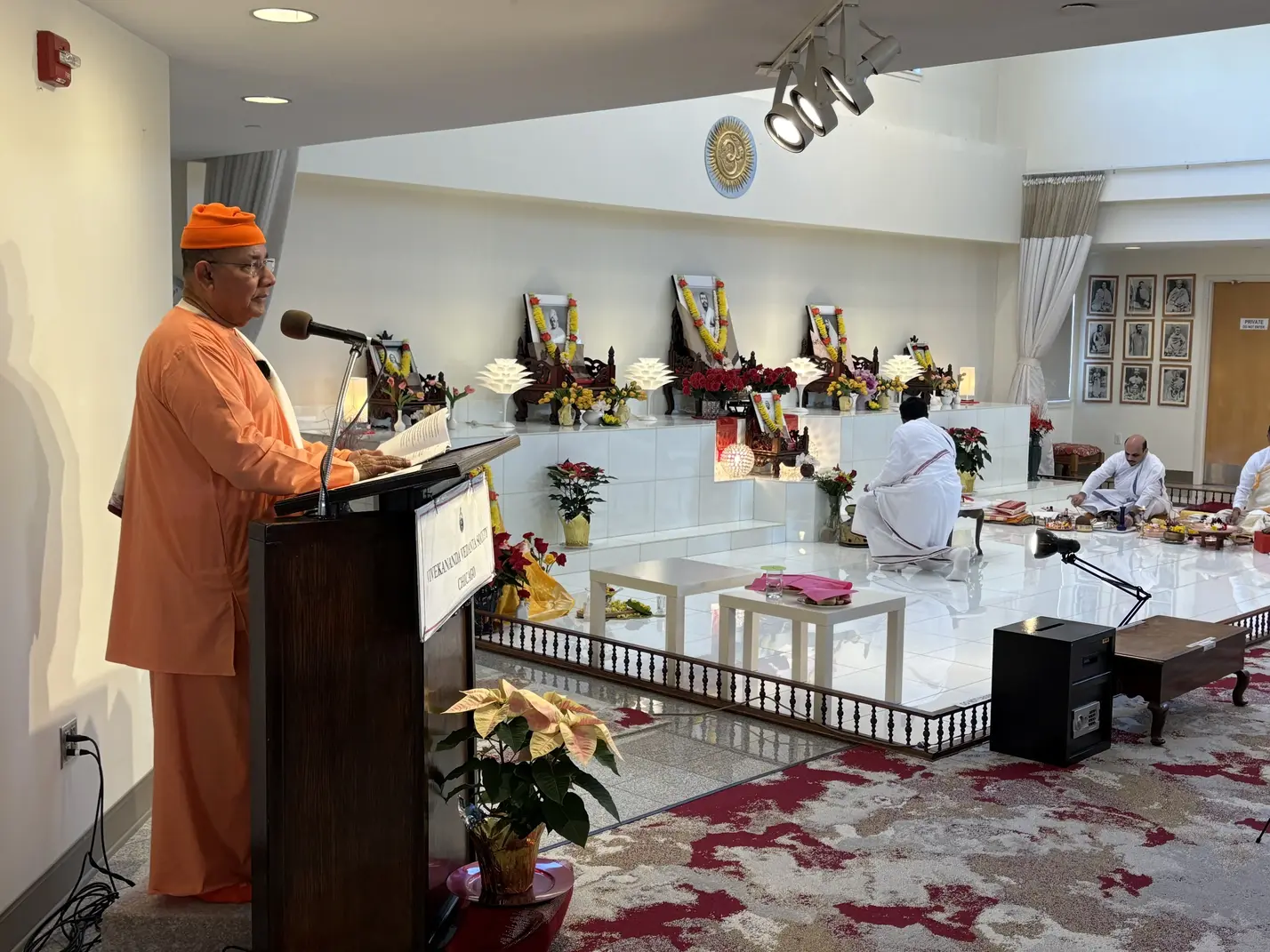
In the tradition of the Ramakrishna movement, this returning is not merely ritual. It is a deliberate turning of the mind toward something steady, something luminous: the words and presence of Sri Ramakrishna, whom devotees call the Jagatguru, the teacher of the world. And the deeper one listens, the more one realizes that the “teacher” is not simply a historical figure or a revered saint. The teacher is the very principle that awakens divinity in human beings and guides it into expression. That, in the language of Vedanta, is the Guru.
This is why Guru Purnima, widely observed in spiritual circles, is not just a day of ceremonial respect. It is a reminder of the most radical possibility in religion: that the truth you seek is not far away, and that the power to realize it is already planted within you—though covered, confused, and often forgotten.
Vivekananda’s Mission in Two Sentences
Swami Vivekananda once summarized his entire mission in an astonishingly compact way: to make people aware of their divinity and to help them manifest it. If one sentence captures the heartbeat of modern Vedanta, it is this.
Notice what it implies. Human life is not meant to end in mere survival. It is meant to evolve: from instinct to conscience, from conscience to wisdom, and from wisdom to spiritual freedom. That progression is the work of education in the deepest sense. But it is also the work of grace. It requires a force that can cut through confusion, dismantle the arrogance of the ego, and restore the soul’s confidence in its own true nature.
In ordinary life, we mistake many things for power: wealth, influence, reputation, titles, or even knowledge. Yet the pandemic years revealed something brutally simple: the body is fragile, social status is temporary, and the world can reorder itself overnight. People who once seemed invincible became vulnerable; people once forgotten became essential. When life confronts us with that truth, it is not cruelty—it is a call to awaken from our hypnotic attachment to surfaces.
In that awakening, the Guru appears—sometimes as a person, sometimes as a teaching, sometimes as an inner push toward honesty, surrender, and courage.
Who Is the Guru?
A striking teaching appears in the Gospel of Sri Ramakrishna: Satchidananda alone is the Guru. Satchidananda is the Vedantic pointer to Brahman—Existence, Consciousness, Bliss—the ultimate reality that cannot be fully described, yet can be experienced.
This claim matters because it challenges the common confusion around spiritual authority. If the Guru is fundamentally Brahman, then the Guru is not “my personal possession.” The Guru is not a brand, not a performance, not a social identity. The Guru is the awakening power of Reality itself—working through a human instrument when necessary, but never limited to that instrument.
And it also clarifies why spiritual liberation cannot be handed over like a transaction. No one can digest your food for you. No one can do your inner work on your behalf. Others can guide, inspire, and correct, but the final transformation must occur in your own consciousness. The true Guru is the one who helps you see that reality directly—and then helps you live it.
Maya: The Twofold Spell
Sri Ramakrishna explains the problem of bondage with remarkable clarity: bondage is caused by Maya. But Maya is not merely “illusion” in the casual sense. It has structure, method, and psychological strategy. The tradition often describes Maya’s two main functions:
- Veiling (Avarana) — It covers the truth.
- Projection or Distraction (Vikshepa) — It throws the mind outward into countless fascinations, fears, and cravings.
Veiling is what makes the real seem distant. Projection is what keeps you busy so you never notice the veil.
This explains a strange paradox: the truth may be right in front of you, and still you do not see it. Not because the truth is absent, but because the mind is occupied, colored, and overwhelmed.
Sri Ramakrishna often used everyday images. Imagine the sun in the sky, blazing and immense. A small cloud drifts in front of it, and suddenly you cannot see the sun. Has the cloud covered the entire sun? Of course not. It has only covered your vision. The obstacle is not the sun’s weakness—it is the viewer’s limitation.
Similarly, Brahman is not hidden because it is far. It is hidden because the mind is clouded by ego and attachment.
The Ego Is Maya
When asked why we remain bound and why we cannot see God, Sri Ramakrishna answered with a sentence that is both simple and devastating:
The ego of the individual is Maya.
Ego here does not mean healthy self-confidence or the ability to function in the world. It means the deep-rooted sense that “I am the doer,” “I am separate,” “I must secure myself,” and “the world exists for my control.” This ego is not merely an idea—it is a pattern of perception. It filters everything.
Ramakrishna’s famous line, translated loosely, is: “When ‘I’ dies, all troubles end.”
If this sounds extreme, it is because we often misunderstand what must die. It is not your intelligence. Not your personality. Not your responsibilities. What must die is the false center—the claim of absolute ownership and control that creates constant fear.
When that false center loosens, a person becomes “akartā,” not the doer in the egoic sense. Life continues. Work continues. Decisions continue. But the inner posture changes: “I am an instrument. The power is not mine.”
This is not weakness. It is liberation.
The Danger of Half-Baked Spiritual Leadership
Sri Ramakrishna did not flatter spiritual ambition. He warned that a “raw” or unripe guide can harm both themselves and their followers. In a vivid metaphor, he described hearing a frog crying loudly. The frog had been seized by a snake. But it was not a venomous snake that could end the frog quickly; it was a weaker snake that could neither swallow the frog nor release it. The result was prolonged suffering—for both.
Ramakrishna’s point was sharp: if the teacher is genuine, the disciple’s ego begins to dissolve quickly. But if the teacher is immature—without realization, without purity, without selflessness—then neither the disciple’s bondage ends nor the teacher’s inner struggle settles. Both remain stuck.
This is why sincere traditions treat spiritual authority as a burden, not a trophy. The true teacher is not someone hungry to be called “Guru.” The true teacher is one through whom ego has been purified into compassion and responsibility.
The Modern Paradox: Organization and Ego
A fascinating modern challenge appears when spiritual life meets organizational life. Traditionally, a renunciate might live quietly, with minimal possessions, devoted mostly to contemplation. But modern spiritual movements often require administration: schools, hospitals, relief work, publishing, community care. In such environments, even sincere monks can be placed into roles with power, visibility, and influence.
And power is an accelerator: it amplifies whatever is already inside. If humility is present, power becomes service. If ego is present, power becomes a trap.
Here is the real difficulty: administration demands firmness. You cannot run a school or an institution by pretending everything is equally fine. Decisions must be made. Discipline must be enforced. Budgets must be managed. People must be held accountable. That assertiveness is part of responsibility.
But the spiritual test is this: can you exercise authority without internal pride?
This is where surrender becomes practical. You do what must be done—clearly, efficiently, firmly—but afterward you return the inner credit to God: “You made this happen. You used me as an instrument. Protect me from arrogance.”
That is not theatrics. It is inner hygiene.
Titles and Money as “Upadhi”: The Costume That Changes the Person
Sri Ramakrishna observed how quickly people change when they acquire an upadhi—a social label or external identity. A title, a new status, a political position, or sudden wealth can act like a costume that reshapes the personality. Someone once humble becomes harsh. Someone once kind becomes dismissive. Someone once approachable becomes intoxicated by their own significance.
Why? Because the ego merges with the costume and begins to say, “This is me.”
Ramakrishna narrated an example of a person whose tone changed after gaining money. The core message was not about judging wealth but about watching its psychological effect. Money itself is not the enemy. Attachment is.
An upadhi is like a mask. The danger is forgetting you are wearing it.
“I” and “Mine”: Two Waves That Create Bondage
Spiritual texts often reduce bondage to two small words: I and mine.
“I” gives rise to self-centered identity. “Mine” gives rise to possession, anxiety, and fear of loss.
Together they produce the drama of life: constant striving, constant defensiveness, constant comparison. The irony is that the world continues with or without our ego’s insistence. We imagine the universe depends on our control, yet life operated before us and will operate after us.
Sri Ramakrishna’s teaching does not demand that we abandon family, work, or planning. It demands that we abandon false ownership. Earn honestly, he says—follow the straight path. But use what you earn ethically. Let it support goodness, serve others, and reduce suffering.
This is how spiritual life becomes realistic: not through denial of the world, but through purification of motive.
The Dog and the Cart: A Comedy of Misunderstanding
A wonderful metaphor captures ego’s absurdity. Imagine a heavy cart being pulled by two strong oxen. A dog walks alongside the cart, staying in its shadow. The dog begins to think, “I am pulling this cart.”
This is exactly what ego does. The real forces—time, nature, society, karma, divine will, the labor of countless others—move the cart of life forward. But the ego, walking in the shadow, claims authorship.
The solution is not to become passive. The solution is to become truthful: “I contribute what I can, but I am not the ultimate controller. I am not the sole cause.”
That single shift reduces anxiety dramatically.
God Is Closer Than Close
One of Sri Ramakrishna’s most tender teachings is this: God is closer to you than anything else, because God is the very ground of your being.
Why then do you not see God?
Because Maya stands in between—like Sita standing between Rama and Lakshmana in Ramakrishna’s metaphor. Rama is the divine reality. Lakshmana is the individual soul. Sita is divine power—Maya—through which God both manifests and hides.
This is subtle: God hides God. Not out of cruelty, but as part of the cosmic play. The world exists, experience exists, growth exists, love exists, struggle exists. And within this play, the soul learns, awakens, and returns.
But when the soul longs for truth, it must pray not only for blessings but for clarity: “Remove the veil. Let me see what is real.”
The Prayer That Protects the Heart
There is a kind of prayer that functions like spiritual armor:
“Let me do my duty with full strength, and let no pride enter my heart.”
This is especially important for those who serve publicly—speakers, leaders, teachers, administrators. Applause is sweet, and respect is intoxicating. If the mind begins to believe that the respect is due to “me,” spiritual life collapses quietly.
The safeguard is remembrance: whatever strength has awakened in you came from grace. Whatever good you accomplish is a channel, not a possession.
True humility is not saying, “I am worthless.” It is saying, “The power is not mine.”
A World in Transition: The Need for Inner Change
The closing prayer of such gatherings often expands beyond personal liberation. We look around and see widespread suffering—some visible, some hidden. We sense that society itself is standing at a threshold, a junction between eras, where older patterns of living are breaking and new ones are emerging.
In such times, spiritual teaching becomes more urgent, not less. Because external change without internal change becomes chaos. Technology can expand power, but without ethics and compassion, it expands harm. Wealth can grow, but without generosity and restraint, it produces alienation. Information can increase, but without wisdom, it becomes noise.
Sri Ramakrishna’s message is not escapism. It is transformation. He insists that human beings can change—not by mere moral lectures, but by awakening to their divine nature.
And perhaps that is the most hopeful idea religion offers: that we are not doomed to remain trapped in our lowest instincts. We can evolve. We can refine. We can become free.
The Final Teaching: Do Your Best, Then Surrender the Credit
So what does this look like in everyday life?
- Work hard. Be competent. Take responsibility seriously.
- Earn through honest means.
- Serve others where you can.
- Remain firm when duty requires it.
- Watch the mind carefully when praise comes.
- When mistakes happen, learn without self-hatred.
- And in all of it, keep the inner posture of surrender: “You are the doer. I am the instrument.”
If the ego loosens, the heart becomes lighter. If “mine” weakens, fear reduces. If surrender deepens, peace grows. And if the veil thins, a person begins to glimpse the astonishing truth Vedanta declares: your essence is not weakness, not limitation, not mortality. Your essence is Satchidananda—Existence, Consciousness, Bliss.
To remember this is the purpose of the Guru. To live it is the fruit of the Guru. To become it is the final liberation.
May the blessing of Sri Ramakrishna, Holy Mother Sri Sarada Devi, and the great teachers of the tradition help us face suffering with compassion, face temptation with clarity, and face life with the courage to awaken.
Om peace, peace, peace.
You will get Vedanta updates in your inbox.
Occasional reflections on Vedanta. Unsubscribe anytime.