Sri Ramakrishna Kathamrita Go Beyond Maya
Swami urges transcend Maya through Mother’s grace, sattva growth, surrender, and God-centered inner joy.
Swami Ishatmananda opens in the traditional way, chanting the familiar invocation that calls Sri Ramakrishna’s words kathamrita, nectar that cools the “heated life” and removes impurity. He then states the purpose in plain terms: these teachings are meant to free us from the cycle of janma, mrityu, jara, vyadhi, and the sorrow that comes with them. How does it free us? Not by mere information, but through jnana, a living clarity that wakes up inside the mind as we listen. The moment the mind truly catches the meaning, something shifts. The same life, the same circumstances, yet the inner grip begins to loosen.
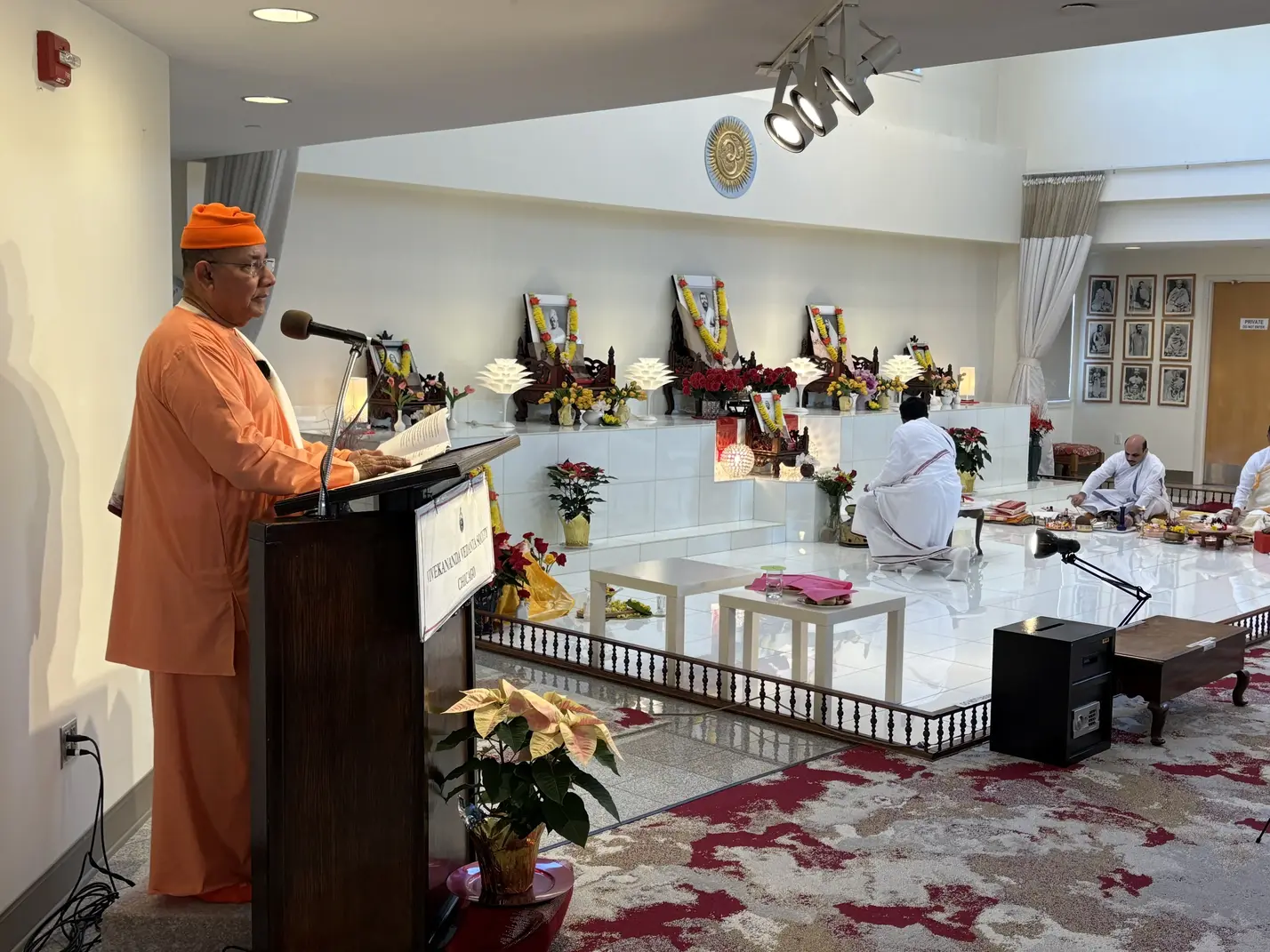
He also gives the setting: this Bengali Kathamrita reading is connected with the Greater Chicago Bengali Association (Bongobhobon), where Durga and Kali images are present, and devotees normally gather in person. Because of COVID restrictions at that time, the sessions moved online. In a way, that becomes part of the message: even when the outer world is disrupted, the inner work can continue.
Who is Mahamaya, and Why We Must “Go Beyond”
The heart of the talk is a bold spiritual diagnosis: we are not simply distracted, we are enchanted. Sri Ramakrishna calls that enchantment Mahamaya, the great power that keeps beings fascinated with what is temporary. Swami Ishatmananda explains that to receive divine grace, Sri Ramakrishna says we must please Adyashakti, the primal Divine Power.
At first, people may feel, “Is God one thing, and Shakti another?” The Swami gently clarifies the traditional viewpoint: the Absolute is not limited by activity, while Shakti is the dynamic power through which creation, preservation, and dissolution appear. In devotional language, we speak of Mother. In Vedantic language, we speak of Maya. Either way, the practical point remains: as long as we are held by Maya, we cannot taste real freedom. To “go beyond Maya” is to go beyond the spell, beyond the hypnotic pull that makes the unreal feel ultimate.
The Kali Image as a Teaching in Symbols
To make this less abstract, Swami Ishatmananda points to something many devotees have seen in Kali temples: the symbolic layering of Shiva and Shakti. He describes the imagery where Shiva appears still, inactive, almost like pure transcendence, and then the awakened, luminous Shiva indicates the will for manifestation. Upon that stands Kali, the active force, a blend of energies through which the play of the universe continues.
His point is not about art history. It is a spiritual map: reality has a silent depth and an active power. The problem begins when we only chase the activity and forget the depth. Going beyond Maya does not mean rejecting the world with bitterness. It generally means recognizing what is passing and rediscovering what is unchanging.
How Maya Works: Two Powers and Three Gunas
Swami Ishatmananda then gives a clean, practical breakdown that helps people see Maya operating in daily life.
Two powers of Maya
- Avarana (covering): it hides what is real.
- Vikshepa (projection): it throws something else on top, a convincing substitute.
Then he connects this with Maya’s three gunas:
- Tamas: darkness, numbness, cruelty, negligence.
- Rajas: restlessness, ambition, ego-driven activity.
- Sattva: clarity, harmony, compassion, upliftment.
To show this is not theory, he gives a striking example: a road accident happens. One person hits someone and drives away, coldly dismissing the life involved. That is tamasic. Others gather, but some are more interested in photos and spectacle than help. That is rajasic mixed with insensitivity. A sattvic person cannot remain a spectator. They generally move to help, arrange care, spend money if needed, and even give blood if required. Same event, different inner composition. Where did those tendencies come from? The Swami points back to the gunas, and the gunas to Mahamaya.
So “going beyond Maya” begins with honesty: Which guna is leading my life today? If we start seeing our own mental coloring, we also start loosening its control.
Vidya and Avidya: The Same Power, Two Directions
Sri Ramakrishna often speaks in a language that goes straight to the heart: vidya and avidya.
- Avidya is the aspect of Maya that binds through kamini-kanchana, obsession with pleasure, status, and possession.
- Vidya is the aspect of the same power that leads upward through devotion, compassion, knowledge, and love of God.
This is a deeply hopeful teaching. The Swami emphasizes that the door out of Maya is not locked. The same energy that can bind can also liberate, depending on how it turns our mind.
He references the Devi stuti idea from Chandi: the world is enchanted by the Divine Mother, and liberation comes when She is pleased. The meaning is not that God is reluctant. It is that grace becomes accessible when the mind stops fighting truth and begins to align with it.
Why the Temporary Looks So Important
Swami Ishatmananda spends time on a human mystery: why do intelligent people chase things they know are temporary?
He gives an example of top-level positions in organizations, where everyone knows the role lasts only months, yet people become obsessed, anxious, almost consumed. After retirement, many spend years retelling those brief seasons of status, with medals and memories, while the deeper questions remain untouched.
This is Maya’s artistry: it convinces the mind that a short-lived title is life itself.
He then shifts to a modern illustration: travel and “must-see” experiences. He mentions going to places that are heavily promoted, where people spend significant money, only to discover that the outer excitement fades quickly. One can sit in a beautiful cabin, but then wonder, “What am I doing here?” The deeper thirst remains. The Swami’s point is gentle but firm: the joy we are seeking outside is actually pointing us inward.
The Shortcut: Childlike Dependence on the Mother
One of the most practical parts of the talk is his emphasis on santan-bhava, the attitude of being the Mother’s child. Other devotional moods require carefulness, effort, precision in service. Child-mood has one central strength: total trust.
He gives a simple scene: a small child runs forward to play, but keeps turning back to see whether mother is there. If mother is present, the child runs fearlessly. That is the spiritual psychology he is recommending. Not laziness, not passivity, but the confidence that “Mother is there; I will not be abandoned.”
He ties this to Sri Ramakrishna’s own life. Even when Totapuri came to teach Vedanta, Sri Ramakrishna first went to Mother Bhavatarini to “ask.” That is not intellectual dependence. It is heart-level surrender.
“One Glance is Enough”: Grace That Breaks the Spell
To show what Shakti’s grace means, he brings in a moving story: a young man travels a long distance just to see Sri Sarada Devi. Circumstances prevent a proper meeting, and he feels crushed. But Turiyananda Maharaj rejoices, almost clapping, because the boy received what mattered: Mother’s glance.
The teaching is subtle and strong: sometimes we think grace means a dramatic conversation, a special moment we can display. The Swami’s framing suggests something quieter: grace can work invisibly, washing old impressions, softening the ego, and turning the mind toward God without any public proof.
That is exactly how we go beyond Maya: not by arguing with the world, but by receiving a higher taste that makes the old fascination fade.
Signs of Going Beyond Maya: “Worldly Splendor is Forgotten”
Swami Ishatmananda repeats a line that contains an entire spiritual path: when God is realized, the splendor of the world is forgotten. Not because the world becomes hateful, but because a greater joy enters. When the heart is absorbed in God, it stops doing constant “profit-loss” calculations. It stops needing to ask endless identity questions and social comparisons. The mind becomes simpler, cleaner, and strangely free.
He illustrates this through Kathamrita episodes: Sri Ramakrishna’s intense hunger for hearing sacred texts, his insistence on faith, and his ability to recognize different levels of understanding even among people who read the same Vedanta. One person may call the holy body a “clay cage” and remain dry. Another sees the devotee’s body as chinmaya, filled with divine presence, and their reverence becomes transforming.
In that light, “go beyond Maya” is not a slogan. It is a shift from dryness to living realization.
A Practical Path: Raise Sattva, Pray for Clarity, Then Transcend Even Sattva
The Swami’s guidance is realistic. Most people cannot jump straight into transcendence. So the first step is usually to raise sattva: sacred reading, holy company, sincere prayer, and inner disciplines that calm restlessness. Then, as devotion deepens, even sattva’s subtle pride dissolves into pure surrender.
In his closing mood, the message becomes simple: call the Mother, ask for grace, and keep moving toward the inner truth. Maya’s spell is powerful, but it is not final. The moment love of God becomes real, the mind naturally begins to step beyond the fascination with the temporary, and freedom starts to feel not like an idea, but like home.
You will get Vedanta updates in your inbox.
Occasional reflections on Vedanta. Unsubscribe anytime.