Jnana Yoga Stages
Swami Ishatmananda outlines seven Jnana Yoga stages, guiding seekers from aspiration to nondual liberation.
On a winter-season Saturday at the Vivekananda Vedanta Society in Chicago—amid holiday travel, festive moods, and a smaller but attentive gathering—Swami Ishatmananda offered something both simple and demanding: a map of inner ascent. The topic was the seven stages of Jnana Marga (the path of knowledge)—a classical Vedantic progression toward Brahma-jnana, the direct realization of the Self as non-dual consciousness.
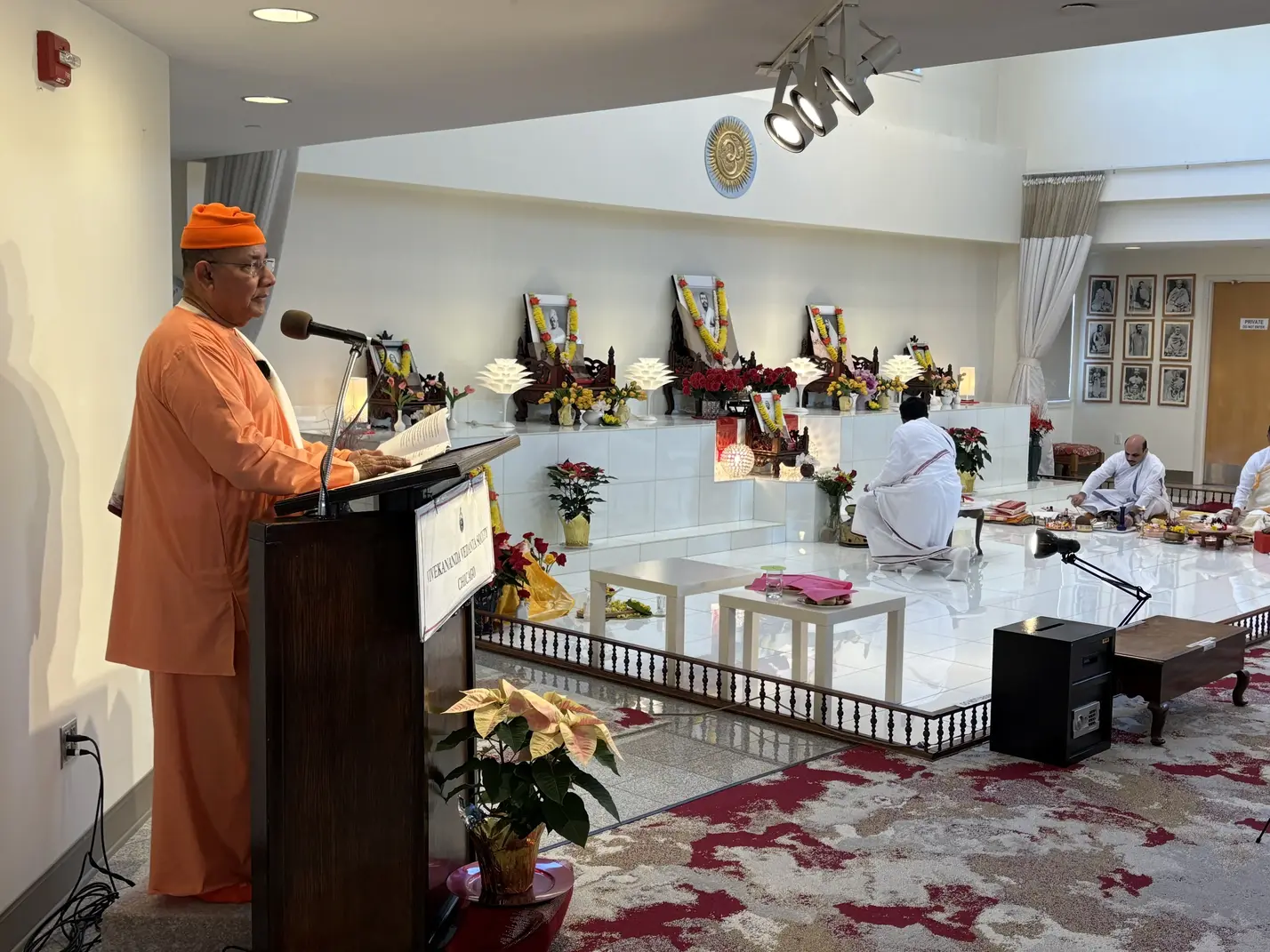
What made the talk distinctive was not only the outline of the stages, but the Swami’s larger frame: spiritual life is not meant to be complicated. Masters across traditions reduce the journey into a handful of steps—four, five, six, seven, eight—because the truth is one, even when languages and methods vary. Human beings, however, often entangle it with commentary, ego, and over-elaboration.
The One Truth, Many Ladders
The Swami began by placing the seven stages in a wide spiritual landscape. Traditions repeatedly distill transformation into short lists:
- Sri Ramakrishna’s “four teachings”: sadhu-sanga (holy company), nirjan-vās (solitude), vichāra (inquiry/discrimination), and prārthanā (prayer). Practiced sincerely, these are enough to reach God-realization.
- Jainism’s five great vows/jewels: ahimsa (non-injury), satya (truth), asteya (non-stealing), brahmacharya (continence), aparigraha (non-possessiveness)—a direct ethical path to liberation.
- Six chakras in certain yogic systems—ascending from muladhara to ājñā—and then the crown, where duality dissolves.
- Patanjali’s eightfold yoga: yama, niyama, asana, pranayama, pratyahara, dharana, dhyana, and samadhi.
- Buddha’s Noble Eightfold Path (right view through right concentration).
- Jesus’ Beatitudes—eight blessings that point to the inner kingdom.
- Bhakti’s ninefold devotion (navadha bhakti).
- And even the Ten Commandments, a moral architecture aimed at a purified life.
The pattern is striking: the saints do not inflate the path; they clarify it. If complexity appears, it is often the byproduct of later argument, not original realization.
With that foundation, the Swami moved into Vedanta’s own specialized ladder for the path of knowledge: the Saptabhūmikā, the seven stages.
Why Jnana Yoga Is Unique: Knowing the Knower
Jnana is commonly translated as “knowledge,” but the Swami emphasized what kind: knowledge of the Self (Atman). Ordinary knowledge depends on the senses. You touch, smell, taste, see, and hear an object. That requires duality: a knower and a known.
But the Self is not an object. You cannot point to it the way you point to a table. In Jnana Marga, a crucial insight arrives early: you are not going to “get” something new; you are going to “reveal” what already is.
So the question becomes: if the five senses cannot grasp it, how do you know yourself?
Vedanta answers by careful inner steps—beginning where most people already have a clue, even if they don’t recognize it: deep sleep. In dreamless sleep, the body is absent from experience, the mind is quiet, and yet when we return we say, “I slept wonderfully. I feel fresh.” That report suggests a silent witness, a presence untouched by waking and dreaming. The Swami used this as a doorway: happiness is everyone’s goal, and deep sleep hints at a kind of happiness not dependent on objects. The spiritual journey, then, is learning to live—awake—rooted in that inner fullness.
The Seven Stages of Jnana Marga
1) Śubhecchā — The Auspicious Wish
Everything begins with a sincere longing: “I want to know myself.” Not curiosity, not social identity, not spiritual fashion, but a clean, urgent desire for liberation.
The Swami compared this to New Year resolutions: people buy a new diary, design routines, and imagine an improved life. Many don’t follow through, but the seed is meaningful—a new direction is conceived first as intention. Similarly, Śubhecchā is the inner declaration: I will not let life pass in eating, sleeping, and merely surviving.
Here he quoted the old Sanskrit warning that without dharma—the urge toward truth—human life collapses into the same pattern as animals: food, sleep, fear, and reproduction. What distinguishes the human being is not cleverness in managing desires, but the awakening of higher purpose.
And what is true purpose? The Swami invoked a forceful line: the truly intelligent person is the one who has realized the Self. Everything else is temporary skill.
Śubhecchā also becomes sharper with time. “I am fifty and going to be fifty-one… sixty and going to be sixty-one,” he remarked. Time is finite. So this stage includes a sober realism: I must know the Self in this very life.
How does this auspicious wish grow strong? Through practical supports:
- Holy company (sadhu-sanga)
- Spiritual study—especially texts that point beyond temporary heaven toward permanent freedom
- Unselfish service—done in a way that actually reduces ego, not increases pride
He gave a memorable caution here: working alone can inflate ego (“I am so good, I am doing so much”), but working in an organization often exposes ego because others will disagree with your preferred methods. That friction is not a problem—it is training. Unselfish service, done properly, chips away at the “I must be right” impulse.
Śubhecchā, then, is both aspiration and the beginning of ego-reduction.
2) Vicāraṇā — Deep Inquiry and Discrimination
The second stage is inquiry: What is real and what is changing? What is permanent and what is temporary?
The Swami described it as a relentless examination of life’s instability. Even the sun—seen by Rama, Krishna, Jesus, Sri Ramakrishna, and by us—will one day change and fade. The body changes from childhood to youth to age. The mind changes constantly. The world changes. And yet the word “I” remains present through all change. Something observes the changing body and mind. Who is that “I”?
This is the heart of Vicāraṇā: repeatedly asking, “Who am I?” and refusing superficial answers.
He illustrated the urgency of discrimination with vivid human scenes: how people cling to wealth for “fourteen generations,” how even near death some minds fixate on bank balances, how attachments that seem absolute in life can appear strangely thin at a funeral. The point was not cynicism. It was clarity: everything you are holding can be taken away, and much of what you cling to will not accompany you.
Here he echoed a Upanishadic teaching:
Atman is to be seen, heard, reflected upon, and meditated upon.
Not merely memorized. Not merely recited.
He also offered a sharp critique of “scripture knowledge” without inner transformation. One may memorize the Veda or the Gita, but without removing ignorance (avidya), it remains performance. The real issue is not quantity of religious information but quality of consciousness.
3) Tanumānasa — The Thinning of the Mind
Tanumānasa literally suggests making the mind “thin”—reducing its heaviness, its burdens, its compulsions.
The Swami compared this to physical weight loss: just as the body becomes lighter when excess weight drops, the inner life becomes lighter when resentments, rivalries, and obsessive judgments fall away. In this stage the seeker stops feeding mental noise:
- less hatred
- less gossip
- less compulsive comparison
- less fixation on “my side vs your side”
He emphasized a practical truth: whatever you repeatedly generate in the mind becomes your inner residue. If you generate hate, hate remains. If you generate love, love remains. Purity is not a last-minute cleanup; it is an ongoing mental diet.
Tanumānasa also has a quality of one-pointedness. The mind gradually refuses to be entertained by petty talk. He narrated an incident of Sri Ramakrishna traveling with wealthy companions who discussed property and business; Sri Ramakrishna became suffocated, unable to breathe in that atmosphere. That, said the Swami, is Tanumānasa—the mind becoming so oriented to the divine that worldly chatter feels like drowning.
At a deeper level, the thinning of mind begins to produce oneness-sensitivity: you feel others as yourself. He recalled stories of Vivekananda unable to sleep because millions suffer, and of Sri Ramakrishna feeling pain when a fisherman struck another. These are not sentimental tales; they demonstrate a psychological shift: the sense of separation weakens.
4) Sattvā-āpatti — The Attainment of Purity
In the Swami’s telling, this fourth stage is extremely high—so high that ethical perfection becomes natural. The word suggests “coming into” sattva, the luminous quality of clarity, balance, and love.
He explained why meditation sometimes seems to worsen the mind at first: suppressed impressions rise from the inner storehouse. People complain, “I never had these thoughts—why now?” The answer is that the old material was always there. When the surface quiets, the basement becomes audible.
The antidote is not panic but patience, perseverance, and inner cleansing. In Jnana Yoga, you keep returning to truth: I am pure awareness. I am not the passing thought. I will rectify and move forward.
How do you know Sattvā-āpatti is arriving? The Swami gave a simple test:
You feel love for everyone.
Not only “my people,” but people as people. Suffering anywhere becomes hard to bear because the heart has expanded.
He told a story involving Vivekananda and Girish Chandra Ghosh. Girish challenges: can Vedanta wipe the tears of widows and feed the hungry? Vivekananda breaks down in tears—not because he lacks intellectual power, but because his heart cannot tolerate suffering. Girish says he loves Vivekananda not for his philosophy but for his compassion. This, the Swami suggested, is purity: love that responds immediately to pain.
He made a striking definition: Purity is love.
And he offered the archetype: the mother. Why is “mother” universally revered? Because mother means sacrifice, service, compassion—love in action.
At this stage, the Swami said, you don’t need external policing. A sattvic person becomes self-controlled. Wrong action becomes psychologically impossible because the sense of shared being is too strong to harm another.
The Higher Stages and the Direction of the Journey
Although the discourse spent most of its detail on the first four stages, the direction was clear: the remaining stages carry the seeker toward the dissolution of subtle duality and into the final non-dual realization—turiya, where the Self alone shines, without the “I-and-That” split.
He hinted at the deeper Vedantic analysis of the “triputi”—knower, known, and knowledge—which ultimately collapses in samadhi-like insight when the Self recognizes itself directly.
He also stressed a sobering reality: Jnana Marga is not easy. It is called the “royal road,” but not everyone can walk it with steadiness. Among Sri Ramakrishna’s disciples, he said, Vivekananda was uniquely suited for the path of knowledge. That is not meant to discourage anyone. It’s meant to encourage seriousness: this is a path requiring strength, clarity, and perseverance.
Unity Without Erasing Diversity
A notable closing theme of the talk was harmony across faiths. The Swami’s message was not “change your religion,” but become a better version of it: a better Christian, a better Muslim, a better Hindu—because the goal is the same truth, the same love.
God, he said, is love—named differently across traditions. Teachers come in different times and forms because humanity has different needs and languages. But the spiritual essence remains: expansion is life, contraction is death. Open the windows of the heart and you become alive; close them and you become absent, even while breathing.
Why “Shanti” Three Times?
The gathering ended, as many Vedantic gatherings do, with “Om Shanti, Shanti, Shanti.” The Swami explained the traditional threefold meaning: peace is invoked in three dimensions of disturbance:
1) Adhi-daivika — forces of nature (weather, storms, the uncontrollable)
2) Adhi-bhautikā — disturbances from other beings (people, animals, environment)
3) Adhyātmika — disturbances within oneself (body and mind)
It’s a humble acknowledgment that inner realization needs supportive conditions: a cooperative body and mind, a peaceful relationship with beings, and harmony with nature.
The Takeaway: Start Where You Are, But Start
Swami Ishatmananda’s discourse did not portray Jnana Yoga as abstract philosophy. It presented it as a lived progression:
- Begin with a genuine wish to know the Self
- Practice inquiry until the temporary loses its hypnotic power
- Thin the mind by dropping the poisons that keep it restless
- Purify the heart until love becomes effortless and universal
- Continue onward until the last trace of separation dissolves
The mood of the season—holidays, travel, celebration—served as an unspoken contrast. Many people celebrate externally while remaining unchanged inside. Jnana Yoga invites a different kind of new beginning: not merely a calendar change, but a reorientation of identity from body-mind to awareness itself.
And perhaps the most practical message of all was this: saints keep it simple. It is we who complicate it. The “seven stages” are not a mysterious ladder reserved for rare mystics. They are a structured way of naming what every sincere seeker must cultivate—the wish, the inquiry, the cleansing, the love, the realization.
You will get Vedanta updates in your inbox.
Occasional reflections on Vedanta. Unsubscribe anytime.