Lessons from Kathamrita on Work, Truth, and Spiritual Growth
Ramakrishna guides both monks and householders: combine ethical work, patience, devotion, and gradual God-remembrance daily.
A spiritual tradition becomes truly universal when it speaks to more than one kind of life. Many teachings inspire those who renounce the world, yet feel distant to those who must earn a living, raise families, and navigate society. Other teachings motivate householders but fail to satisfy the deep hunger of those who feel called to radical renunciation. What makes Sri Ramakrishna’s message extraordinary is that it nourishes both.
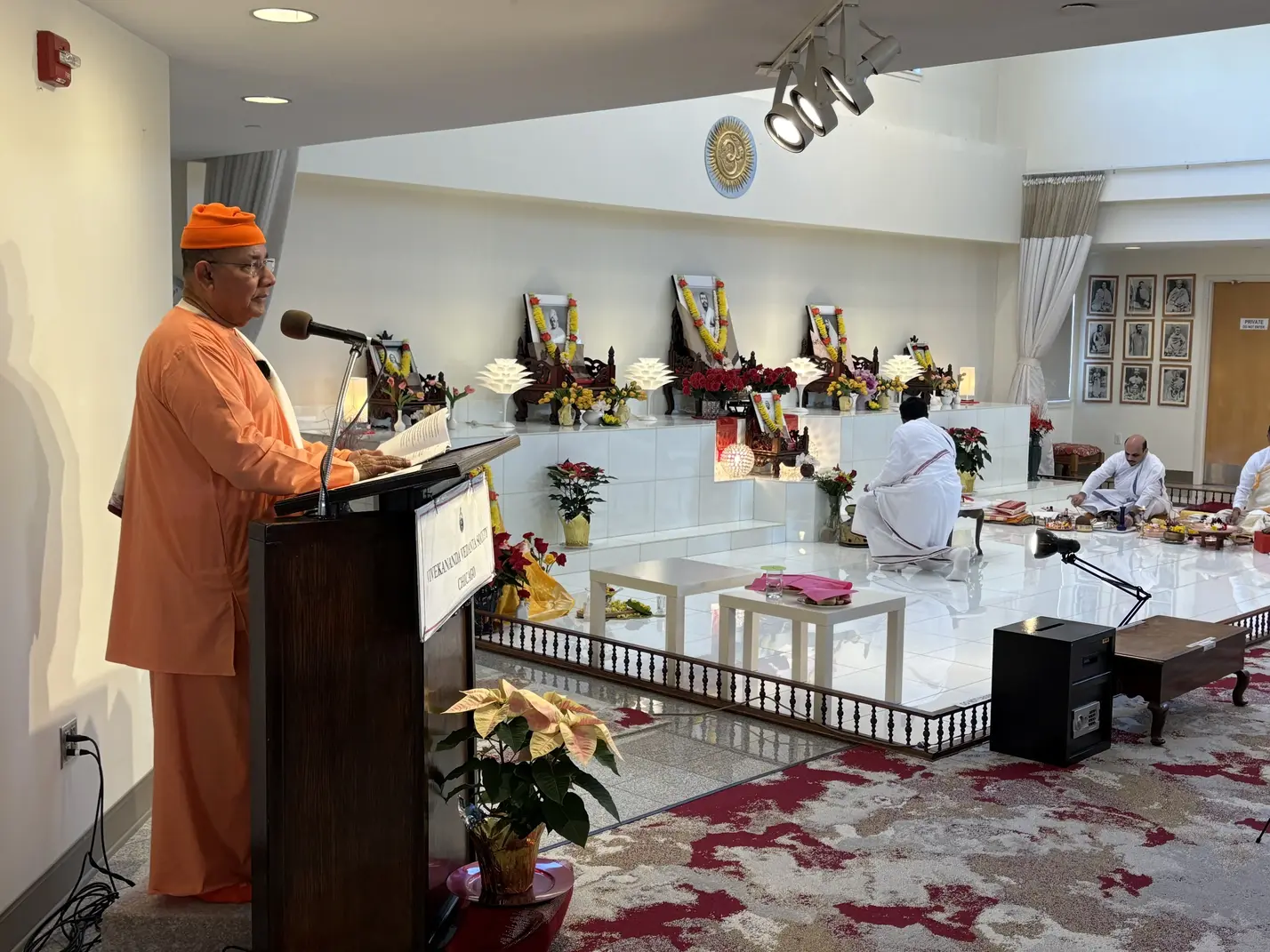
The discourse behind this article begins with a simple scene: a community effort to study and explain the Kathamrita (The Gospel of Sri Ramakrishna) among Bengali devotees in Chicago. The speaker mentions the limitations of gathering in person and the slow return to normal life after a public health crisis. Yet even these practical details carry a spiritual hint: life is uncertain, conditions change, and the need for inner steadiness never disappears.
From this living context, the talk opens with a traditional invocation that praises the Kathamrita as nectar: healing for the “heated” human life, cleansing of inner stains, and auspicious to hear. The praise is not ornamental. It frames the central claim: Sri Ramakrishna’s words are not meant only for private inspiration, but for transformation—of how we work, speak, desire, and grow.
This essay explores the key teachings expressed through that discussion: why Sri Ramakrishna inspires both monks and householders, how effort and grace work together, why ethical earning matters in spiritual life, what “gradual progress” truly means, how to understand spiritual experience without chasing drama, and how the Kathamrita turns history into meditation.
1) One Teacher, Two Directions: Renunciation and Service
When monks read the Kathamrita, many feel a surge of renunciation. They hear Sri Ramakrishna repeatedly pointing to the impermanence of the world—how everything that appears solid eventually dissolves. For them, the message sounds like a call: “Do not entangle yourself; move forward; dedicate everything to God.”
When householders read the same book, they often feel something different. They feel encouraged to live responsibly—perform their duties well, serve their families, and dedicate their work to God. In other words, the same words awaken detachment in one group and devotion-in-action in another.
This dual effect is not accidental. The talk cites a beautiful idea: Sri Ramakrishna becomes the “fixed star” for both the renunciant and the householder. That is rare. How can one figure guide two paths that seem opposite—one moving away from worldly life, the other moving through it?
The answer is that Sri Ramakrishna does not glorify “world” or “non-world.” He glorifies God. When God becomes central, renunciation becomes natural for some, and dedicated service becomes natural for others. Both become expressions of the same orientation: moving toward the eternal.
2) The Upanishadic Blueprint: Cover the World with God
To show that this harmony is not new, the talk reaches back to the Upanishads—especially the opening of the Isha Upanishad. Its message is strikingly modern: see everything as pervaded and covered by the Divine. When that becomes your inner vision, you can live in the world without being trapped by it.
Then comes an equally practical instruction: if you want to live long, live through your work in a way that moves toward God. Work is unavoidable. Even “retirement” does not end work; it often simply shifts work onto others or creates new kinds of restlessness.
This is where the spirit of karma yoga enters: do your work, but do not cling to its “consumption” as the ultimate meaning. Work becomes an offering rather than a chain.
Sri Ramakrishna embodies this in a uniquely compelling way. He appears as the “God of renunciants,” deeply established in spiritual states; yet he also lives in relationship—caring for the Holy Mother, remaining connected to people, and showing warmth to devotees from all backgrounds. He becomes, in the talk’s phrase, “everyone’s Sri Ramakrishna.”
3) Effort and Grace: Two Hands of the Same Truth
A classic spiritual tension appears in the discussion: if everything depends on God’s will, why should we try? If not even a dry leaf can fall without God’s permission, why make effort at all?
The teaching presented is not one-sided. It admits both realities:
- Complete dependence is possible—like an infant who does nothing, because the parents do everything.
- Effort is also necessary—especially for those who have not yet reached total surrender.
Sri Ramakrishna’s own life shows both. When the call to renunciation appeared through Totapuri, he did not decide only by reasoning—he ran to the Divine Mother and returned saying, in essence, that the Mother had arranged it. That is grace-centered dependence.
But the same Sri Ramakrishna also struggled intensely for the Mother’s vision, reaching a point of unbearable longing. That is effort at its highest pitch—almost a spiritual desperation that refuses to settle for mere belief.
The point is subtle: effort and grace are not enemies. They are two modes through which the same relationship matures. Sometimes you move with initiative; sometimes you are carried. Often, both happen at once.
4) The Marwari Devotees and the Real Spiritual Danger of “My, Mine”
In the day’s Kathamrita episode, a group of Marwari businessmen from Kolkata comes to meet Sri Ramakrishna. This becomes a doorway to discuss a very practical spiritual issue: the danger of “my, mine” thinking.
Sri Ramakrishna warns that when we act with constant ownership—“my profit, my status, my achievement”—we tighten bondage. The talk uses a vivid image: a stone breaking down slowly over time—becoming pebbles, then sand, then finally dissolving into the vastness. All beings will merge into the ultimate reality eventually, but the length and pain of the cycle depend on how quickly the ego loosens.
Business, by its nature, can strengthen ego: negotiation, persuasion, strategy, and competition. Yet Sri Ramakrishna does not condemn business itself. He speaks directly to the mindset: redirect desire. If you must desire, desire God. If you must hunger, hunger for liberation.
The teaching is not to become lifeless or passive. It is to transform the inner engine. Most people cannot stop wanting; they can only change what they want and why they want.
5) The Elephant and the Hook: How to Restrain the Mind
To make self-control concrete, the talk recalls an image: an elephant reaching toward someone else’s banana plant. The mahout uses a hook to stop it immediately. The lesson: when the mind stretches toward harmful habits, you must restrain it right then—not after it has already eaten the “banana.”
This is not suppression born of fear. It is correction born of wisdom. Spiritual life is not only about long meditations; it is also about those quick, decisive moments of restraint:
- stopping a lie before it forms,
- refusing a cruel word before it escapes,
- stepping back from greed before it becomes justification,
- catching a harmful mental story before it becomes identity.
Such restraint is the real “hook.” It creates freedom.
6) Gradual Progress: Spirituality Like Business Growth
Sri Ramakrishna uses the businessmen’s own world to explain spiritual development: people often grow step by step. A person may start with a small trade and gradually expand as resources and skills increase. Similarly, a seeker begins with small practices—daily remembrance, simple prayer, a little japa—and then gradually matures into deeper disciplines: solitude, longer contemplation, a more stable mind.
This teaching corrects a common modern impatience: we want instant transformation. But spiritual growth is a reshaping of the inner personality. That takes time.
The talk emphasizes this: “do not rush; do not panic; do not become impatient.” You can intensify sincerity without demanding immediate results.
7) “Time Must Be Ripe”: Why Some Grow Faster Than Others
A deeper point follows: sometimes nothing seems to “work” because the time is not ripe. This is not fatalism; it is spiritual realism. Each person carries a long history of tendencies and consequences. Some ripen quickly. Others ripen slowly.
To explain this, the discourse offers a memorable medical metaphor: a boil should not be operated on too early. If a surgeon cuts before it ripens, the result can be worse. When it ripens, the right intervention becomes effective.
So too with spiritual breakthroughs: certain realizations arrive when inner maturity reaches a threshold. Before that, the mind may hear truth but not absorb it. The solution is not despair; it is steady practice and patience.
The mention of Swami Vivekananda’s poem “The Cup” adds emotional depth: not everyone’s path is equally smooth. For some, every step hurts; for others, the road is flower-strewn. But both can arrive—if they do not stop.
8) Why Sri Ramakrishna Refuses Certain Offerings: The Ethics of Earning
One of the most striking teachings in the discussion is Sri Ramakrishna’s sensitivity to how offerings are earned. The talk notes a paradox: Sri Ramakrishna may ask a poor devotee for something simple, yet refuse lavish gifts from wealthy visitors. Why?
Because the spiritual quality of an offering is not measured by its price. It is measured by its inner purity—which includes the means by which it was obtained.
Here the talk confronts an uncomfortable truth: if money is earned through deception, exploitation, or cruelty, then even if it is later used for religious projects, it carries that stain. The example of unethical profit being used to build temples is deliberately provocative: can the Divine be truly honored by what was acquired through someone else’s suffering?
The teaching is not that every business is corrupt. The teaching is that dishonesty has a spiritual cost, even when wrapped in religious packaging.
This becomes especially concrete through everyday examples:
- selling a product by exaggerating scarcity,
- speaking sweetly while intending manipulation,
- giving samples of quality but delivering inferior goods,
- taking advantage of distance and the customer’s inability to return items.
These are not merely social “tricks.” They shape the soul. And the spiritual law is simple: the world may not notice, but the deeper witness does.
9) Jagannath: The Witness With Unblinking Eyes
To deepen the point, the talk reflects on the symbolism of Lord Jagannath: large eyes, no eyelids; hands and feet not emphasized; a form that appears unusual to the unfamiliar.
The philosophical meaning offered is powerful:
- God is everywhere, so He does not “need” feet to travel.
- God’s will accomplishes everything, so He does not “need” hands.
- God is the witness, always seeing, so there are no eyelids to close.
This image becomes a spiritual reminder: you cannot “buy” your way out of truth. You cannot bribe the witness. You can deceive people, but you cannot deceive the law of cause and consequence—nor the divine presence that sees without blinking.
This is not meant to terrify. It is meant to awaken responsibility. If God is truly present, then ethics is not optional; it is the natural expression of spiritual intelligence.
10) The Simplest Remedy: Constant Remembrance of the Name
After describing complex moral and psychological issues, the talk returns to a surprisingly simple instruction: repeat God’s name constantly.
But not as hypocrisy. Not as a badge. Not as a ritual used to cover wrongdoing. Rather, bring the name into the mind sincerely so that the mind cannot easily run toward harmful impulses.
The teaching is psychologically sound: attention cannot hold two dominant contents at once. If the mind is genuinely filled with remembrance, certain other thoughts lose their grip. This is why the talk compares it to physical discomfort: even if you do your work, the mind stays glued to the pain. In the same way, if remembrance becomes deep, the mind naturally leans toward it even while outward activity continues.
The talk also expands the meaning of “name” by pointing to the divine as both intimate and infinite: the same Reality can appear as a historical figure (like Rama as Dasharatha’s son) and as the creator present in all beings. That is the spiritual genius of devotional language: it keeps God close without making God small.
11) Spiritual Experience: Don’t Chase Drama—Look for Transformation
A crucial caution appears: many confuse God-realization with dramatic mystical events. People may report visions, dreams, and unusual sensations and feel eager to broadcast them.
The discourse offers a sharp insight: if a flower blooms, it does not need to invite bees. The fragrance does the work.
In other words, genuine spiritual realization has a quiet authority. It may include visions; it may not. But it always includes transformation:
- less fear,
- less selfishness,
- less craving,
- more compassion,
- more truthfulness,
- more steadiness,
- a stronger capacity to love without agenda.
This is a mature definition of realization. It does not reject mystical experience, but it refuses to make it the measure. The measure is character, freedom, and love.
12) A Story of Reputation: How Actions Return to the Doer
A striking folk story illustrates how thoughtless blame can backfire. A king fails to hunt and decides the day went badly because the first face he saw was a cobbler’s. He wants to punish him publicly, making him a scapegoat.
The cobbler asks to whisper a warning: if the king publicly claims that seeing this cobbler’s face causes misfortune, people will conclude that seeing the king’s face is deadly—because the cobbler will be executed for it. Soon no one will want to see the king.
The king realizes the danger and releases him.
The deeper point is spiritual: careless actions and speech create consequences that return—sometimes socially, sometimes internally, sometimes later. Wisdom is to act in a way that does not poison your own life.
13) History Becomes Meditation: Master Mahashay’s Cinematic Precision
Near the end, the talk returns to what makes the Kathamrita unique: the vivid historical detail. Exact dates, seasons, clothing, seating arrangements, who is present, the time of day—Master Mahashay records it with precision.
Why does that matter spiritually? Because it makes remembrance easier. You can close your eyes and “arrive” there. You can picture Sri Ramakrishna sitting with devotees, eating a little sweet, joking gently, then suddenly entering samadhi in the middle of ordinary life.
This is one of the most astonishing features of Sri Ramakrishna’s life: he is fully human—laughing, speaking, playful—and then in a moment fully absorbed in the Divine. It is like a searchlight showing that divinity is not separate from humanity. The divine is hidden within the human frame, and under certain conditions it blazes forth.
14) The New Human Being: Discrimination and Renunciation as Daily Companions
A song is mentioned that speaks of a “new human being” arriving—one who carries discrimination and renunciation on both shoulders:
- Discrimination: the ability to distinguish the permanent from the temporary.
- Renunciation: not hatred of the world, but loosening attachment to what cannot satisfy.
That is the “new human” Sri Ramakrishna points toward: not a person who escapes the world, but a person who sees through it; not a person who becomes cold, but a person who becomes free.
15) Practical Closing: Patience, Safety, and a Small Daily Vow
The discourse ends with a caring, community-minded tone: be patient, do not lose discipline, take precautions, protect life. Spirituality is not only about inner states; it is also about compassion expressed through responsibility.
A practical suggestion is offered: gradually increase japa—not by an impossible leap, but by small increments. Even a modest daily increase becomes meaningful across a year. The spirit of the advice is more important than the exact number: build practice patiently, sustainably, and sincerely.
Conclusion: The Gospel That Trains the Whole Person
This teaching, drawn from the Kathamrita and lived community reflection, is remarkably complete. It does not flatter monks by condemning household life, nor does it flatter householders by dismissing renunciation. It calls both to the same truth:
- Work is inevitable; make it an offering.
- Desire is inevitable; redirect it toward God.
- The mind is restless; restrain it with wisdom.
- Progress is slow; accept gradual growth.
- Realization is not performance; it is transformation.
- Ethics is not optional; it is spiritual law.
- God is not distant; God is the witness, present, unblinking.
- The simplest doorway is remembrance—steady, sincere, and humble.
Sri Ramakrishna’s genius is that he makes the highest spiritual vision practical without making it small. He speaks of eternity while addressing daily earning. He speaks of samadhi while laughing with devotees. He speaks of God not as an escape from life, but as the true center that allows life to be lived without bondage.
That is why the Kathamrita can guide both the renunciant and the householder. It does not offer a single lifestyle. It offers a single direction: toward the Divine—through truth, love, patience, and steady remembrance.
You will get Vedanta updates in your inbox.
Occasional reflections on Vedanta. Unsubscribe anytime.