Kathamrita: Practical Spirituality in the Spirit of Sri Ramakrishna
Ramakrishna teaches balanced spirituality: honest work, gradual growth, renunciation, devotion, remembrance, inner transformation always.
In times when the world feels unsettled—when public gatherings pause, routines shift, and uncertainty lingers—spiritual communities often discover something quietly powerful: devotion does not depend on perfect circumstances. The setting may change, but the inner direction remains the same. A group might meet through a community initiative, continue a study circle from a distance, and wait patiently for the day when everyone can sit together again. Yet even in that waiting, the tradition continues—through reflection, chanting, remembrance, and careful living.
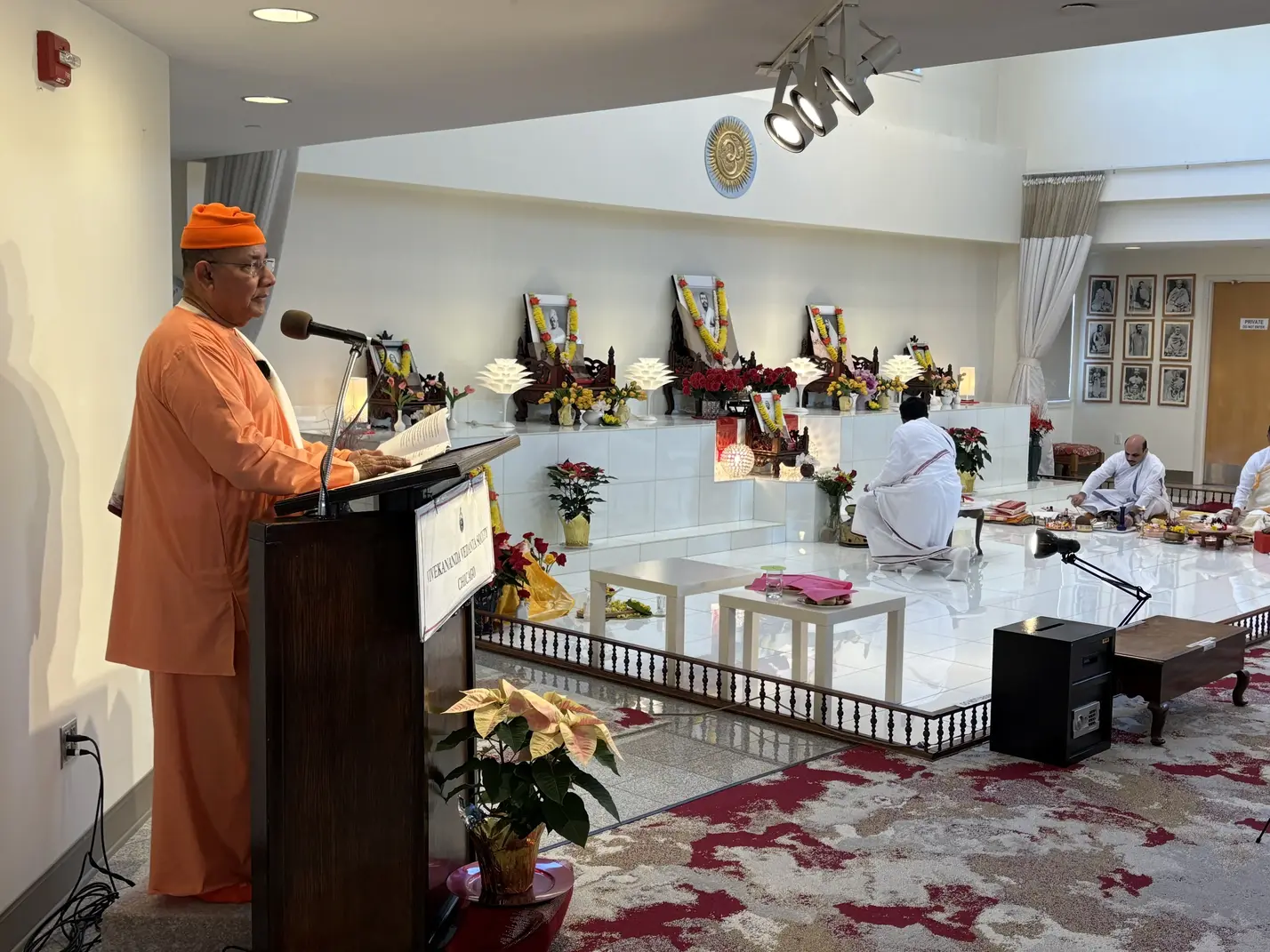
This is the spirit in which many devotees return again and again to the Kathāmṛta—the recorded conversations and presence of Sri Ramakrishna. These pages are not merely biography. They feel like a living manual: intensely human, yet mysteriously luminous. People come to it from very different paths, and still find their own guidance reflected there.
A scripture that speaks to both renunciation and responsibility
One striking idea repeated in the talk is this: Sri Ramakrishna belongs to everyone. Renunciates read the Kathāmṛta and feel their courage rise. They hear the call of detachment—the world is temporary; do not cling. Householders read the same lines and feel something different: not an urge to flee life, but an urge to sanctify it. They return to work, family, and duty with renewed clarity, wanting to offer their effort as service.
This balance is not accidental. Sri Ramakrishna stands in a rare position—deeply rooted in the world, yet free from it. He could speak to the monk and the merchant without diluting truth for either. It is as if he held two apparently opposite directions in one steady gaze: the pull toward renunciation, and the call to serve while living in society.
This harmony echoes an old Upanishadic vision: cover everything with the presence of the Divine, then live in such a way that your actions do not bind you. The message is not “stop acting,” because no one can live without action. The message is: act, but do not let action become chains.
The paradox of effort and grace
A common spiritual confusion arises when people hear that everything happens by the Divine will. If even a dry leaf cannot fall without God’s permission, then why do anything? Why strive, plan, work, or struggle?
The teaching offered here is subtle and practical. Total surrender is possible, but it is rare and demanding. It resembles the trust of a tiny infant—completely dependent, not pretending independence, not secretly holding on to control. If that level of surrender is real, then the burden of anxious doing falls away.
But for most people, both effort and grace operate together. The talk uses Sri Ramakrishna’s own life to show this clearly. At times he moved like someone carried by the Divine—asking the Mother, receiving an inner command, and following it without doubt. At other times he struggled with all the intensity of a human heart—longing, crying, refusing to settle for anything less than direct realization.
This is not contradiction. It is the human journey. We strive because we must, and grace arrives because we cannot complete the journey by effort alone. Spiritual life becomes mature when we stop turning this into an argument—“only effort” versus “only grace”—and start seeing it as a living relationship: we offer our sincere work, and we accept what comes as the Divine response.
“Mine” is the root of bondage
When business-minded devotees come to meet Sri Ramakrishna, the conversation naturally touches worldly life. The talk highlights a key warning: the problem is not activity itself, but the psychology of possession—my, my, my. When everything becomes “mine,” bondage grows stronger.
This is not a moral lecture. It is a diagnosis. “Mine” tightens the mind. It turns work into anxiety, success into arrogance, failure into bitterness, and relationships into fear. It makes life heavy because it forces the ego to carry what it cannot hold forever.
The speaker explains this with a powerful image: a stone repeatedly struck and worn down becomes pebbles, then sand, then eventually merges into the ocean. Everyone will merge one day; the question is how long it takes—how many collisions, disappointments, and cycles of suffering must occur before the mind becomes soft enough to let go. Spiritual practice is offered as a way to shorten that painful journey, not through denial of life, but through purification of intention.
The ethical tension in worldly professions
A major section of the talk deals with a very uncomfortable truth: certain professions—especially business—can tempt people toward distortion. In many marketplaces, sellers survive by exaggeration, by sweet talk, by hiding flaws, by manipulating scarcity, by presenting “A” in the showroom and delivering “B” afterward.
The talk does not claim that commerce is evil. It recognizes that business has legitimate costs: materials, transportation, labor, and fair profit. That is not the issue. The issue is deception and the inner damage it causes.
A vivid story illustrates this: a truthful young person, trained in an ashram’s discipline, stands behind a manager who is trying to raise prices by claiming shortage. The young man blurts out the truth: “There’s plenty in stock.” The manager later complains that he cannot “do business” with such honesty nearby.
This story is humorous, but it points to something serious: when deception becomes normalized, truth appears “impractical.” Yet spiritual life insists that truth is not optional decoration—it is the foundation of inner freedom. Without truth, devotion becomes performance, charity becomes calculation, and worship becomes a mask.
Why some offerings are accepted and others are refused
The talk offers a striking spiritual principle: not every gift is spiritually equal. Two people can offer the same sweet, the same fruit, the same donation—yet the inner result differs, because intention differs.
Sri Ramakrishna is described as sometimes refusing lavish offerings from wealthy devotees while accepting small offerings from someone poor. The reason is not social status; it is inner purity. A gift offered with hidden motive—fear, bargaining, ego, or the desire to “buy protection”—carries its own subtle weight. To accept it is to participate in its moral atmosphere.
This is difficult for ordinary minds to measure. Most of us cannot read intention cleanly, either in ourselves or in others. But the teaching still matters: we should watch our own motive when giving, and we should not assume that external generosity automatically means spiritual sincerity.
The talk uses mythic examples to make the point sharper: the same Divine presence can bless one person with joy and burn another with consequence, depending on the heart’s orientation. Devotion is not merely what is offered; it is how it is offered.
Symbolism that trains the mind
A beautiful part of the discourse explores Hindu symbolism—not as superstition, but as psychological training. Ritual gestures, temple forms, and traditional acts often encode deep inner lessons.
Consider the image of Jagannath: wide eyes without eyelids. To some outsiders it looks peculiar. To a contemplative mind it becomes profound: the Divine sees everything—steadily, without blinking. The “lack of limbs” becomes a teaching too: the Divine is everywhere; movement is unnecessary. Action happens by will, not by physical limitation. And the stance of witness—always watching—reminds us that nothing is truly hidden.
The talk also mentions funeral symbolism, such as water poured from a pot with a small hole while circling the body. This becomes a lesson on karma: what we have accumulated is left behind. It cannot be carried into death. The ritual presses a truth into the mind that we otherwise avoid: your possessions, your achievements, your social identity—none of it follows you. What remains is character and consequence.
Even temple water offerings can become a living warning: if you “offer” your deeds to God, you must consider what you are offering. If the deed is harmful and you are trying to wash it away with ritual, the ritual becomes hypocrisy. Symbolism is meant to awaken honesty, not replace it.
Spiritual progress is gradual—like business growth
One of the most practical teachings in the talk is the insistence on gradual progress. People often want spiritual life to be dramatic: instant transformation, extraordinary visions, quick results. But the tradition repeatedly says: real change matures slowly.
The talk uses an everyday analogy: business growth. A person might begin with a small enterprise—something modest—and then, as resources grow, move into larger ventures. Rarely does someone become established overnight. Similarly, spiritual life usually progresses step by step: a little prayer, a little discipline, a little self-restraint, a little deeper silence.
This teaching also protects people from discouragement. If we expect instant perfection, we collapse when we fail. If we accept gradual progress, we learn to keep walking.
The talk adds another important nuance: solitude has its place. Occasionally, one must step away—go into “seclusion,” not necessarily a forest, but a space where the mind is not constantly pulled by social identity, distraction, and habitual noise. Solitude is not escape; it is recalibration.
“Time must come”: ripening cannot be forced
Perhaps the most emotionally honest teaching offered is this: “Until the time comes, nothing happens.” This is not fatalism; it is a recognition of inner ripening.
Just as a medical condition cannot be treated properly before it matures, spiritual awakening also cannot be forced prematurely. Some people turn inward early; others take longer. Some carry heavy karmic burdens, suffering repeatedly, learning slowly. Others move with fewer obstacles. The point is not comparison. The point is endurance.
The talk references a poetic image of two journeys: one path is decorated with flowers, another is full of pain—yet both lead to the same destination. The instruction is simple: do not stop. The pain is not proof of failure; it can be the process of purification.
The danger of spirituality without integrity
Another theme is the rejection of hypocrisy. Saying lofty words while living contrary to them is not merely a moral flaw; it damages society’s trust in religion itself.
The talk mentions people who speak of non-dual realization while living with obvious contradiction—using spiritual language as a display rather than a transformation. The warning is strong: when religion becomes costume and performance, it ruins both the individual and the community.
This is why the talk repeatedly returns to the same foundation: truthfulness, simplicity, sincerity. Without these, even sacred practices become hollow.
The simplest practice: remembrance of the Divine Name
After exploring complex moral and philosophical issues, the talk returns to an almost shockingly simple instruction: remember the Divine Name—always.
This is not meant as mechanical chanting while continuing harmful behavior. The warning is explicit: do not use devotion as a cover for wrongdoing. Instead, bring the Name genuinely into the mind so that it reshapes thought, speech, and action.
The talk gives a vivid example: when you have pain in the body, even while doing other tasks your mind keeps returning to the painful spot. In the same way, remembrance should become natural—an inner leaning that continues while you work, speak, and move through life.
Name-remembrance is not only repetition; it is relationship. It is an attempt to live with awareness of the Divine presence near, within, and around us—closer than breath.
What “God-realization” really means
A major correction offered is about the meaning of spiritual experience. Many people assume that realization must look like visions, voices, and extraordinary events. Such experiences may occur, but they are not the definition of realization.
The talk insists that realization is transformation. When the Divine becomes real, the person changes: fear loosens, selfishness softens, love expands, and character becomes steady. The inner fruits—compassion, purity, courage, selflessness—are more reliable than dramatic experiences.
An elegant metaphor makes the point: when a flower blooms, it does not need to invite bees; they come on their own. In the same way, if someone is truly transformed, they do not have to advertise their spirituality. The fragrance becomes visible through conduct.
Sri Ramakrishna as the “searchlight” of human potential
The talk paints Sri Ramakrishna as both playful and transcendent—someone who could joke, eat sweets, and laugh with devotees, and then enter deep absorption in the same moment. This is presented not as theatrical display, but as a revelation: the divine is not separate from the human. The human is capable of becoming transparent to the divine.
That is why his life functions like a searchlight. It shows the hidden possibility inside ordinary existence: a life where work becomes worship, where sincerity defeats hypocrisy, where truth remains steady, and where devotion is not a mood but a direction.
Providence in daily life: recognizing quiet miracles
The discourse also offers stories of unexpected help arriving at the right moment—transport appearing when needed, food being offered by strangers, support coming without planning. These stories are not meant to create superstition or dependence. They are meant to awaken gratitude and attention.
Often people say, “I haven’t seen God.” But when we look carefully, our lives are full of small providences: timely assistance, unseen protection, the right person appearing, the right door opening. The talk suggests that the real tragedy is not lack of divine presence but our forgetfulness.
Yet it also reminds us: the Divine does not merely give “vegetables and fruit”—the ordinary comforts. The deeper gift is “nectar”: liberation, inner freedom, and the unfolding of love.
A disciplined hope for the new year
Near the end, the tone becomes tender and practical. There is a blessing for health and well-being, an emphasis on patience rather than panic, and a reminder to practice safety and care in public life. Spirituality is not separate from responsibility; it expresses itself through wise behavior.
There is also a gentle, realistic suggestion about daily practice: do not set goals so extreme that they collapse. Instead, increase gradually. If you chant a certain number daily, add a small amount step by step. Spiritual ambition must be guided by compassion for one’s real capacity.
This is the kind of instruction that makes the talk feel intimate: it does not demand impossible heroism. It encourages steady sincerity.
Conclusion: A path that is honest, gradual, and alive
The heart of the message can be held in three simple movements.
First, live truthfully. Devotion without integrity is fragile and harmful. Truth is not merely a rule; it is a medicine that makes the mind clear.
Second, progress gradually. Whether in work or worship, maturity grows step by step. Seclusion and silence have their place, but they must support life, not replace it.
Third, remember the Divine always—not as a performance, but as a real inner turning that reshapes speech, intention, and action.
Sri Ramakrishna’s genius is that he does not force everyone into one uniform path. He offers a living spirituality that can hold both the monk’s renunciation and the householder’s responsibility. He teaches that the world is temporary—but also that life can be offered as service. He exposes hypocrisy—but also gives the simplest remedy: sincere remembrance.
In uncertain times, such teaching becomes even more relevant. It reminds us that the real work is internal: purifying motive, strengthening love, anchoring truth, and learning to act without bondage. When that work continues, even a disrupted world cannot disrupt the soul’s journey.
May that journey be steady. May practice be sincere. May truth be protected. And may remembrance deepen until work itself becomes worship.
You will get Vedanta updates in your inbox.
Occasional reflections on Vedanta. Unsubscribe anytime.