Gospel of Sri Ramakrishna: Swami Ishatmananda on the Meeting with Vidyasagar
Swami Ishatmananda recounts Ramakrishna–Vidyasagar meeting, revealing seven Jnana Yoga stages toward liberation for seekers.
“তব কথামৃতম তপ্ত জীবনম…” — the nectar of sacred words cools the fever of life. In this Bengali lecture at Banga Bhavan (Glendale Heights, Chicago), Swami Ishatmananda guides listeners through a vivid section of Sri Ramakrishna Kathamrita (The Gospel of Sri Ramakrishna): the conversation at Ishwar Chandra Vidyasagar’s home. The Swami’s style is practical and piercing—he does not treat the Gospel as distant history or abstract theology. Instead, he shows how Sri Ramakrishna’s lines are mirror-sentences: words that repeatedly match what we ourselves experience—aging, attachment, fear, pride, loss, and the strange way the heart keeps searching for shelter.
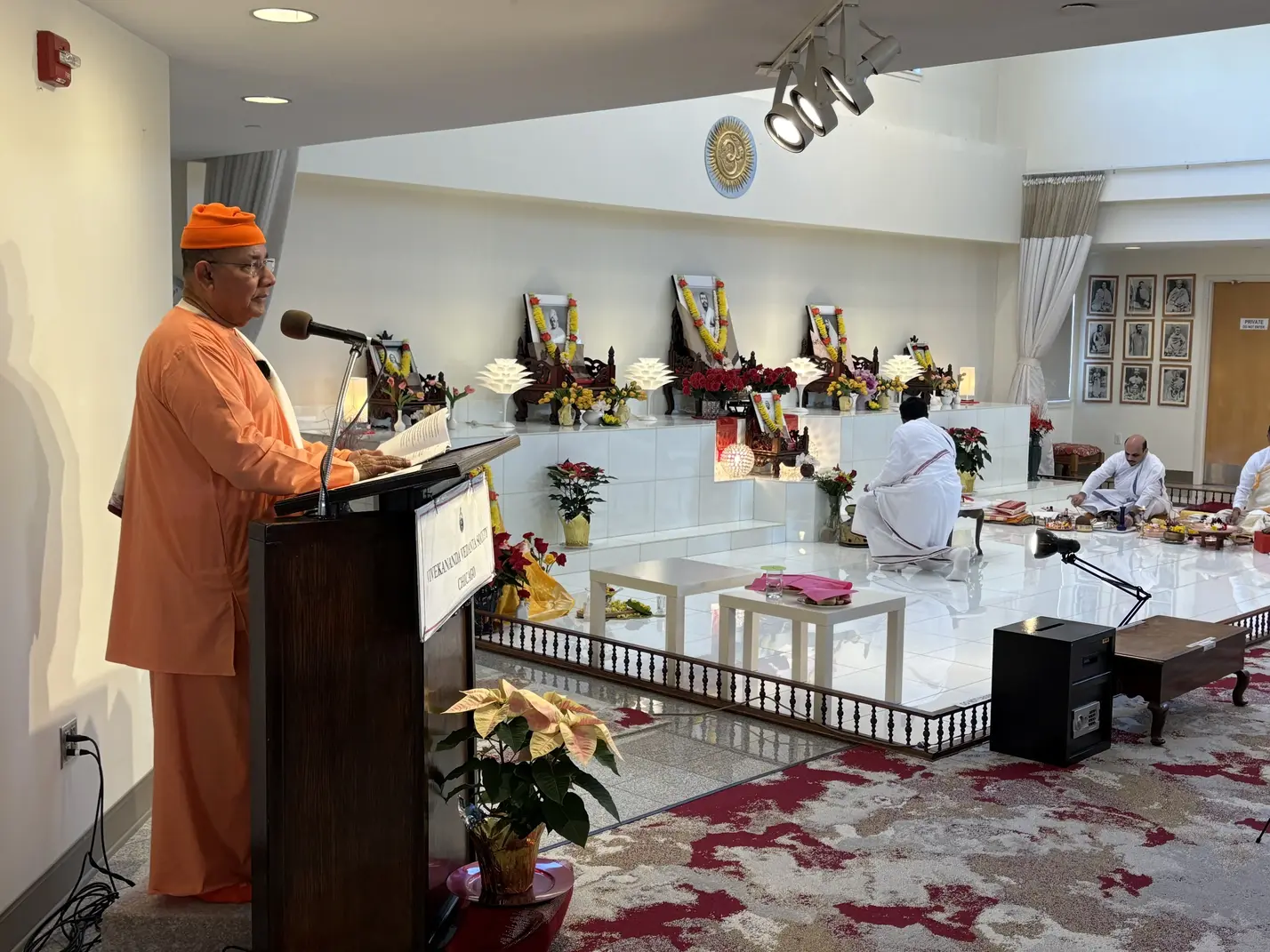
The talk moves through a few central pillars: the pain of worldly life when seen clearly, the meaning of “I” and “mine” as ignorance, the role of holy company, the liberating discipline of remembering death (not as fear, but as truth), the idea of this world as a workplace where we must act without bondage, and finally the power of faith and devotion as the most natural bridge to God.
1) When the World’s Suffering Becomes Visible, Religion Opens
Swami Ishatmananda begins by recalling Sri Ramakrishna’s ongoing theme: if you truly observe worldly life, you eventually see that its suffering has no end. He mentions Sri Ramakrishna’s striking example of the cow—how even after a lifetime of labor, it is not left in peace after death. The point is not cruelty as spectacle, but impermanence and exploitation as a pattern: the world constantly takes, constantly changes, and rarely offers lasting security.
The Swami links this to a psychological truth: until a person feels the world’s instability deeply, “religion” doesn’t naturally arise in the mind. When we are intoxicated by youth, strength, and momentum, the soul stays half-asleep. But when life begins to show its changing nature—health shifts, energy declines, breath shortens—then a person starts knocking at the door of dharma.
He frames this using a verse from the Bhagavad Gita: Krishna says four kinds of people worship Him—ārta (distressed), arthārthī (seeking worldly gain), jijñāsu (curious/inquisitive), and jñānī (the wise knower). In the Swami’s explanation, the “jñānī” is not merely someone who knows books; it is someone who has gained a mature realization: the world is always changing. That realization is often born from experience—aging, disappointment, loss, or simply the unstoppable drift of time. It begins as surprise (“How did this happen?”) and later becomes acceptance (“This is how life is.”). But once the impermanence is seen clearly, the heart asks: Then what should I do with this life?
That question is the turning point. It is the beginning of real spiritual life.
2) Sadhu-sanga: Why the Seeker Runs Toward the Holy
Once the door of dharma begins to open, the seeker instinctively looks for someone who has walked further—someone who practices. The Swami names this plainly: sadhu-sanga (holy company). To go to a sadhu is to go to someone who has already tasted the world’s emptiness and therefore no longer burns with worldly obsession.
Swami Ishatmananda emphasizes that spiritual progress is not random. A person who starts early in this life often carries saṁskāra—spiritual impressions from previous striving. Some move slowly, some quickly, and some seem to avoid the inner path altogether until life forces them. But the Hindu vision is patient: a person is not “lost forever.” If not now, then later; if not in this birth, then in another.
He illustrates this with the idea (mentioned in the lecture) that Buddha progressed across many births—gathering inner momentum until awakening became inevitable. Likewise, Krishna says that a sincere spiritual striver is not wasted: even if someone “fails” in one lifetime, they will be born in conditions where the journey resumes from a higher starting point—“সুচি নাম শ্রীমতাং গেহে যোগভ্রষ্ট বিজায়তে”: the one who falls from yoga is born again in favorable circumstances.
This is comforting and demanding at once: it means spiritual effort is never wasted, but also that postponing “later” is risky—because later can become a habit.
3) “I” and “Mine”: Sri Ramakrishna’s Definition of Ignorance
The Swami then lands on one of Sri Ramakrishna’s most famous, sharp definitions:
Ignorance (ajñāna) is “আমি” and “আমার”—“I” and “mine.”
“My house, my money, my learning, my status, my power…”
Swami Ishatmananda acknowledges that this is hard to digest. A listener may protest: “If it is my money, what else should I call it?” Sri Ramakrishna is not asking you to lie about ownership in a social sense. The issue is attachment—the inner clenching that turns objects into identity and identity into pride and fear.
To make it concrete, the Swami shares a modern illustration: financial fraud calls. A person loses money and suffers intensely because they cannot honestly say, “It’s not mine.” The grief reveals the depth of attachment. The Swami adds humor and realism: he was also called, but he already knew about such scams; he answered differently and the scammer quickly disappeared. The lesson is not about cleverness—it is about how much inner suffering comes from the tightness of “mine.”
Then he introduces a deeper Vedantic angle through an example connected to Swami Vivekananda. When Vivekananda told Rockefeller to give charity, the wealthy man asked, “Why should I give? I earned it with my intelligence.” Swami Vivekananda’s implied response (as presented in the talk) is razor-clear: what if tomorrow morning that intelligence is not there? If the brain, memory, or capacity suddenly collapses—then what remains of pride? The point is not to shame achievement; it is to loosen the illusion that we are permanent controllers.
So Sri Ramakrishna’s remedy is not merely “renounce the world,” but replace the inner posture:
- Ignorance: “I am the owner; everything is mine.”
- Knowledge: “O Lord, You are the doer; these are Yours—home, family, children, friends.”
This shift is spiritual oxygen. It makes the mind lighter without abandoning responsibilities.
4) The Quiet Practice Everyone Avoids: Remember Death
A powerful moment in the lecture comes when Swami Ishatmananda addresses a teaching many people try to avoid:
Sri Ramakrishna says we should remember death.
At first, this sounds frightening. People fear hospitals, doctors, diagnoses—anything that reminds them of mortality. But the Swami clarifies: this is not about panic, pessimism, or acting as if death is “immediately coming.” It is about anitya-bodha—the wisdom of impermanence.
When you remember that you are here temporarily, ego loses heat. The Swami gives a simple example: when you are traveling and know you’ll leave in an hour, you don’t fight intensely about small things. You think, “Let it be.” That same perspective, brought into everyday life, reduces unnecessary conflict.
Remembering death becomes a spiritual disinfectant: it prevents arrogance and reduces obsessive ownership. It teaches you to use life wisely, because you feel time as real—not theoretical.
5) We Are Daily Passengers: The World as Workplace, Not Home
One of the lecture’s most memorable portions is Sri Ramakrishna’s analogy (as explained by the Swami): the daily passenger who comes from a village to Kolkata for work.
The passenger may spend years commuting, gaining a role, building routine, even speaking proudly. But the real “home” remains elsewhere. The commuter comes to the city to do a job and then returns.
Swami Ishatmananda expands this: we too have come here to do certain works (কয়েকটি কর্ম করতে আসা) and then we must return to our original place. This world is karmabhūmi—a field of action. We are not meant to become hypnotized by status and performance.
Sri Ramakrishna gives an even sharper illustration: the manager of a rich man’s garden. When visitors come, he says, “This is our pond, our garden.” But if the owner dismisses him, he cannot even take his cheap mango-wood box. A gatekeeper will stop him. The Swami underscores the sting: we call so much “mine,” yet we may leave with nothing—not even the smallest box.
Then he points to modern ego-display: some people will not open their own car door; they wait for a driver to run and open it so they can step out “with style.” The Swami’s question is devastatingly simple: what is the value of that pride? If the truth of impermanence is seen, the glamour collapses.
The takeaway is not “do nothing.” It is the opposite: work must be done, and the Gita also insists: without work, there is no freedom. But the work must be done in the right spirit—as offering.
6) “Do Work, But Be Unbound”: Karma Yoga in One Line
Swami Ishatmananda connects Sri Ramakrishna’s teaching with the Buddha’s Four Noble Truths and Vedanta’s view of bondage. Different languages, same structure:
- This world has suffering.
- There is a cause of suffering (bondage/attachment).
- Freedom is possible.
- There is a path.
Sri Ramakrishna’s practical solution, as presented in the lecture, is beautifully compact:
Do your work, and offer it to God.
Not laziness. Not escape. Not moral performance for applause. But work without ownership—niṣkāma spirit, offering-buddhi. The Swami says this is the entire religion in essence: do what you must do, but place the “doer-ship” and the “fruit” at the feet of God.
To illustrate, he narrates a moving story forwarded to him: a woman in Maharashtra who suffered severe cruelty from birth, endured abuse, survived an attempted murder, and then experienced a turning point: she was “supposed to die,” but did not. In that moment, the bondage broke. She decided to live for others—especially abandoned children. Through service, her life transformed; respect and support came. The moral the Swami draws is classical and paradoxical:
When you cling, you suffer; when you let go, life opens.
“When you give everything away, you receive everything.”
It echoes Sri Ramakrishna’s repeated emphasis: renunciation is not always external; it is primarily inner detachment.
7) God Laughs at Two Human Sentences
Sri Ramakrishna’s humor carries philosophical depth. Swami Ishatmananda repeats two lines that make God “laugh”:
1) When a doctor says to a mother: “Don’t worry, I will save your son.”
God laughs because the doctor forgets: Who is the true doer?
2) When two brothers divide land and say: “This side is mine, that side is yours.”
God laughs because the universe belongs to Him, yet humans fight over small lines.
These are not jokes for entertainment; they are spiritual medicine. They expose arrogance gently, without hatred. Sri Ramakrishna’s genius is that he uses situations everyone recognizes. That is why the Kathamrita feels intimate: as soon as you hear it, you remember your own life and say, “Yes—this happens.”
8) Why Bhakti Is Natural: “Use the Surrender Already Inside You”
A key turn in the lecture arrives when Swami Ishatmananda explains why Sri Ramakrishna emphasizes surrender—especially while speaking to Vidyasagar, a man known for rational inquiry.
Sri Ramakrishna asks, in effect: Can God be known by argument alone?
Scriptures say: the Self is known to the one whom It chooses—often interpreted as grace. Shankaracharya also says three things are rare and come by divine favor: human birth, desire for liberation, and refuge in a great soul.
The Swami’s practical point is this: even if the path of inquiry is true, it is often difficult. Many people cannot sustain it. They become sleepy, postpone, or intellectualize without transformation. So why not take the path that matches human nature?
Every person has an instinct: “I need someone I can open my heart to.” That dependence is already present. Sri Ramakrishna says: if that instinct exists, and God created you, then use it—turn that need into surrender to God. Do not fight your own nature just to impress an idea.
Swami Ishatmananda offers a vivid analogy: a student attending an advanced math class sees symbols on the board and understands nothing. Yet the student sits, copies, and persists because of faith: “If I continue, I will understand.” Similarly, in spiritual life, you may not “feel” God immediately, but if you keep practice with faith, clarity eventually arrives. Faith here is not blind; it is disciplined trust in a proven path and a trustworthy guide.
He emphasizes two essentials:
- বিশ্বাস (faith/trust) — in the guru’s instruction and in the possibility of realization
- ভক্তি (devotion/love) — doing practice lovingly, not mechanically
When faith and devotion unite, Sri Ramakrishna says, God-realization does not delay.
9) Sri Ramakrishna’s Highest Power: Turning Philosophy into Living Experience
Near the end, Swami Ishatmananda highlights something extraordinary about Sri Ramakrishna: he does not merely speak; he transmits. After telling Vidyasagar that God is not attained by scholarship alone, Sri Ramakrishna becomes premonmত্ত (intoxicated with divine love) and begins to sing.
The lecture recalls the famous song themes: that many philosophical systems can point toward truth but cannot “take your hand” and lead you across; that yogic inner ascent speaks of energy rising from muladhara to sahasrara; that Omkara (pranava) is the primal proof of divine vibration. Whether one approaches through bhakti or jnana, Sri Ramakrishna’s method is to make God feel present—not as a theory, but as immediacy.
This is also why the Swami urges reading the Kathamrita with reverence and intimacy—opening it, taking notes, letting it enter the inner life. It is not a book “made up.” It is a record of direct realization expressed in human language.
Conclusion: Work, Offer, Surrender—And Let the Heart Become Light
Swami Ishatmananda’s lecture, rooted in the Vidyasagar meeting, ultimately teaches a complete spiritual cycle:
- See the world’s change clearly—then dharma becomes real.
- Seek holy company—because faith grows in living presence.
- Understand “I and mine” as attachment—then ego loosens.
- Remember death—not as fear, but as truth that cleans pride.
- Treat life as a workplace—do the necessary actions.
- Offer the work to God—so bondage does not form.
- Choose surrender and devotion—because it matches human nature and invites grace.
Sri Ramakrishna’s path is not complicated. It is intimate, practical, and direct. His words work like keys: they unlock the same doors again and again—until the heart stops clenching and begins to rest in God.
You will get Vedanta updates in your inbox.
Occasional reflections on Vedanta. Unsubscribe anytime.