How Sri Ramakrishna Kathamrita Trains the Mind for God
Kathamrita paints living scenes; practice name-with-qualities, satsang, solitude, and discernment to realize God.
There are books that inform, and there are books that transport. The Bengali spiritual classic Sri Sri Ramakrishna Kathamrita (known in English as The Gospel of Sri Ramakrishna) belongs to the second kind. It does not merely state ideas about God, devotion, and inner life. It makes you see them.
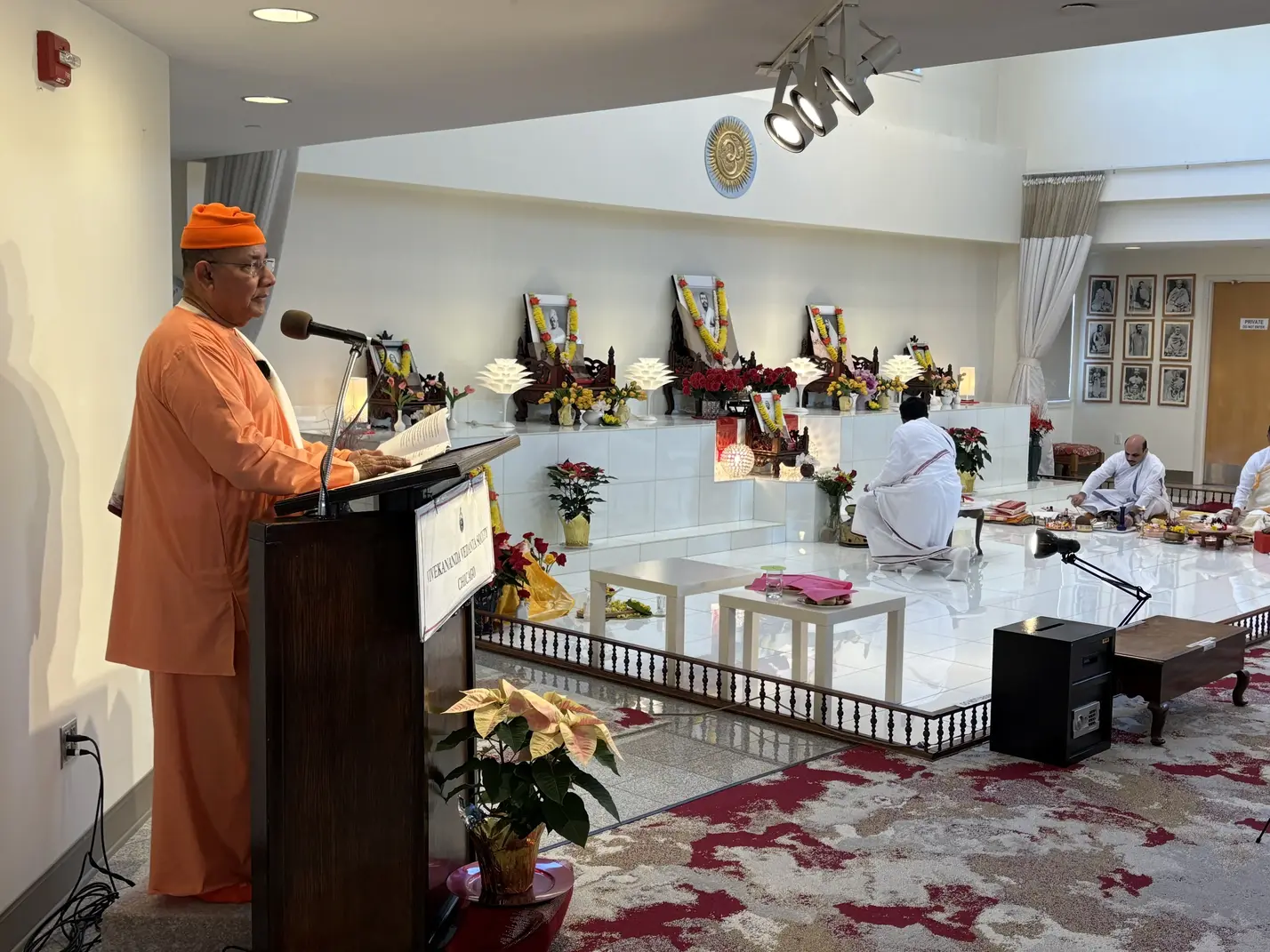
The discourse behind this essay highlights a simple but profound claim: the Kathamrita has a special power because it draws a living picture with conversation. Through everyday dialogue—who entered the room, where Sri Ramakrishna was seated, which way he faced, how the Ganga flowed nearby—the reader is pulled into a scene so vividly that the mind naturally begins to meditate.
And that matters, because for many people the hardest spiritual work is not philosophy; it is attention. The mind does not stay where we want it to stay. It drifts, worries, compares, judges, plans, and replays. In that restlessness, even sincere seekers ask the same question Master Mahashay asked: How does one keep the mind on God?
This essay explores the answer offered through Sri Ramakrishna’s teachings—an answer that is practical, psychologically sharp, and deeply compassionate.
1) The Historical Scene That Becomes a Meditation Object
A striking feature of the Kathamrita is its “historical feel.” It is not written like a distant scripture floating above time. It is grounded in place and moment. Sri Ramakrishna is not described as an abstract symbol. He is pictured sitting in a room at Dakshineswar, facing a direction, with the river nearby. People arrive, sit, speak, smile, ask questions, and receive replies.
This detail produces two effects:
-
It preserves a living record. We meet real people with real personalities—educated householders, young men with pride, seekers with longing, devotees with doubts.
-
It gives future readers a ready-made meditation form. Later generations who want to contemplate the divine can “see” the entire scene with the mind’s eye.
A suggested practice emerges from this: before you read the dialogue, pause. Imagine the setting. Let the mind enter the room. Then read. After two or three pages, close your eyes and replay what you just “witnessed.”
Something subtle happens. You forget your present surroundings for a moment. Your mind is gently carried—almost without strain—toward the presence of the saint. This inner “transportation” becomes a purification. It is not dry concentration; it is a devotional recollection that makes the mind cleaner, softer, and more receptive.
2) Meeting the Guru: Not a Theory, a Turning Point
Master Mahashay’s relationship with Sri Ramakrishna evolves rapidly. After the first meeting, he does not merely admire a holy man. He begins to recognize a guru—a spiritual guide whose role is to bring the disciple to God.
But what does that actually mean?
A common assumption is that God is a distant object: something we must travel outward to find, like a hidden treasure far away. The teaching here reverses that. God is not “out there” as an uncertain object that may or may not exist. God is eternal—not something that becomes real only when we manage to “know” Him. The problem is not God’s absence; it is our blindness.
The language used is vivid: ignorance is like dense darkness. In the dark, a treasure can lie right beside you and still feel nonexistent. The guru’s task is like lighting a lamp—the lamp of knowledge. The moment light appears, you recognize what was already there.
So the guru “takes” the disciple to God by removing what blocks the vision. And what is the main block?
Ego.
3) The Guru Breaks Ego—Because Ego Is the Wall
In the account, Master Mahashay’s ego is not portrayed as crude arrogance. It is refined, respectable, and socially understandable. He is an M.A. graduate—at that time, a major accomplishment. Sri Ramakrishna, by contrast, appears outwardly simple: a temple priest with little formal education and a small income.
That contrast quietly creates an inner hierarchy in the educated mind:
- “I am trained.”
- “He is unlettered.”
- “Still, he is holy—so I will respect him.”
This is precisely the type of ego that can survive inside spiritual life: not loud, but persistent; not rude, but controlling.
The guru’s compassion is severe when necessary. In the text, Sri Ramakrishna shatters Master Mahashay’s pride more than once—not to humiliate him, but to free him. Because as long as ego stands, God appears distant. Ego creates separation: “I am the knower; God is what I will know.” When ego collapses, the wall collapses—and God is recognized as the ever-present reality.
4) “How Does the Mind Go to God?”—The Three-Part Answer
When Master Mahashay asks, “How does the mind go to God?” Sri Ramakrishna does not answer with vague inspiration. He gives a three-part method, and the emphasis is unmistakably practical:
- Name and qualities of God—always.
- Holy company (satsang).
- Occasionally, go into solitude and think of Him.
This is not a rejection of worldly duties. It is an instruction designed for people who live in the world but refuse to surrender their inner life.
Let’s unpack each element.
5) Not Only the Name—Also the Qualities
Many people repeat the divine name as a habit. The lips move; the mind remains unchanged. Sri Ramakrishna’s instruction is sharper: do not only chant the name—remember the One who bears the name.
Why? Because names can be borrowed. A label can be used by anyone. But a name plus the remembrance of qualities reshapes the heart.
When devotees love Sri Ramakrishna, it is not because of a title. It is because of what he embodies: simplicity, truthfulness, renunciation, tenderness, intense devotion, and spiritual certainty. When those qualities are held in memory along with the name, devotion becomes specific and transformative.
The practical logic is clear:
- If you remember truth, you begin to avoid falsehood.
- If you remember simplicity, you begin to drop manipulation.
- If you remember renunciation, you begin to loosen the grip of cravings and status.
- If you remember love of God, you begin to see God everywhere.
A helpful analogy was offered: grandparents often see a child and instinctively feel, “This looks like my grandchild.” The child may not actually be related. But the inner image is so strong that it overlays the outer world. Love does that. When the inner image of God becomes powerful through remembrance, the mind starts recognizing God-like presence everywhere—clouds, faces, moments, silence.
This does not happen in one day. It becomes “normal” through repetition: hearing, reflecting, practicing, and returning.
6) Satsang: The Company That Rewrites Your Habits
Spiritual company is not just social comfort. It is habit formation.
We become what we repeatedly hear, admire, and imitate. A group of students who constantly talk about music—melody, lyrics, rhythm, new compositions—gradually develops a musical mind. In the same way, those who spend time with sincere devotees, renunciants, or God-centered people slowly acquire a different default setting.
Satsang works through small corrections:
- “Why see it that way? See it this way.”
- “Why speak like that? Speak more gently.”
- “Why chase that desire? Look at what it costs.”
One example shared was maternal correction: a person speaks loudly and harshly, and later a wise elder warns, “If you keep speaking like this, it will become your habit. Wherever you go, you will feel compelled to speak in the same tone.” That is spiritual psychology: repeated expression becomes personality.
Sri Ramakrishna’s instruction is balanced. He does not say “abandon your responsibilities and stay with monks all day.” He says go sometimes. Household life has obligations. But without periodic contact with spiritual people, the mind is quickly swallowed by worldly patterns.
7) Solitude: Not Escapism—Training Dependence on God
The third instruction is solitude—again, sometimes, especially in the early stage.
Solitude is not only about going to a forest. It can also mean being in a place where nobody knows you, where you cannot rely on your usual supports, where the ego cannot perform. In such moments, the heart becomes honest. You feel helpless, and that helplessness can become prayer: “Only You can see me now. Only You can guide me.”
A story illustrates this vividly: a monk traveling without money arrives earlier than expected, and the people meant to receive him do not come. He sits for hours in a foreign airport, unable to communicate easily, with no clear plan. Yet he remains calm, because his trust is total: “If God brought me here, God will arrange something.” Eventually, an attentive person helps locate the hosts, and everything resolves.
This is not a recommendation to be reckless. The point is inner dependence. In solitude, the mind’s usual distractions fall away: no television, no constant messaging, no entertainment loops. The mind slowly settles into itself. In that quieter space, remembrance becomes easier.
Sri Ramakrishna compares early spiritual life to a tender sapling: it needs a fence. Without protection, goats and cows will eat it. Solitude and satsang are that fence.
8) “In Mind, in a Corner, or in the Forest”: The Real Place of Meditation
A famous line appears: meditate in the mind, in a quiet corner, or in the forest.
The teaching is almost humorous in its practicality. People sometimes say, “I cannot meditate because I have no forest.” The reply is clear: the first and closest option is the mind. If the mind is not trained, even a forest will not help. If the mind is trained, even an airport can become a place of practice.
This is an important correction. Spiritual life cannot depend on perfect external conditions. Waiting for ideal silence is a form of delay. The real discipline is to carry remembrance into imperfect conditions—travel, work, crowds, inconvenience.
A simple method: set a small goal.
- “I have a two-hour flight. Let me complete a certain number of repetitions.” Distractions will come: announcements, food service, movement. But the mind returns again and again. Over time, the returning becomes easier, and the inner current strengthens.
9) Discrimination: Permanent vs. Impermanent
Another key instruction is constant discernment: distinguish between the permanent and the impermanent.
Here the language can confuse people, because “good” and “bad” are often treated as moral categories. But the teaching points to something deeper: “the Real” as the unchanging, and the “unreal” as that which constantly changes.
Look around: grass grows and dries, bodies age, reputations rise and fall, pleasures appear and vanish. Even the sun changes. Everything in the observable field is impermanent. So what is permanent? The teaching answers: God, the eternal ground of existence.
This discernment is not cold. It is freeing. It slowly reduces addiction to what cannot be held. Like the great seekers in the Upanishads, one comes to see: possessions and achievements cannot provide lasting security. The hunger for the eternal becomes natural when the mind repeatedly notices the fragility of everything else.
10) How to Live in the World Without Being Bound by It
After asking how to fix the mind on God, Master Mahashay asks another question: How should one live in the world?
Sri Ramakrishna’s answer is famous and startling: do all duties, love your family, serve them with care—but inwardly know they are not your permanent possession.
At first this sounds harsh. But the meaning is not emotional neglect. It is realism. No matter how deep the bond, separation comes—through distance, change, or death. If the mind refuses to accept this, it breaks later. If the mind quietly remembers this truth early, it becomes prepared. Love becomes purer, less possessive, less anxious.
Two analogies clarify the attitude:
The maidservant in a wealthy house
She does all work sincerely. She even raises the master’s children with affection, calling them “my dear.” Yet inwardly she knows: “This is not my home. My true home is elsewhere.”
Likewise, live responsibly in the world, but keep the heart anchored in God.
The turtle in the water
The turtle swims in water, but its mind is “at home,” where its eggs are kept.
Likewise, perform worldly actions, but let the mind rest in God.
Sri Ramakrishna adds a warning: without devotion, worldly life becomes a tightening knot. With devotion, worldly life becomes a field of practice.
A classic Vedantic line captures it: the mind is the cause of bondage and liberation. Bondage is not defined by whether you have objects; it is defined by whether the mind clings. Liberation is not defined by whether you have responsibilities; it is defined by whether the mind remains free.
11) “Oil on the Hands”: The Final Image
The teaching concludes with a memorable Bengali proverb-like instruction: break the jackfruit after oiling your hands.
Jackfruit is sticky. If you handle it carelessly, everything becomes messy. But with oil, you can cut it cleanly.
Worldly life is like that jackfruit: sticky with attachment, pride, grief, and craving. You may have to handle it. But if your inner life is “oiled” with remembrance—name and qualities, satsang, solitude, discernment—then duties can be performed without becoming trapped.
A Simple Practice Plan Inspired by the Teaching
If you want to apply this teaching concretely, try the following:
-
Daily scene-meditation (5 minutes):
Read a short passage of Kathamrita. Pause. Visualize the room, the people, the dialogue. Close your eyes and replay it. -
Name + quality remembrance (throughout the day):
Choose one divine quality—truth, simplicity, compassion, renunciation—and remember it with the name. -
Weekly satsang (even occasional):
Spend time with sincere devotees or spiritual material that elevates your language and habits. -
Short solitude intervals:
Even 20–30 minutes without screens or conversation, with quiet repetition and prayer, can reset the mind. -
Discernment practice:
When a desire rises, ask: “Is this permanent or impermanent?” This question alone weakens many chains.
Closing Thought
The deepest promise in this teaching is not that life will become free of struggle. It is that the mind can become free even while life continues. The Kathamrita does not only teach devotion; it gives a method to train attention, soften ego, and make God-remembrance natural.
When that training ripens, the world remains the world—work remains work, family remains family, joys and sorrows still arrive—but the heart carries a different center of gravity.
And that, in the end, is what it means for the mind to “go to God”: not by traveling somewhere else, but by removing the wall within, until the eternal Presence—already here—becomes unmistakable.
You will get Vedanta updates in your inbox.
Occasional reflections on Vedanta. Unsubscribe anytime.