Kathamrita: The Gospel as a Living Conversation
Sri Ramakrishna’s Gospel simplifies profound philosophy through stories, urging sincere faith, transformation, and inclusive harmony.
Every spiritual tradition has two parallel lives. One is the formal life of philosophy and theology—precise terms, careful definitions, and difficult arguments. The other is the lived life—how real people actually understand truth when they are tired, confused, tempted, grieving, or trying to be kind in a messy world. The enduring power of Sri Sri Ramakrishna Kathamrita (often called The Gospel of Sri Ramakrishna) is that it belongs completely to the second life while still carrying the depth of the first.
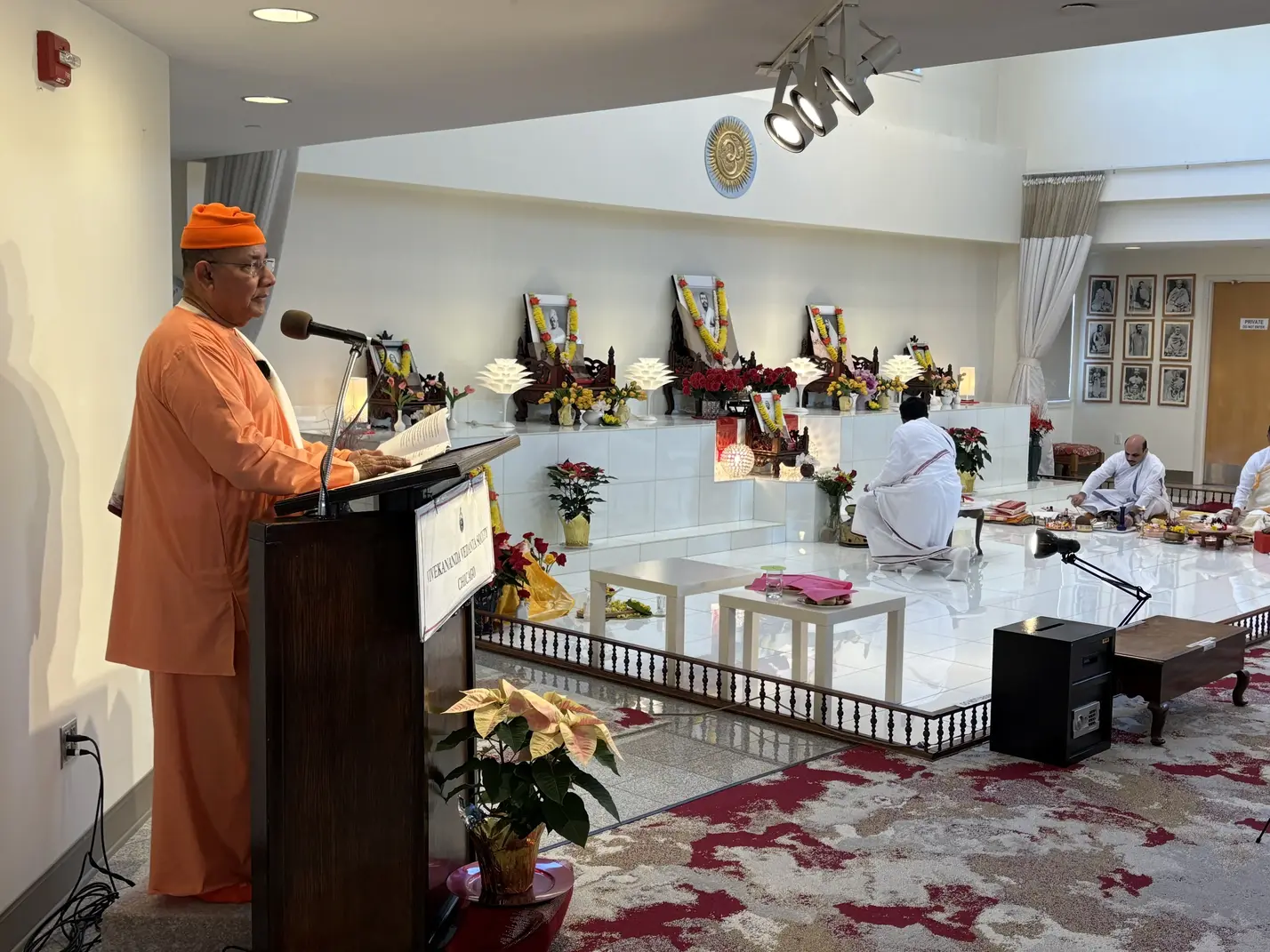
In many gatherings, the reading begins almost like a weekly appointment with the soul: meet on a fixed Sunday, read slowly, and discuss one passage rather than chasing many topics. The method itself is a teaching. It says: “Don’t rush. Let one idea settle. Let one story work on you.” Because the distinctive genius of the Gospel is repetition with variety—Sri Ramakrishna returns to the same truth again and again, but through different images, different moods, and different audiences, until something finally lands in you.
A student might ask, “Why say it so many times?” But human understanding is not a single click of the mind; it’s more like dye soaking into cloth. One example grips the intellect; another touches the heart; a third changes behavior months later when life cornered you and you needed a steadying voice.
A Doorway into Philosophy Without Jargon
Consider one of India’s most demanding frameworks: Sāṅkhya, with its foundational distinction between Purusha (pure consciousness) and Prakriti (nature, the active field of change). This idea can feel abstract, academic, and distant. Yet Sri Ramakrishna explains it with a home scene so ordinary it feels almost humorous: the “master of the house” and the “mistress of the house.”
In the metaphor, the householder appears to do nothing—yet authority is said to rest with him. The mistress runs the household—she is activity itself. In modern homes the roles may invert, but the point remains: one principle is stillness and witnessing, the other is power and motion. Prakriti does the work; the power belongs to the Lord.
Then he points to an image countless devotees already know: the iconography of Kali standing upon Shiva. Shiva lies like a corpse—no activity, no movement—yet he represents pure consciousness and the clarity of knowledge, symbolized by his luminous whiteness. Kali is dynamic energy: creation, preservation, transformation. What philosophers present as a difficult metaphysical theory becomes, in his hands, something you can recognize at a glance in a temple image.
That is the Gospel’s method: translating complexity into intimacy. It does not dilute depth; it carries depth into the language of everyday life.
The Difference Between Being “Learned” and Being “Awakened”
The Gospel also delivers a sharp warning: scholarship is not realization. Many can quote scripture, deliver eloquent discourses, and perform persuasive religious theater. It can impress crowds—especially when paired with costume, music, and social charisma. Yet Sri Ramakrishna directs attention away from performance and toward inner transformation.
There is an old saying often repeated in spiritual circles: you can become a parrot by reading books. A parrot can reproduce the sounds perfectly; it can even appear wise to a casual listener. But parroting is not knowing. Knowing, in the spiritual sense, is a change of being—humility replacing ego, compassion replacing cruelty, truthfulness replacing manipulation, steadiness replacing restless hunger.
When religious speakers later fall into scandal, it damages more than their reputation. People begin to doubt the spiritual path itself. The tragedy is not that religion is false, but that imitation has been mistaken for attainment. The Gospel’s corrective is simple: ask not how well someone speaks, but how deeply they have practiced and how purely they live.
New Times Require Living Understanding
Sri Ramakrishna also makes another subtle point: methods must be appropriate to time and context. He uses a striking image from the colonial era: “Nawab-era currency won’t work in Company-era markets.” A coin may have been valid in one regime but becomes useless when the system changes. The insight is not about rejecting tradition; it is about understanding what is timeless and what is adaptable.
In Indian thought, this difference appears as shruti and smriti. Shruti—the deepest spiritual insight—is unchanging: the reality of the Self, the ground of consciousness, the origin and support of all existence. Smriti—the remembered, interpreted cultural forms—changes with time: social rules, external customs, even certain practices shaped by historical contexts.
A striking example is language itself. In one period, speaking a foreign language for religious teaching might have been seen as taboo. Later, teachers like Swami Vivekananda spoke in English to communicate spiritual truth across cultures. What mattered was not the language but the sincerity, clarity, and universal reach of the message.
The Gospel does not trap you in the past; it trains you to seek the spirit behind forms.
A “All-Embracing” Teacher Who Refuses to Exclude
One of the most beautiful descriptions of Sri Ramakrishna is that he offers an “all-devouring embrace.” He does not discard people for being imperfect. He does not tell the skeptic, “Leave.” He does not tell the sinner, “You are unworthy.” He finds a way to begin from where the person truly stands.
When someone says, “I don’t even believe in God—how can I pray?” his answer is startlingly practical: pray like this—“O God, if You exist, please hear me.” That single sentence respects the person’s honesty while opening a door.
This is spiritual realism. Many religious environments demand certainty before entry. Sri Ramakrishna allows entry through sincerity. Even doubt can become a form of prayer if it is humble and earnest.
This is why so many different kinds of people—monks and householders, believers and doubters, the “respectable” and the socially criticized—found themselves drawn into his circle. He did not teach by protecting his purity from people. He taught by transforming people through love and truth.
The Girish Ghosh Lesson: Radical Surrender Without Pretending
Among the most dramatic examples is the story of Girish Ghosh—talented, turbulent, and not at all “religious” in the conventional sense. He admits his limitations honestly: he cannot maintain regular practices, cannot control his habits, cannot present a saintly image.
Sri Ramakrishna does not demand hypocrisy. Instead, he offers a kind of spiritual contract: give your whole responsibility to God with complete sincerity. Not partially. Not politely. Completely.
This is not a lazy excuse to do anything. True surrender is not permission; it is accountability transferred to a higher truth. If someone can genuinely say from the heart, “Lord, I am Yours; I have placed myself in Your hands,” the mind begins to change. The conscience becomes sharper. Inner guidance becomes louder. What was once an impulsive life begins to feel supervised from within.
In the Girish narrative, the evidence is not miraculous visions. The evidence is moral transformation—an inability to casually choose wrong, because the presence of the Teacher becomes a living voice inside.
Spirituality for Householders: A Joyful Discipline, Not a Curse
The Gospel is not only for renunciants. It contains a dignified path for householders as well. Sri Ramakrishna does not describe worldly life as automatically impure; he describes it as a field where love can mature and ego can be refined.
He insists that family life should not be joyless. If it becomes dry and resentful, something essential has been forgotten. The cure is not sentimental romance; it is understanding. Why do you love someone? Because you see good qualities in them. If you consciously appreciate those qualities and express that appreciation, love becomes a spiritual exercise rather than a demand for personal gratification.
This turns ordinary relationships into practice: less “what can I take?” and more “what goodness can I honor?” Household life becomes meaningful when affection is grounded in respect and selflessness.
The Gospel as Literature: Why It Captivates Readers
Many spiritual texts are profound but difficult to read. The Gospel is unusual: it is spiritually rich and also literary. It moves through small scenes, simple dialogues, and vivid human moments that make the reader feel present.
That is why, even decades after its compilation, it spread rapidly. People did not read it merely as doctrine; they read it as an encounter—like entering a room where a living teacher is speaking, laughing, correcting, consoling, and suddenly falling into deep divine absorption.
The writing does not feel like preaching. It feels like life with the veil lifted.
One God, Many Names: A Conversation Across Religions
The Gospel also carries a powerful universalism without forcing uniformity. A simple story makes the point: imagine one pond with several steps leading down to the same water. People approach from different sides and call the water by different names—water, jal, pani, aqua. The names differ; the substance is one.
This is not a cheap slogan. It is a method of compassion. If people have different languages, they naturally address the same reality through different symbols. The mature spiritual move is not to argue about the label but to drink the water.
A single conversation can change a person’s attitude, because it changes the frame from “my God versus your God” to “the same Reality spoken in different tongues.”
In a world where religious identity often becomes political or hostile, this principle acts like medicine. It lowers fear. It creates curiosity. It makes unity possible without erasing diversity.
“God of Harmony”: The Gospel’s Central Spiritual Architecture
Sri Ramakrishna is often called the “God of Harmony” because he integrates the major paths: knowledge (jnana), action (karma), devotion (bhakti), and meditative discipline (yoga). In many places, spiritual communities argue as if only one path is valid. The Gospel refuses that narrowness. It shows how different temperaments require different emphases.
Some people need devotion because the heart is their doorway. Some need inquiry because the mind is their instrument. Some need disciplined work because action is their arena. The goal is not to win a philosophical debate; the goal is transformation into truth.
This is why the Gospel contains, line after line, a kind of fearlessness. It does not threaten you into religion. It invites you into freedom. It says, in effect: “Wherever you are, begin. However you can, begin.”
The Opening Verse: Why “Hearing” Is Considered Blessed
In many readings, the gathering begins with a verse praising the “nectar” of divine talk: the words about God that cool a burning life, cleanse inner stains, and bring auspiciousness simply through listening.
The idea is subtle: hearing itself can transform. When the mind listens deeply, it takes in more than information. It absorbs vibration, meaning, and direction. Words become impressions; impressions become tendencies; tendencies become character.
The Gospel insists that what we call “sin” is not merely ritual mistake. It is deeper: selfishness, the ego’s compulsive centering of everything around “me.” And that selfishness is built from attachment to name and form—identity bound tightly to the body, reputation, status, and the thirst to be recognized.
When we begin to loosen that grip—when we realize that the world is largely a play of names and forms—we step closer to inner freedom. This is not nihilism; it is clarity. It is the beginning of peace.
The Story of the Master: A Moment That Reveals Preparation
The Gospel’s own origin story illustrates its teaching.
Mahendranath Gupta—later known as “M.”—was highly educated, respected, and professionally established. Yet life became unbearable due to domestic conflict. The suffering pushed him toward despair. In a moment of emotional crisis, he even considered ending his life.
A friend took him, not explicitly to a temple, but “to see a garden” across the river at Dakshineswar. The friend’s wording is revealing: not everyone is ready for “religion,” but everyone can be offered beauty.
M. arrived and saw Sri Ramakrishna seated, speaking to visitors. Immediately a striking perception rose in him—as if he were seeing a sage explaining sacred truth, as if all pilgrimages had gathered into one spot. His mind recognized sanctity before the intellect could analyze it.
His friend, however, felt no such awakening and suggested they go see the garden. Two people stood before the same scene; only one was pierced by it. The difference was not intelligence. It was inner preparation—what traditions call samskara, the unseen accumulation of spiritual impressions.
The Gospel quietly teaches: when preparation is present, even a brief encounter can open the door. When it is not, the same encounter may appear ordinary.
When Practice Drops Away: The Sign of Genuine Inner Change
In the very scene M. overhears, Sri Ramakrishna speaks about something many seekers wonder: how do you know real spiritual awakening has begun?
He gives a simple sign: when the Divine Name produces real inner response—joy, trembling, tears, a deep shift—then mechanical rituals begin to fall away naturally. Not out of rebellion, but because the heart has found its center. Practices that once required willpower now flow as love. The seeker does not force spirituality; spirituality carries the seeker.
This does not demean disciplined practice. It reveals its purpose: practice leads to taste, taste leads to longing, longing leads to absorption. When absorption arrives, the scaffolding is no longer needed.
A Mother’s Glance: Faith as the Final Key
A closing story captures the Gospel’s emotional truth.
A young man travels from far away to see Holy Mother, Sri Sarada Devi. The journey is difficult. He tries repeatedly, but each time he hears she is resting, absent, unavailable. Days pass, and he must soon return without having seen her.
Then, finally, he sees her carriage arriving. He runs toward the narrow lane. She steps down, turns her head briefly, and her eyes fall upon him—only for a moment—before she goes inside.
The young man returns crushed, weeping. He wanted her feet, her blessing, her words. He received only a glance.
Swami Turiyananda’s response is fierce and tender: “Do you understand what has happened? Her gaze has fallen on you. You are blessed. You do not need repeated proof. That single glance carries grace.”
The entire spiritual life can be summarized there: the Divine may not appear in the form you demand, but grace arrives in the form you are ready to receive. The question is not whether grace exists. The question is whether you can recognize it.
And what makes recognition possible? Faith.
Not blind belief. Not borrowed slogans. But a steady trust that the spiritual is real, that goodness is possible, and that surrender is not foolishness.
Sri Ramakrishna’s message can be compressed into a line: when faith is complete, the path becomes simple. The difficulty is not the teaching; the difficulty is our divided heart.
The Gospel’s Single Topic: God and the Way to Realize Him
Despite its many stories, jokes, metaphors, and human scenes, the Gospel has one subject: God—and how to realize God. Everything else is secondary: social respectability, intellectual vanity, religious competition, performative holiness.
The Gospel’s invitation is gentle yet uncompromising:
- Don’t become a parrot; become transformed.
- Don’t cling to outdated forms; grasp the timeless truth.
- Don’t exclude yourself because you doubt; begin with honesty.
- Don’t turn religion into fear; let it become courage.
- Don’t demand dramatic experiences; watch for deep change.
- Don’t underestimate a single glance of grace.
When people read the Gospel together—slowly, regularly, and with discussion—it becomes more than a book. It becomes a mirror. It reveals where we are attached to image, where we hide behind words, where we fear surrender, and where we secretly long to be free.
And it offers a remarkably practical hope: the deepest truths do not belong only to philosophers or saints. They belong to anyone willing to begin—right where they are—with sincerity, remembrance, and a heart that keeps turning toward the Real.
You will get Vedanta updates in your inbox.
Occasional reflections on Vedanta. Unsubscribe anytime.