Kalpataru Day: A Living Promise of Grace
Kalpataru Day recalls Ramakrishna’s grace, urging prayer, discrimination, love, and God-realization now.
The first day of the year carries a special mood for many of us. It feels like a clean page, a new start, a fresh promise. But in the spiritual tradition of Sri Ramakrishna, January 1 is not only a calendar milestone. It is remembered as Kalpataru Day: the day Sri Ramakrishna revealed an extraordinary outpouring of compassion, blessing devotees with fearlessness and divine shelter. In the Vivekananda Vedanta Society of Chicago, Swami Ishatmananda’s talk invites everyone to enter this sacred remembrance not as a distant story, but as a living opportunity: a day to pray deeply, to renew aspiration, and to turn the mind toward God-realization, the true goal of human life.
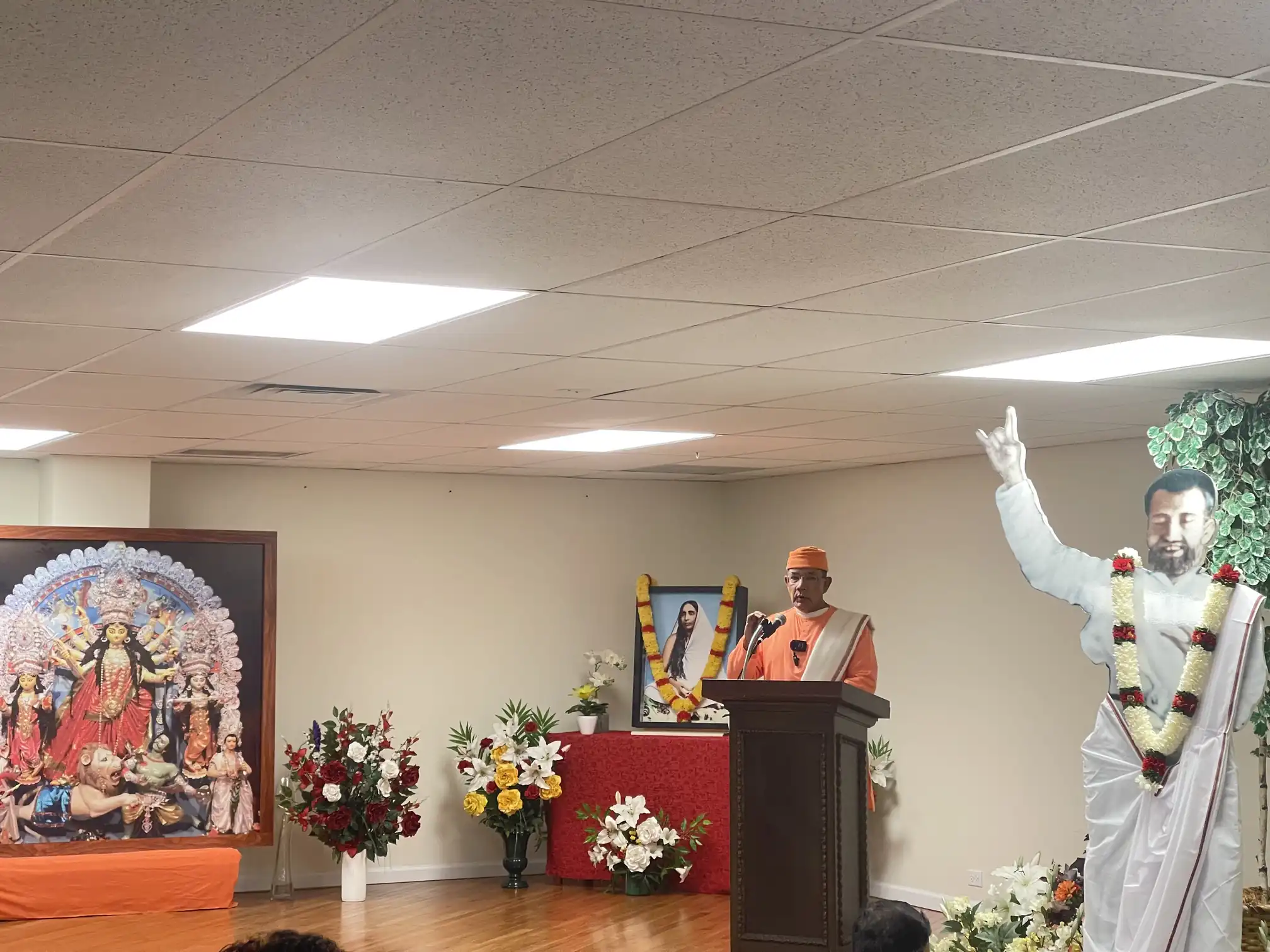
Swami Ishatmananda begins in a spirit of reverence and focus. He emphasizes that the goal of human life, as Vedanta insists again and again, is God-realization. This is not a poetic idea, not a motivational phrase, and not a cultural ritual. It is the central direction of life. Sri Ramakrishna, he says, came in human form to guide us to that ultimate Reality, where we discover our own Self and find the only happiness that does not fade. If we do not keep this aim in view, everything else we do, even good things, becomes scattered and incomplete.
Sri Ramakrishna’s Teaching: Not Theory, but Decision
Swami Ishatmananda draws a key contrast: many teachings take the form of philosophy, argument, and analysis. Sri Ramakrishna’s approach is different. It is not primarily theoretical. It is decisive. He does not merely present ideas and wait for our intellectual approval. He speaks with the force of direct realization: “This is this.” Whether we understand it or not, believe it or not, practice it or not, the truth does not change. That is why Sri Ramakrishna’s message has such urgency. It is less like a classroom explanation and more like a lamp being brought into a dark room.
In this context, Swami Ishatmananda briefly addresses a common misunderstanding. Sometimes people assume the Ramakrishna tradition is simply “Shankaracharya’s Advaita” in a modern package. The truth is subtler. Sri Ramakrishna indeed affirms Brahman as the highest reality, but he also insists that God is not limited by our categories. God is with form, without form, and beyond both. If we try to trap the Infinite in one definition, we reduce what cannot be reduced.
Brahman, Shakti, and Lila: The Two Aspects
Swami Ishatmananda explains Sri Ramakrishna’s language about Brahman and Shakti in a simple way. Brahman, in its eternal aspect, is still, unchanging, silent, beyond activity. When that same Reality is active, expressing itself, playing as the universe, it is spoken of as Shakti and Lila. This is why Sri Ramakrishna could say, “What you call Brahman, I call Kali.” It is not a contradiction. It is an insight: the formless Absolute and the Divine Mother are two ways of referring to the same Truth, depending on whether we speak of it as silent Reality or dynamic power.
This also brings clarity to the spiritual path. The ultimate goal is Brahman, God-realization. Sri Ramakrishna did not only teach it, Swami Ishatmananda reminds us. He practiced it, lived it, and then blessed others to awaken to it.
The Blessing of January 1, 1886
The heart of Kalpataru Day is an incident from January 1, 1886, when Sri Ramakrishna was living at the garden house in Cossipore (Kashipur) during his final illness. To ground the remembrance in authentic detail, a reading is shared from Sri Ramakrishna and His Divine Play by Swami Shuddhidananda, describing how the Master came down into the garden, and devotees gathered around him.
As the story unfolds, Sri Ramakrishna sees Girish Chandra Ghosh and asks him directly what he has seen and understood that makes him speak of Ramakrishna as an avatar. Girish, overwhelmed, replies that even sages like Vyasa and Valmiki could not measure his glory. Hearing such faith, the Master becomes moved and offers a blessing that pierces the heart:
“I bless you all. May you all be conscious.”
Then, overwhelmed by love and compassion, he enters a deep spiritual state. The devotees forget his illness, forget even the careful rules about not touching him, and surge forward with joy, calling out in victory. One by one, Sri Ramakrishna touches them, pouring grace into each heart. The account describes the atmosphere as if heaven had opened and a divine being had descended not to judge, but to shelter.
The reading also clarifies why the day is associated with the term Kalpataru, the wish-fulfilling tree of mythology. Yet the author makes an important distinction: Sri Ramakrishna did not grant whatever anyone asked, good or bad. Instead, he gave something higher, something purer: fearlessness and spiritual refuge without discrimination. In a world where we usually feel unworthy, unprepared, and incomplete, the message is startling: shelter is offered even to sinners and sufferers, even to those who feel inadequate.
A final vignette in the reading illustrates the power of the touch. A devotee asks for grace, and the Master says, “You have achieved everything.” When the devotee asks for help understanding this, Sri Ramakrishna gently touches his chest. The devotee then experiences a sweeping vision: the Master’s luminous presence appears in the sky, in houses, in trees, in human beings, everywhere. The experience lasts for days, affecting even his ordinary work, until he prays, frightened by its intensity, for release. The vision subsides, yet a remnant remains, a daily glimpse that continues like a quiet blessing.
Swami Ishatmananda emphasizes why this story is read every year: not only to remember, but to enter the scene inwardly. To imagine that the Master stands before us and we sit at his feet. To feel that the blessing is not locked in history. Grace is not old. Grace is present.
Meditation: Seeing the Lord in the Lotus of the Heart
From remembrance, the talk moves naturally toward practice. Swami Ishatmananda introduces a short dhyana, a meditation instruction: imagine the Lord seated within the heart on a radiant lotus. He encourages the devotees to visualize not an abstract idea, but a God who cannot bear the suffering of beings, a God of love who comes down again and again to help.
He points to a symbolic gesture often seen in pictures: two fingers held close, signifying the individual soul and God. When the two become one, when the apparent separation collapses, what arises is tremendous joy, the kind of joy the heart can scarcely contain. This, he suggests, is not fantasy. It is the direction of spiritual life.
Freedom While Living in the World
Swami Ishatmananda’s guidance is practical and compassionate, especially for householders. We carry roles: son, daughter, parent, spouse, worker. Duties are real. But bondage is not inevitable. He suggests a simple inner method: perform responsibilities fully, but maintain the awareness that after the work is over, you are inwardly free. Attachment is what binds, not activity itself.
He recommends vichar, reflective discrimination: before your birth, where were your property, position, family titles? After death, where will they be? This is not meant to create bitterness. It is meant to create clarity. Life is temporary. We are here for some time. Gratitude is appropriate for parents, for circumstances, for the chance to live. But the deepest responsibility is to shape our present karma so it moves us toward the ultimate goal: Sat-Chit-Ananda, existence, knowledge, bliss.
A striking point follows: why do people resist death so instinctively? Because our nature is existence. Why do we want knowledge? Because our source is knowledge. Why do we want happiness? Because we come from happiness. The problem is ignorance: we forget our real nature. Therefore the real prayer becomes: “God, give me knowledge that breaks my ignorance.”
Ramakrishna as Harmony: Brahma, Vishnu, Shiva, and the Divine Mother
Swami Ishatmananda also highlights Sri Ramakrishna’s unique inclusiveness. He speaks of Ramakrishna as a convergence, expressing the essence of the divine functions worshipped in Hinduism: creation, preservation, dissolution. He also emphasizes Kali as Shakti, not a symbol of punishment but the living power of spirituality.
He narrates a memorable incident from Ramakrishna’s life in Calcutta during Kali Puja: preparations were complete but there was no image of Kali. While the Master sat in samadhi, devotees wondered what to do. Girish arrived and pointed out the obvious truth they had missed: the Master himself is the living presence of the Divine Mother. He offered flowers to Sri Ramakrishna as Kali. The lesson is profound: God and God’s power cannot be separated, like fire and its burning. Where God is, Shakti is.
The Real Measure of Spiritual Progress
Swami Ishatmananda then challenges a very common misunderstanding: spiritual life is not primarily about external austerity. Fasting, rituals, and forms have their place, but without listening, reflection, and inner transformation, progress remains shallow. He recalls Sri Ramakrishna’s practical instruction to devotees who fasted and then became drowsy during spiritual conversation: “Eat and come. Listen.” Food nourishes the body. Teachings nourish the mind. If we neglect the mind’s nourishment, we stay stuck.
How do we know we are progressing spiritually? Not by miracles, not by dramatic displays, not by strange phenomena. The most reliable signs are inward: jealousy decreases, anger softens, compassion grows, the heart becomes more forgiving, love becomes natural. When someone criticizes you, you can see their pain rather than reacting with hatred. Spiritual life is transformation, not performance. Religion is realization. And at its center is love: God is love.
Kalpataru Day: Pray, Don’t Waste the Gift
The talk closes with a direct appeal that fits the spirit of the day. Swami Ishatmananda urges devotees not to waste time gossiping or drifting mentally. This is a day to pray deeply. When offering flowers, one may pray for family, children, responsibilities, and needs without hesitation. But he adds an even higher prayer: gratitude for human birth, prayer for devotion, and a plea for God’s presence at the final moment, when no one else can accompany us.
Kalpataru Day, in this framing, becomes both tender and powerful: the day we remember that grace is real, that fearlessness is offered, that God is not distant, and that the spiritual aim of life is not an abstract ideal, but a practical direction we can take right now. If the year begins with that orientation, then whatever comes, we will not be empty-handed. We will carry the most precious blessing: awareness of consciousness, the beginning of freedom, and the quiet certainty that the Divine is with us.
You will get Vedanta updates in your inbox.
Occasional reflections on Vedanta. Unsubscribe anytime.