Kalpataru Day in Chicago: Remembering Sri Ramakrishna’s Gift of Fearlessness
Kalpataru Day recalls Ramakrishna’s 1886 blessing, urging prayer, faith, selfless work, inner realization today.
Every spiritual tradition has certain days that don’t feel like “anniversaries” at all. They feel like a door—quietly open—through which grace seems unusually near. In the Ramakrishna tradition, Kalpataru Day is one such door.
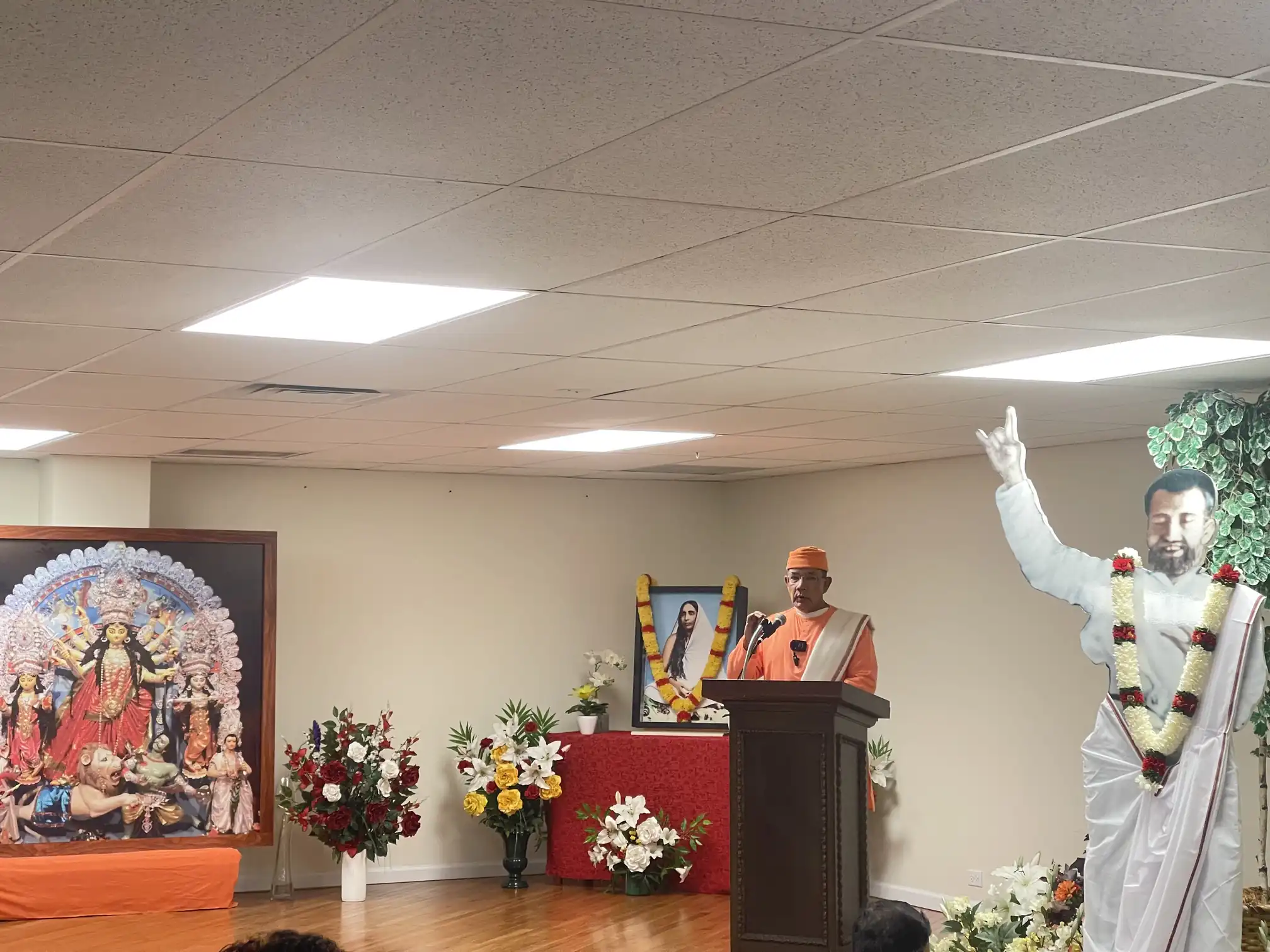
Observed on January 1, Kalpataru Day recalls a remarkable moment in 1886 at the garden house in Kashipur (near Kolkata), when Sri Ramakrishna—already physically weakened by severe illness—became absorbed in an overflowing compassion for devotees and blessed them in an extraordinary way. The day is remembered as the day he became, for seekers, like the Kalpataru, the mythic wish-fulfilling tree.
Yet the deeper meaning shared in the Kalpataru Day talk is subtle and transforming: this isn’t about getting whatever the mind demands. It is about receiving something far rarer—fearlessness, inner clarity, and the courage to turn toward God.
In Chicago, in a gathering marked by prayer, chanting, silence, reading, and offering, the day was presented not merely as a historical recollection, but as a spiritual opportunity—a living reminder that the same grace can touch a heart today, if faith is sincere and the mind is willing.
The Original Scene: A Sick Saint and a Sudden Flood of Grace
By late 1885, Sri Ramakrishna’s health had declined drastically. He was moved from Dakshineswar to the garden house at Kashipur for better air and care. During this period, devotees—householders and monastics—were consumed with worry. Many maintained a cautious distance, afraid of causing him pain, while still feeling irresistibly drawn to his presence.
On January 1, devotees arrived in large numbers, as on a holiday. Sri Ramakrishna came down and walked slowly in the garden. There was nothing dramatic planned—just the simple movement of a saint among those who loved him. But the spiritual atmosphere was already charged: people came not merely to “see” him, but to receive a blessing, to feel reassured, to place their burdens before something greater than themselves.
In the talk, the day’s turning point centers on a direct interaction between Sri Ramakrishna and one of the most influential household devotees: Girish Chandra Ghosh.
Girish and the Spark that Ignited the Blessing
Girish was known for his intense devotion and for boldly proclaiming Sri Ramakrishna as a divine incarnation. Yet he was also human—full of sharp emotions, strong personality, and sometimes inner turmoil. That combination made his devotion feel raw and real, not polished or performative.
Sri Ramakrishna questioned him openly: What makes you speak of me as divine? What have you truly seen or understood? It wasn’t a demand for flattery. It was as though the Master was testing the depth behind the words, calling Girish to speak from the heart rather than from excitement or reputation.
Girish responded with a humility that carried the force of surrender. The core of his reply, as explained in the gathering, was not philosophical argument but devotional certainty: that the greatness of Sri Ramakrishna could not be measured by ordinary language or scholarship.
And then came the moment that defines Kalpataru Day.
Sri Ramakrishna, moved by Girish’s faith and by the gathered longing of so many seekers, offered a sweeping blessing—something like: “I bless you all. May you be illumined.” The phrasing is less important than the spiritual gesture: he did not bless one person privately; he opened the blessing to all—without discrimination.
This is the first key theme: grace that does not ask who deserves it.
Kalpataru: Not “Wish-Granting,” but “Fearlessness-Granting”
The term Kalpataru can easily be misunderstood. In stories, the wish-fulfilling tree gives whatever is asked—good, bad, wise, foolish. But the talk emphasized a more mature interpretation: Sri Ramakrishna’s blessing was not a transaction that turns spirituality into a shopping list.
Instead, what he offered was closer to abhaya—fearlessness. It is the fearlessness that comes when a person feels sheltered by something infinite; when the heart realizes, even briefly, that it is not alone; when the grip of anxiety loosens and the mind becomes capable of turning inward.
That fearlessness changes everything. It does not remove problems immediately, but it changes the relationship to problems. It turns panic into prayer. It turns confusion into seeking. It turns resignation into spiritual effort.
So Kalpataru Day, in this framing, becomes the day Sri Ramakrishna revealed:“If you come to me sincerely, you will not be rejected.”
The Devotees’ Response: When Love Breaks All Rules
A striking detail in the account is how devotees—despite previous vows not to touch the Master due to his illness—were suddenly overwhelmed. Their devotion rose like a wave. They forgot social restraint and personal caution. They wanted to bow at his feet, to feel close to him, to receive the blessing not as an abstract idea but as a tangible encounter.
This illustrates a second theme: when spiritual love becomes intense, it can dissolve the mind’s calculations. It is not irrationality; it is a different kind of knowing—one that does not operate through analysis but through surrender.
And Sri Ramakrishna responded to that wave of devotion with an equally astonishing wave of grace—touching devotees one by one, blessing them with a directness that people felt in their hearts, minds, and spiritual practice.
Vaikuntha’s Story: The Gift That Was Almost Too Much
Among the most human and unforgettable stories shared is the experience of a devotee who had long prayed for spiritual vision—praying again and again to perceive the divine presence he worshiped.
When his turn came, he begged Sri Ramakrishna: Please give me your grace. The Master assured him that his goal was already achieved, and then gave a brief, gentle touch—simple, not theatrical.
What followed was profound: the devotee began to perceive the Master’s luminous presence everywhere—in sky, trees, people, and the whole world, as though the ordinary world had become transparent and flooded with sacred meaning.
For days, this vision persisted, even during work and daily responsibilities. And then the devotee faced a crisis few speak about honestly: the intensity became difficult to carry. He began to fear for his stability and begged to be released from the experience.
The story is spiritually rich because it reveals something many seekers don’t anticipate:
-
We often think we want spiritual experience.
-
But we rarely consider what it takes to contain it.
-
A mind full of restlessness can be overwhelmed by what it asked for.
In the end, the heightened vision subsided. Yet it didn’t vanish completely—something remained, a quieter residue: a continuing sense of the divine presence returning throughout the day.
This becomes the third theme: grace is real, but preparation matters. A mind purified through devotion, discipline, and selfless living can hold more light without burning.
“Faith Makes It Present”: Not Only 1886, but Now
A central message of the talk was simple and bold: such grace is not locked in a museum of history. Kalpataru Day is not valuable merely because something happened once. It is valuable because it declares a principle:
If the heart opens in faith, the divine is near.
The gathering’s structure itself expressed this: chanting, reading, silence, prayer, offering. These are not performances; they are methods—ways of shaping the mind so that devotion becomes concentrated and real.
This is why Kalpataru Day is often treated as a time for prayer with full sincerity: asking not only for external improvements but for inner transformation—purity, steadiness, selflessness, love.
What the Ritual Means: Offering, Light, and Inner Purification
The talk did not treat worship as empty formality. It explained worship as a training of consciousness.
Offering is not about feeding God, as if the Infinite needs food. It is about training the mind to recognize: the first claim on my life is not my craving, but the divine center.
That is why traditional instruction emphasizes offering the best, offering the “first portion,” offering with care. It is not superstition; it is spiritual psychology. If we habitually give God what is leftover—leftover time, leftover attention, leftover sincerity—then the mind quietly learns that God is secondary. But if we offer first, the mind learns the opposite.
Similarly, ārati (the offering of light) was presented as symbolism with a clear message: light is knowledge. Knowledge is not merely information—it is the recognition that behind the changing surface of life there is a deeper truth, and that the soul’s joy is not manufactured by possessions or status.
This leads directly into another strong theme of the talk: detachment.
Why People Aren’t Happy (Even When They “Have Everything”)
The speaker made an observation that cuts through modern illusions: if you ask adults honestly whether they are truly happy, you rarely find stable satisfaction. Wealth does not guarantee peace. Power does not guarantee contentment. Achievement does not guarantee rest.
Why? Because external conditions are constantly changing, and the mind keeps chasing what cannot stay.
The talk framed this not as pessimism but as a diagnosis:happiness is already within, but we keep searching outside.
Kalpataru Day is thus a day to remember that the deepest human hunger is not for entertainment or applause, but for the joy of the soul, which is close—intimate—already present as the divine within.
Three Practical Paths: Knowledge, Devotion, and Selfless Work
The talk pointed toward three classic approaches (often described as three “yogas”) that help purify and steady the mind:
-
Discrimination and insight (Jnana orientation) Recognize what changes and what does not. Ask: Why am I exhausting myself for what cannot remain? This questioning loosens attachment.
-
Devotion (Bhakti orientation) Pray repeatedly, not as a ritual of fear but as a relationship of love. Devotion softens the ego and draws the mind inward.
-
Selfless work (Karma Yoga orientation) Help others without bargaining for reward. Doing good without “what’s in it for me” purifies the mind, because it breaks the reflex of selfishness.
These are not competing ideologies. They are complementary tools. Together they create the inner capacity that makes spiritual life stable—not just emotional.
The New Year Resolution That Matters
Because Kalpataru Day falls on January 1, it naturally invites reflection on what “New Year” really means.
The talk suggested that a real resolution is not just a lifestyle tweak. It is a spiritual decision:
-
I will stop searching only outside.
-
I will remember God is within.
-
I will cultivate pure love and pure unselfishness.
-
I will pray, serve, and discriminate—consistently.
That is a powerful shift: from celebrating a calendar change to renewing the direction of the heart.
What to Ask for on Kalpataru Day
If Kalpataru Day is not merely about getting whatever the mind wants, what should a seeker pray for?
The talk’s themes imply a beautiful hierarchy of prayers:
-
Purity of mind (so the heart can hold spiritual life steadily)
-
Unselfishness (so relationships become less transactional)
-
Love (so devotion becomes real, not merely formal)
-
Detachment (so life’s changes don’t crush inner peace)
-
Faith and surrender (so fearlessness becomes natural)
These prayers are “wish-fulfilling” in the deepest sense: they fulfill the soul’s true wish—the wish to be free.
Kalpataru Day as a Living Practice
In the end, Kalpataru Day is not only about what happened in Kashipur. It is about what can happen in any heart that becomes sincerely receptive.
A person may not receive visions like the devotees of 1886. But a person can receive something equally miraculous:
-
the first taste of inner peace,
-
the courage to pray again,
-
the strength to serve without ego,
-
the ability to let go of what cannot last,
-
the awareness that God is not distant.
Kalpataru Day reminds us that grace is not only a reward for saints; it is a shelter offered to ordinary people who come with sincerity.
The wish-fulfilling tree does not merely give objects. It gives direction. It turns the heart toward what truly satisfies.
And that is why, year after year, people gather—whether in Kolkata or Chicago—not only to remember Sri Ramakrishna, but to ask for illumination, and to step into a New Year with a quieter, braver, more God-centered life.
You will get Vedanta updates in your inbox.
Occasional reflections on Vedanta. Unsubscribe anytime.