Bhagavad Gita in Daily Life — Swami Purnananda’s Message
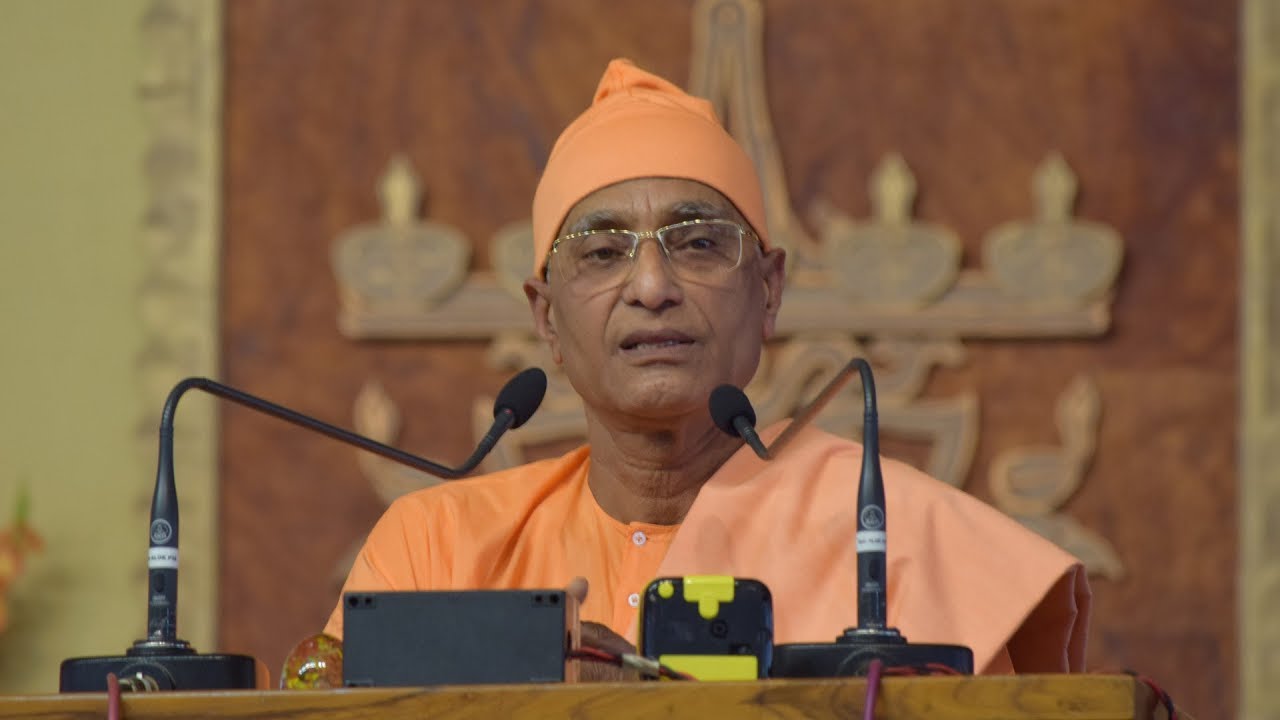
Swami Purnananda explains Gita’s daily-life guidance: courage, selfless action, surrender, God-centered living, compassion always.
Swami Purnananda begins with a traditional salutation—invoking Holy Mother Sri Sarada Devi, Sri Ramakrishna, and the world-teacher—before greeting the assembled monks, brahmacharis, and devotees. The occasion is devotional and celebratory: Sri Ramakrishna’s birth anniversary has been observed at Belur Math and across many places worldwide, and the Bhakta Sammelan offers a collective space to remember, reflect, and renew one’s practice. Within that setting, he is asked to speak on a theme both timeless and immediate: how the Bhagavad Gita’s teachings can be lived in daily life.
The Gita as the Essence of the Mahabharata
The Swami first situates the Gita: it is a section of the Mahabharata—yet calling it “just a part” is, in his view, too small a description. To express the Gita’s stature, he uses a vivid image. The Mahabharata is like a great fruit, and the Gita is the fruit’s essence—the nourishing pulp we actually consume. The shell and seeds may exist, but what sustains us is the inner substance. In the same way, the Mahabharata is vast; the Gita is its distilled vitality.
From there he points to the Gita’s layered richness. It is not only scripture but also literature of extraordinary beauty—poetic, complete, and memorable in form. It has a “method” of expression, an artistic power, and a dramatic setting. Even identifying the Gita’s “hero,” he suggests, is not straightforward. The speaker is Sri Krishna; the listener is Arjuna. The moment is Kurukshetra, where two armies stand ready, and history is about to turn.
Why Arjuna? The Fitness to Receive the Teaching
The Swami lingers on a crucial question: Why was this teaching given to Arjuna? Arjuna is not an ordinary person. He is Krishna’s friend, and in the human world of his time, he is one of the greatest. But friendship alone is not the full explanation. Swami Purnananda recalls how Acharya Shankara, in the introduction to his Gita commentary, emphasizes that this dharma is received and practiced by those who possess the necessary qualifications—“those endowed with superior qualities” who can grasp it, live it, and thereby help the dharma spread and flourish.
He draws a parallel with Sri Ramakrishna selecting Narendra (later Swami Vivekananda) for intimate spiritual instruction. Sri Ramakrishna spoke many profound truths, but certain “secret” teachings—secret not because they are illicit, but because they concern the hidden reality dwelling in the cave of the heart—were shared with Narendra behind closed doors. Why Narendra? Because he was “gūṇādhika,” fit by temperament and capacity to receive, practice, and transmit. In the Swami’s framing, Arjuna stands in a similar place in the Gita: he becomes the channel through which a universal message is delivered.
That is not meant to exclude others; it is a reminder that spiritual knowledge has a living dimension. It must be heard, digested, and applied, not merely admired.
Three Dimensions: Theory, Practice, Application
A major structure of the talk is the Swami’s emphasis that every meaningful teaching has at least three aspects:
- Theoretical: understanding the principle.
- Practical: testing it in life.
- Applied: using it so that it yields tangible transformation.
He illustrates this with an example Sri Ramakrishna himself used: fire exists in wood as a principle. Knowing this is valuable, but by itself it does not cook rice or warm a room. The principle must be verified—rub two pieces of wood, kindle the flame—and then applied to produce real benefit.
This is how the Swami wants us to approach the Gita. The Gita is not merely a ceremonial book to be listened to and kept on a shelf. Just as modern science finds value in “applied science,” spiritual teaching finds value in lived spirituality. Otherwise it remains ornamentation rather than illumination.
The Battlefield Within: Arjuna’s Collapse and Our Daily Crises
Why does the Gita begin on a battlefield? Because, Swami Purnananda suggests, our lives are also battlegrounds—filled with conflict, moral confusion, pressure, and fear. Arjuna may have known intellectually whom he must fight, but when he sees his relatives and teachers face to face—Bhishma, Drona, and others—his heart trembles. Knowledge and direct confrontation are different. In that shock, he is overwhelmed by moha—delusion that clouds duty and clarity.
He drops his famous bow Gandiva and sits on the chariot, refusing to fight. The Swami treats this not as a distant myth but as a mirror of our own experience: when difficulties arrive, we too become shaken, unable to decide, unable to act, and our sense of “what is right” becomes blurred.
Krishna’s first response is sharp and bracing. This is not the time for weakness. Swami Purnananda highlights the famous line: “Klaibyam mā sma gamaḥ Pārtha”—do not yield to impotence, do not surrender to cowardice of the heart. This weakness, he says, makes one lose discrimination and become like inert matter. In moments of crisis, sitting with hands on cheeks and lamenting does not solve anything. The Gita’s first call is: Get up. Stand. Face the situation.
He connects this to Swami Vivekananda’s practical counsel: Face the brute. When trouble threatens, do not run; confront it. Often the bully—whether external or internal—shrinks when challenged. The Swami’s message is clear: fear magnifies what lacks substance. Courage restores proportion.
Renunciation as Inner Re-centering: The Theocentric Life
From courage, he moves to another Gita theme: tyāga, renunciation. Sri Ramakrishna famously advised devotees to repeat the word “Gita” until it becomes “tyagi”—renunciation—suggesting that the scripture’s heart leads toward letting go of egoistic clinging. In the Gita’s final teaching, Krishna says: “Sarva-dharmān parityajya mām ekaṁ śaraṇaṁ vraja”—abandon all and take refuge in Me alone.
Swami Purnananda interprets this as a shift toward a God-centered life, what he calls a theocentric life. God becomes the center, and the wheel of worldly responsibilities rotates around that center. He repeats Sri Ramakrishna’s simple illustration: a child runs around holding a post. As long as the child holds the post, he does not fall. Let go, and he is flung away. In the same way, keep God at the center and engage in the world without fear of losing balance.
This is deeply relevant to daily life because it avoids extremes: it does not demand that one abandon responsibilities, nor does it permit one to drown in them. It demands a re-centering of the heart.
“Run and Pray”: Spirituality During Life, Not After It
A particularly practical section of the talk addresses a common spiritual procrastination: “When life becomes peaceful, then I will pray.” The Swami cites an analogy: one who says, “When the ocean’s waves stop, I will bathe,” will never bathe. The waves never stop. Likewise, the challenges of life will not pause to give us a quiet hour of perfect devotion.
So what is the method? The Swami summarizes it in a phrase: Run and pray. Do not postpone prayer until after responsibilities; weave prayer into movement. The Gita itself speaks in this spirit: remember Me and fight—“mām anusmara yudhya ca.” Remembrance and action proceed together, simultaneously, like parallel tracks.
He tells a small story of two schoolboys—one rich, one poor—hurrying to class, fearing punishment for being late. When the rich boy mockingly suggests praying, the poor boy proposes a wise alternative: do not stop and pray; run while praying. The lesson is that spiritual practice should accompany life as it is, not as we wish it to be.
Sri Ramakrishna used another image: a Baul sings while playing instruments with both hands—work and worship together. The household devotee can do the same: hands engaged in duties, lips engaged in God’s name, heart engaged in surrender.
Assurance in the Storm: The Gita’s Promises
Courage and remembrance are strengthened by assurance. Swami Purnananda emphasizes Krishna’s declaration: “Kaunteya pratijānīhi na me bhaktaḥ praṇaśyati”—O son of Kunti, proclaim it boldly: My devotee never perishes. To be a devotee is to love God more than one’s own body, to place God above the ego.
He adds another assurance: “Na hi kalyāṇa-kṛt kaścit durgatiṁ tāta gacchati”—no one who does good comes to ruin. These are not sentimental slogans; they are stabilizing truths meant to help a person stand steady when life shakes. In daily life, where anxiety often comes from imagining that everything can collapse, the Gita offers a deeper confidence: sincere striving, aligned with dharma, is never wasted.
The Power of Surrender: God’s “Weakness” Discovered by Devotees
A striking passage in the talk is the Swami’s reflection on surrender—śaraṇāgati. God is infinite power; yet devotees, he says, have discovered a “weakness” in God. Not a flaw—rather a tender law of love: God cannot abandon one who truly takes refuge.
He recalls Rama’s vow: even once, if someone says “I am Yours,” seeking protection, God grants fearlessness from all beings. This is presented not as poetry but as a spiritual principle: surrender is not passive helplessness; it is the active placing of one’s burden into the hands of the Infinite.
Swami Vivekananda’s four-verse hymn, recited in many centers daily, ends repeatedly with the same line: “Therefore I take refuge in You, my friend of the distressed.” The Swami points out that whether the verse speaks of knowledge, devotion, yoga, or action, it concludes in surrender. That is not accidental. It is a summary of spiritual maturity: all paths, when ripened, return to refuge.
Worship That Becomes Life: From Ritual to Compassion
Swami Purnananda then redirects the meaning of worship. Many perform elaborate rituals with multiple “upacharas” (offerings). But he recalls a powerful teaching attributed to Kapila: worship that ignores God dwelling in beings becomes a kind of farce. God is present in the hungry, the sick, the suffering. To worship an image while ignoring living pain is to miss the central presence.
So what does daily-life worship look like? The Swami offers a simple fourfold emphasis (in the spirit of the text he cites):
- Dāna: give what is needed—food, clothing, education, support.
- Māna: offer respect—treat beings with dignity.
- Maitrī: cultivate friendliness—remove hostility and contempt.
- An avibhakta-dṛṣṭi: see without divisiveness—recognize the same Divine in all.
He includes a delightful example of humility from Sri Ramakrishna and Girish Chandra Ghosh. When Girish greets Ramakrishna, the Master responds by becoming even more humble—lowering himself until he lies down—teaching that true spiritual stature is measured by the ability to bow.
In daily life, therefore, the Gita’s teaching is not merely inward; it becomes outward as compassion, respect, and service.
Offer Everything: The Practice of Consecration
The Swami repeatedly returns to one core Gita discipline: offering. Krishna says: “Yat karoṣi yad aśnāsi… tat kuruṣva mad-arpaṇam”—whatever you do, whatever you eat, whatever you give, whatever austerity you perform, offer it to Me.
Swami Purnananda explains that consecration should be done at the beginning, during, and at the end of work. Begin with the intention: “What I am about to do is Yours.” In the middle: “What I am doing is Yours.” At the end: “What I have done is Yours.” This practice steadily dissolves the ego’s claim—“I am the doer”—and converts ordinary life into spiritual life.
He notes that human relationships expose a truth: people gladly accept good offerings but reject what is “bad.” Yet God, Krishna says, accepts everything when offered with sincerity. Only God can say, “Give Me all of it”—because God alone can purify and transform it.
Closing: A Lamp for the Path
Swami Purnananda closes by turning this teaching into prayer. The Gita’s message is not distant philosophy but a “lamp” for the road—a guide for navigating daily struggles with courage, remembrance, surrender, and compassion. If we can live in this way—facing problems without cowardice, keeping God at the center, praying while running, serving God in beings, and offering every action—then life becomes fruitful and purposeful.
In that spirit, he prays to Sri Ramakrishna that devotees may live according to these teachings and attain the highest good—śreyas—the true fulfillment of human life.
Om Tat Sat. Sri Ramakrishnarpanamastu.
You will get Vedanta updates in your inbox.
Occasional reflections on Vedanta. Unsubscribe anytime.